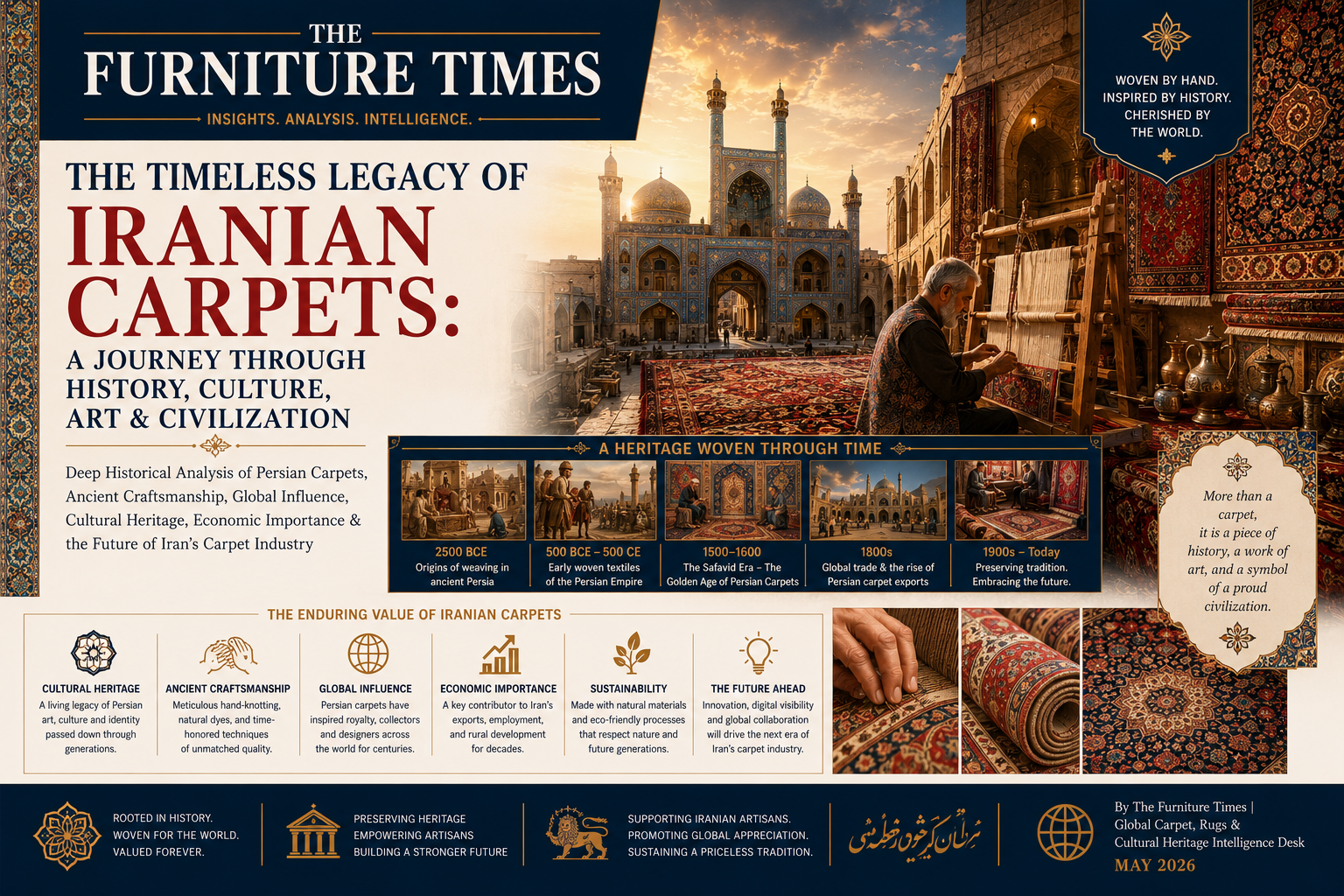
The Timeless Legacy of Iranian Carpets: A Journey Through History, Culture, Art & Civilization
Deep Historical Analysis of Persian Carpets, Ancient Craftsmanship, Global Influence, Cultural Heritage, Economic Importance & the Future of Iran’s Carpet Industry
By The Furniture Times | Global Carpet, Rugs & Cultural Heritage Intelligence Desk | May 2026
Few products in human history have achieved the global admiration, artistic respect, and cultural significance of the Iranian carpet.
Known worldwide as:
Persian Carpets
these extraordinary handwoven masterpieces are not merely floor coverings.
They are:
works of art
historical documents
cultural symbols
economic assets
expressions of identity
For thousands of years, Persian carpets have represented the soul of Iranian craftsmanship, carrying stories, traditions, symbolism, and artistic excellence across generations. Persian carpet weaving is recognized internationally as part of Iran’s intangible cultural heritage.
Today, despite economic challenges and geopolitical pressures, Persian carpets remain among the most respected handcrafted products in the world.
The Origins of Persian Carpet Weaving
The history of Persian carpet weaving stretches back thousands of years.
Many historians and cultural researchers believe carpet weaving in Persia dates back more than 2,500 years, making it one of the oldest continuously practiced artistic traditions in human civilization.
The famous Pazyryk Carpet, often regarded as the oldest known knotted carpet in the world, is widely associated with ancient Persian artistic influence and demonstrates the remarkable sophistication of early carpet-making traditions.
Long before modern industries existed, Persian artisans were already creating complex woven masterpieces that combined:
mathematics
geometry
symbolism
storytelling
craftsmanship
into a single product.
Carpets Were More Than Decoration
In ancient Persia, carpets were never viewed merely as decorative objects.
They served practical and cultural functions:
protection from cold climates
ceremonial use
family heritage
religious spaces
royal courts
Over time, carpets became symbols of:
prestige and identity.
Many Persian families passed carpets through generations as treasured possessions and heirlooms.
The Golden Age of Persian Carpets
The Safavid era (1501–1736) is often regarded as the golden age of Persian carpet weaving.
During this period, carpet production evolved from a regional craft into a highly organized artistic industry supported by royal workshops and court patronage. Historical research shows that carpet weaving became a large-scale state-supported artistic industry during this era.
Master weavers created carpets that combined:
floral motifs
medallions
gardens
poetry-inspired symbolism
intricate geometry
Many of the world’s most famous Persian carpets originated during this period.
The legendary Ardabil Carpet remains one of the greatest surviving examples of Persian weaving artistry.
Every Region Developed Its Own Identity
One remarkable aspect of Iranian carpet culture is regional diversity.
Different cities and provinces developed unique styles, colors, motifs, and weaving traditions.
Some of the most famous carpet-producing regions include:
Kashan
Known for:
elegant floral designs
silk weaving
extraordinary knot density
UNESCO recognizes the traditional carpet weaving skills of Kashan as part of the world’s intangible cultural heritage.
Tabriz
Known for:
detailed artistic patterns
fine craftsmanship
export influence
Isfahan
Known for:
luxury carpets
artistic sophistication
royal design influence
Qom
Known for:
silk carpets
high-end luxury weaving
Kerman
Known for:
floral artistry
intricate detailing
Fars Province
Known for:
tribal weaving traditions
nomadic craftsmanship
Traditional carpet weaving skills in Fars are also recognized by UNESCO.
Each region developed its own visual language.
Carpet Weaving Became a Family Tradition
One of the most beautiful aspects of Persian carpet culture is how knowledge passes through generations.
In many communities:
mothers taught daughters
grandmothers taught grandchildren
families preserved patterns and techniques
UNESCO notes that carpet weaving skills in Kashan are traditionally transmitted through apprenticeship within families.
The carpet became:
living heritage.
Natural Materials Created Timeless Beauty
Traditional Persian carpets relied heavily on:
wool
silk
cotton
Colors were produced from natural sources such as:
madder root
walnut skins
pomegranate skins
vine leaves
These natural dyes created the rich and enduring colors that made Persian carpets famous globally.
The result was not only beauty.
It was longevity.
Many Persian carpets survive for generations.
Persian Carpets Became Global Luxury Symbols
As international trade expanded through the Silk Road and later global commerce, Persian carpets became highly prized across:
Europe
Asia
the Middle East
Historical records show that Persian carpets were often displayed as luxury objects and even hung on walls due to their artistic value.
By the nineteenth century, Persian carpets had become important exports to Europe and North America.
Owning a Persian carpet became associated with:
sophistication and prestige.
The Economic Importance of the Industry
For generations, carpet weaving supported millions of people across Iran.
The industry created employment for:
weavers
dyers
wool suppliers
designers
traders
exporters
Persian carpets became one of Iran’s most important non-oil exports and contributed significantly to rural economies.
The carpet industry was not merely a craft sector.
It was an economic ecosystem.
UNESCO Recognition Preserved Cultural Heritage
In 2010, UNESCO formally recognized the traditional skills of carpet weaving in:
Fars Province
Kashan
as elements of the Intangible Cultural Heritage of Humanity.
This recognition acknowledged:
craftsmanship excellence
cultural importance
intergenerational knowledge
artistic value
The recognition also highlighted the importance of protecting weaving traditions for future generations.
Modern Challenges Facing the Industry
Despite its historical prestige, the industry faces significant modern challenges.
Industry reports indicate that exports have fallen dramatically compared to historic levels, affected by:
sanctions
international trade restrictions
payment challenges
changing consumer preferences
geopolitical instability
Recent reports suggest exports that once exceeded billions of dollars annually have fallen sharply in recent years.
Many traditional workshops face:
rising costs
reduced demand
labor shortages
Competition Has Increased
Persian carpets now compete with:
machine-made rugs
lower-cost imports
synthetic flooring products
mass production systems
Countries including:
India
Turkey
China
have expanded their own carpet industries.
This creates new pressure on traditional producers.
Yet Global Respect Remains Strong
Despite challenges, Persian carpets remain among the most respected handcrafted products in the world.
Collectors, designers, architects, and luxury homeowners continue valuing Persian carpets for:
authenticity
craftsmanship
cultural depth
artistic beauty
Interior design experts frequently describe Persian rugs as timeless design elements capable of fitting both traditional and contemporary spaces.
The artistic reputation of Persian carpets remains extraordinary.
Technology Is Entering the Carpet Industry
The future industry may increasingly combine:
traditional craftsmanship
with:
digital innovation
Researchers are already exploring AI-assisted carpet design systems capable of generating modern Persian-inspired carpet patterns.
This suggests that the future carpet industry may become a hybrid ecosystem combining:
heritage and technology.
Why Persian Carpets Matter Beyond Economics
Persian carpets represent something deeper than commerce.
Each carpet contains:
stories
symbols
regional identity
cultural memory
Many observers describe Persian carpets as reflections of Iranian civilization itself.
Every knot carries:
patience
skill
tradition
human creativity
The Furniture Times Industry Insight
The story of Iranian carpets teaches an important lesson for the global furniture and interior industry:
Great products survive centuries when they combine:
craftsmanship
culture
identity
emotional value
Persian carpets were never merely manufactured products.
They became:
cultural masterpieces.
And that is why they continue inspiring admiration across the world today.
Final Thought
The history of Iranian carpets is ultimately the history of human creativity woven into material form.
From ancient Persia to modern interiors, Persian carpets have survived:
dynasties
empires
wars
political changes
economic challenges
because their value extends beyond markets.
They represent:
heritage
artistry
craftsmanship
identity
The future of the industry will depend on preserving these traditions while adapting to a changing world.
But one reality remains unchanged:
A Persian carpet is not simply a carpet.
It is a woven piece of civilization.
And that legacy continues to inspire the world.

Related Posts
Iran’s Carpet Industry Faces Historic Collapse: Why Visibility, Discoverability & Industry Connectivity Have Become More Important Than Ever
Global Carpet & Rugs Industry Faces New Uncertainty as Wars, Trade Disruptions & Economic Pressures Reshape the Market