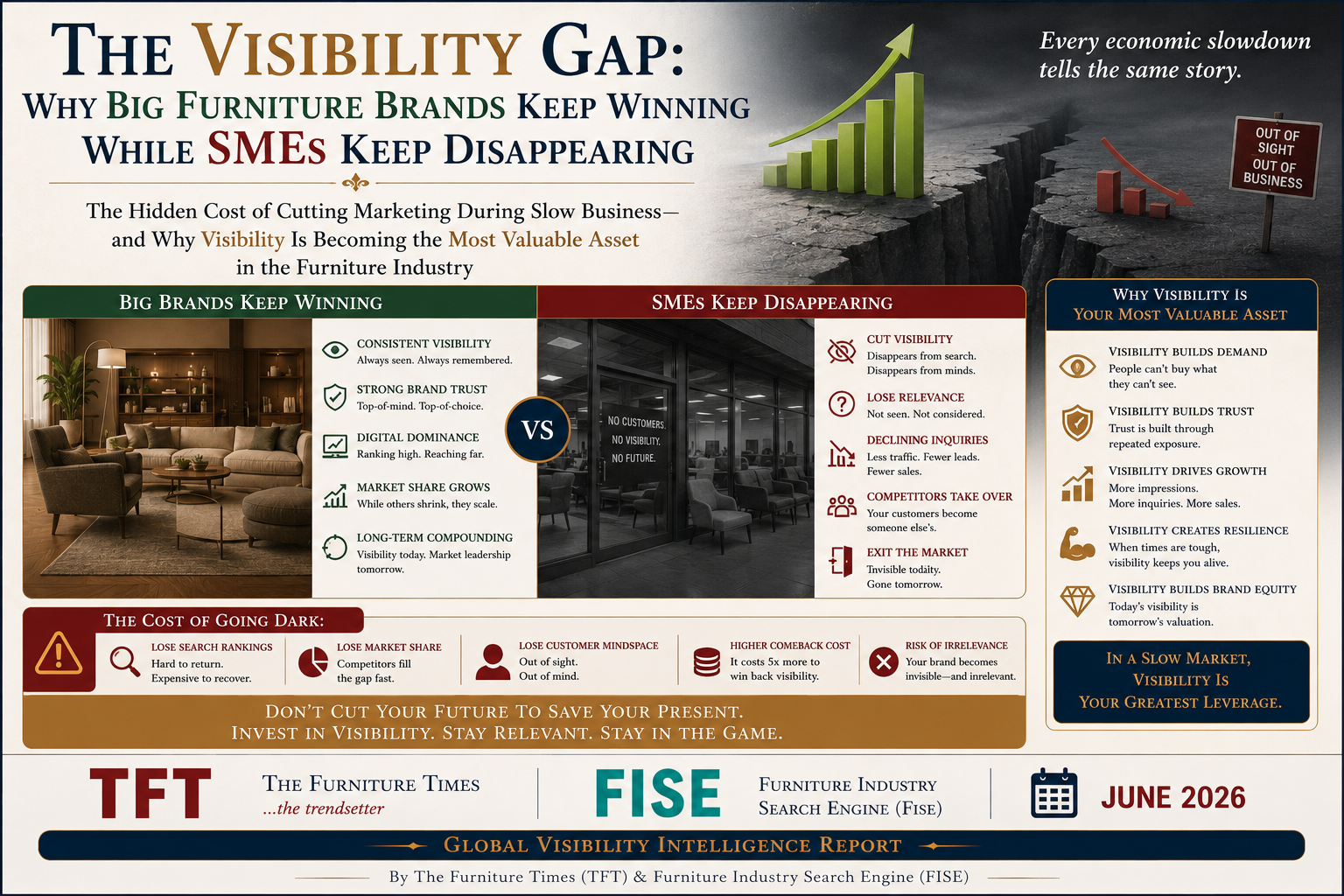
The Visibility Gap: Why Big Furniture Brands Keep Winning While SMEs Keep Disappearing
The Hidden Cost of Cutting Marketing During Slow Business—and Why Visibility Is Becoming the Most Valuable Asset in the Furniture Industry
Global Visibility Intelligence Report
By The Furniture Times (TFT) & Furniture Industry Search Engine (FISE)
June 2026
Every economic slowdown tells the same story.
Sales decline.
Foot traffic slows.
Projects are delayed.
Customers become more cautious.
Business owners become concerned.
And almost immediately, one decision is made in boardrooms around the world.
“Cut the marketing budget.”
“Pause advertising.”
“Reduce branding expenses.”
“Stop digital campaigns.”
“Let’s save money until business improves.”
For thousands of small and medium-sized enterprises (SMEs), this has become an automatic response.
Unfortunately, it is also one of the most expensive mistakes they can make.
Because while SMEs are becoming quieter…
The world’s largest companies are becoming louder.
That is one of the biggest reasons they continue to grow.
Not because they are always making better products.
Not because they always have lower prices.
Not because they always provide better service.
They win because they remain visible.
Visibility is no longer simply a marketing activity.
It has become a business strategy.
And in today’s digital economy, invisibility has become one of the greatest risks facing the furniture industry.
The Biggest Misunderstanding During a Slowdown
Many furniture business owners believe that advertising is an expense.
Large companies see advertising differently.
They see it as an investment.
When business slows, SMEs often reduce visibility.
Large companies often maintain—or even increase—their presence.
Why?
Because they understand something important.
During difficult times, customer attention becomes easier to capture because fewer competitors are communicating.
Silence creates opportunity for those who continue speaking.
Visibility Is a Long-Term Asset
Brand awareness is not built in a single month.
Trust is not created by a single advertisement.
Reputation is not established by one campaign.
Visibility compounds over time.
Every advertisement.
Every article.
Every exhibition.
Every customer testimonial.
Every search result.
Every social media post.
Every press release.
Every video.
Every product page.
Every Google Business Profile update.
Together they create familiarity.
Familiarity builds trust.
Trust creates preference.
Preference creates sales.
The companies that remain visible year after year benefit from this cumulative effect.
Big Companies Never Disappear
Think about the brands that dominate global markets.
Whether the economy is booming or slowing, they continue to appear.
You see them:
On television.
In search results.
On LinkedIn.
On YouTube.
At exhibitions.
In magazines.
On billboards.
Across social media.
In news articles.
Inside AI-generated answers.
They understand a simple principle:
If customers stop seeing you, customers start forgetting you.
And once customers forget you, competitors take your place.
The Furniture Industry Behaves Differently
One of the biggest mistakes marketing agencies make is treating furniture businesses like fashion retailers, electronics stores, or supermarkets.
The furniture industry behaves differently.
Furniture purchases are:
High value.
Long-term.
Emotionally significant.
Research intensive.
Project driven.
Furniture customers rarely purchase immediately.
Instead, they spend weeks or months researching.
They compare suppliers.
They save product ideas.
They discuss purchases with family.
They consult designers.
They review specifications.
They revisit websites multiple times.
This means visibility during the research stage is just as important as visibility during the purchase stage.
If a business disappears during those months, it disappears from the customer’s consideration.
The Fragmented Nature of the Furniture Industry
Unlike many industries dominated by a handful of global corporations, the furniture industry is highly fragmented.
Millions of businesses operate worldwide.
Manufacturers.
Retailers.
Importers.
Exporters.
Interior designers.
Custom cabinet makers.
Outdoor furniture specialists.
Hospitality suppliers.
Artisans.
Small workshops.
Family businesses.
This fragmentation creates opportunity.
But it also creates intense competition for attention.
The challenge is no longer simply making good furniture.
The challenge is making sure people know you exist.
The Visibility Trap
A furniture business experiences slower sales.
Revenue declines.
The owner cuts advertising.
Website updates stop.
Social media becomes inactive.
Newsletters disappear.
No new articles are published.
No exhibitions are attended.
No SEO investment continues.
Months later the owner says:
“There are no customers.”
The reality may be different.
Customers still exist.
But they cannot find the business.
Visibility was reduced precisely when customers needed reassurance.
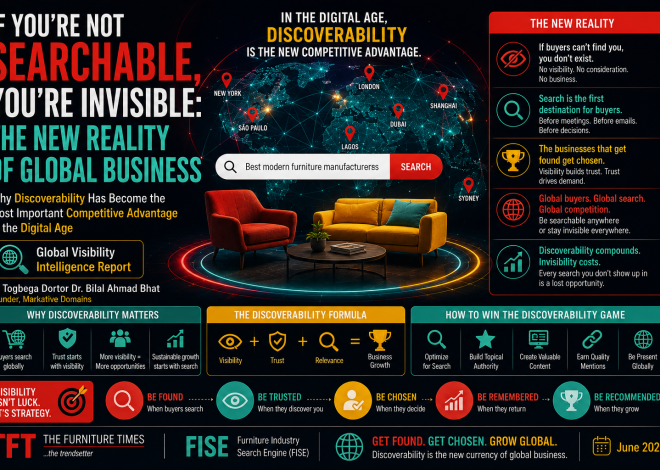
Customers Cannot Buy What They Cannot Find
This may be the simplest truth in modern business.
Customers cannot purchase from businesses they never discover.
Excellent craftsmanship is invisible without exposure.
Outstanding service is invisible without communication.
Superior products are invisible without discoverability.
Quality matters enormously.
But quality alone does not create awareness.
Visibility introduces quality to the market.
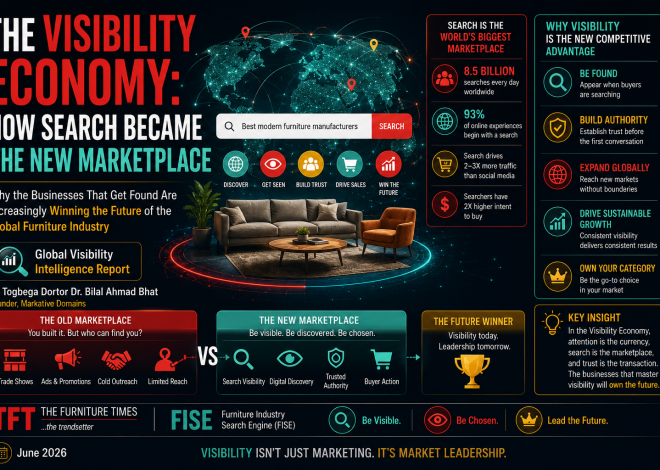
Search Has Replaced Geography
Twenty years ago, businesses depended largely on location.
Today, businesses depend on discoverability.
Customers increasingly search:
“Outdoor furniture supplier.”
“Kitchen cabinets near me.”
“Hotel furniture manufacturer.”
“Restaurant furniture Malaysia.”
If your business does not appear during these searches, it effectively disappears from the buying journey.
Search is becoming the new showroom.
AI Is Accelerating the Visibility Gap
Artificial intelligence is creating another layer of competition.
AI systems increasingly recommend businesses based on publicly available information.
Companies with:
Strong websites.
Regular news.
Comprehensive product information.
Thought leadership.
Structured content.
Reviews.
Media mentions.
…are more likely to appear in AI-driven recommendations.
Businesses that remain digitally silent risk becoming invisible not only to people—but also to machines.
Visibility During Recessions Creates Future Growth
History repeatedly shows that companies maintaining marketing investment during economic downturns often emerge stronger when markets recover.
Why?
Because while competitors disappear, they remain present.
Customers continue seeing them.
Hearing them.
Reading about them.
Trust continues building.
When confidence returns, customers naturally gravitate toward familiar brands.
Visibility creates memory.
Memory creates preference.
SMEs Don’t Need Bigger Budgets
One common misconception is that SMEs cannot compete because they lack large marketing budgets.
Budget matters.
But consistency matters more.
An SME does not need millions.
It needs discipline.
Publishing regularly.
Sharing customer stories.
Creating educational content.
Improving local SEO.
Updating product pages.
Participating in exhibitions.
Issuing press releases.
Building partnerships.
Staying active on professional platforms.
Being visible consistently is often more powerful than running one expensive campaign and then disappearing for six months.
Visibility Is More Than Advertising
Many business owners think visibility equals advertising.
It does not.
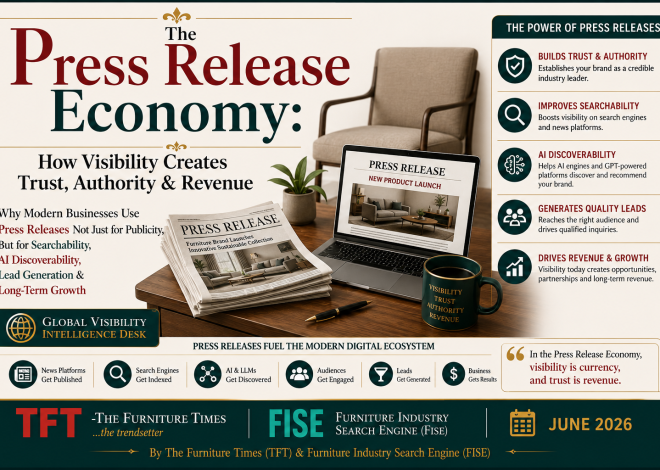
Visibility includes:
Search Engine Optimization
Press Releases
Google Business Profile
Industry News
Product Education
Customer Reviews
Videos
Case Studies
Project Portfolios
AI-Friendly Product Data
Industry Listings
Thought Leadership
Advertising is only one part of the visibility ecosystem.
The strongest brands build visibility across multiple channels.
Why Furniture SMEs Must Think Long Term
Furniture companies often focus on today’s sales.
Large companies focus on tomorrow’s reputation.
They invest in visibility even when immediate returns are difficult to measure.
Because they understand that visibility compounds.
The article published today may generate business next year.
The product page created this month may attract buyers for years.
The press release issued today may be discovered by an architect six months later.
Visibility is a long-term asset.
Not a short-term expense.
The Role of TFT & FISE
This is exactly why The Furniture Times and the Furniture Industry Search Engine were created.
The furniture industry does not suffer from a shortage of talent.
It suffers from a shortage of visibility.
Thousands of outstanding businesses remain unknown.
Not because they lack quality.
But because they lack discoverability.
TFT exists to tell their stories.
FISE exists to help the world find them.
Together, they aim to reduce the visibility gap between global corporations and small businesses.
Because every great manufacturer deserves to be found.
Every skilled craftsman deserves recognition.
Every retailer deserves discoverability.
TFT & FISE Analysis
The future of competition will no longer depend solely on manufacturing capacity.
Nor solely on pricing.
Nor solely on distribution.
It will increasingly depend on visibility.
The companies that continue communicating during difficult times will build stronger brands.
The companies that disappear during downturns may find it much harder to recover.
The furniture industry is entering what can only be described as the Visibility Economy.
In this economy:
Visibility creates familiarity.
Familiarity creates trust.
Trust creates inquiries.
Inquiries create opportunities.
Opportunities create growth.
Final Verdict
The question is no longer whether your business makes good furniture.
The question is:
Can the world find you?
Large companies continue winning because they remain visible.
They continue investing.
They continue communicating.
They continue educating.
They continue appearing.
Many SMEs disappear exactly when visibility matters most.
That must change.
Because slowing down does not mean disappearing.
Reducing unnecessary costs may be wise.
Reducing visibility is often not.
Especially in the furniture industry, where buying decisions are slow, research-intensive, and built on trust.
The businesses that remain visible during difficult times will often become the businesses remembered when better times return.
Because in today’s furniture economy:
If customers cannot see you…
They cannot choose you.
And if they cannot choose you…
Someone else will.
By The Furniture Times (TFT) & Furniture Industry Search Engine (FISE)
Global Visibility Intelligence Report | June 2026
“TFT tells their story. FISE helps the world find them.”
The furniture industry ecosystem is a $1 Trillion Dollar Industry.