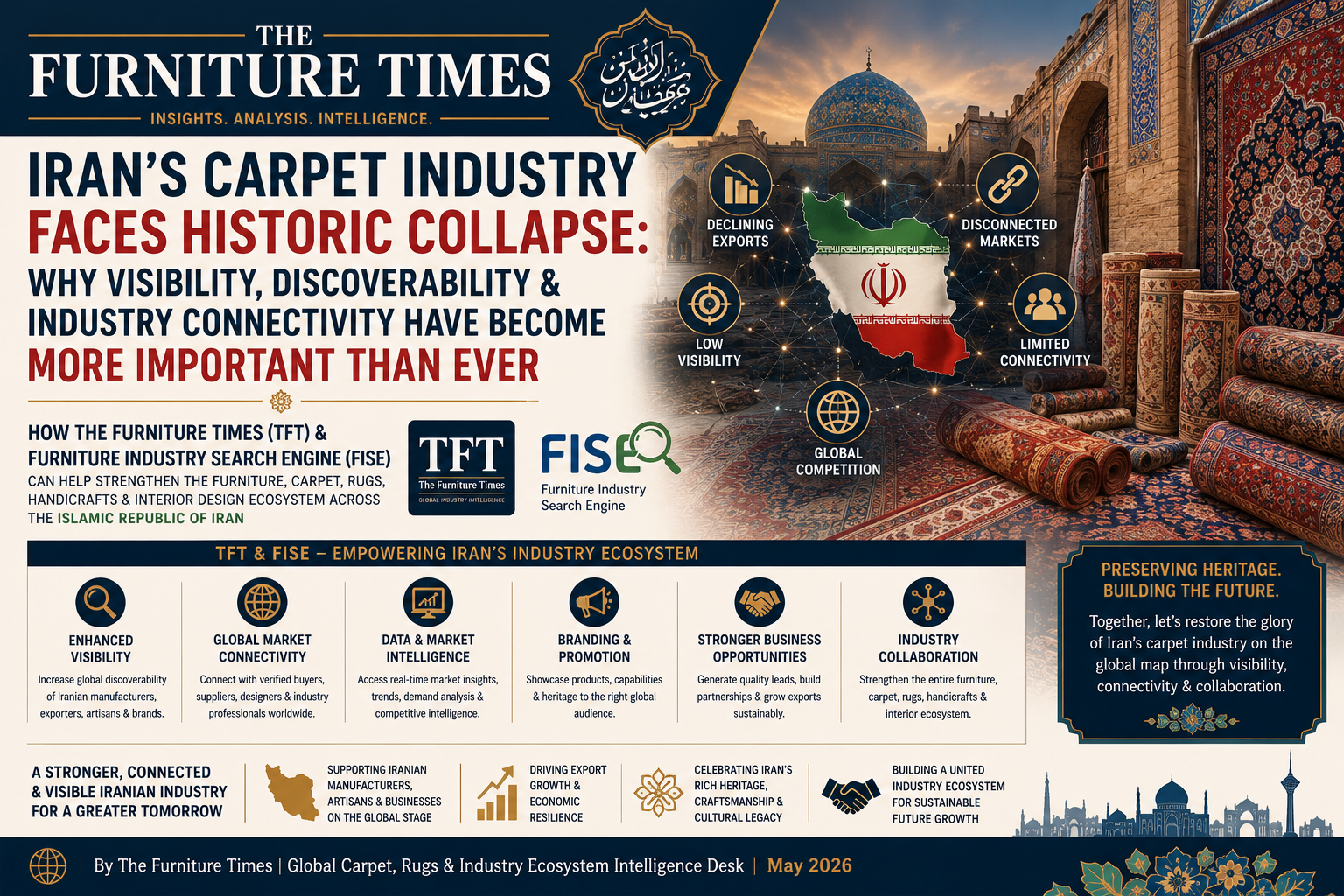
Iran’s Carpet Industry Faces Historic Collapse: Why Visibility, Discoverability & Industry Connectivity Have Become More Important Than Ever
How The Furniture Times (TFT) & Furniture Industry Search Engine (FISE) Can Help Strengthen the Furniture, Carpet, Rugs, Handicrafts & Interior Design Ecosystem Across the Islamic Republic of Iran
By The Furniture Times | Global Carpet, Rugs & Industry Ecosystem Intelligence Desk | May 2026
One of the most iconic industries in the history of global craftsmanship is facing one of its most difficult periods.
Iran’s handwoven carpet industry, once considered one of the most powerful symbols of cultural heritage, craftsmanship, artistry, and non-oil exports, is experiencing a historic decline.
Recent industry reports indicate that Iran’s carpet exports, which once generated nearly US$2.5 billion annually, have now fallen to levels described by industry officials as “virtually stopped,” with exports dropping below US$50 million in recent years.
For generations, Persian carpets represented:
craftsmanship
luxury
heritage
artistry
global prestige
Today, the industry faces:
sanctions
export challenges
reduced tourism
logistics difficulties
international payment restrictions
declining global visibility
The challenge is no longer only production.
The challenge increasingly becomes:
discoverability.
A Historic Industry Under Pressure
For decades, Persian carpets were among Iran’s most recognized exports worldwide.
The industry supported:
weavers
artisans
exporters
traders
workshops
family businesses
Millions of livelihoods were directly or indirectly connected to the carpet ecosystem.
However, industry reports show exports have fallen dramatically compared to historic highs. Industry officials state that exports which once approached US$2.5 billion annually have now declined to below US$50 million.
This is not only an economic issue.
It is also a visibility issue.
The Modern Industry Is Being Rewritten
The global furniture, carpets, rugs, handicrafts, and interior design sectors are changing rapidly.
Today, buyers increasingly discover suppliers through:
search engines
AI systems
digital directories
industry media
online marketplaces
industry ecosystems
Many exceptional businesses remain:
invisible
difficult to find
disconnected from global buyers
This challenge affects not only Iran.
It affects furniture and handicraft industries across the world.
The Future Industry Runs on Visibility
The global furniture and interior design industry is entering what The Furniture Times calls:
The Visibility Economy
In the past:
Production = Power
Today:
Discoverability = Power
Many businesses produce extraordinary products.
But if buyers cannot:
find them
discover them
verify them
connect with them
growth becomes difficult.
This is where industry ecosystems become important.
How The Furniture Times (TFT) Can Help
The Furniture Times (TFT) was created with a simple vision:
Bringing Furniture Brands Into Global Spotlight
TFT is not only a news platform.
It aims to become:
an industry visibility platform
a knowledge platform
a global furniture intelligence ecosystem
a discoverability engine
For businesses across the Islamic Republic of Iran, TFT can help by providing:
Industry Visibility
Helping companies tell their story globally.
Industry News Coverage
Highlighting manufacturers, artisans, exporters, designers, and industry leaders.
Global Exposure
Connecting regional businesses with international audiences.
Industry Intelligence
Sharing market updates, trends, opportunities, and global insights.
Brand Authority
Helping companies build trust through visibility.
How FISE Can Support the Iranian Industry Ecosystem
Furniture Industry Search Engine (FISE) was designed around one important reality:
If you are not searchable, you may become invisible.
The future furniture industry increasingly depends on:
searchability
discoverability
connectivity
digital presence
FISE aims to help businesses become:
Findable
Searchable
Discoverable
Connected
For companies across:
furniture
carpets
rugs
handicrafts
interiors
hospitality
visibility may become one of the most valuable assets in the future economy.
Why Connectivity Matters
One of the biggest challenges facing many industries today is fragmentation.
Manufacturers often operate separately from:
designers
retailers
exporters
buyers
architects
hospitality developers
Future growth increasingly depends on:
connectivity.
The businesses that connect effectively often gain:
opportunities
partnerships
exposure
business inquiries
The Carpet Industry Needs Global Storytelling
Persian carpets remain among the most respected handmade products in the world.
Their value extends beyond commerce.
They represent:
culture
history
craftsmanship
identity
However, younger generations increasingly discover products online rather than through traditional trade channels.
This means the industry increasingly requires:
digital storytelling
visibility systems
online discoverability
search infrastructure
Without visibility,
even world-class craftsmanship can remain hidden.
AI Is Changing How Buyers Discover Businesses
Artificial Intelligence is rapidly changing business discovery.
Buyers increasingly use:
AI assistants
search engines
recommendation systems
digital research tools
This means companies increasingly compete not only in physical markets.
They also compete inside:
digital ecosystems.
The future industry may reward businesses that become:
searchable
indexed
visible
connected
A Message to the Industry Ecosystem in Iran
The challenges facing the carpet, furniture, handicraft, and interior industries are real.
However, challenges also create opportunities.
The future may increasingly belong to businesses that combine:
craftsmanship
quality
visibility
discoverability
connectivity
digital presence
The global furniture industry itself is moving toward:
ecosystem thinking.
TFT Industry Insight
The collapse in exports highlights a larger lesson for the global furniture and handicraft ecosystem:
Great products alone are no longer enough.
The modern economy increasingly rewards:
Visibility
Trust
Discoverability
Connectivity
The future winners may not simply be the largest manufacturers.
They may become the most visible manufacturers.
Final Thought
Iran’s carpet industry remains one of the world’s most respected craftsmanship traditions.
Its heritage cannot be measured only through export statistics.
Its value lies in:
artistry
culture
craftsmanship
human skill
Yet the future industry increasingly requires more than heritage.
It requires:
visibility
discoverability
connectivity
digital transformation
The Furniture Times (TFT) and Furniture Industry Search Engine (FISE) believe the future furniture and interior ecosystem will increasingly be built around:
Findability
Searchability
Credibility
Connectivity
Because in the next generation of the global industry economy:
Being great is important.
But being discoverable may become equally important.
And that transformation has already begun.