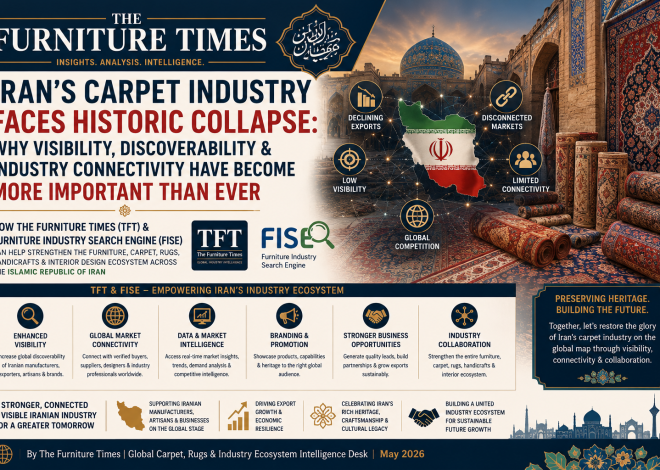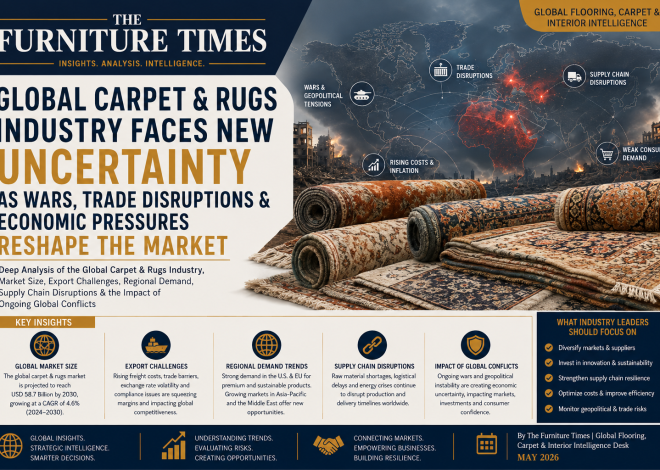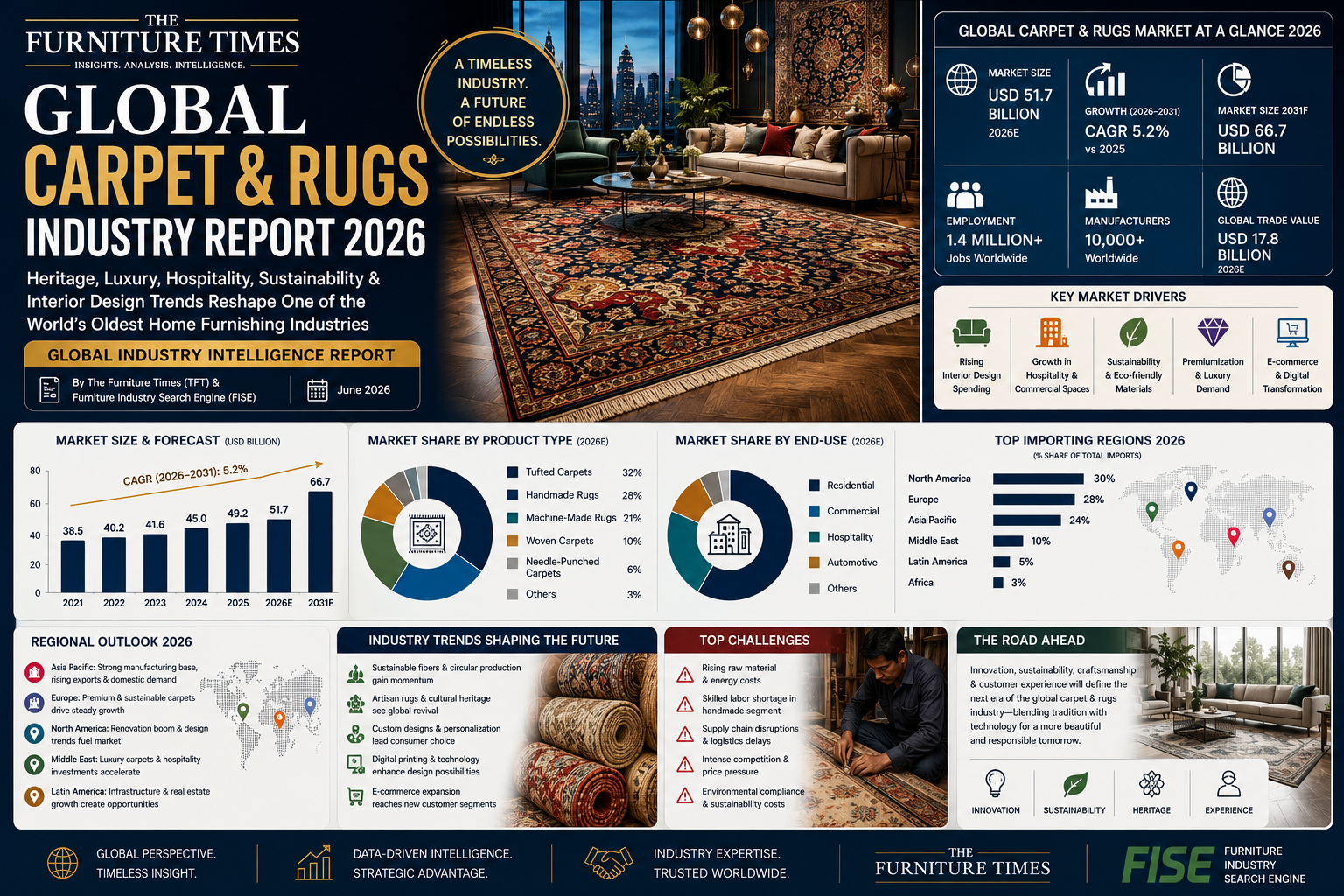
Global Carpet & Rugs Industry Report 2026
Heritage, Luxury, Hospitality, Sustainability & Interior Design Trends Reshape One of the World’s Oldest Home Furnishing Industries
Global Industry Intelligence Report | By The Furniture Times (TFT) & Furniture Industry Search Engine (FISE) | June 2026
The global carpet and rugs industry is experiencing one of the most significant transformations in its history.
For centuries, carpets and rugs were viewed primarily as floor coverings. Today, they have evolved into lifestyle products, design statements, luxury assets, hospitality essentials, acoustic solutions, sustainability products, and cultural artifacts.
From the hand-knotted carpets of Iran, Turkey, India, Afghanistan, Morocco, and Central Asia to the technologically advanced machine-made rugs produced across Europe, China, the United States, and the Middle East, the industry remains one of the most globally interconnected sectors within the furnishing ecosystem.
In 2026, the global carpets and rugs market is estimated at roughly US$50–65 billion, with industry forecasts indicating continued expansion through the next decade. Growth is being supported by rising residential spending, hospitality investments, luxury interior demand, urbanization, and increasing consumer interest in personalized home décor.
Executive Summary
Global Carpet & Rugs Industry Health Score
Manufacturing Health: 8.1 / 10
Consumer Demand Health: 7.8 / 10
Luxury Segment Health: 8.6 / 10
Hospitality Demand Health: 8.4 / 10
Export Market Health: 7.5 / 10
Digital Retail Transformation: 8.0 / 10
Sustainability Readiness: 7.4 / 10
Overall Industry Health Score: 8.0 / 10
The industry remains healthy, resilient, and increasingly design-driven.
Why Carpets & Rugs Still Matter
In an age of minimalist interiors, smart homes, and digital lifestyles, carpets continue playing an essential role.
They provide:
Comfort
Warmth
Acoustic control
Luxury appeal
Interior identity
Cultural expression
Space definition
Visual storytelling
A rug is often the first element that defines the character of a room.
Interior designers frequently describe rugs as “the foundation of the space.”
This explains why carpets remain relevant despite changing design trends.
The Global Industry Structure
The carpet and rug industry can broadly be divided into two segments:
Handmade Carpets
Produced by skilled artisans using traditional weaving techniques.
Machine-Made Carpets
Produced using automated manufacturing systems for large-scale distribution.
The handmade segment emphasizes:
Heritage
Craftsmanship
Luxury
Collectibility
The machine-made segment emphasizes:
Affordability
Consistency
Volume production
Retail scalability
Both sectors continue to coexist and serve different market segments.
Asia: The Global Production Powerhouse
Asia remains the center of global carpet production.
Major producing countries include:
India
One of the world’s largest exporters of handmade carpets.
China
Major producer of machine-made rugs and carpet materials.
Turkey
Leading exporter of machine-made rugs globally.
Iran
Globally recognized for luxury Persian carpets.
Pakistan
Strong handmade carpet tradition.
Afghanistan
Known for traditional handwoven rugs.
Nepal
Specialized in premium hand-knotted wool carpets.
Asia’s advantage lies in:
Skilled labor
Manufacturing capacity
Raw material access
Export infrastructure
Cultural heritage
The region continues supplying both luxury and mass-market segments worldwide.
Middle East: The Home of Carpet Heritage
No discussion about carpets is complete without acknowledging the Middle East.
Countries such as:
Iran
Turkey
United Arab Emirates
Saudi Arabia
Qatar
continue influencing the global carpet economy.
Persian Carpets
Persian carpets remain among the most respected and valuable floor coverings in the world.
They are often viewed as:
Investments
Cultural assets
Luxury products
Heritage pieces
Gulf Region Demand
The Gulf region remains a major buyer of:
Luxury carpets
Hospitality rugs
Mosque carpets
Villa interiors
Custom-made designs
Large hospitality and real estate developments continue driving demand.
Europe: Premium Design & Sustainability
Europe remains one of the most sophisticated carpet markets globally.
Major markets include:
Germany
United Kingdom
France
Italy
Spain
Netherlands
European consumers increasingly prioritize:
Sustainability
Demand for environmentally responsible products continues growing.
Natural Fibers
Wool, jute, sisal, and recycled materials are gaining popularity.
Contemporary Design
Modern aesthetics are replacing traditional patterns in many urban markets.
Custom Solutions
High-end residential and commercial projects increasingly require customized designs.
Europe continues setting global standards for quality and sustainability.
North America: The World’s Largest Consumer Market
The United States remains one of the largest carpet and rug markets globally.
Demand is driven by:
Residential renovations
New housing
Commercial interiors
Hospitality projects
Home décor spending
American consumers increasingly view rugs as interchangeable design elements rather than permanent purchases.
This has accelerated demand for:
Modern rugs
Designer collaborations
Washable rugs
E-commerce rug brands
Seasonal design collections
The market continues evolving toward convenience and personalization.
Africa: The Next Growth Frontier
Africa remains one of the most underdeveloped but promising carpet markets.
Growth drivers include:
Urbanization
Housing development
Hospitality expansion
Rising middle-class populations
Retail modernization
Key markets include:
South Africa
Nigeria
Kenya
Egypt
Morocco
Ghana
Morocco in particular has become internationally recognized for handcrafted rugs that combine traditional techniques with contemporary design.
African rug exports continue attracting global design attention.
Oceania: Premium Residential Demand
Australia and New Zealand continue supporting premium carpet demand.
Consumers increasingly seek:
Sustainable fibers
Wool carpets
Luxury rugs
Interior design-led purchases
Australia’s strong housing renovation culture supports continued demand for flooring and decorative rug products.
The Hospitality Boom
One of the strongest drivers of carpet demand globally is hospitality.
Hotels require:
Guest room carpets
Corridor carpeting
Ballroom installations
Conference facilities
Luxury area rugs
Major tourism growth markets include:
UAE
Saudi Arabia
Qatar
Malaysia
Thailand
Indonesia
Vietnam
Every new hotel development creates opportunities for carpet manufacturers.
Hospitality projects often involve large-scale procurement contracts.
Materials Defining the Industry
The carpet industry utilizes a wide range of materials.
Wool
Premium, durable, natural, and highly respected.
Nylon
Strong and widely used in commercial environments.
Polyester
Affordable and stain-resistant.
Polypropylene
Popular in mass-market rugs.
Silk
Luxury handmade carpets.
Jute
Sustainable and natural.
Sisal
Increasingly popular in eco-conscious markets.
Recycled Fibers
Growing rapidly as sustainability becomes more important.
Material innovation continues shaping product development.
Sustainability Is Changing Consumer Behavior
Environmental concerns are transforming purchasing decisions.
Consumers increasingly ask:
Is it recyclable?
Is it made from sustainable fibers?
Is the manufacturing process responsible?
What is the carbon footprint?
Manufacturers are responding through:
Recycled yarns
Circular production systems
Sustainable wool sourcing
Water-efficient manufacturing
Eco-certifications
Sustainability is moving from niche preference to mainstream expectation.
Digital Transformation & E-Commerce
The carpet industry has undergone significant digital transformation.
Consumers increasingly purchase rugs online.
Technology now enables:
Room visualization
Virtual placement tools
Augmented reality previews
AI-driven recommendations
Digital design customization
This has reduced one of the industry’s historic barriers: the inability to visualize a rug before purchase.
Digital commerce is expanding market reach globally.
Major Trends Shaping 2026–2030
Washable Rugs
Strong demand among younger consumers and families.
Sustainable Carpets
Growing rapidly worldwide.
Custom Designs
Consumers increasingly want personalized products.
Luxury Handmade Carpets
Continued demand among affluent buyers.
Hospitality Carpets
Strong pipeline of projects globally.
Outdoor Rugs
Growing demand for patios, terraces, and hospitality spaces.
Acoustic Flooring Solutions
Corporate and commercial spaces seek sound-control benefits.
Smart Manufacturing
Automation improves productivity and consistency.
Challenges Facing the Industry
Despite strong fundamentals, challenges remain.
Rising Raw Material Costs
Wool, synthetic fibers, and logistics costs remain volatile.
Labor Shortages
Handmade carpet sectors face artisan shortages.
Counterfeit Products
Luxury carpet segments continue facing imitation issues.
Freight Costs
Global logistics disruptions affect margins.
Consumer Price Sensitivity
Mass-market segments remain highly competitive.
Manufacturers must balance affordability with quality.
The Future of Handmade Carpets
One of the most important questions is whether handmade carpets can survive in a machine-made world.
The answer is yes.
In fact, handmade carpets are increasingly positioned as:
Luxury products
Collectibles
Cultural heritage assets
Sustainable alternatives
Consumers seeking authenticity continue supporting artisan-produced products.
The challenge is attracting younger generations into traditional craftsmanship.
TFT & FISE Analysis
The carpet and rugs industry is no longer simply a flooring business.
It is becoming part of:
Interior design
Hospitality development
Luxury living
Cultural preservation
Sustainability
Lifestyle branding
The strongest companies are no longer selling carpets.
They are selling stories, heritage, craftsmanship, comfort, and design identity.
This transformation is creating opportunities for manufacturers, designers, exporters, digital platforms, and hospitality suppliers.
Final Verdict
The global carpet and rugs industry enters the second half of 2026 in a healthy position.
Demand remains strong.
Hospitality investment is expanding.
Luxury segments continue growing.
Sustainability is creating innovation.
Digital platforms are increasing accessibility.
While challenges remain, the long-term outlook is positive.
The future winners will be the companies that successfully combine:
Craftsmanship + Design + Sustainability + Technology + Global Visibility
Because carpets are no longer just floor coverings.
They are becoming one of the most powerful expressions of how people experience, personalize, and define their spaces.
By The Furniture Times (TFT) & Furniture Industry Search Engine (FISE)
Global Industry Intelligence Report | June 2026
“TFT tells their story. FISE helps the world find them.”