
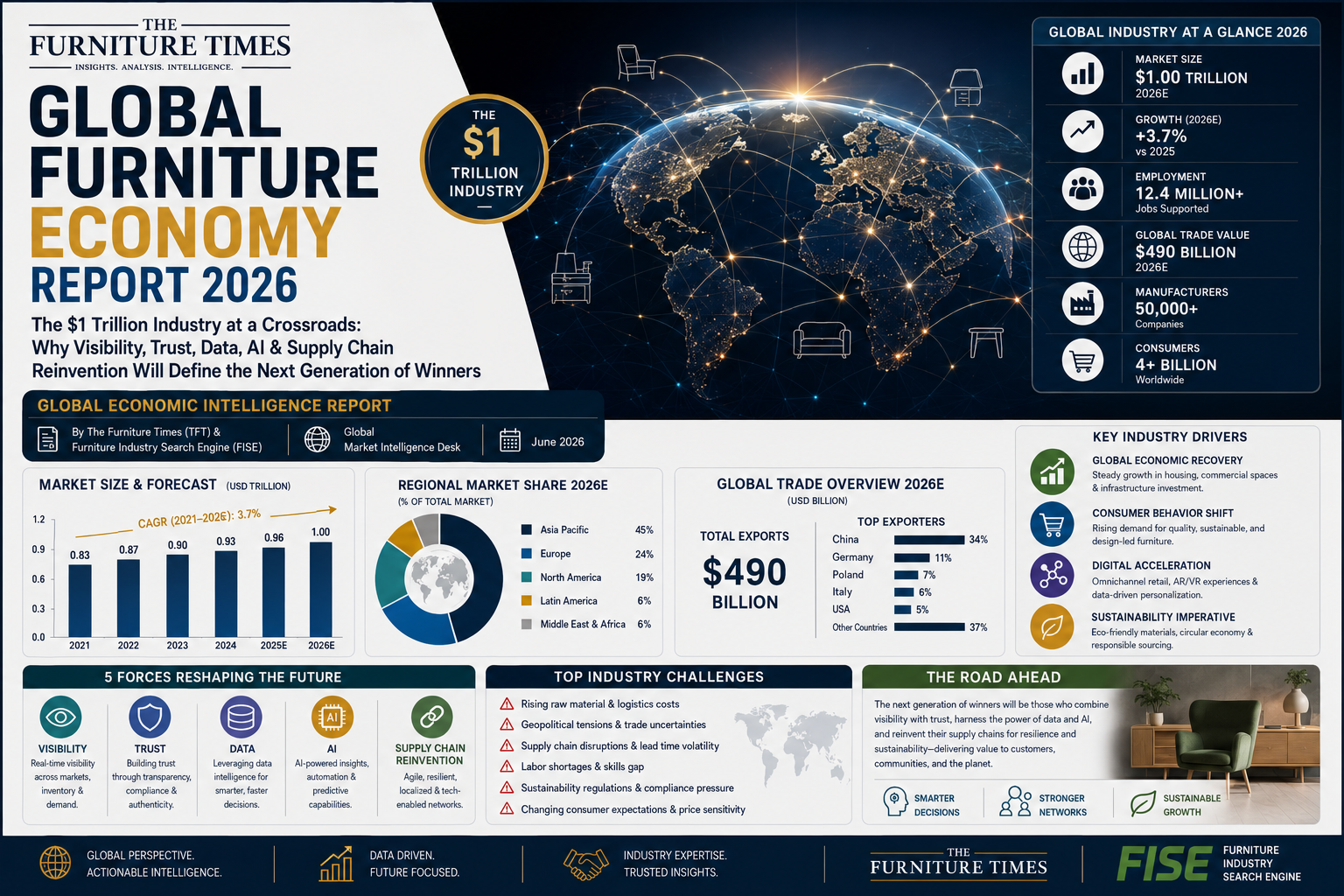
Global Furniture Economy Report 2026
The $1 Trillion Industry at a Crossroads: Why Visibility, Trust, Data, AI & Supply Chain Reinvention Will Define the Next Generation of Winners
Global Economic Intelligence Report | By The Furniture Times (TFT) & Furniture Industry Search Engine (FISE) | June 2026
The global furniture industry is one of the largest and most underestimated industries in the world.
Valued at approximately US$1 trillion across the broader furniture ecosystem, the industry touches nearly every aspect of modern life. Every home, office, hotel, hospital, school, restaurant, airport, government building, retail outlet, and public space depends on furniture in some form.
Yet despite its size, the furniture economy remains one of the most fragmented industries globally.
Unlike technology, finance, energy, or automotive sectors, the furniture industry lacks a centralized intelligence system. Millions of manufacturers, retailers, suppliers, designers, distributors, importers, exporters, artisans, contractors, architects, logistics providers, and service companies operate largely disconnected from one another.
As the industry enters the second half of 2026, a fundamental transformation is underway.
The future of furniture will not be determined solely by manufacturing capacity or product quality.
It will increasingly be determined by:
Visibility
Discoverability
Trust
Data
AI Readiness
Supply Chain Resilience
Customer Experience
Industry Connectivity
This report examines the current state of the global furniture economy and where it is heading over the next decade.
Executive Summary
Global Furniture Economy Health Score
Manufacturing Health: 7.8 / 10
Retail Health: 6.9 / 10
Consumer Demand Health: 7.4 / 10
Supply Chain Health: 6.2 / 10
Technology Adoption: 6.8 / 10
Digital Visibility Maturity: 4.9 / 10
AI Readiness: 3.8 / 10
Overall Industry Health Score: 6.8 / 10
The industry remains fundamentally strong, but structurally under-digitized and highly fragmented.
The Furniture Industry Is Bigger Than Most People Realize
The furniture economy extends far beyond chairs, tables, sofas, and cabinets.
The ecosystem includes:
Manufacturing
Factories producing furniture products worldwide.
Materials
Timber, MDF, plywood, laminates, textiles, metals, plastics, glass, foam, adhesives, and hardware.
Machinery
Woodworking equipment, CNC systems, finishing machinery, automation technologies.
Logistics
Warehousing, shipping, freight forwarding, installation, and distribution.
Design
Interior design, furniture design, architecture, space planning.
Retail
Physical stores, online marketplaces, showrooms, distributors.
Hospitality
Hotels, resorts, restaurants, serviced apartments.
Commercial
Offices, educational facilities, healthcare institutions.
Technology
Search platforms, AI systems, software providers, ERP solutions.
The furniture economy is therefore far larger than furniture products alone.
The Great Fragmentation Problem
The single biggest challenge facing the industry today is fragmentation.
Millions of businesses operate independently.
Most buyers struggle to find suppliers.
Most suppliers struggle to find buyers.
Many exceptional manufacturers remain invisible globally.
Many buyers continue relying on outdated sourcing methods.
This fragmentation creates inefficiencies throughout the ecosystem.
The industry generates enormous economic value but lacks a unified discovery infrastructure.
This is one of the reasons why digital discoverability is becoming increasingly important.
Manufacturing Is Shifting East and South
Furniture manufacturing continues evolving geographically.
Remains the world’s largest furniture manufacturing nation.
Continues strengthening its export position.
India
Rapidly expanding manufacturing capacity.
Growing as a major woodworking and furniture production hub.
Maintains strong specialization in wood furniture and hospitality sectors.
One of Europe’s strongest furniture exporters.
Increasingly competitive in regional and international markets.
Benefiting from nearshoring opportunities.
The future manufacturing map is becoming more diversified.
Companies are increasingly reducing dependency on single-country sourcing strategies.
Supply Chains Are Being Rebuilt
The last five years have fundamentally changed supply chain thinking.
COVID-19.
Red Sea disruptions.
Russia-Ukraine conflict.
Middle East tensions.
Freight volatility.
Port congestion.
These events exposed weaknesses within global supply chains.
Furniture businesses are increasingly prioritizing:
Multi-country sourcing
Nearshoring
Inventory resilience
Regional manufacturing
Supplier diversification
The objective is no longer maximum efficiency.
The objective is resilience.
The Rise of the Hospitality Furniture Economy
One of the fastest-growing segments globally is hospitality furniture.
Growth is being driven by:
Hotel expansion
Resort development
Tourism recovery
Mixed-use developments
Luxury hospitality projects
Countries experiencing strong hospitality furniture demand include:
UAE
Saudi Arabia
Qatar
Malaysia
Indonesia
Thailand
Vietnam
India
Hospitality furniture is becoming one of the most attractive sectors within the industry.
Consumer Behavior Has Changed Forever
Today’s furniture buyer behaves differently.
Before making a purchase, consumers increasingly:
Search online
Compare reviews
Check ratings
Research suppliers
Watch videos
Use AI tools
The traditional showroom remains important.
But it is no longer the starting point.
The buying journey now begins digitally.
This shift is changing how furniture businesses must operate.
Search Is Becoming the New Marketplace
Historically, furniture marketplaces dominated discovery.
Today, search engines increasingly function as marketplaces.
Every day, buyers search for:
Furniture manufacturers
Hospitality furniture suppliers
Outdoor furniture companies
Contract furniture specialists
Kitchen cabinet manufacturers
The businesses that appear first often receive the first inquiry.
This creates a new competitive reality.
Visibility is becoming a business asset.
AI Will Reshape Furniture Discovery
Artificial Intelligence represents the next major disruption.
Buyers are increasingly asking AI systems:
Who are the best furniture manufacturers?
Which suppliers are trusted?
What brands specialize in hospitality projects?
This changes the traditional discovery process.
Companies that are invisible to AI may become invisible to future buyers.
AI discoverability is becoming an emerging competitive advantage.
Sustainability Is No Longer Optional
Environmental responsibility is becoming a market requirement.
Consumers increasingly demand:
Sustainable wood
Recyclable materials
Transparent sourcing
Lower carbon footprints
Governments and institutional buyers are also increasing sustainability expectations.
Furniture businesses that ignore sustainability may face increasing barriers to market access.
The Visibility Economy
TFT and FISE define the next phase of the industry as the Visibility Economy.
The traditional formula was:
Manufacturing + Distribution = Growth
The new formula is:
Visibility + Trust + Data + Searchability + Product Quality = Growth
The most visible companies increasingly generate the most opportunities.
Visibility influences:
Discovery
Trust
Leads
Partnerships
Sales
Visibility is becoming infrastructure.
The Data Gap
One of the industry’s largest weaknesses is data.
Many furniture businesses still operate with limited visibility into:
Market demand
Customer behavior
Competitive positioning
Search trends
Supply chain intelligence
The next generation of furniture leaders will be data-driven.
The future belongs to businesses that can convert information into decisions.
Why FISE Matters
The Furniture Industry Search Engine (FISE) was created to address a fundamental industry challenge:
The furniture industry is difficult to search.
Millions of businesses remain undiscovered.
Buyers struggle to identify relevant suppliers.
FISE aims to become:
A search engine
A discovery platform
An intelligence system
A visibility ecosystem
The objective is simple:
Make the global furniture industry searchable.
The Next Decade: 2026–2036
Several themes will likely define the future.
AI-Powered Discovery
Search behavior will increasingly shift toward AI recommendations.
Digital Supplier Verification
Trust signals will become more important.
Sustainability Leadership
Environmental performance will influence competitiveness.
Smart Manufacturing
Automation and data integration will expand.
Global Connectivity
Industry ecosystems will become increasingly interconnected.
Visibility-Based Competition
Discoverability will become a key business advantage.
TFT Final Analysis
The furniture industry is not facing a demand crisis.
It is facing a transformation challenge.
Demand remains strong.
Urbanization continues.
Housing demand continues.
Hospitality projects continue.
Population growth continues.
What is changing is how business is discovered, evaluated, and selected.
The future furniture winners will not necessarily be the largest factories.
They will be the most visible.
The most trusted.
The most searchable.
The most connected.
The most adaptable.
And the most prepared for a world increasingly driven by data and AI.
Final Verdict
The global furniture economy remains one of the world’s most resilient industries.
However, the next decade will reward a different type of leader.
Not only manufacturers.
Not only retailers.
But organizations capable of combining:
Manufacturing + Visibility + Trust + Data + AI + Sustainability + Connectivity
The industry’s future will belong to those who understand that furniture is no longer only a product business.
It is becoming an intelligence business.
And the businesses that recognize this shift first may define the next generation of global industry leadership.
By The Furniture Times (TFT) & Furniture Industry Search Engine (FISE)
Global Economic Intelligence Report | June 2026
“TFT tells their story. FISE helps the world find them.”
