
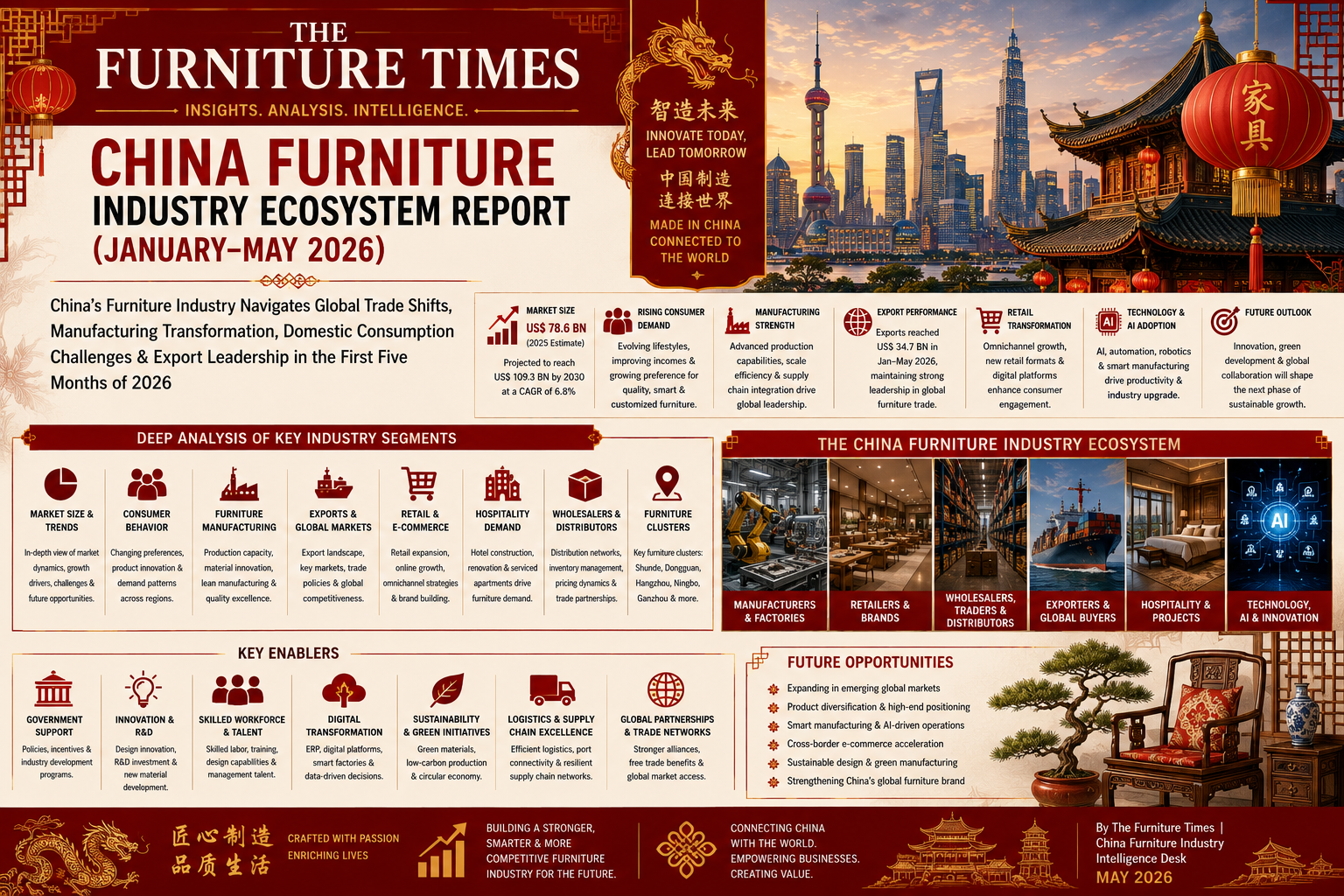
China’s Furniture Industry Navigates Global Trade Shifts, Manufacturing Transformation, Domestic Consumption Challenges & Export Leadership in the First Five Months of 2026
China Furniture Industry Ecosystem Report (January–May 2026)
Deep Analysis of Market Size, Consumer Behavior, Manufacturing, Exports, Retail, Hospitality Demand, Furniture Clusters, Wholesalers, Technology, AI Adoption & Future Opportunities
By The Furniture Times | China Furniture Industry Intelligence Desk | June 2026
China remains the world’s largest furniture manufacturing ecosystem.
Between January and May 2026, China’s furniture industry continued demonstrating enormous industrial scale despite facing:
global trade uncertainty
tariff pressures
changing consumer behavior
real estate challenges
international competition
rising labor costs
Yet despite these pressures, China remains the undisputed giant of global furniture manufacturing, accounting for a substantial share of worldwide furniture production and exports.
The industry is no longer simply competing through:
scale.
It is increasingly competing through:
automation, technology, design, sustainability, AI integration, and manufacturing intelligence.
January–May 2026 Industry Overview
The first five months of 2026 reflected a market undergoing transformation.
The industry experienced:
Positive Drivers
export resilience
manufacturing modernization
automation investments
hospitality recovery
international sourcing demand
Key Challenges
domestic property sector weakness
slower household spending
tariff uncertainty
global competition
margin pressure
China’s broader economy continued showing mixed signals, with manufacturing remaining relatively stable while property-related sectors faced continuing adjustment. This directly influenced furniture demand patterns.
The industry entered 2026 with caution but also confidence in its long-term manufacturing leadership.
China Remains the World’s Largest Furniture Manufacturing Ecosystem
China continues dominating global furniture production.
The country hosts:
tens of thousands of furniture manufacturers
vast supplier networks
integrated industrial clusters
machinery ecosystems
hardware manufacturers
upholstery suppliers
logistics infrastructure
China’s furniture ecosystem includes:
residential furniture
office furniture
hospitality furniture
outdoor furniture
smart furniture
luxury furniture
OEM manufacturing
private label production
Few countries possess such a complete furniture supply chain.
The industry functions as:
an industrial ecosystem rather than a manufacturing sector.
Market Size Remains Massive
China’s domestic furniture market remains one of the largest in the world.
Industry estimates place China’s furniture market well above US$150 billion annually, making it one of the largest furniture consumption economies globally.
The market benefits from:
urbanization
middle-class purchasing power
housing demand
commercial projects
hospitality expansion
Even during slower economic periods, the sheer scale of China’s population creates enormous furniture demand.
Consumer Behavior Is Changing Rapidly
One of the biggest developments during January–May 2026 was the evolution of consumer preferences.
Chinese consumers increasingly prioritize:
quality
durability
wellness
smart home integration
sustainability
aesthetics
Consumers increasingly seek:
Premium Products
Rather than low-cost furniture alone.
Health-Conscious Furniture
Materials with low emissions and better environmental credentials.
Smart Furniture
Technology-integrated furniture solutions.
Custom Furniture
Personalized products designed around specific living spaces.
The modern Chinese furniture buyer increasingly purchases:
lifestyle solutions.
Domestic Consumption Is Becoming More Important
Historically, China’s furniture industry relied heavily on exports.
Today, domestic consumption plays an increasingly important role.
Manufacturers increasingly focus on:
local branding
domestic retail
direct-to-consumer models
digital sales channels
This reduces dependence on external markets while creating stronger long-term resilience.
Furniture Retail Is Becoming Digital
China remains one of the most advanced furniture retail markets in the world.
Furniture purchasing increasingly occurs through:
e-commerce platforms
live commerce
social commerce
digital marketplaces
AI-assisted shopping
Consumers increasingly research products online before making purchasing decisions.
The customer journey increasingly follows:
Search → Compare → Review → Purchase
This transformation continues reshaping furniture retail.
Live Commerce Is Influencing Buying Behavior
China remains a global leader in:
live commerce.
Furniture brands increasingly use:
livestream sales
influencer marketing
virtual showrooms
digital product demonstrations
to generate customer engagement.
Furniture companies increasingly sell through:
mobile platforms
video content
digital ecosystems
rather than traditional retail alone.
Major Furniture Manufacturing Clusters Continue Leading Production
China’s furniture ecosystem remains heavily concentrated in powerful industrial regions.
Guangdong Province
The largest furniture manufacturing hub.
Known for:
Foshan
Dongguan
Guangzhou
Specializes in:
residential furniture
office furniture
export production
Zhejiang Province
Known for:
modern furniture production
export manufacturing
e-commerce integration
Jiangsu Province
Strong in:
hospitality furniture
contract furniture
commercial projects
Shandong Province
Known for:
wooden furniture
manufacturing clusters
export production
These regions collectively create one of the most sophisticated furniture ecosystems on Earth.
Export Performance Remains Critical
China remains the world’s largest furniture exporter.
Major export destinations include:
United States
Europe
Japan
Australia
Middle East
Southeast Asia
Despite tariff concerns and geopolitical pressures, China continues benefiting from:
manufacturing efficiency
supplier integration
logistics infrastructure
production scale
Export markets remain essential to industry health.
Tariff Pressures Continue Influencing Strategy
One of the biggest concerns during early 2026 remained:
trade uncertainty.
Manufacturers continue adapting to:
tariffs
geopolitical tensions
supply chain diversification
Many exporters increasingly explore:
ASEAN markets
Middle East opportunities
Africa
Latin America
to diversify risk.
The industry is becoming more geographically balanced.
Hospitality Furniture Demand Is Growing
Hospitality remained one of the strongest-performing segments.
Demand continues expanding across:
hotels
resorts
serviced apartments
commercial projects
tourism infrastructure
China’s hospitality furniture manufacturers increasingly serve:
domestic projects
international hotel chains
Middle Eastern developments
Asian tourism markets
The hospitality ecosystem remains a major growth engine.
Office Furniture Is Evolving
Office furniture demand increasingly focuses on:
ergonomic products
wellness-focused design
collaborative workspaces
hybrid workplace solutions
Corporate buyers increasingly prioritize:
productivity
employee wellbeing
flexible work environments
The office furniture sector continues adapting to post-pandemic workplace realities.
Automation Is Transforming Manufacturing
China leads the world in furniture manufacturing automation.
Factories increasingly invest in:
robotics
CNC systems
automated cutting
AI-driven production
smart manufacturing
The future Chinese furniture factory increasingly operates through:
intelligent manufacturing.
Automation helps address:
labor shortages
productivity goals
quality consistency
Artificial Intelligence Is Entering the Industry
One of the most important developments in 2026 is:
AI integration.
Furniture companies increasingly use AI for:
product design
demand forecasting
inventory management
customer service
marketing
manufacturing optimization
China is rapidly becoming one of the global leaders in AI-enabled furniture production.
Sustainability Is Becoming a Competitive Requirement
Global buyers increasingly expect:
sustainable sourcing
low-emission products
environmentally responsible manufacturing
carbon reduction initiatives
Chinese manufacturers increasingly invest in:
cleaner production
renewable energy
sustainable materials
environmental certifications
The future furniture market increasingly rewards:
green manufacturing.
Wholesalers Continue Supporting Distribution
Despite digital growth, wholesale networks remain extremely important.
Wholesalers continue connecting:
factories
retailers
importers
project buyers
hospitality operators
China’s wholesale ecosystem remains among the largest in the world.
The wholesale layer continues supporting global furniture movement.
The Rise of Smart Furniture
One emerging trend gaining momentum is:
Smart Furniture
Products increasingly include:
charging systems
connectivity features
integrated technology
smart home compatibility
China is positioned to become a major leader in this category due to its broader technology ecosystem.
Real Estate Challenges Continue Influencing Demand
One of the biggest domestic challenges remains:
property market adjustment.
Slower housing activity influences demand for:
residential furniture
renovation projects
home furnishing purchases
However, replacement demand and urban consumption continue supporting market activity.
Global Competition Is Intensifying
China increasingly competes with:
Vietnam
India
Indonesia
Malaysia
Türkiye
These countries continue expanding their furniture manufacturing ecosystems.
This forces Chinese manufacturers to compete increasingly through:
innovation
efficiency
technology
quality
speed
rather than scale alone.
The Rise of the Visibility Economy
One major transformation is often overlooked.
The future furniture industry increasingly depends on:
visibility
discoverability
AI search presence
digital authority
Manufacturers increasingly recognize that being found online influences global business opportunities.
The future buyer increasingly discovers suppliers through:
search engines
AI systems
digital sourcing platforms
The discoverability economy has arrived.
The Furniture Times Industry Insight
The first five months of 2026 revealed a powerful reality:
China’s furniture industry is evolving from:
Manufacturing Giant
to
Intelligent Furniture Ecosystem
The future winners will increasingly combine:
automation
AI
sustainability
branding
discoverability
manufacturing excellence
Final Thought
China remains the most influential furniture manufacturing ecosystem in the world.
Between January and May 2026, the industry demonstrated:
resilience
adaptability
technological leadership
export strength
Yet the next phase of growth will require more than manufacturing capacity.
Future success increasingly depends on:
AI Integration
Smart Manufacturing
Sustainability
Global Visibility
Consumer-Centric Innovation
Because the future furniture economy is no longer only about producing products.
It is increasingly about building intelligent ecosystems capable of connecting manufacturing, technology, consumers, exports, and digital discoverability.
And China is positioning itself at the center of that transformation.
