Top Global Markets for Decking and Fencing
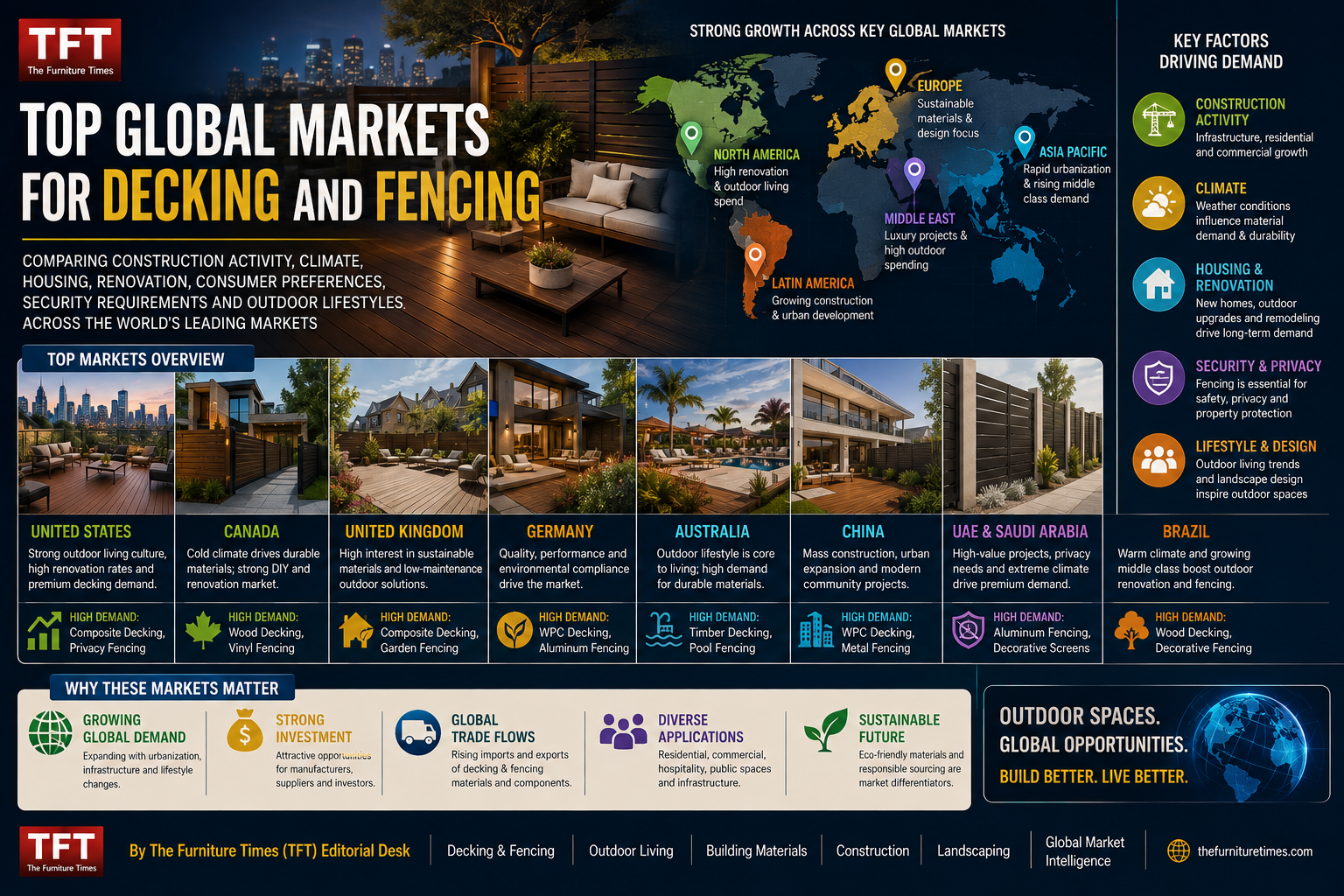
Comparing construction activity, climate, housing, renovation, consumer preferences, security requirements and outdoor lifestyles across the world’s leading markets
By The Furniture Times (TFT) Editorial Desk | Decking & Fencing | Outdoor Living | Building Materials | Construction | Landscaping | Global Market Intelligence
The global decking and fencing industry is expanding beyond its traditional role as a supplier of basic construction materials.
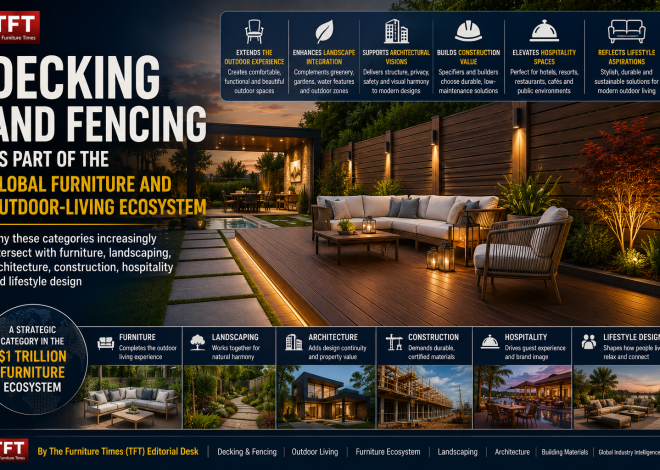
Decking now supports outdoor dining areas, residential gardens, pool surrounds, hotel terraces, rooftop lounges, commercial spaces, parks, boardwalks and public infrastructure. Fencing is simultaneously evolving from a simple boundary product into a wider system encompassing privacy, security, architectural screening, safety, landscape design and automated access.
However, demand is not developing uniformly around the world.
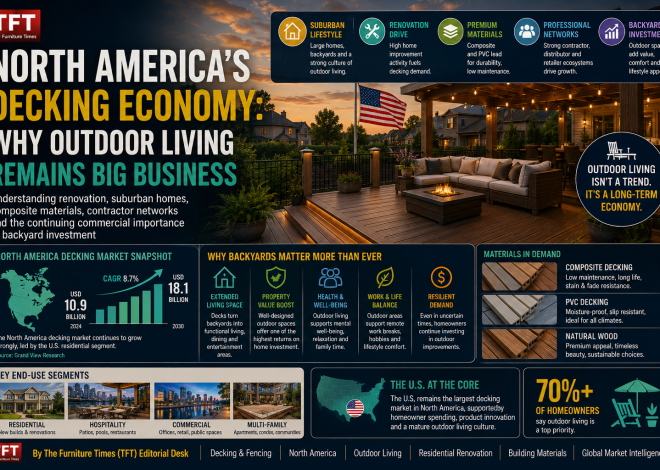
In North America, large suburban housing markets, established renovation activity and outdoor lifestyles support substantial demand for decks, railings and residential fencing. In Europe, ageing buildings, environmental expectations and compact urban spaces create opportunities for renovation-oriented, design-conscious and lower-maintenance systems.
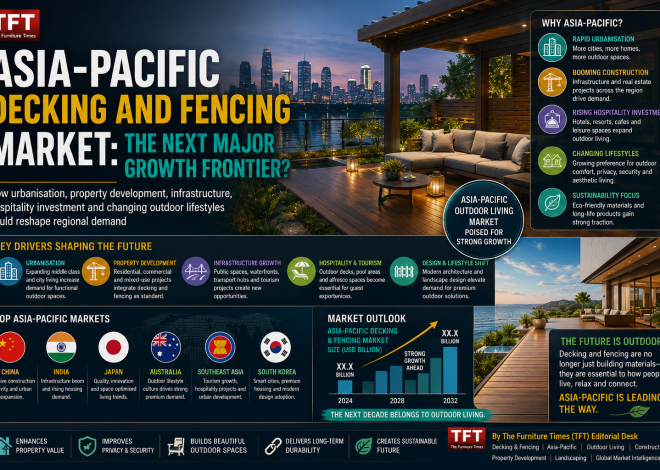
Across Asia-Pacific, urbanisation, infrastructure, hospitality development and rising household incomes are expanding the addressable market. In the Gulf, luxury property, hospitality, security and climate performance are particularly important. Australia combines a powerful outdoor culture with demanding environmental exposure, while emerging markets in India, Southeast Asia, Latin America and Africa offer growth potential accompanied by price sensitivity and fragmented distribution.
The most attractive market therefore depends on what a supplier sells.
A composite-decking manufacturer may prioritise North America, the United Kingdom or Australia. A security-fencing company may find stronger opportunity in infrastructure-heavy markets. A decorative-screen supplier may focus on the Gulf, hospitality markets and premium residential projects. A timber business must evaluate local design preferences, forestry regulation, treatment requirements and climate exposure.
There is no single “best” market. There are multiple market types requiring different products, prices, certifications and routes to customers.
A global market shaped by several demand engines
Decking and fencing demand is influenced by a combination of economic, physical and cultural factors:
- New housing construction
- Renovation and home improvement
- Single-family housing prevalence
- Urban density and available outdoor space
- Climate and seasonal outdoor use
- Hospitality and tourism investment
- Commercial construction
- Infrastructure and public-space development
- Security and privacy requirements
- Landscaping culture
- Material preferences
- Environmental regulations
- Skilled-installer availability
- Household purchasing power
- Distribution and retail maturity
These variables often work together.
A country with a warm climate may offer year-round outdoor-living potential, but extreme sunlight and humidity can increase product-performance requirements. A country with high household incomes may support premium materials, but planning controls and slow housing construction may limit project volumes.
Likewise, a large population does not automatically translate into a large addressable decking market. Housing format matters. Decking demand is generally stronger where households have gardens, patios, balconies, pools or rooftop terraces. Fencing has a wider addressable base because it serves residential, agricultural, commercial, industrial, security and infrastructure applications.
Market estimates show strong potential—but disagree on size
Published market estimates vary because researchers define decking and fencing differently. Some include only wood decking, while others include composites, railings, substructures or complete outdoor patio systems. Fencing reports may include residential, agricultural, commercial, industrial, temporary and high-security products.
One 2026 industry estimate valued the global fencing market at approximately US$35.6 billion for 2026 and projected it could reach US$52.4 billion by 2033. The same research identified North America as the largest regional market in 2025. Grand View Research
Another market study placed Asia-Pacific first, attributing 42.6% of 2025 fencing revenue to the region. Transparency Market Research
The disagreement demonstrates why a single headline number should not be treated as unquestionable fact. Definitions, geographic coverage, currency assumptions and included applications can materially change the result.
For composite railing and decking, one estimate valued the global market at US$5.1 billion in 2026 and identified North America as the leading region. Grand View Research
The direction across reports is more consistent than the precise figures: renovation, housing, infrastructure, security, outdoor living and demand for durable materials are supporting long-term opportunity.
Leading established markets
1. United States: the global reference market for residential decking
The United States remains one of the world’s most important decking and fencing markets because of its large housing stock, extensive single-family suburbs, developed home-improvement sector and strong culture of backyard living.
Decks are frequently treated as extensions of the home. They support barbecues, family gatherings, pool areas, garden furniture, outdoor kitchens and entertainment spaces.
Residential fencing is equally established, serving privacy, pets, children, pools, boundaries, landscaping and security.
Principal demand drivers
- Large stock of detached and single-family homes
- Mature renovation and remodelling market
- Strong outdoor-living culture
- Developed home-improvement retail channels
- Widespread use of professional contractors
- High awareness of composite and low-maintenance materials
- Pool and garden ownership
- Commercial, hospitality and public-space construction
The scale of American construction activity remains significant. U.S. Census Bureau data placed private residential construction at a seasonally adjusted annual rate of approximately US$877.1 billion in June 2026. That figure covers the broad residential construction market rather than decking and fencing specifically, but it illustrates the size of the underlying construction economy. U.S. Census Bureau
Product opportunities
- Composite decking
- Pressure-treated and naturally durable timber
- Deck railings and balustrades
- Vinyl and composite fencing
- Aluminium fencing
- Privacy screens
- Pool fencing
- Repair and resurfacing systems
- Integrated lighting
- Hidden fasteners and installation accessories
Market challenges
The United States is highly competitive. Established brands, strong distributors and professional contractor networks create barriers for unfamiliar international suppliers.
Products must address building codes, regional climate differences, warranties, slip resistance, fire considerations and installation practices. A product suitable for a humid southern state may require different communication and testing from one marketed in a cold northern region or wildfire-prone western location.
For exporters, the United States offers scale—but it demands documentation, inventory availability and dependable after-sales support.
2. Canada: renovation, timber familiarity and climate performance
Canada shares many characteristics with the United States, including detached housing, backyard culture and demand for residential renovation. Decks, fences, railings and privacy screens are common elements of suburban housing.
Canada’s climate creates both demand and technical challenges. Products must withstand snow, moisture, freeze-thaw cycles, temperature variation and seasonal cleaning.
Principal demand drivers
- Strong detached-housing base
- Familiarity with timber construction
- Renovation and replacement demand
- Summer outdoor-living culture
- Cottage, lake and recreational properties
- Residential privacy requirements
- Commercial and municipal projects
Product opportunities
Low-maintenance systems can appeal to households seeking to reduce regular staining, sealing and repairs. Durable fasteners, stable substructures and replaceable components are particularly important.
Manufacturers should avoid treating Canada as a simple extension of the U.S. market. Provincial codes, distribution geography, bilingual requirements and severe seasonal conditions require dedicated planning.
3. Australia: outdoor living as a national lifestyle category
Australia is one of the most naturally aligned markets for decking, fencing and outdoor furniture.
Detached homes, verandas, patios, pools, coastal living and year-round outdoor activity in many regions create consistent demand. Hospitality projects also make extensive use of terraces, screening, shade and outdoor dining.
Principal demand drivers
- Strong outdoor and backyard culture
- Detached housing
- Pool and garden development
- Residential renovation
- Hospitality and tourism
- Coastal construction
- Demand for privacy and boundary fencing
- Integration with pergolas and outdoor kitchens
Product opportunities
- Hardwood and treated-timber decking
- Composite decking
- Aluminium and steel fencing
- Pool fencing and balustrades
- Privacy screens
- Bushfire-conscious product systems
- Coastal-grade fixings and finishes
- Heat-conscious decking surfaces
- Integrated shade and furniture solutions
Australia’s environment is demanding. UV exposure, heat, salt air, termites, bushfire risk and intense weather conditions mean that generic “outdoor grade” claims are insufficient.
Suppliers need region-specific evidence and clear installation instructions. Dark-coloured surfaces, for example, may absorb significant heat under direct sunlight. Coastal installations require careful consideration of metals, coatings and maintenance.
4. United Kingdom: renovation, gardens and composite adoption
The United Kingdom is an important European market for residential decking, garden fencing and outdoor improvement.
Although plots are generally smaller than in North America or Australia, gardens remain valuable extensions of the home. Renovation, landscaping and property improvement support demand for timber and composite decking, privacy fencing, decorative screens and garden structures.
Principal demand drivers
- Large existing housing stock
- Strong repair and renovation culture
- Widespread private gardens
- Demand for privacy between adjoining properties
- Growth of composite and lower-maintenance products
- Hospitality terraces and pub gardens
- Landscape redesign and home improvement
Product opportunities
Compact outdoor spaces create demand for coordinated solutions rather than isolated building materials. Decking can be combined with planters, privacy screens, built-in benches, pergolas and modular outdoor furniture.
Moisture management, drainage, slip resistance, algae growth and substructure ventilation are important considerations in the UK climate.
Price competition is significant, but customers may pay more for credible warranties, reliable installation and convincing long-term maintenance benefits.
5. Germany: performance, engineering and sustainability
Germany is a strategically important market for decking, fencing, privacy screens and landscape systems. Buyers frequently place strong emphasis on durability, engineering, documentation and environmental performance.
Germany’s detached and semi-detached housing, balconies, gardens and hospitality spaces support consumer demand. Commercial, industrial and infrastructure applications strengthen the fencing market.
Principal demand drivers
- Established construction and renovation sector
- Quality-conscious consumers
- Strong landscaping and garden culture
- Technical-product acceptance
- Sustainability expectations
- Commercial and industrial security
- Public and infrastructure investment
Germany’s infrastructure investment outlook also strengthens the wider building-materials environment. In 2026, the country’s €500 billion infrastructure modernisation fund was cited as a significant driver for construction-material demand, although not specifically for decking and fencing.
Product opportunities
- High-performance composite decking
- Certified timber products
- Aluminium screens and fencing
- Acoustic and privacy systems
- Industrial fencing
- Modular landscape products
- Repairable and recyclable systems
- Documented low-maintenance materials
Suppliers entering Germany should be prepared for detailed technical questions. Claims about sustainability, recycled content, durability and recyclability require evidence.
6. France: renovation, hospitality and regional diversity
France combines a large housing base with gardens, terraces, swimming pools, tourism and hospitality. Demand varies considerably between dense urban regions, rural communities, Atlantic areas and Mediterranean locations.
Residential fencing serves privacy, boundary control and security. Decking is used around pools, gardens, holiday properties, restaurants and tourism facilities.
Principal demand drivers
- Extensive existing housing stock
- Home renovation
- Pool and terrace development
- Tourism and hospitality
- Regional outdoor lifestyles
- Landscape architecture
- Public-space improvement
Natural-looking finishes, architectural integration and sustainable-material narratives can perform strongly. Suppliers must consider local planning requirements, regional climate and the need for French-language technical documentation.
7. The Nordic countries: timber culture and sustainability leadership
Sweden, Norway, Denmark and Finland form a sophisticated Northern European opportunity cluster.
These markets have strong associations with timber, outdoor living, cabins, terraces and nature. Although the outdoor season can be shorter, consumers often invest in quality spaces designed for seasonal enjoyment.
Principal demand drivers
- High household incomes
- Timber-building traditions
- Cabins and recreational properties
- Strong design culture
- Sustainability expectations
- Demand for durable outdoor systems
- Public-space and waterfront projects
Nordic customers may value understated design, responsibly sourced materials, replaceable components and lifecycle transparency. Products must withstand moisture, snow, freeze-thaw conditions and temperature changes.
Asia-Pacific growth and scale markets
8. China: construction scale, manufacturing strength and urban landscaping
China is important both as a production centre and as a domestic market.
Its massive construction base, urban development, parks, tourism projects, residential communities, commercial landscapes and transport infrastructure create demand for many types of fencing and decking.
China’s fencing opportunity is broader than its conventional residential decking opportunity because high-density urban housing can limit private gardens. However, commercial developments, resorts, public spaces, roof terraces and landscape projects create specialised decking demand.
Principal demand drivers
- Urban infrastructure
- Residential-community development
- Public landscaping
- Commercial construction
- Tourism and hospitality
- Domestic manufacturing capability
- Security and perimeter applications
- Parks, promenades and waterfronts
Product opportunities
- Wood-plastic composites
- Aluminium systems
- Industrial and security fencing
- Public-space decking
- Boardwalks
- Modular landscape products
- Architectural screening
- Smart access and surveillance-integrated fencing
Competition from domestic manufacturers is intense. International companies generally need differentiated technology, design, specification support or a premium brand proposition rather than commodity products.
9. India: one of the strongest long-term growth opportunities
India combines rapid urban development, infrastructure spending, hospitality expansion, premium residential construction and growing interest in designed outdoor spaces.
Traditional decking use is less widespread than in North America, but terraces, balconies, resorts, villas, farmhouses, clubs, restaurants and urban landscapes are expanding the opportunity.
Fencing has a much broader market across residential, agricultural, industrial, infrastructure, institutional and security applications.
Principal demand drivers
- Urbanisation
- Infrastructure development
- Gated communities
- Industrial construction
- Hospitality and tourism
- Farmhouses and premium villas
- Airports, metros, roads and public projects
- Security requirements
- Expansion of organised landscaping
India’s wider construction outlook remains substantial. In August 2026, the country was reported to be considering a US$1.2 billion incentive plan for domestic high-value construction-equipment manufacturing as infrastructure investment accelerates.
Product opportunities
- Economical modular fencing
- Security and industrial fencing
- Agricultural fencing
- Composite decking
- Heat-resistant outdoor surfaces
- Terrace and balcony flooring
- Decorative screens
- Resort and poolside systems
- Locally manufactured components
India is highly price-sensitive, but it is not one uniform market. Premium urban buyers, architects, developers and hospitality groups may prioritise design and lifecycle value, while large-volume infrastructure and agricultural segments focus on cost, strength and availability.
10. Japan: quality, compact spaces and ageing infrastructure
Japan presents a technically demanding market with opportunities in compact outdoor living, balconies, terraces, landscaping, public spaces and property renovation.
Traditional timber aesthetics remain influential, while contemporary customers may prefer low-maintenance materials that reproduce a natural appearance.
Principal demand drivers
- High quality expectations
- Compact-space design
- Renovation and replacement
- Hospitality and tourism
- Landscape architecture
- Ageing property stock
- Demand for privacy in dense environments
Product dimensions, installation precision, weather resistance and documentation are critical. Space-efficient screens, compact modular decking and integrated planter-seating systems may be more relevant than large suburban decks.
11. South Korea: dense urban living with premium design demand
South Korea’s high urban density limits traditional backyard decking, but creates opportunities in rooftops, apartment terraces, cafés, resorts, commercial spaces and premium landscaping.
Design-conscious consumers and sophisticated commercial environments can support architectural screening, composite decking and integrated outdoor furniture solutions.
Suppliers should focus on compact, contemporary systems rather than applying suburban North American assumptions.
12. Southeast Asia: climate-driven opportunity across multiple countries
Southeast Asia should not be treated as a single market, but Malaysia, Indonesia, Thailand, Vietnam, the Philippines and Singapore collectively represent an important opportunity cluster.
Tropical climates encourage outdoor living, hospitality, resort development and landscaping. At the same time, intense UV exposure, rainfall, humidity, termites, mould and coastal salt make product performance challenging.
Malaysia
Malaysia offers demand from landed homes, condominiums, resorts, hotels, restaurants, property developments and pool areas. Tropical weather supports year-round outdoor use, but rainfall and heat demand careful material selection.
Indonesia
Indonesia combines a large population with resort development, villas, hospitality and a strong timber and craft economy. Bali is especially influential in outdoor design, although the national opportunity extends much further.
Thailand
Thailand’s tourism, hospitality, luxury residential and resort sectors support demand for pool decking, screens, fencing and outdoor furniture.
Vietnam
Vietnam combines expanding urban development with significant manufacturing capacity. Commercial projects, resorts, residences and exports create opportunities.
Singapore
Singapore is geographically small but commercially sophisticated. High-value landscape, rooftop, hospitality and public projects can support premium, technically documented products.
Philippines
Residential, resort and commercial development creates potential, while typhoons, heat, rainfall and coastal conditions raise technical requirements.
Across Southeast Asia, products must be designed for drainage, ventilation, biological growth, corrosion and UV stability. Materials successful in temperate climates may not perform equally well under tropical exposure.
Middle Eastern opportunity markets
13. Saudi Arabia: megaprojects, hospitality and landscape transformation
Saudi Arabia is emerging as a major opportunity for architectural fencing, public-space systems, hospitality decking and outdoor environments.
Tourism development, residential communities, resorts, entertainment projects and infrastructure investment are creating demand for high-performance external materials.
Principal demand drivers
- Large development projects
- Tourism and hospitality expansion
- New residential communities
- Public-realm investment
- Security requirements
- Luxury outdoor design
- Resorts and waterfronts
Products must address intense heat, UV exposure, dust, thermal movement and, in coastal areas, corrosion. Dark decking surfaces may become uncomfortably hot. Design teams need realistic temperature-performance information.
14. United Arab Emirates: premium specifications and hospitality leadership
The UAE is one of the region’s most visible markets for premium outdoor environments.
Hotels, resorts, villas, restaurants, beach clubs, rooftop spaces and mixed-use developments create demand for decking, fencing, screens, balustrades, shade systems and outdoor furniture.
Principal demand drivers
- Luxury hospitality
- Premium residential property
- Tourism
- Waterfront development
- Commercial landscaping
- High demand for privacy
- Architectural experimentation
The UAE can be an attractive specification market, but competition is international. Products need rapid availability, credible project references, technical support and strong resistance to heat, UV, sand and salt air.
15. Qatar and the wider Gulf
Qatar, Oman, Bahrain and Kuwait offer smaller but valuable markets in hospitality, premium residential, infrastructure and public-space development.
Oman’s resorts and distinctive landscapes can create opportunities for natural-looking materials. Qatar supports hospitality and public-realm projects. Kuwait and Bahrain combine residential privacy needs with commercial and infrastructure demand.
Regional distributors are important because customers expect technical support, installation coordination and replacement availability.
Latin American opportunity markets
16. Brazil: climate, housing and leisure culture
Brazil offers a natural connection between outdoor living, pools, gardens, hospitality and residential leisure.
Warm climates across many regions support terraces and outdoor social areas. Timber familiarity and significant domestic material resources shape consumer expectations, while security concerns support residential and commercial fencing.
Principal demand drivers
- Warm-weather outdoor living
- Large residential market
- Pools and gardens
- Hospitality and tourism
- Gated developments
- Security requirements
- Domestic timber and metal industries
Market entry requires attention to regional economic differences, local sourcing, distribution, regulation and currency risk. Products must also address tropical exposure in many locations.
17. Mexico: North American integration and hospitality growth
Mexico benefits from manufacturing links with North America, a large housing market and major tourism destinations.
Resorts, hotels, villas and coastal properties create demand for decking, privacy systems and outdoor furniture. Industrial and security applications support fencing.
Coastal conditions, heat, hurricanes and regional security concerns influence specifications.
18. Chile and selected South American markets
Chile, Colombia, Argentina, Peru and other markets present more selective opportunities.
Chile’s construction standards, varied climate and developed urban centres can support technically documented systems. Colombia offers warm-climate residential and hospitality potential. Argentina has established design and outdoor-living cultures but can face economic volatility.
Companies should approach Latin America through country-specific strategies rather than regional generalisations.
Africa’s emerging markets
19. South Africa: the continent’s most developed outdoor-living opportunity
South Africa combines detached housing, gardens, pools, hospitality, tourism and strong security requirements.
Decking is used in residential properties, lodges, resorts, restaurants and waterfront projects. Fencing demand extends across residential security, wildlife management, agriculture, industry and infrastructure.
Product opportunities
- Security fencing
- Pool fencing
- Timber and composite decking
- Lodge and resort systems
- Decorative screens
- Coastal-grade products
- Outdoor furniture integration
Price sensitivity and security performance are central. Products must also suit strong UV exposure, coastal conditions and regional climate differences.
20. Kenya, Morocco, Egypt and selected growth markets
Kenya’s hospitality, residential development and tourism can support fencing, resort decking and landscape systems. Morocco offers opportunities through tourism, villas, hospitality and urban development. Egypt’s vast population, construction activity and security needs create fencing potential, although traditional decking remains a more specialised category.
Across Africa, local manufacturing, accessible components and installer training may be more important than premium imported positioning alone.
Comparing the leading market types
| Market | Decking potential | Fencing potential | Main opportunity |
|---|---|---|---|
| United States | Very high | Very high | Residential renovation and outdoor living |
| Canada | High | High | Climate-resistant replacement products |
| Australia | Very high | High | Outdoor lifestyle, pools and coastal projects |
| United Kingdom | High | High | Garden renovation and privacy |
| Germany | Medium-high | High | Engineered and sustainable systems |
| France | High | High | Terraces, pools and hospitality |
| Nordics | Medium-high | Medium | Quality timber and lifecycle performance |
| China | High in projects | Very high | Infrastructure and urban landscaping |
| India | Emerging-high | Very high | Infrastructure, security and urban development |
| Japan | Specialist | High | Compact, high-quality applications |
| Southeast Asia | High in hospitality | High | Tropical outdoor living and resorts |
| Saudi Arabia | Project-driven | Very high | Megaprojects, hospitality and security |
| UAE | High-value | High | Luxury hospitality and premium residential |
| Brazil | High | High | Leisure, housing and security |
| South Africa | High | Very high | Residential security and tourism |
These assessments are directional rather than audited market-size rankings. Actual opportunity depends on product definition, price level, local codes, distribution and project access.
Climate should shape market-entry strategy
Cold and freeze-thaw markets
Canada, Northern Europe, the northern United States and Japan require products that can manage snow, ice, moisture and repeated temperature changes.
Priorities include:
- Dimensional stability
- Appropriate board spacing
- Freeze-thaw resistance
- Strong substructures
- Corrosion-resistant fixings
- Safe winter surfaces
- Replaceable damaged components
Tropical markets
Southeast Asia, parts of India, Brazil and equatorial Africa require resistance to:
- Heavy rain
- Humidity
- UV exposure
- Termites and insects
- Mould and algae
- Coastal salt
- Rapid biological growth
Ventilation and drainage are as important as the visible material.
Hot and arid markets
The Gulf, parts of India, Australia and the American Southwest demand attention to:
- Surface temperature
- UV degradation
- Dust accumulation
- Thermal expansion
- Colour fading
- Water scarcity
- Sudden intense rainfall
- Coastal corrosion where relevant
Coastal markets
Australia, Canada, the United States, Southeast Asia, the Gulf, the Mediterranean and island markets require careful selection of metals, coatings, fasteners and maintenance procedures.
Consumer preferences are becoming more sophisticated
Customers increasingly want products that combine performance with appearance.
Key preferences include:
- Natural timber aesthetics
- Lower routine maintenance
- Concealed fasteners
- Coordinated decking and fencing colours
- Integrated lighting
- Privacy without complete enclosure
- Sustainable sourcing
- Recycled content
- Long warranties
- Replaceable components
- Easy cleaning
- Resistance to fading and staining
- Compatibility with outdoor furniture
- Digital visualisation before purchase
However, preferences differ by market.
North American customers may prioritise large decks and low-maintenance composites. European customers may place greater emphasis on compact design, environmental credentials and architectural integration. Gulf buyers may seek premium finishes, privacy and heat performance. Tropical-market buyers need moisture resistance, while high-security markets prioritise strength and access control.
What manufacturers should evaluate before entering a market
A large population or impressive construction forecast is not enough to justify entry.
Manufacturers should assess:
- Addressable applications: Is demand residential, commercial, hospitality, agricultural or security-driven?
- Housing format: Are detached homes, gardens, balconies or rooftop terraces common?
- Climate suitability: Has the product been tested for local exposure?
- Regulatory requirements: Which building, fire, pool-safety, structural and environmental rules apply?
- Distribution: Are sales controlled by retailers, contractors, architects, developers or government procurement?
- Installer availability: Can the system be installed correctly and supported after sale?
- Price architecture: Is the market driven by entry-level, middle-market or premium demand?
- Competitive position: What does the product offer that established local suppliers do not?
- Inventory requirements: Can spare boards, panels, hardware and colours remain available?
- Trust and discoverability: Can customers find evidence of completed projects, warranties and reviews?
The strongest opportunity is integration
The next stage of market development will not come only from selling more boards or fence panels.
Growth will increasingly come from connecting decking and fencing with:
- Outdoor furniture
- Pergolas and shade
- Landscape design
- Pools and spas
- Outdoor kitchens
- Lighting
- Access control
- Smart technology
- Repair and maintenance
- Hospitality design
- Public-space development
A supplier capable of explaining this complete ecosystem becomes more valuable to architects, developers and end users.
The market is moving from product selection to outdoor-environment planning.
TFT, FISE and FurniReviewology: making global suppliers discoverable
Thousands of decking manufacturers, fencing businesses, contractors, installers, component suppliers and craftspeople remain difficult to find outside their local markets.
The Furniture Times can document their materials, innovations, projects, technical capabilities and market stories.
Furniture Industry Search Engine can organise the global ecosystem by country, product, material, application and service.
FurniReviewology can provide a trust layer through customer experiences, verified information and professional reputation.
The Furniture Times tells their story.
Furniture Industry Search Engine helps the world find them.
FurniReviewology helps the world trust them.
The furniture industry ecosystem is a $1 trillion industry ecosystem, and decking and fencing represent an increasingly important connection between furniture, construction, architecture, landscaping and outdoor living.
The opportunity exists—but businesses must understand the market, adapt to the climate, meet local requirements and become searchable.
Be the next one. Be part of the movement.