Decking and Fencing as Part of the Global Furniture and Outdoor-Living Ecosystem
Why these categories increasingly intersect with furniture, landscaping, architecture, construction, hospitality and lifestyle design
By The Furniture Times (TFT) Editorial Desk | Decking & Fencing | Outdoor Living | Furniture Ecosystem | Landscaping | Architecture | Building Materials | Global Industry Intelligence
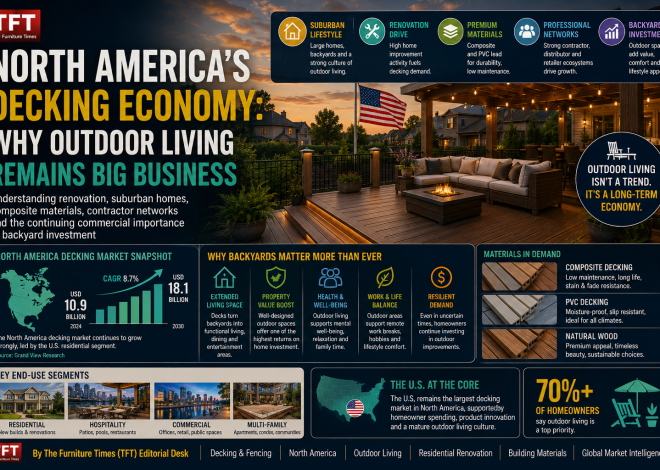
Decking and fencing were once treated largely as construction products. Decking created a usable surface outside a building, while fencing established a boundary around it. Manufacturers concentrated on structural performance, contractors handled installation and customers generally selected products according to cost, durability and availability.
That definition is no longer sufficient.
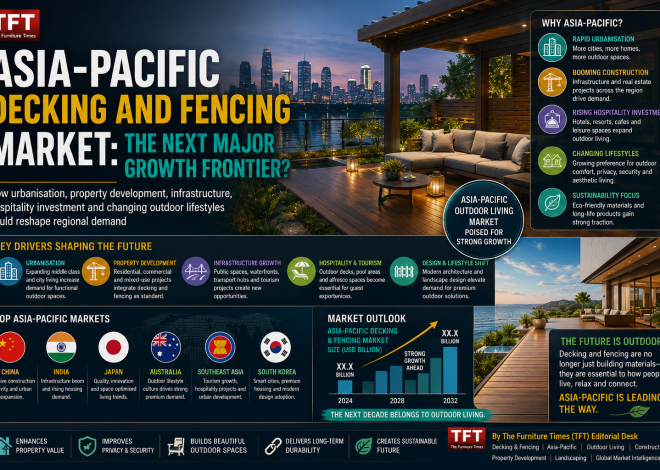
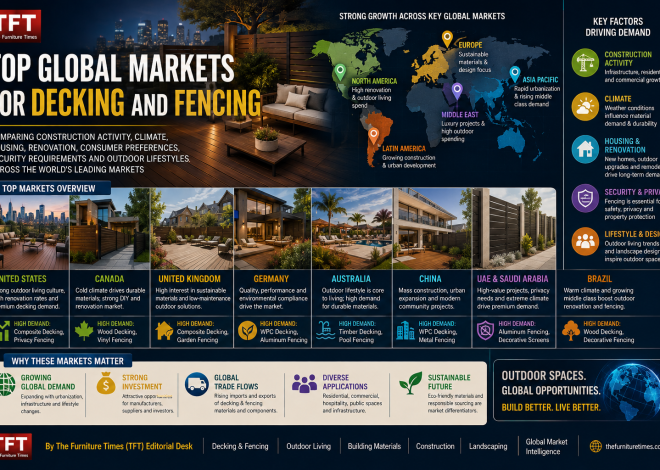
Today, decking and fencing influence how people live, entertain, work, dine, relax and move through outdoor spaces. They help define the character of homes, resorts, hotels, restaurants, offices, schools, public parks, rooftop terraces and mixed-use developments.
A deck is no longer merely a platform. It can become an outdoor dining room, poolside lounge, hospitality terrace, garden office, retail extension or entertainment area.
A fence is no longer only a boundary. It can provide privacy, security, shade, wind protection, acoustic separation, visual identity and architectural continuity.
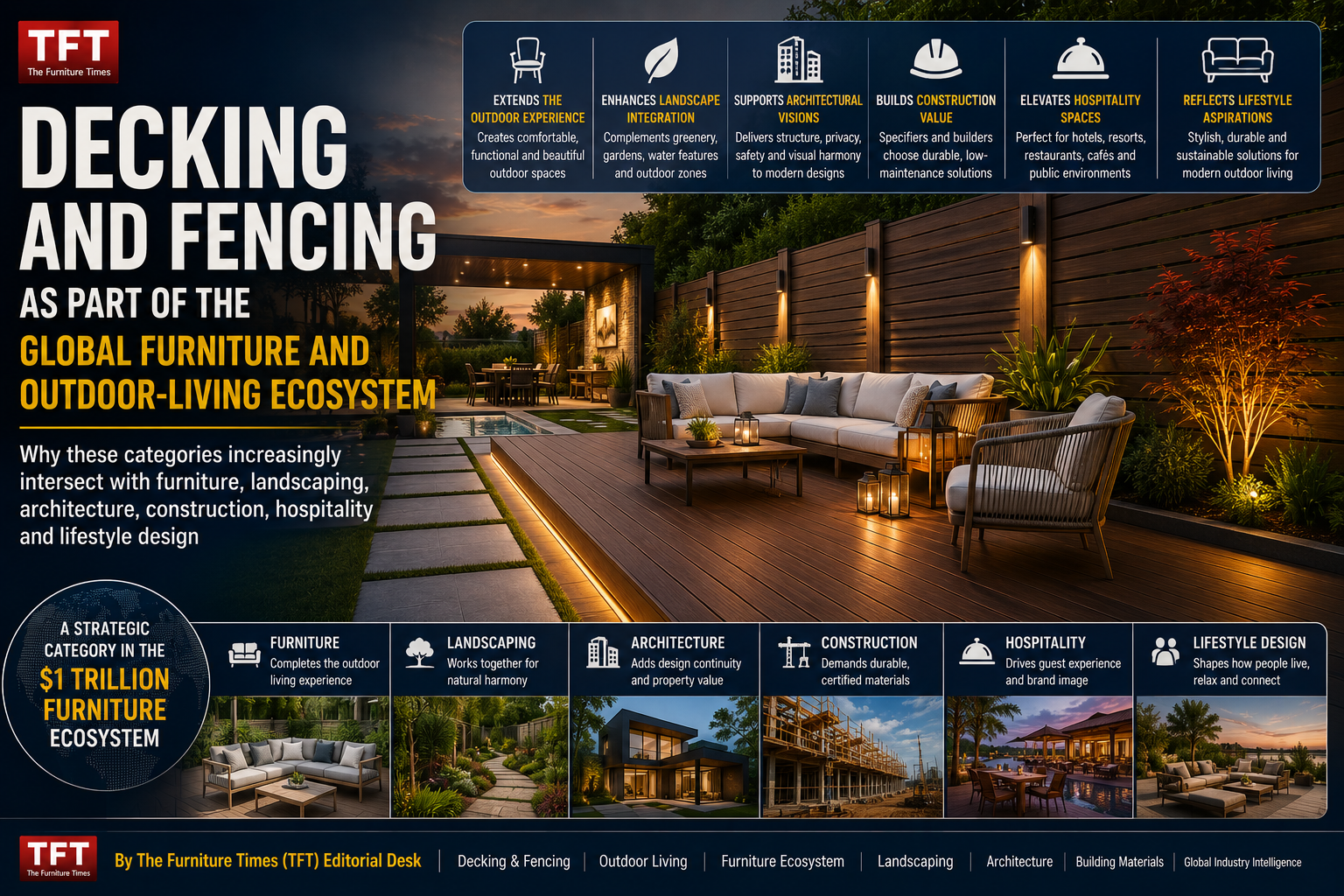
As outdoor areas become more carefully designed, decking and fencing increasingly intersect with furniture, lighting, landscaping, architecture, technology and lifestyle products. They are becoming essential components of a much larger outdoor-living ecosystem.
Outdoor space is becoming functional space
Urbanisation, smaller interior footprints, hospitality competition and changing lifestyle expectations are encouraging people and businesses to make better use of every available square metre.
A balcony can become a breakfast area. A rooftop can become a restaurant. A garden can become an outdoor living room. A hotel terrace can become a revenue-generating event space. An underused courtyard can become a collaborative workplace.
None of these transformations depends on furniture alone.
An outdoor sofa requires a stable and suitable surface. A dining area needs safe circulation, drainage and lighting. A poolside arrangement needs slip resistance and materials compatible with moisture and chemicals. A rooftop lounge requires consideration of weight, wind, privacy and access.
Decking creates the surface on which outdoor activity takes place. Fencing, screens and balustrades define the space around it. Furniture then makes that environment usable.
The categories are therefore commercially and functionally connected.
The outdoor-living ecosystem
A complete outdoor environment may involve dozens of interconnected industries:
- Decking and fencing manufacturers
- Outdoor furniture brands
- Timber, composite, metal and polymer suppliers
- Architects and landscape architects
- Interior and exterior designers
- Property developers
- Builders and specialist contractors
- Installers and maintenance businesses
- Pergola, gazebo and shade-system suppliers
- Parasol and umbrella companies
- Outdoor-lighting manufacturers
- Pool and spa businesses
- Planter and landscaping suppliers
- Outdoor-kitchen manufacturers
- Hospitality operators
- Facility-management companies
- Hardware and fastener suppliers
- Waterproofing and drainage specialists
- Smart-home and access-control providers
- Retailers, distributors and online platforms
Traditionally, these companies have been classified and marketed separately. Yet the customer experiences them as one project.
A homeowner does not see disconnected industries when creating a garden. The homeowner sees a complete outdoor space.
A hotel operator does not want an isolated deck, a collection of chairs and an unrelated privacy screen. The operator wants a safe, attractive and commercially productive guest environment.
The industry must therefore move from product-centred thinking to ecosystem thinking.
Decking as the foundation of the outdoor room
Indoor furniture is supported by floors designed for predictable conditions. Outdoor furniture is placed on surfaces exposed to sunlight, rain, temperature changes, moisture, dirt and biological growth.
This makes decking a direct contributor to furniture performance.
An uneven or unstable surface can cause tables to wobble, chairs to sit incorrectly and loungers to move. Poor drainage can leave furniture bases in standing water. Excessive heat can make a terrace uncomfortable. Inadequate spacing or structural movement can create safety and maintenance problems.
A well-designed deck must consider:
- Structural load requirements
- Intended furniture layout
- Pedestrian circulation
- Accessibility
- Slip resistance
- Drainage and water management
- Heat absorption
- UV exposure
- Expansion and contraction
- Ventilation below the surface
- Fixings and substructure
- Cleaning and maintenance
- Resistance to insects, moisture and decay
- Compatibility with pools and coastal conditions
- Access to concealed services
- Fire and building requirements
These decisions cannot be separated from furniture planning.
Heavy planters, outdoor kitchens, large parasol bases and commercial furniture can create loads that differ from those of a simple residential seating arrangement. Furniture designers, suppliers and decking contractors should therefore exchange specifications at the planning stage.
Fencing as architecture, privacy and identity
Fencing has historically been associated with perimeter control. Contemporary projects are expanding its role.
Fencing and screening can now contribute to:
- Privacy
- Security
- Wind reduction
- Noise management
- Shade
- Spatial zoning
- Pool safety
- Pet and child protection
- Decorative identity
- Wayfinding
- Landscape structure
- Concealment of utilities and waste areas
- Separation of dining and circulation zones
- Protection from neighbouring views
- Visual continuity with the building
In hospitality settings, screens can divide one large terrace into smaller, more private seating zones. In compact urban homes, carefully designed fencing can make an exposed garden feel like a protected outdoor room.
The visual relationship with furniture matters. A minimalist aluminium fence may complement contemporary furniture, while timber screening can support a warmer natural character. Decorative metalwork may reinforce a heritage environment, and planted screens can soften commercial terraces.
When fencing is selected without reference to furniture, landscape or architecture, the project can appear fragmented. When the elements are coordinated, the outdoor area develops a coherent identity.
Material selection connects every category
Decking, fencing and outdoor furniture often use related materials, but those materials may behave differently according to product design and exposure.
Natural timber
Timber offers warmth, texture and a strong connection with nature. It can be used across decks, fences, benches, dining furniture, screens and pergolas.
However, timber performance depends on species, treatment, moisture content, detailing, installation, ventilation and maintenance. A timber described as suitable for furniture is not automatically appropriate for structural decking or ground-adjacent fencing.
Specifiers must distinguish between visual coordination and technical suitability.
Wood-plastic and mineral composites
Composite decking and fencing can offer consistent dimensions, lower routine maintenance and a broad selection of colours and textures.
Performance varies significantly between products. Surface temperature, expansion, staining, scratching, fading, fastener systems and substructure requirements must be evaluated for the location.
Composite surfaces can coordinate with synthetic-rattan, aluminium and mixed-material furniture, but customers should understand that “low maintenance” does not mean “no maintenance.”
Aluminium
Aluminium is widely used for fencing, screens, balustrades, pergolas and outdoor furniture. It is relatively lightweight, adaptable and suitable for contemporary designs when correctly specified and finished.
Using coordinated powder-coat colours across furniture frames, fencing and architectural elements can create visual continuity. Coastal or chemically exposed environments may require more careful finish and maintenance specifications.
Steel and stainless steel
Steel can provide strength and slender structural profiles, while stainless steel is frequently selected for exposed architectural details.
The correct material grade, coating, drainage and isolation from incompatible metals are essential. Corrosion at furniture feet, fence fixings or concealed joints can undermine both appearance and performance.
PVC, vinyl and other polymers
Polymer fencing and decking products may offer easy cleaning, consistent appearance and resistance to certain environmental conditions. Their quality, structural behaviour, UV stability and thermal movement should be examined carefully.
Outdoor furniture manufacturers using polymers face similar requirements: the material must withstand real exposure rather than look attractive only at the time of installation.
Bamboo, rattan and natural fibres
Bamboo and rattan can strengthen a tropical or handcrafted aesthetic, particularly in furniture and decorative screening. Their suitability depends on processing, treatment, protection and exposure.
Natural-rattan furniture intended for protected interiors should not be confused with synthetic woven materials designed for outdoor use.
Architecture is moving beyond the building envelope
The boundary between indoors and outdoors is becoming less distinct.
Large openings, covered terraces, courtyards, biophilic interiors and transitional rooms connect buildings with their surrounding landscapes. Architects increasingly use continuous materials, coordinated colours and aligned visual axes to make indoor and outdoor spaces feel related.
Decking can visually extend an interior floor. Fencing and screens can echo façade patterns. Outdoor furniture can repeat the proportions, colours or materials of the interior scheme.
This approach requires collaboration between disciplines.
If furniture is selected after the deck has been installed, power points may be inaccessible, circulation may be restricted and shade may fall in the wrong place. If fencing is positioned without considering the view from seated height, it may fail to provide privacy where customers actually need it.
Outdoor-living design should therefore evaluate the space from the perspective of people sitting, dining, reclining, working and moving—not only from a plan drawing.
Landscaping makes hard surfaces habitable
A deck without landscaping can feel exposed. A fence without planting can appear harsh. Furniture without environmental integration can seem temporarily placed rather than intentionally designed.
Landscape design creates the relationship between hard materials and living systems.
Trees, shrubs, climbers and planters can provide:
- Shade
- Privacy
- Cooling
- Seasonal variation
- Biodiversity support
- Visual softness
- Wind filtering
- Spatial definition
- Improved guest experience
Yet plants also introduce practical considerations. Falling leaves, roots, irrigation, soil, moisture and organic debris can affect decking and furniture maintenance. Planters can create significant loads. Climbing plants can attach to fences, conceal damage or trap moisture.
Successful outdoor projects therefore coordinate planting, irrigation, drainage, furniture placement and access for cleaning.
The most attractive design will fail commercially if it is impossible to maintain.
Hospitality is driving integration
Hotels, resorts, restaurants, cafés and event venues demonstrate why decking and fencing belong inside the furniture ecosystem.
An outdoor dining terrace is a complete commercial asset. Its success depends on:
- Seating capacity
- Table arrangement
- Guest comfort
- Surface safety
- Shade and weather protection
- Privacy
- Lighting
- Service circulation
- Accessibility
- Acoustic management
- Cleaning requirements
- Emergency movement
- Maintenance downtime
- Visual identity
Decking establishes the operating surface. Fencing and screens control the perimeter and atmosphere. Furniture determines how many guests can use the space and how long they are likely to remain.
A poorly designed deck can reduce usable seating. Excessively high or opaque fencing can block views. Inadequate screening can make guests uncomfortable. Furniture that is too heavy may be difficult to reconfigure, while furniture that is too light may be unstable in exposed conditions.
Every decision affects revenue, operating cost and customer experience.
This is why hospitality procurement should evaluate outdoor furniture, decking, screening and shade as one coordinated investment.
Residential outdoor living is changing purchase behaviour
Homeowners increasingly approach gardens, balconies and terraces as extensions of the home.
Their purchasing journey may begin with one category but quickly expand:
- A new outdoor dining set creates demand for a deck.
- A deck creates demand for privacy screening.
- A fence creates interest in lighting and planting.
- A pool installation creates demand for loungers and slip-resistant surfaces.
- A pergola creates demand for an outdoor kitchen and entertainment furniture.
This connected buying behaviour presents an opportunity for manufacturers and retailers.
Instead of selling isolated products, businesses can help customers understand complete environments. A decking showroom can display furniture. An outdoor furniture retailer can explain surface suitability. A fencing supplier can demonstrate privacy solutions around actual seating arrangements.
Digital platforms can also connect these categories through project-based search.
A customer should be able to explore “small tropical balcony,” “hotel pool deck,” “coastal restaurant terrace” or “rooftop office lounge” and discover the relevant furniture, surfaces, fencing, shade and landscaping suppliers together.
Commercial and institutional opportunities
The ecosystem extends far beyond homes and hotels.
Workplaces
Outdoor workspaces require tables, seating, power access, shade, stable surfaces and acoustic separation. Fencing and screening can create privacy without fully enclosing the area.
Education
Schools and universities use decks, fences, benches and outdoor classrooms. Durability, supervision, accessibility, impact resistance and safe detailing are critical.
Healthcare and senior living
Therapeutic gardens and outdoor rest areas need stable walking surfaces, supportive furniture, shade, handrails and secure boundaries. Design decisions must consider mobility and visibility.
Public spaces
Parks, promenades and community areas combine street furniture, boardwalks, barriers, planting and lighting. High usage requires strong maintenance planning.
Retail and mixed-use developments
Restaurants, shopping centres and lifestyle precincts use coordinated outdoor areas to increase dwell time and strengthen place identity.
Transport and infrastructure
Waiting areas, observation decks, terminals and public corridors can require integrated seating, surfaces, barriers and weather protection.
These markets create opportunities for suppliers able to provide documented performance, technical support and coordinated systems.
Climate change is raising performance expectations
Outdoor products are exposed to more demanding environmental conditions than most indoor furniture.
Intense rainfall, extreme heat, humidity, drought, storms, salt exposure and rapid temperature changes can affect materials and installations. A product that performs successfully in one climate may fail in another.
Climate-responsive specification should examine:
- Maximum surface temperatures
- Water drainage
- Flood exposure
- Wind loading
- UV resistance
- Corrosion risks
- Timber movement
- Mould and biological growth
- Freeze-thaw conditions
- Fire exposure in high-risk landscapes
- Availability of replacement components
Furniture, decking and fencing suppliers must communicate realistic performance limitations. Generic claims such as “weatherproof” or “maintenance-free” are rarely sufficient for professional procurement.
The industry needs location-specific evidence and clear maintenance requirements.
Fire safety is becoming a shared responsibility
Outdoor environments can contain timber, polymers, cushions, plants, coatings and electrical systems. Their combined fire behaviour may differ from the performance of each product assessed separately.
Decking close to a building, rooftop terraces, evacuation routes and developments in wildfire-prone areas require particular attention.
Project teams may need to evaluate:
- Applicable building and fire regulations
- Material reaction to fire
- Separation from ignition sources
- Outdoor cooking equipment
- Heater placement
- Electrical installations
- Cushion and upholstery performance
- Access for emergency services
- Evacuation routes
- Vegetation management
A decorative material should not be selected solely because it matches the furniture. Safety, compliance and intended use must come first.
Accessibility must begin before furniture placement
Accessible outdoor spaces require more than an entrance ramp.
The complete route must be usable, including transitions, deck-board gaps, changes in level, circulation around furniture and access to tables or viewing points.
Fencing, planters and screens should not obstruct movement. Furniture layouts must leave appropriate routes, while surface materials should remain stable and reasonably slip-resistant under expected conditions.
Accessible design benefits many users: older adults, parents with pushchairs, people using mobility devices, service staff and guests carrying luggage.
Treating accessibility as a late-stage adjustment often produces awkward compromises. It should guide the deck, fence and furniture layout from the beginning.
The hidden component economy
The performance of decking and fencing depends on components that customers rarely notice:
- Screws and concealed fasteners
- Brackets and connectors
- Post supports
- Anchors and base plates
- Joists and substructures
- Gates, hinges and latches
- Levelling systems
- Expansion-control details
- Drainage accessories
- Caps and trims
- Handrails and balustrade components
- Surface coatings and preservatives
These components connect the sector directly with the furniture-hardware economy.
A premium deck installed with unsuitable fasteners can deteriorate prematurely. A well-designed gate with a weak hinge becomes a maintenance problem. A visually attractive screen with poor anchoring can become a safety risk.
Quality is determined not only by the visible surface but by the complete system behind it.
Installation quality can determine product lifespan
Manufacturers can produce high-quality materials, but installation often determines whether the finished project performs as intended.
Failures may result from:
- Incorrect spacing
- Inadequate ventilation
- Poor drainage
- Weak foundations
- Incompatible metals
- Incorrect fasteners
- Failure to allow thermal movement
- Improper cutting or sealing
- Insufficient structural support
- Uncontrolled contact with soil or water
- Failure to follow manufacturer instructions
The same principle applies to furniture assembly and installation.
This creates a need for trained, searchable and accountable contractors. Customers should be able to identify installers by location, product expertise, certification, completed projects and verified reviews.
The installation economy should not remain invisible within the outdoor-living sector.
Repairability and lifecycle planning
Decking and fencing should be designed as maintainable systems.
Individual boards, panels, rails, hinges, screens and fittings should be replaceable where technically possible. Access to substructures, drainage and concealed services should be considered before installation.
Furniture procurement should follow the same philosophy. Replaceable cushions, slings, feet, castors and hardware can extend product life.
A lifecycle-oriented project asks:
- Can damaged sections be replaced independently?
- Will compatible parts remain available?
- Can surfaces be cleaned and refinished?
- Is the structure accessible for inspection?
- Can furniture layouts change without rebuilding the deck?
- Can fencing panels be repaired after localised damage?
- Is maintenance information documented?
- Who is responsible for inspection?
The cheapest initial installation can become the most expensive option when repair access and replacement parts are ignored.
Circular-economy opportunities
Decking, fencing and outdoor furniture can all contribute to circular business models.
Potential strategies include:
- Designing products for disassembly
- Using replaceable components
- Recovering reusable boards or panels
- Refurbishing metal frames
- Replacing furniture fabrics instead of complete products
- Offering take-back programmes
- Providing repair and maintenance contracts
- Selling certified reclaimed materials
- Creating material and product passports
- Documenting composition for future recovery
- Developing resale markets for commercial assets
Circularity should be evaluated carefully. Recycled content alone does not make a product circular if it cannot be repaired, separated or recovered after use.
Durability, maintenance, replaceability and end-of-life planning must work together.
Technology is entering the outdoor environment
Decking and fencing are also becoming more technologically connected.
Outdoor projects may include:
- Integrated lighting
- Solar systems
- Access-control gates
- Security sensors
- Motorised privacy screens
- Smart irrigation
- Weather monitoring
- Heating and cooling
- Charging points
- Audio systems
- Automated shade
- Connected outdoor furniture
Technology creates convenience, but it also introduces repair, electrical-safety, data-security and obsolescence risks.
A motorised gate, smart fence or illuminated deck requires service access and replaceable components. Technology should not shorten the life of an otherwise durable outdoor system.
Suppliers must plan for firmware, compatibility, spare parts and safe manual operation when systems fail.
From product selling to outdoor-space solutions
The greatest commercial opportunity may belong to companies that understand how categories work together.
A decking manufacturer can collaborate with furniture brands to demonstrate completed environments. A fencing supplier can work with landscape architects to create modular privacy systems. An outdoor retailer can offer planning support that considers surface, shade, furniture and maintenance.
This does not mean every company must become a full-service contractor. It means each company should understand its place within the complete customer outcome.
Useful collaboration models include:
- Joint showrooms
- Shared specification libraries
- Coordinated colour and material collections
- Referral networks
- Installer directories
- Project visualisation tools
- Bundled maintenance programmes
- Hospitality procurement partnerships
- Cross-category exhibitions
- Shared case studies and educational content
The outdoor-living customer is already thinking across categories. The industry must catch up.
Making the ecosystem searchable
One of the sector’s biggest problems is fragmentation.
A buyer may find decking suppliers but not qualified installers. A hotel may locate furniture brands but struggle to identify privacy-screen manufacturers. A landscape architect may need technical information that is hidden inside disconnected catalogues.
Furniture Industry Search Engine can organise the ecosystem around how people actually search.
Relevant categories can include:
- Timber decking
- Composite decking
- Aluminium decking
- Residential fencing
- Commercial fencing
- Security fencing
- Decorative screens
- Balustrades and handrails
- Pergolas and gazebos
- Outdoor furniture
- Poolside furniture
- Hospitality furniture
- Outdoor kitchens
- Parasols and shade systems
- Landscape contractors
- Decking installers
- Fencing installers
- Repair and maintenance services
- Hardware and component suppliers
Location, material, application, project scale, certification and service capability should all become searchable.
A directory listing is no longer a minor piece of business information. It is a digital storefront connecting specialised suppliers with local and international opportunities.
TFT, FISE and FurniReviewology: connecting the outdoor-living economy
The global outdoor-living sector needs more than products. It needs information, discoverability and trust.
The Furniture Times can document manufacturers, projects, material innovations, design trends, installation challenges and emerging market opportunities.
Furniture Industry Search Engine can connect customers, architects, developers and hospitality buyers with suppliers across decking, fencing, furniture, landscaping and related categories.
FurniReviewology can help buyers evaluate products, manufacturers, retailers, contractors and installers through credible customer experiences.
The Furniture Times tells their story.
Furniture Industry Search Engine helps the world find them.
FurniReviewology helps the world trust them.
The furniture industry ecosystem is a $1 trillion industry ecosystem, and decking and fencing deserve recognition within its expanding outdoor-living economy.
A deck supports the experience. A fence defines it. Furniture makes it usable. Landscaping gives it life. Architecture connects everything into one environment.
These are no longer isolated categories. They are parts of one global ecosystem.
Be the next one. Be part of the movement.