Foshan’s Furniture Economy Draws Global Buyers—and Reveals the Growing Potential of Furniture Tourism
Smart technology, original design, vast showroom districts and integrated manufacturing are transforming China’s furniture capital into a destination where international buyers can discover, experience, source and understand furniture at its origin
By The Furniture Times (TFT) Global Furniture Tourism Intelligence Desk | Furniture Tourism | Foshan Furniture | Smart Furniture | Original Design | International Sourcing | China Furniture Industry | Global Industry Intelligence
Foshan is demonstrating that the future of furniture trade may depend on more than factories, catalogues, exhibitions and online marketplaces.
It may also depend on destinations.
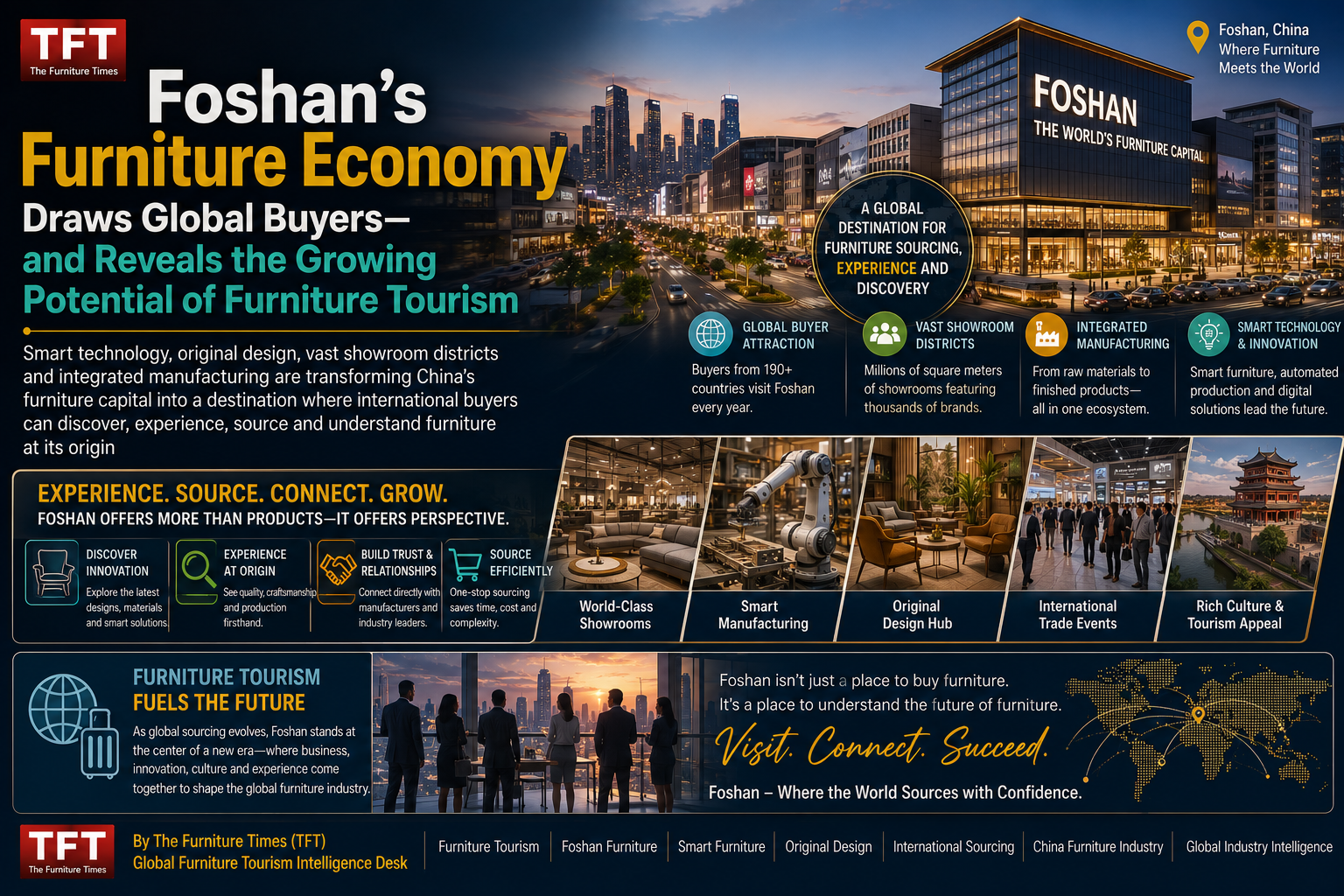
Located in Guangdong Province in southern China, Foshan has developed one of the world’s most concentrated furniture-industry ecosystems. International buyers do not visit the city merely to inspect a few products. They enter a vast commercial and manufacturing environment connecting furniture brands, component suppliers, material specialists, designers, technology providers, showrooms, trading companies, logistics operators and export services.
A recent report published by Bastille Post shows how Foshan is attracting overseas buyers through smart furniture, original design and an industrial chain that integrates production with sales.
The report describes Foshan as China’s furniture capital and highlights the strength of Longjiang Township, which is reportedly home to more than 2,000 branded furniture manufacturers and over 5,000 suppliers of new materials for the furniture sector. International buyers interviewed in the report expressed interest in electrically operated chairs, recliners, sofas, flooring, building materials and culturally distinctive original furniture. Bastille Post
These developments are important for global furniture trade. But they also point towards a much larger opportunity: Furniture Tourism.
Furniture tourism can transform an industrial cluster into an international destination where manufacturers, retailers, interior designers, architects, developers, hospitality buyers, investors, students and design enthusiasts travel to experience the furniture ecosystem directly.
Foshan is not only producing furniture for the world. It is increasingly giving the world a reason to visit the place where that furniture is designed, manufactured, displayed and traded.
From Furniture Manufacturing Centre to Global Sourcing Destination
Traditional furniture manufacturing was usually separated from the customer experience.
Factories produced the goods. Wholesalers distributed them. Retailers displayed them. Trade fairs temporarily brought buyers and sellers together.
Foshan offers a different model.
Within the wider Foshan–Shunde furniture ecosystem, buyers can move between expansive furniture malls, specialised showrooms, manufacturing centres, material suppliers, component companies, design studios and export-service providers. This concentration reduces the distance between inspiration, product evaluation, supplier discovery, negotiation and procurement.
For an international buyer, that concentration can create several advantages:
- More suppliers can be evaluated during one visit
- Products can be experienced physically
- Materials and mechanisms can be inspected
- Customisation requirements can be discussed directly
- Price points can be compared across market segments
- Factories may be visited after showroom selection
- Packaging and export requirements can be clarified
- Entire room packages can be sourced from one region
- New materials and technologies can be discovered
- Relationships can be built beyond digital communication
A conventional holiday destination attracts travellers through natural beauty, entertainment, food, heritage or culture. An industrial destination attracts professional visitors through opportunity, knowledge, products, networks and access.
Foshan has the ingredients to combine both.
It can welcome buyers as commercial visitors while allowing them to experience Chinese design culture, manufacturing capability, regional cuisine, architecture, craft traditions and the broader Guangdong economy.
That combination is the foundation of furniture tourism.
What Is Furniture Tourism?
Furniture tourism is travel motivated partly or entirely by furniture-related discovery, sourcing, education, culture, craftsmanship, design or commercial opportunity.
It may include:
- Visits to furniture manufacturing clusters
- Guided factory tours
- Furniture-shopping districts
- International sourcing missions
- Design-centre visits
- Furniture fairs and exhibitions
- Museum and heritage-furniture experiences
- Craft-village tours
- Visits to timber, upholstery and component suppliers
- Interior-design study tours
- Furniture-making workshops
- Architecture and design itineraries
- Hospitality-furniture procurement tours
- Buyer–seller meetings
- Product-launch experiences
- Showroom trails
- Furniture export and logistics education
- Visits to restoration and recycling facilities
Furniture tourism should not be confused with ordinary shopping tourism.
Buying furniture may be one part of the experience, but a properly developed furniture-tourism economy is much broader. It connects manufacturing, trade, culture, education, design, hospitality, logistics and destination marketing.
A buyer may visit Foshan to procure sofas for a retail chain. An architect may visit to discover new materials. A hotel developer may search for complete room packages. A designer may study emerging forms and finishes. A student may observe mass-production systems. A consumer may travel to furnish a new house.
All are furniture tourists, although their objectives, spending levels and required services differ.
Smart Furniture Is Becoming a Travel-Worthy Attraction
One of the strongest themes emerging from Foshan is smart furniture.
The overseas buyers cited in the original report were especially interested in products blending electronics with furniture, including electrically operated recliners, moving chairs and sofas. Their reactions demonstrate an important change in buyer behaviour.
Furniture is no longer expected to remain mechanically passive.
Modern products may incorporate:
- Electric reclining systems
- Adjustable headrests and footrests
- Massage functions
- Heating or cooling elements
- Charging ports
- Wireless charging
- Integrated lighting
- Voice or app control
- Motion sensors
- Sleep monitoring
- Height adjustment
- Smart storage
- Motorised television mechanisms
- Automated beds
- Health and posture features
These products are more difficult to evaluate through photographs alone.
A buyer needs to sit, touch, operate, compare and inspect them. The smoothness of a reclining mechanism, responsiveness of a control panel, comfort of an adjustable position and integration of electronics into upholstery are experiential qualities.
This makes smart furniture particularly relevant to furniture tourism.
A city able to assemble hundreds or thousands of technology-enabled products in accessible showrooms can become an innovation theatre for the global furniture industry. Buyers can see what is commercially available now rather than relying only on conceptual presentations.
The experience also helps buyers understand practical questions:
- What voltage is required?
- Are electrical systems certified for the destination market?
- Can components be replaced?
- Is servicing available internationally?
- How reliable are motors and control units?
- Can functions be customised?
- What is the weight and packaging impact?
- How should smart furniture be demonstrated at retail?
- What cybersecurity or data considerations apply to connected products?
Furniture tourism therefore supports more informed procurement. It turns technology from an online claim into a physical experience.
Original Design Is Becoming a Competitive Export Asset
Price and production scale helped many Chinese furniture businesses enter international markets, but Foshan’s latest evolution is increasingly connected to original design.
According to the report, designers in Foshan are creating furniture collections that combine Chinese and Western cultural elements. The products integrate cultural meaning with Chinese craftsmanship and are reportedly gaining favour among certain overseas markets, including buyers from the Middle East.
Tan Guangyong, executive chairman of the Shunde Furniture Association, was cited as saying that original products represented approximately 35% of total furniture exports and had recorded year-on-year growth of 15%. Bastille Post
These reported figures suggest that differentiation is becoming commercially important.
International buyers are not searching only for another generic sofa, table or bed. Many want products that can distinguish their retail stores, hospitality projects and design portfolios from competitors.
Original design can give manufacturers greater control over:
- Brand identity
- Product positioning
- Intellectual property
- Retail exclusivity
- Export margins
- Collection development
- Customisation
- Cultural storytelling
- Long-term customer relationships
The shift also strengthens the furniture-tourism proposition.
A destination filled with identical products competes mainly through price. A destination offering distinctive design becomes worth exploring.
Visitors need a reason to move from one showroom to another. Originality creates discovery. Each supplier, designer or district can present a different interpretation of materials, culture, technology and lifestyle.
This turns sourcing into an experience rather than a transaction.
Why Cultural Fusion Matters to Overseas Buyers
Furniture travels across cultures, but successful export products must still feel appropriate in their destination markets.
A sofa designed for a compact urban apartment may not suit the scale of a large villa. A minimalist dining set may not satisfy a customer seeking formal hospitality furniture. Materials, colours, ornamentation, proportions, seating depth and surface finishes may carry different meanings across markets.
Foshan’s combination of Chinese and Western influences provides a potentially valuable design bridge.
For Middle Eastern buyers, for example, demand may include:
- Large-scale seating
- Formal reception furniture
- Luxurious fabrics
- Metallic detailing
- Generous proportions
- Decorative craftsmanship
- Coordinated room collections
- Custom colours and finishes
- Furniture for villas and hospitality projects
European buyers may place more emphasis on:
- Space efficiency
- Material traceability
- Repairability
- restrained styling
- Regulatory compliance
- Modular systems
- Environmental performance
Southeast Asian buyers may prioritise:
- Humidity resistance
- Compact dimensions
- Contemporary tropical styling
- Competitive pricing
- Hospitality suitability
- Fast project supply
North American buyers may examine:
- Comfort dimensions
- Motion furniture
- Larger seating profiles
- E-commerce packaging
- Residential safety expectations
- Replacement components
A strong furniture destination should help suppliers interpret these differences. Furniture tourism can provide direct contact between manufacturers and international markets, allowing design decisions to emerge from real conversations rather than assumptions.
Foshan’s Industrial-Chain Advantage
Products alone do not create a furniture capital. The surrounding industrial chain determines how quickly ideas can become commercially viable collections.
Longjiang’s reported concentration of manufacturers and new-material suppliers indicates the depth of Foshan’s supporting ecosystem.
A furniture product may depend on:
- Timber and panel materials
- Metal frames
- Foam
- Textiles and leather
- Adhesives and coatings
- Springs and webbing
- Recliner mechanisms
- Motors and electronic controls
- Fasteners and connectors
- Packaging
- Product testing
- Photography
- Digital catalogues
- Shipping and consolidation
- Export documentation
When these capabilities exist in proximity, manufacturers may be able to develop samples more quickly, compare material options, solve production problems and respond to customised orders.
For visiting buyers, this creates a form of industrial transparency.
A buyer can begin with a finished sofa and then explore the mechanism, upholstery, frame, foam, packaging and factory behind it. That journey helps the buyer understand not only what the product looks like, but how reliably it can be produced.
This is especially important for:
- Furniture importers
- Retail groups
- Hotel procurement teams
- Property developers
- Interior-design firms
- Project-furniture contractors
- E-commerce brands
- Private-label buyers
- Wholesalers
- Government and institutional purchasers
The destination becomes a live sourcing platform.
Export Growth Demonstrates the Commercial Momentum
The report, citing Foshan Customs, states that Foshan’s furniture exports reached RMB11.77 billion—approximately US$1.75 billion—during the first seven months of 2026, representing year-on-year growth of 10.7%. Bastille Post
This performance is significant because the global furniture market remains highly competitive.
Manufacturers are navigating:
- Freight-cost volatility
- Trade-policy uncertainty
- Currency movements
- Weakness in some consumer markets
- Rising compliance expectations
- Environmental requirements
- Competition from other manufacturing countries
- Pressure on retail margins
- Digital disruption
- Shorter design cycles
Export growth in this environment suggests that Foshan’s combination of value, variety, industrial capacity, smart technology and original design continues to resonate with international buyers.
However, export statistics show only the value of goods leaving the region. They do not capture the complete economic value generated when buyers visit.
A visiting buyer may also spend on:
- Hotels
- Restaurants
- Local transport
- Translators
- Sourcing agents
- Inspection companies
- Business services
- Warehousing
- Sample shipping
- Design consultation
- Tourism activities
- Events and networking
Furniture tourism can therefore multiply the local impact of furniture exports.
The destination earns not only from the product order but also from the journey surrounding the order.
The Buyer Journey Is Becoming Part of the Product
International sourcing is often complex.
Online catalogues may not show true colour, comfort, surface quality, scale or construction. Video calls help, but they cannot completely replace physical examination. Buyers may also struggle with language, supplier verification, factory location, minimum order quantities, payment conditions, testing requirements and shipping arrangements.
Furniture tourism can organise this fragmented process into a structured buyer journey.
A well-designed Foshan furniture itinerary could include:
Before arrival
- Buyer-needs assessment
- Product-category selection
- Supplier shortlisting
- Visa and invitation guidance
- Translation arrangements
- Appointment scheduling
- Factory verification
- Route planning
- Budget and price-position mapping
During the visit
- Airport or station transfer
- Guided showroom tours
- Product testing
- Factory visits
- Material-library access
- Design consultations
- Supplier meetings
- Compliance discussions
- Sample selection
- Packaging evaluation
- Export-cost estimation
After the visit
- Quotation comparison
- Supplier follow-up
- Sample management
- Quality inspections
- Order consolidation
- Documentation support
- Freight coordination
- Production monitoring
- Replacement and warranty communication
This level of organisation would make a furniture destination easier to navigate, especially for first-time buyers.
The next competitive advantage for major furniture clusters may not be the number of showrooms alone. It may be how efficiently those showrooms are connected into a trustworthy international sourcing experience.
Furniture Tourism Can Serve More Than Large Importers
The furniture-tourism opportunity should not be designed exclusively for high-volume wholesalers.
Different visitor groups can support different programmes.
Retailers and distributors
They need commercial collections, pricing structures, territorial opportunities, repeat supply and marketing materials.
Architects and interior designers
They need specifications, samples, customisation, material knowledge and project coordination.
Property developers
They may require complete furnishing packages for apartments, villas, show units and common spaces.
Hospitality buyers
Hotels, resorts, restaurants, serviced apartments and holiday-home operators need durable, operationally appropriate furniture.
E-commerce businesses
They need products designed for digital merchandising, efficient packaging, straightforward assembly and manageable returns.
Independent homeowners
They may want complete home furnishing, custom furniture or access to greater variety than is available locally.
Students and educators
They can study manufacturing systems, design development, materials, automation and commercial furniture markets.
Designers and content creators
They can document new products, interview manufacturers and interpret furniture trends for wider audiences.
Investors and economic-development organisations
They can examine cluster development, export infrastructure and industrial policy.
A mature furniture-tourism strategy must create separate pathways for these audiences rather than offering the same general showroom visit to everyone.
The Role of Showrooms in Furniture Tourism
Showrooms are often treated simply as sales spaces. Within furniture tourism, they become destination infrastructure.
A strong destination showroom should help the visitor:
- Understand the brand
- Compare collections
- Experience furniture functions
- Learn about materials
- See coordinated room settings
- Identify customisation options
- Understand price positioning
- Access technical specifications
- Explore manufacturing capability
- Begin a commercial relationship
Showroom districts can become comparable to cultural quarters or shopping streets when they offer variety, navigation, comfort and storytelling.
However, scale alone can overwhelm visitors. A buyer entering an enormous furniture district may not know where to begin.
Furniture destinations therefore need:
- Clear product-category maps
- Multilingual signage
- Verified supplier directories
- Appointment systems
- Digital navigation
- Accessibility information
- Reliable transport routes
- Buyer lounges
- Meeting facilities
- Freight and export help desks
- Professional interpreters
- Transparent business information
The objective is to turn abundance into accessibility.
Thousands of suppliers have limited value if buyers cannot identify which companies match their requirements.
Trust Will Determine the Future of Furniture Tourism
The larger a furniture destination becomes, the more important trust becomes.
International buyers need confidence that:
- The company exists
- The showroom represents the actual supplier
- The factory can produce the promised quantity
- Product specifications are accurate
- Materials match declarations
- Certifications are valid
- Intellectual property is respected
- Deposits are protected
- Delivery schedules are realistic
- Quality can be reproduced consistently
- Complaints will be addressed
- Replacement components will remain available
Furniture tourism cannot succeed sustainably if it is based only on impressive showrooms.
It requires verification infrastructure.
Industry associations, destination authorities and digital platforms can strengthen confidence through:
- Verified business profiles
- Factory and showroom identification
- Product-category classification
- Export-history information
- Certification records
- Buyer reviews
- Complaint-resolution channels
- Quality-inspection partnerships
- Transparent commercial terms
- Multilingual documentation
- Traceable quotations
- Responsible-tourism standards
Foshan’s industrial depth is a major advantage, but the global buyer experience will increasingly depend on how clearly that depth can be searched, verified and trusted.
From Product Export to Knowledge Export
Furniture tourism can also help Foshan export knowledge.
International visitors may want to understand:
- How major furniture clusters operate
- How showrooms connect with factories
- How products move from design to mass production
- How smart components are integrated
- How supply chains respond to customisation
- How cross-border e-commerce affects development
- How manufacturers prepare for export markets
- How material suppliers support innovation
- How packaging is engineered
- How furniture businesses build international brands
Training programmes, industry tours and executive learning missions could become valuable additions to the city’s furniture economy.
Universities, design schools, trade associations and manufacturing organisations could collaborate on:
- Short furniture-industry courses
- Manufacturing masterclasses
- Smart-furniture demonstrations
- Design residencies
- Material innovation tours
- Export-readiness workshops
- Retail and showroom studies
- Sustainability programmes
- Furniture-cluster research
The city would then become not only a place to buy furniture but also a place to learn how the furniture economy works.
Furniture Tourism as Destination Branding
Many cities are recognised internationally for a dominant industry or creative identity.
A successful furniture destination needs a recognisable proposition answering a simple question:
Why should a global furniture professional travel here?
For Foshan, the answer could combine:
- Industrial concentration
- Extensive furniture choice
- Smart-furniture innovation
- Original Chinese design
- Custom manufacturing
- Competitive value
- Integrated material supply
- Large showroom districts
- Export capability
- Access to the Greater Bay Area
These strengths should be communicated as a coherent destination identity.
Furniture tourism can become a bridge between industrial promotion and city branding. It can show the human, cultural and creative dimensions of a manufacturing economy that international audiences might otherwise understand only through shipping documents and product catalogues.
Stories could focus on:
- Designers behind new collections
- Families operating multigenerational workshops
- Technicians developing smart mechanisms
- Upholsterers and craftspeople
- Material innovators
- International buyers building businesses through Foshan
- The evolution of furniture districts
- The relationship between regional culture and design
- Sustainable manufacturing experiments
- Young entrepreneurs transforming traditional factories
A destination becomes memorable when people understand its stories—not merely its production figures.
What Other Furniture-Producing Countries Can Learn From Foshan
Foshan’s development carries lessons for furniture regions worldwide.
Furniture tourism is not exclusive to China. It can be developed wherever a country or region has concentrated expertise, distinctive craftsmanship, important furniture history or a powerful retail ecosystem.
Potential models include:
- Manufacturing-cluster tourism
- Craft and artisan tourism
- Design-capital tourism
- Furniture-fair tourism
- Heritage-furniture tourism
- Retail sourcing tourism
- Timber and material tourism
- Hospitality-procurement tourism
- Restoration and antique-furniture tourism
- Sustainable-furniture tourism
A region does not need thousands of factories to participate.
A small craft village can create a meaningful furniture-tourism experience by connecting workshops, local materials, traditional techniques, storytelling, demonstrations, retail and hospitality.
Similarly, a country with strong contract-furniture production could develop specialised programmes for hotel developers, restaurant groups and commercial designers.
The essential requirement is an identifiable furniture experience that visitors cannot obtain as effectively from a catalogue or ordinary online search.
The Infrastructure Furniture Tourism Needs
Furniture tourism will not grow automatically because factories and showrooms exist.
It requires intentional infrastructure.
Digital infrastructure
Visitors need searchable information about suppliers, locations, categories, capabilities, languages, certifications and appointment availability.
Physical infrastructure
Showroom routes, transport, signage, meeting spaces, accessible facilities and buyer-support centres must be dependable.
Commercial infrastructure
Inspection, contracting, payment, consolidation, shipping and dispute-resolution services must be accessible.
Hospitality infrastructure
Hotels, restaurants and local travel operators should understand the schedules and needs of professional buyers.
Communication infrastructure
Multilingual guides, interpreters, digital content and industry terminology are essential.
Trust infrastructure
Supplier verification, genuine reviews, transparent company identities and traceable transactions reduce risk.
Cultural infrastructure
Museums, exhibitions, workshops, heritage narratives and design events give the destination meaning beyond procurement.
When these layers work together, furniture tourism becomes an economic-development system rather than a promotional slogan.
TFT to Launch Furniture Tourism as a Dedicated Vertical
The Furniture Times recognises Furniture Tourism as an emerging opportunity within the global furniture-industry ecosystem.
TFT is preparing to launch Furniture Tourism as one of its dedicated editorial and intelligence verticals, initially focusing on a couple of selected countries, with further destinations to be introduced as the initiative develops.
Coverage will be led through the Global Furniture Tourism Intelligence Desk.
The vertical will examine how cities, countries and furniture clusters can attract:
- International furniture buyers
- Importers and distributors
- Interior designers
- Architects
- Property developers
- Hospitality procurement teams
- Retailers
- Investors
- Students
- Researchers
- Craft and design enthusiasts
- Professional sourcing delegations
The forthcoming coverage will explore more than tourism promotion. It will investigate the complete relationship between furniture and destination economies.
Editorial areas will include:
- Global furniture destinations
- Manufacturing-cluster profiles
- Furniture sourcing journeys
- Factory-tour programmes
- International buyer itineraries
- Furniture museums and heritage
- Craft villages
- Design districts
- Furniture fairs and exhibitions
- Smart-furniture innovation centres
- Sustainable manufacturing visits
- Hospitality and project-furniture sourcing
- Destination readiness
- Buyer safety and verification
- Export and logistics support
- Local economic impact
- Furniture education and study tours
The purpose is to help the global furniture industry understand that a furniture-producing location can become much more than a place on a shipping document.
It can become a destination.
Building a Global Map of Furniture Destinations
The Furniture Tourism vertical will support a broader vision: building awareness of the world’s furniture-producing and furniture-experiencing destinations.
The future global furniture map should help users identify:
- What a destination produces
- Which market segments it serves
- Where its showrooms are located
- When its major trade events occur
- What makes its design identity distinctive
- Which materials and crafts define the region
- What buyers should prepare before visiting
- How to reach manufacturers
- Which logistics services are available
- What cultural experiences complement the business visit
This information is currently fragmented.
Some destinations are well known inside regional trade networks but almost invisible internationally. Others host important craftsmanship traditions that are poorly documented online. Many manufacturers are export-ready but difficult for first-time buyers to find.
The Global Furniture Tourism Intelligence Desk can help connect those pieces through reporting, destination profiles, interviews, directories and industry analysis.
How TFT, FISE and FurniReviewology Can Support Furniture Tourism
The furniture-tourism economy needs three fundamental layers: information, discovery and trust.
The Furniture Times can tell the stories of destinations, manufacturers, designers, craftspeople, showrooms and industrial clusters.
Furniture Industry Search Engine can help buyers find companies, products, categories, suppliers and services within those destinations.
FurniReviewology can strengthen confidence through credible reviews of furniture products, manufacturers, showrooms, installers and sourcing experiences.
Together, these platforms can support the buyer journey before, during and after travel.
TFT tells their story.
FISE helps the world find them.
FurniReviewology helps the world trust them.
This model is especially relevant to furniture tourism because visitors require more than inspiration. They need actionable information and confidence.
Foshan Shows What the Future Could Look Like
Foshan’s appeal to international furniture buyers reflects more than competitive manufacturing.
It reflects the power of concentration.
Manufacturers, suppliers, materials, technology, original design, showrooms and export capability exist within an interconnected furniture environment. Smart recliners can be experienced. Original collections can be discovered. Materials can be compared. Factories can be visited. Commercial relationships can begin face to face.
That experience cannot be reduced to a product listing.
Foshan demonstrates how a furniture city can become a marketplace, learning centre, innovation platform and international destination simultaneously.
The reported growth in exports, expanding interest in original design and overseas demand for smart furniture show that global buyers are responding to the city’s evolving value proposition. But the opportunity reaches further than sales.
With coordinated destination marketing, verified supplier information, multilingual services, curated itineraries and strong buyer support, Foshan can strengthen its position as one of the world’s most significant furniture-tourism destinations.
Other furniture regions should pay attention.
The next competition between furniture clusters may not be limited to who can manufacture the most products or offer the lowest price. It may also depend on who can provide the most productive, trustworthy and memorable furniture journey.
The furniture industry ecosystem is a $1 trillion industry ecosystem. Its factories, showrooms, design districts, craft communities, museums, exhibitions and material centres represent an enormous but underdeveloped tourism opportunity.
Furniture has always travelled around the world.
Now the world may increasingly travel to furniture.