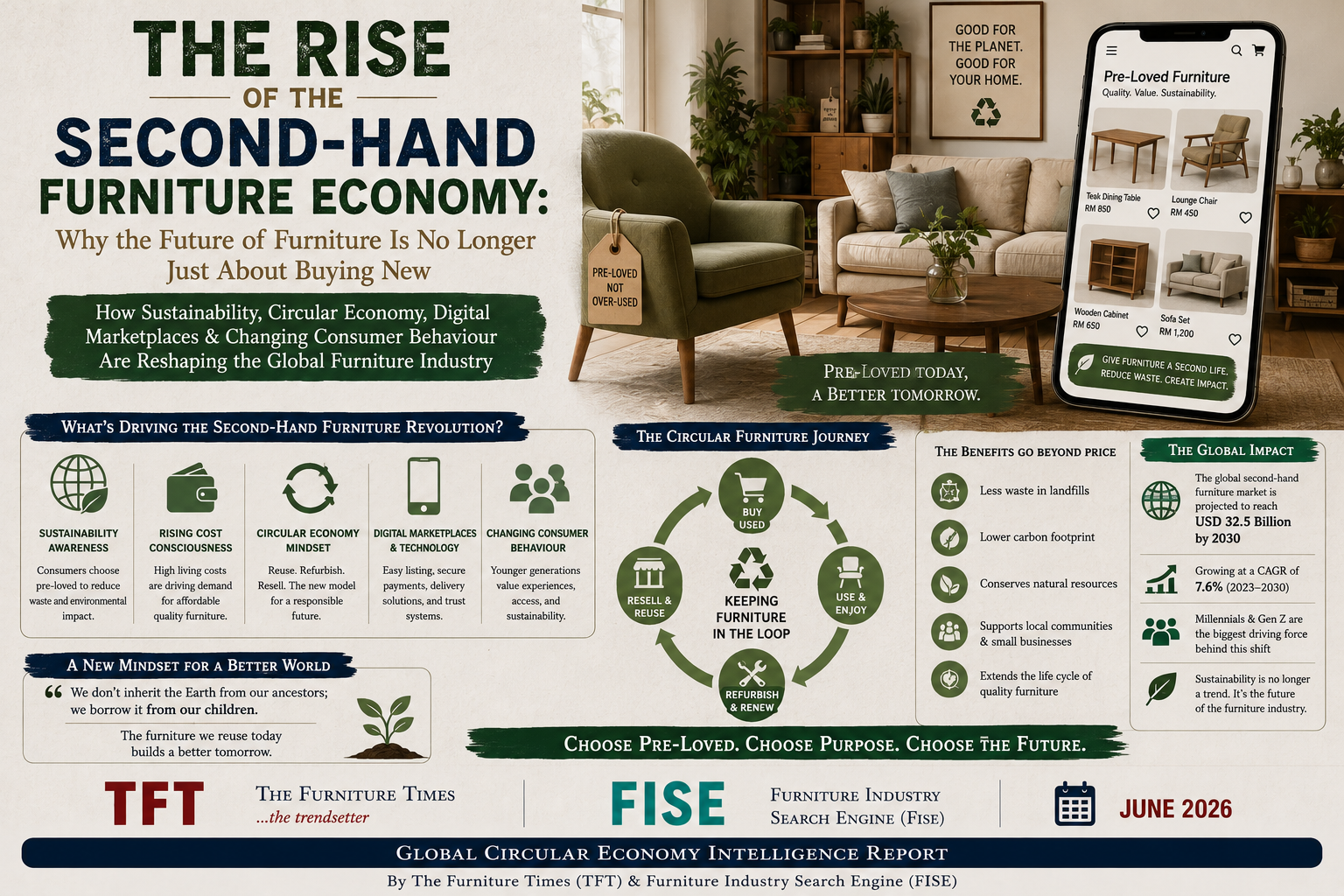
The Rise of the Second-Hand Furniture Economy: Why the Future of Furniture Is No Longer Just About Buying New
How Sustainability, Circular Economy, Digital Marketplaces & Changing Consumer Behaviour Are Reshaping the Global Furniture Industry
Global Circular Economy Intelligence Report
By The Furniture Times (TFT) & Furniture Industry Search Engine (FISE)
June 2026
The global furniture industry is undergoing one of the most significant transformations in its history.
For decades, success was measured by how many new products manufacturers could produce and retailers could sell.
The business model was straightforward.
Manufacture.
Distribute.
Sell.
Replace.
Repeat.
Today, a new economy is emerging alongside the traditional furniture market.
The second-hand furniture economy.
What was once considered an informal marketplace has become one of the fastest-growing segments of the global furniture ecosystem.
According to Mordor Intelligence, the global second-hand furniture market was valued at USD 47.17 billion in 2025, is expected to reach USD 49.46 billion in 2026, and is projected to grow to USD 62.66 billion by 2031, expanding at a 4.85% CAGR.
This growth reflects more than increasing demand for used furniture.
It signals a fundamental shift in how consumers think about ownership, sustainability, affordability, and value.
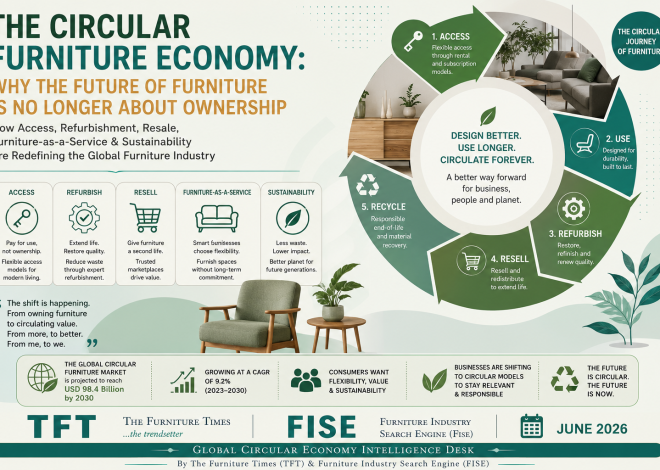
Furniture Is Becoming Part of the Circular Economy
For decades, the furniture industry largely operated within a linear model.
Raw materials became products.
Products were sold.
Products were eventually discarded.
Today, governments, businesses, and consumers are increasingly embracing the principles of the circular economy.
Instead of disposing of furniture after one life cycle, products are being:
- Reused
- Refurbished
- Restored
- Repaired
- Resold
- Repurposed
The result is an industry where furniture remains economically valuable for much longer.
This transition is being supported by environmental regulations, retailer buy-back programmes, and growing consumer interest in reducing waste.
Why Consumers Are Buying Second-Hand Furniture
The demand is being driven by several global trends.
Affordability
Economic uncertainty has encouraged households to seek quality furniture at lower prices.
Consumers increasingly recognise that well-maintained furniture can deliver excellent value.
Sustainability
Environmental awareness has become a major purchasing driver.
Many buyers prefer extending a product’s life instead of purchasing new items.
Choosing second-hand furniture helps reduce waste, conserve resources, and lower environmental impact.
Quality
Many older furniture pieces were built using solid wood and durable construction methods.
Consumers increasingly appreciate craftsmanship that can last for decades.
Unique Design
Second-hand furniture offers character.
Vintage collections.
Antique pieces.
Limited editions.
Designs no longer available through mainstream retailers.
For many consumers, individuality has become more important than buying something brand new.
Digital Platforms Have Changed Everything
One of the biggest reasons behind market growth is technology.
Selling bulky furniture was once difficult.
Today, digital platforms simplify:
- Product listings
- Image uploads
- Buyer communication
- Secure payments
- Delivery coordination
Online marketplaces have significantly reduced the barriers associated with buying and selling pre-owned furniture, making transactions faster and more convenient.
The second-hand furniture market has become a digital business.
Residential Buyers Lead the Market
Residential customers continue to dominate global demand.
According to Mordor Intelligence, the residential segment accounted for 58.15% of market revenue in 2025, making it the largest end-user category.
Several factors explain this trend:
- Rising housing costs
- Apartment living
- Student accommodation
- First-home buyers
- Temporary relocation
- Budget-conscious families
Second-hand furniture provides affordable furnishing solutions without compromising functionality.
Commercial Demand Is Also Growing
The commercial market is also expanding.
Businesses increasingly purchase refurbished furniture for:
- Offices
- Start-ups
- Co-working spaces
- Restaurants
- Cafés
- Educational institutions
Corporate sustainability initiatives are encouraging organisations to extend furniture life cycles rather than replacing assets prematurely.
Office furniture is expected to be among the faster-growing product segments over the coming years.
Regional Analysis
North America
North America remains the largest regional market, supported by established resale infrastructure, strong consumer awareness, and ongoing office restructuring.
Asia-Pacific
Asia-Pacific is projected to record the fastest growth through 2031.
Rapid urbanisation, increasing relocation, expanding digital marketplaces, and rising sustainability awareness continue driving demand across the region.
Countries such as:
- China
- India
- Indonesia
- Malaysia
- Vietnam
are expected to contribute significantly.
Europe
Europe continues leading circular economy initiatives.
Buy-back programmes, refurbishment businesses, and sustainability regulations encourage consumers to embrace furniture reuse.
Middle East & Africa
Growing urban populations and increasing awareness of affordability are creating new opportunities for organised resale platforms.
What This Means for Furniture Manufacturers
At first glance, some manufacturers may view second-hand furniture as competition.
The reality is more nuanced.
The rise of resale creates opportunities.
Manufacturers can benefit by:
- Designing longer-lasting products
- Launching certified refurbishment programmes
- Offering replacement parts
- Creating buy-back initiatives
- Providing restoration services
Rather than competing with resale, forward-looking manufacturers can participate in it.
The Rise of Refurbishment Businesses
A completely new industry is emerging.
Furniture refurbishment.
Businesses specialising in:
- Restoration
- Reupholstery
- Refinishing
- Repair
- Upcycling
are becoming increasingly important within the global furniture ecosystem.
This creates employment opportunities while extending product life.
Digital Trust Is Becoming Critical
Second-hand buyers increasingly want confidence.
They ask:
- Is the furniture authentic?
- What condition is it in?
- Has it been repaired?
- Is it structurally safe?
- Is delivery available?
This creates demand for:
- Product verification
- Better photography
- Transparent descriptions
- Ratings
- Reviews
Trust has become just as important as price.
Sustainability Is Becoming a Business Model
Second-hand furniture is no longer simply a budget option.
It has become part of corporate sustainability strategies.
Retailers increasingly explore:
- Buy-back programmes
- Certified pre-owned collections
- Rental models
- Circular product design
Consumers increasingly reward brands that demonstrate environmental responsibility.
Challenges Ahead
The market also faces several challenges.
These include:
- Product quality verification
- Logistics for bulky items
- Fraud prevention
- Standardised condition grading
- Limited warranties
- Cross-border shipping
Businesses that solve these challenges will create significant competitive advantages.
The Opportunity for TFT & FISE
The second-hand furniture market remains highly fragmented.
Thousands of local businesses, refurbishers, charities, dealers, and online sellers remain difficult to discover.
This creates a major visibility opportunity.
Platforms such as The Furniture Times (TFT) and Furniture Industry Search Engine (FISE) can help organise this growing ecosystem by improving:
- Discoverability
- Industry visibility
- Buyer confidence
- Business credibility
The future of the circular furniture economy will depend not only on sustainability but also on searchability.
TFT & FISE Analysis
The second-hand furniture market is no longer a niche sector.
It has become a strategic component of the global furniture economy.
Consumers increasingly value:
- Sustainability
- Affordability
- Quality
- Longevity
- Digital convenience
Manufacturers that embrace circular thinking, retailers that innovate, and digital platforms that simplify discovery will shape the next phase of industry growth.
Final Verdict
The future of furniture is not simply about manufacturing more products.
It is about creating longer-lasting value.
The rise of the second-hand furniture market demonstrates that consumers are redefining ownership.
Products are becoming assets with multiple life cycles.
Businesses are becoming service providers rather than simply manufacturers.
The companies that embrace refurbishment, resale, sustainability, and digital discoverability will be best positioned for long-term success.
Because in the future furniture economy:
A product’s first owner may no longer determine its greatest value.
Its second life may become just as important as its first.
By The Furniture Times (TFT) & Furniture Industry Search Engine (FISE)
Global Circular Economy Intelligence Report | June 2026
“TFT tells their story. FISE helps the world find them.”
The furniture industry ecosystem is a $1 Trillion Dollar Industry.