
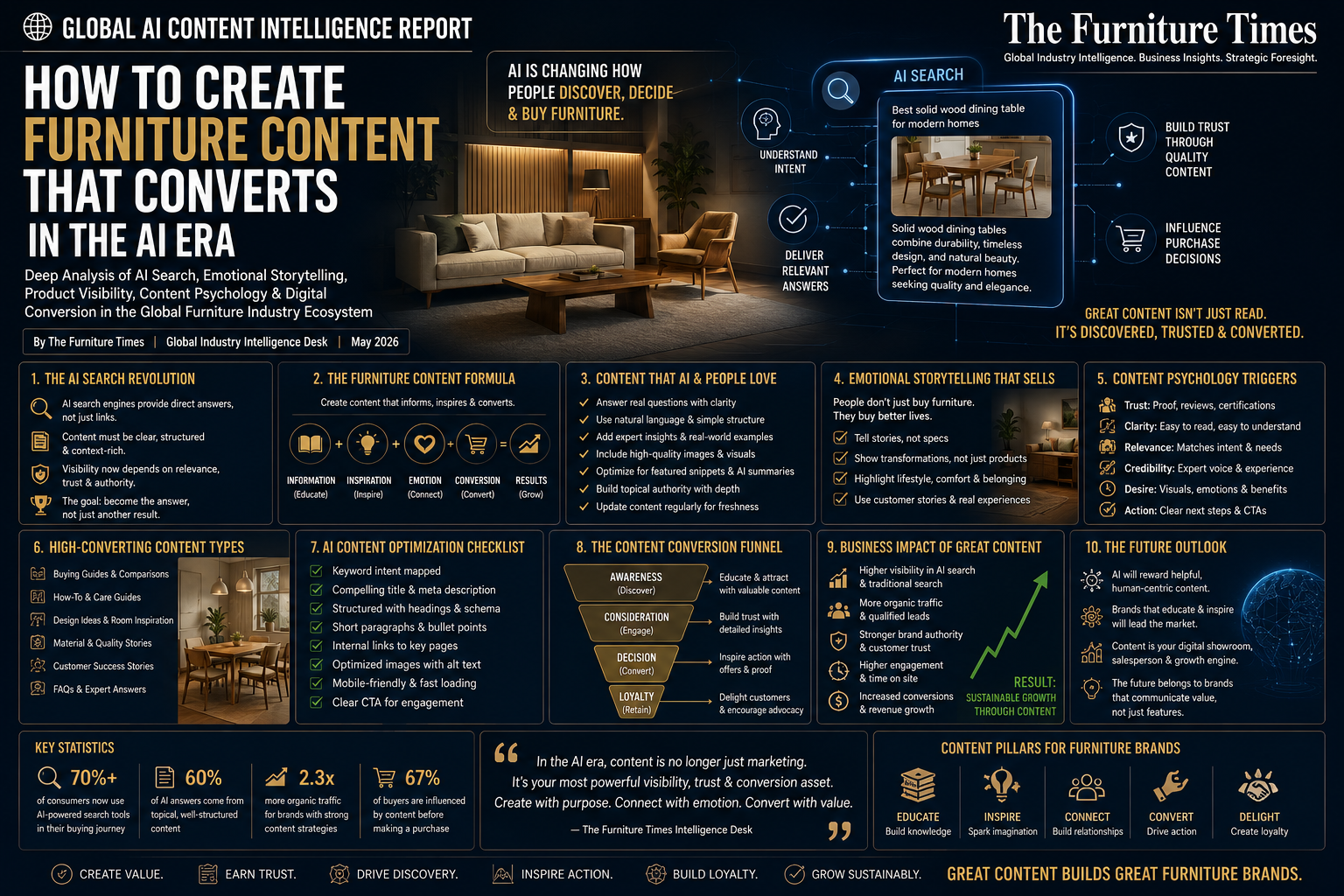
How to Create Furniture Content That Converts in the AI Era
Deep Analysis of AI Search, Emotional Storytelling, Product Visibility, Content Psychology & Digital Conversion in the Global Furniture Industry Ecosystem
By The Furniture Times | Global AI Content Intelligence Report | Global Industry Intelligence Desk | May 2026
The global furniture industry is entering a completely new content era.
For years, furniture brands focused mainly on:
catalogs
showroom photography
brochures
exhibitions
product listings
printed marketing
But today, the rules of visibility are changing dramatically.
Modern consumers increasingly discover furniture through:
AI search systems
ChatGPT-style assistants
social media algorithms
visual discovery platforms
conversational search
video-driven content ecosystems
And in this new environment:
content is no longer optional.
It is now infrastructure.
The furniture companies that understand:
storytelling
emotional positioning
AI discoverability
content psychology
search visibility
will increasingly dominate the future digital furniture economy.
The AI Era Is Changing Furniture Discovery
Traditional search focused mainly on:
keywords
rankings
backlinks
But AI-driven search increasingly focuses on:
context
usefulness
trust
expertise
conversational relevance
semantic understanding
Modern AI systems increasingly:
summarize brands
recommend products
explain features
compare suppliers
answer customer questions directly
This means furniture content must evolve from:
static information → intelligent communication.
Why Most Furniture Content Fails
Many furniture brands still create:
generic product descriptions
repetitive catalog text
weak social media captions
low-value content
This creates:
poor engagement
low trust
weak conversions
minimal AI visibility
In the AI era:
generic content disappears.
AI systems increasingly prioritize:
structured expertise
unique insights
clear explanations
authentic authority
user-focused value
Content Is Becoming the New Showroom
Traditionally, customers visited:
furniture stores
exhibitions
physical catalogs
Now, content itself becomes:
the showroom experience.
A strong furniture article, video, or product page can:
educate customers
build emotional trust
explain materials
showcase lifestyle usage
answer objections
inspire purchases
The modern consumer increasingly buys:
emotionally first, logically second.
Furniture Is Emotional, Not Just Functional
Furniture content that converts does not simply explain:
dimensions
materials
pricing
It communicates:
lifestyle
comfort
identity
aspiration
belonging
emotional atmosphere
Consumers rarely buy:
“just a sofa.”
They buy:
relaxation
status
family comfort
hospitality experience
interior identity
This is one of the biggest secrets of high-converting furniture content.
AI Search Rewards Helpful Content
Modern AI systems increasingly prioritize content that:
answers questions clearly
demonstrates expertise
provides context
explains usage
solves problems
This means furniture brands should increasingly create:
buying guides
material comparisons
maintenance tips
interior inspiration
ergonomic education
sustainability explanations
Research increasingly shows AI-driven search systems prioritize authoritative and structured information ecosystems.
Product Descriptions Must Evolve
Most furniture product descriptions remain weak because they focus only on:
measurements
technical details
specifications
But high-converting descriptions increasingly require:
storytelling
emotional framing
room visualization
lifestyle context
practical usability
For example:
Instead of:
“Solid oak dining table.”
Modern content should explain:
how it transforms dining experiences
why the grain matters
how it ages beautifully
why it suits modern interiors
AI Understands Context Better Than Keywords Alone
Traditional SEO often focused heavily on repeating keywords.
The AI era increasingly focuses on:
semantic understanding.
AI systems now analyze:
expertise depth
topical authority
contextual relevance
informational completeness
This means furniture brands must increasingly create:
comprehensive content ecosystems.
Visual Content Is Becoming Critical
Furniture is one of the world’s most visual industries.
Consumers increasingly expect:
lifestyle imagery
room inspiration
immersive visuals
AR previews
short-form videos
cinematic product storytelling
Research into AI-driven advertising systems highlights how realistic lifestyle imagery improves emotional engagement and conversion potential.
Video Content Is Dominating Furniture Discovery
Short-form video increasingly shapes:
furniture trends
buying inspiration
interior design discovery
product education
Furniture brands that use:
cinematic product walkthroughs
material close-ups
behind-the-scenes craftsmanship
transformation videos
often create:
higher emotional trust.
Educational Content Converts Better
One major shift in the AI era:
educational brands increasingly outperform promotional brands.
Consumers increasingly trust brands that teach:
design understanding
furniture care
material quality
space planning
ergonomic principles
Educational content positions brands as:
authority ecosystems.
The Rise of Conversational Content
Consumers increasingly search conversationally:
“What is the best sofa material for hot climates?”
“How to choose outdoor furniture for resorts?”
“Which dining table lasts longer?”
This means furniture content should increasingly mirror:
natural human conversation.
AI Search Is Becoming Citation-Based
Modern AI systems increasingly cite:
trusted brands
expert content
structured information sources
This means the future of visibility may increasingly depend on:
authority
consistency
content quality
expertise recognition
Research into AI search optimization confirms visibility increasingly depends on trusted digital signals across the entire web ecosystem.
Why Furniture Blogs Matter More Than Ever
Blogs are no longer simply:
marketing content
They are becoming:
discoverability infrastructure.
Strong blog systems help brands:
rank in search
appear in AI responses
answer customer intent
build authority
generate long-term traffic
The future furniture brand increasingly becomes:
a media ecosystem.
The Power of Human Storytelling
One major mistake brands make:
they sound too robotic.
Ironically, in the AI era:
human authenticity becomes even more valuable.
Customers increasingly connect with:
founder stories
craftsmanship journeys
manufacturing transparency
artisan culture
behind-the-scenes narratives
Emotion remains one of the strongest conversion drivers.
Trust Is the Real Conversion Engine
AI may change discovery,
but:
trust still drives purchases.
Furniture content must increasingly build:
transparency
expertise
emotional safety
credibility
consistency
because furniture purchases often involve:
high spending
long-term use
emotional investment
Sustainability Content Is Rising
Consumers increasingly want to understand:
sourcing
wood certification
carbon footprint
eco-materials
ethical manufacturing
Brands explaining sustainability clearly increasingly gain:
emotional trust advantages.
AI Era Content Must Be Structured
AI systems understand content better when it is:
organized clearly
logically structured
semantically connected
easy to extract
This means brands should increasingly use:
headings
FAQs
structured layouts
comparison guides
educational frameworks
Research into AEO and GEO strategies highlights structured information as increasingly critical for AI discoverability.
Why SMEs Must Adapt Quickly
Large brands increasingly invest heavily in:
AI optimization
content ecosystems
multimedia storytelling
digital infrastructure
SMEs that fail to adapt risk becoming:
digitally invisible.
The future furniture market may increasingly reward:
discoverability
expertise
content consistency
search presence
as much as:
manufacturing itself.
The Rise of AI-Native Furniture Brands
Future furniture brands may increasingly operate like:
media companies
educational ecosystems
AI-readable platforms
digital lifestyle authorities
This represents a major industry transformation.
FISE & The Future of Furniture Visibility
This is exactly why:
TFT
become increasingly important.
Because the future global furniture ecosystem may depend heavily on:
searchable content infrastructure.
Businesses without:
structured visibility
educational content
AI-readable systems
may struggle to survive in the next digital economy.
TFT Philosophical Industry Insight
The furniture industry historically believed:
good products alone guaranteed success.
But the AI era increasingly proves:
invisible products cannot compete.
The future may not belong only to factories that manufacture furniture.
It may increasingly belong to brands that:
communicate intelligently
educate customers
build emotional trust
structure discoverable ecosystems
create meaningful content experiences
Final Thought
The AI era is transforming furniture content from:
promotional material
into:
intelligent business infrastructure.
The brands that learn how to:
educate
inspire
emotionally connect
structure discoverability
create authority ecosystems
will increasingly dominate:
search visibility
AI recommendations
customer trust
digital conversions
Because in the future:
content itself may become the most powerful showroom in the furniture industry.
Closing Insight
“The future of furniture marketing may not belong to the brands shouting the loudest.
It may belong to the brands that communicate most intelligently, most authentically, and most meaningfully in a world increasingly guided by AI-driven discovery.”
