
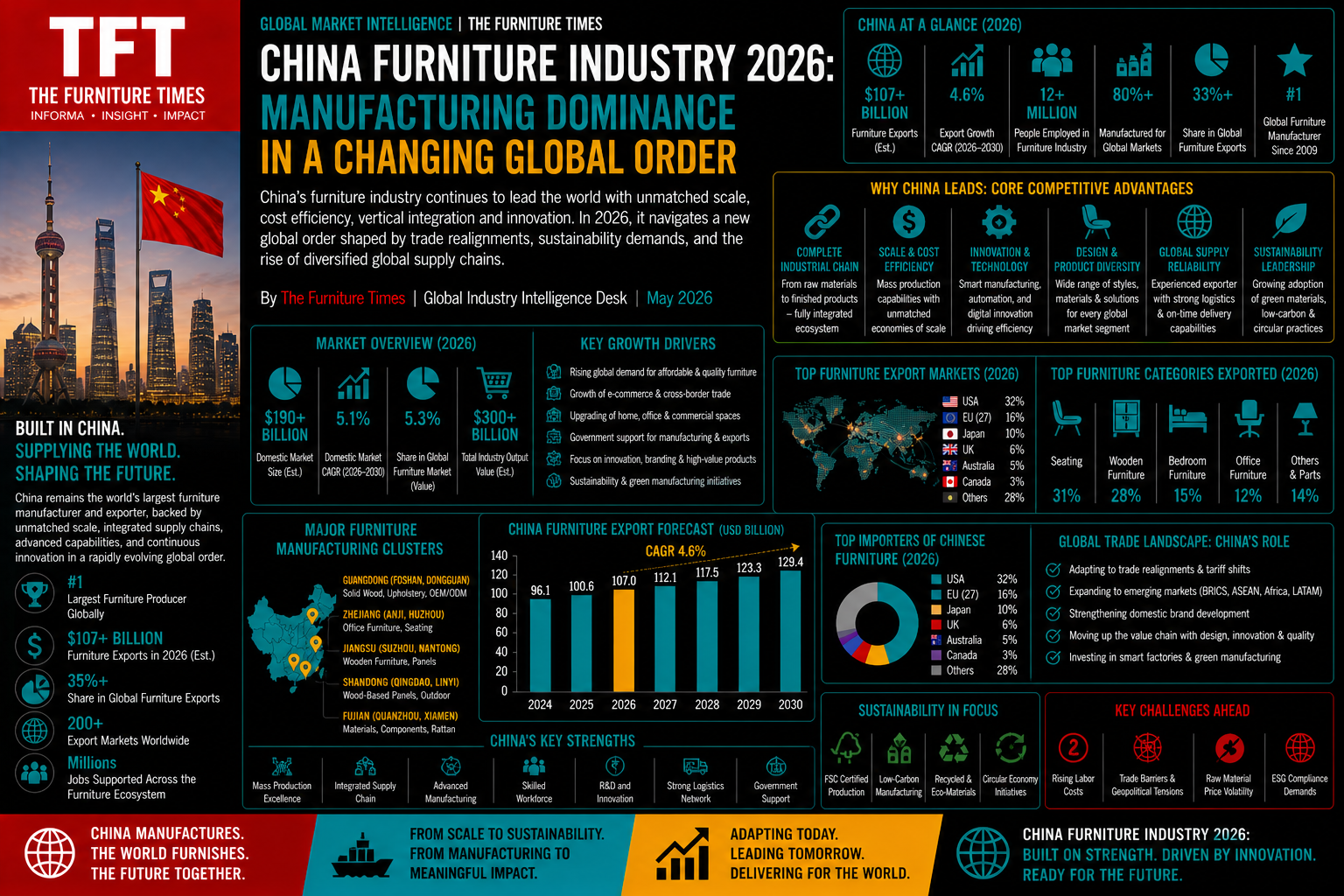
China Furniture Industry 2026: Manufacturing Dominance in a Changing Global Order
By The Furniture Times | Global Industry Intelligence Desk | May 2026
Introduction: The World’s Furniture Factory
China remains the most dominant manufacturing force in the global furniture ecosystem.
No country matches China in scale, speed, and industrial depth.
For decades, China has powered global supply—producing everything from mass-market furniture to increasingly sophisticated, design-led products.
The Big Narrative: Scale at Unmatched Levels
China’s position is built on one defining advantage:
Industrial-scale manufacturing dominance
What That Means
Massive production capacity
Integrated supply chains
Advanced manufacturing systems
Global export reach
China is not just a producer.
It is the backbone of global furniture supply.
1. Manufacturing Power: End-to-End Ecosystem
Fully Integrated Supply Chain
China controls:
Raw materials processing
Component manufacturing
Assembly lines
Packaging and logistics
Industrial Clusters
Major production regions specialize in:
Wooden furniture
Upholstered furniture
Office systems
Panel-based furniture
Everything needed to build furniture exists within one ecosystem
2. Export Dominance
Global Reach
China exports to:
United States
Europe
Middle East
Africa
Asia-Pacific
Strength in Volume
High-volume production
Competitive pricing
Fast delivery capability
China defines the supply side of global trade
3. Product Range: From Mass to Premium
Mass Market
Affordable furniture
Large-scale production
Mid-Market
Export-ready solutions
Consistent quality
Premium Segment (Growing)
Design-focused products
Improved quality standards
China is moving up the value chain
4. The Evolution: Beyond Low-Cost Manufacturing
Key Shifts
Automation and smart factories
Focus on quality and branding
Investment in design
Domestic consumption growth
China is transforming from “low-cost” to “high-efficiency”
5. Domestic Market Strength
China is also one of the largest furniture consumers:
Urban housing demand
Middle-class growth
E-commerce expansion
China is both a global supplier and a massive market
6. The Challenge: Global Pressure & Transformation
Key Pressures
1. Tariffs & Trade Policies
Increased cost pressure
Export challenges
2. Rising Costs
Labour
Logistics
Compliance
3. Competition
Vietnam
India
Southeast Asia
China is no longer competing alone
7. The Visibility Gap
Despite its dominance:
Many manufacturers are not globally visible
Smaller suppliers remain hidden
Discovery still depends on networks
China produces the most—but not all are discoverable
8. TFT Deep Analysis: China Is Entering the Intelligence Economy
The industry is evolving:
Phase 1: Manufacturing Economy
Scale-driven production
Phase 2: Export Economy
Global supply leadership
Phase 3: Intelligence Economy (NOW)
Data, AI, and visibility will define the next leaders
9. Role of FISE in China
The Furniture Industry Search Engine (FISE) can:
For Manufacturers
Increase global discoverability
Reduce reliance on intermediaries
Expand direct buyer connections
For Buyers
Access diverse suppliers
Compare options faster
Improve sourcing efficiency
For the Ecosystem
Structure supplier data
Improve transparency
Enable intelligent trade
The Power Statement
From manufacturing dominance → to discoverability dominance
10. Strategic Recommendations
For Chinese Manufacturers
Invest in branding and visibility
Diversify export markets
Upgrade product positioning
For Global Buyers
Continue leveraging China’s scale
Balance sourcing across regions
Focus on quality and reliability
For the Industry
Adopt digital systems
Structure data
Improve transparency
11. Key Takeaways
1. China Remains the Global Manufacturing Leader
2. Integrated Supply Chain Is Its Biggest Strength
3. Moving Toward Higher Value Segments
4. Facing Global Competitive Pressure
5. Visibility Will Define the Next Phase
Conclusion: The Next Evolution of China’s Leadership
China’s dominance is not ending.
It is evolving.
From:
Scale → Intelligence
Production → Visibility
Export → Direct connection
Final Thought
China built the global furniture supply chain.
Now it must lead the next phase—discoverability and intelligent trade.
The future will not only belong to those who produce the most.
It will belong to those who are found the fastest.
