The Circular Furniture Economy: Why the Future of Furniture Is No Longer About Ownership
How Access, Refurbishment, Resale, Furniture-as-a-Service & Sustainability Are Redefining the Global Furniture Industry
Global Circular Economy Intelligence Desk
By The Furniture Times (TFT) & Furniture Industry Search Engine (FISE)
June 2026
For more than a century, the furniture industry has followed a familiar business model.
Manufacture.
Distribute.
Sell.
Own.
Replace.
Repeat.
It was a linear economy.
Raw materials entered one end of the supply chain.
Finished furniture left the other.
Consumers purchased products, used them for several years, and eventually replaced them.
This model helped build one of the world’s largest industries.
But today, a profound transformation is underway.
The furniture industry is moving from an ownership economy to a circular economy.
Consumers are no longer asking only:
“What should I buy?”
They are increasingly asking:
“Can I rent it?”
“Can I subscribe to it?”
“Can I refurbish it?”
“Can I trade it in?”
“Can I give it a second life?”
These questions are changing the future of furniture.
The next decade will not be defined only by how much furniture the world manufactures.
It will also be defined by how intelligently the industry extends the life of every product.
The End of the Linear Furniture Economy
For decades, success in the furniture industry meant producing more.
More factories.
More products.
More sales.
More replacements.
This approach generated tremendous economic growth.
However, it also created significant challenges.
Millions of tonnes of furniture reach landfills every year around the world.
Perfectly usable products are discarded because consumers redecorate, relocate, or simply want a different style.
Natural resources continue to be extracted.
Energy continues to be consumed.
Waste continues to increase.
The future cannot depend only on producing more furniture.
It must also depend on using existing furniture more intelligently.
What Is the Circular Furniture Economy?
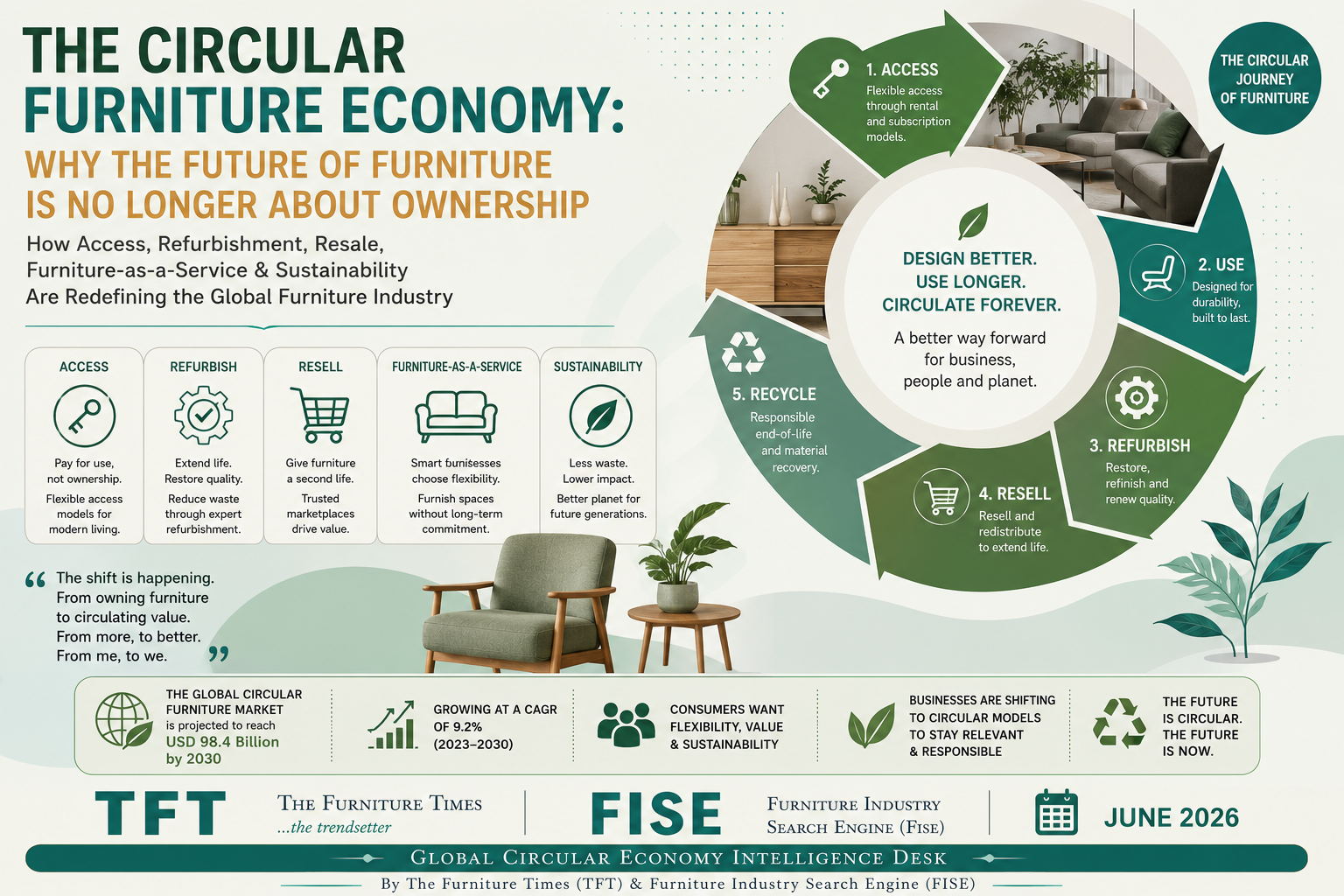
The circular furniture economy is a business model designed to maximize the value of furniture throughout its entire lifecycle.
Instead of focusing only on selling new products, it encourages businesses and consumers to:
- Repair furniture
- Refurbish products
- Restore quality
- Reuse materials
- Resell furniture
- Lease furniture
- Rent furniture
- Recycle components
- Design products for longer life
The objective is simple.
Keep products in use for as long as possible.
Reduce waste.
Create more value from fewer resources.
This benefits businesses, consumers, and the environment simultaneously.
Ownership Is No Longer the Only Business Model
The younger generation is changing how furniture is consumed.
Previous generations viewed furniture as a lifetime purchase.
Today’s consumers often live differently.
They relocate more frequently.
Work remotely.
Rent apartments.
Move between cities.
Work internationally.
Study abroad.
Live in smaller homes.
For many of these consumers, ownership is becoming less important than flexibility.
Instead of purchasing furniture outright, they increasingly consider:
- Furniture rental
- Furniture subscriptions
- Flexible leasing
- Certified refurbished furniture
- Trade-in programmes
The question is shifting from:
“Can I own it?”
to
“Can I access it when I need it?”
Furniture-as-a-Service (FaaS): A New Business Model
One of the fastest-emerging concepts in the industry is Furniture-as-a-Service (FaaS).
Rather than purchasing furniture permanently, customers pay recurring fees to use furniture for a defined period.
The provider remains responsible for:
- Delivery
- Installation
- Maintenance
- Replacement
- Upgrades
- Collection
- Refurbishment
This model is especially attractive for:
- Corporate offices
- Co-working spaces
- Hotels
- Student accommodation
- Serviced apartments
- Healthcare facilities
- Expatriate housing
- Short-term residential leasing
Furniture becomes a service rather than a one-time transaction.
Why Consumers Are Embracing Circular Furniture
Several powerful trends are driving this transformation.
Sustainability
Consumers increasingly understand the environmental impact of manufacturing.
Buying refurbished furniture extends product life while reducing demand for new raw materials.
Every product reused represents fewer resources consumed.
Affordability
Economic uncertainty has changed purchasing behaviour.
Many consumers seek quality without paying premium prices.
Certified refurbished furniture often delivers exceptional value.
Quality
Older furniture frequently features:
- Solid timber
- Traditional craftsmanship
- Long-lasting construction
Many consumers now recognize that durability often outweighs novelty.
Individuality
Vintage and restored furniture offers character.
Consumers increasingly value uniqueness over mass production.
Product Lifecycle Is Becoming a Competitive Advantage
Historically, manufacturers focused on selling products.
Tomorrow’s manufacturers must manage the entire product lifecycle.
That includes:
Design
Manufacturing
Sales
Service
Maintenance
Repairs
Refurbishment
Resale
Recycling
Companies that think beyond the first sale will build stronger customer relationships.
The product’s value should not end when it leaves the factory.
ESG Is Reshaping the Industry
Environmental, Social and Governance (ESG) principles are increasingly influencing business decisions.
Global investors.
Corporate buyers.
Governments.
Consumers.
All increasingly evaluate companies according to ESG performance.
For furniture businesses, ESG includes:
Responsible sourcing
Sustainable manufacturing
Waste reduction
Circular product design
Ethical labour practices
Carbon reduction
Responsible disposal
The circular economy naturally supports many ESG objectives.
It transforms sustainability from a compliance requirement into a competitive advantage.
Manufacturers Must Rethink Success
For decades manufacturers measured success through:
- Production volume
- Factory output
- Annual sales
Tomorrow’s leaders may also measure:
- Product lifespan
- Repairability
- Refurbishment rate
- Customer retention
- Circular revenue
- Carbon reduction
Success is becoming broader than manufacturing alone.
Retailers Must Evolve
Furniture retailers have traditionally sold new products.
Tomorrow’s retailers may also offer:
- Certified pre-owned collections
- Trade-in programmes
- Rental services
- Subscription plans
- Refurbishment partnerships
Retail stores may become lifecycle management centres instead of simply sales outlets.
Digital Platforms Will Power the Circular Economy
The circular furniture economy depends heavily on digital infrastructure.
Customers need platforms where they can:
- Discover used furniture
- Verify product condition
- Compare quality
- Schedule collection
- Arrange delivery
- Purchase confidently
Artificial Intelligence will further improve:
- Product valuation
- Condition grading
- Demand forecasting
- Recommendation engines
- Inventory management
Technology will become the backbone of furniture circulation.
Why Searchability Matters More Than Ever
The second-hand furniture market remains highly fragmented.
Millions of products exist.
Thousands of businesses operate locally.
Yet many remain invisible.
A refurbished dining table hidden inside a warehouse has little value.
The same product becomes valuable when buyers can find it.
Searchability creates liquidity.
Visibility creates opportunity.
This is where platforms like Furniture Industry Search Engine (FISE) become increasingly important.
The future circular economy requires discoverability.
What This Means for The Furniture Industry
Manufacturers should stop viewing second-hand furniture as competition.
Instead, it represents an extension of their business.
A sofa sold today may generate revenue again through:
- Maintenance
- Upholstery
- Replacement parts
- Trade-ins
- Certified resale
One product.
Multiple revenue cycles.
That is the power of circular thinking.
Challenges Still Exist
The transition is not without obstacles.
The industry still needs:
- Standardised quality grading
- Better refurbishment infrastructure
- Product authentication
- Digital verification
- Reverse logistics
- Customer education
- Industry standards
Businesses that solve these problems will shape the future.
The Role of TFT & FISE
The Furniture Times believes the circular economy represents one of the biggest opportunities facing the furniture industry.
The Furniture Industry Search Engine believes every stage of a product’s lifecycle deserves visibility.
Not only manufacturers.
But also:
- Refurbishers
- Restoration specialists
- Rental providers
- Recycling companies
- Certified pre-owned dealers
- Repair professionals
The future furniture ecosystem must include everyone.
Because inclusion creates sustainability.
TFT & FISE Analysis
The furniture industry is experiencing one of its greatest philosophical shifts.
The question is no longer:
“How many products can we manufacture?”
The question is becoming:
“How many lives can every product have?”
Businesses that embrace this thinking will discover entirely new revenue streams.
They will build stronger customer relationships.
They will contribute to sustainability.
And they will help redefine the future of the global furniture economy.
Final Verdict
The future of furniture is no longer defined solely by ownership.
It is defined by access.
By longevity.
By intelligent product lifecycle management.
By sustainability.
By circular thinking.
The companies that continue focusing only on manufacturing new products may struggle to capture tomorrow’s opportunities.
The companies that embrace refurbishment, resale, Furniture-as-a-Service, and circular innovation will build more resilient businesses.
Because the future customer is not simply buying furniture.
They are buying flexibility.
They are buying sustainability.
They are buying experiences.
And they are buying into a smarter way of living.
The circular furniture economy is no longer an emerging trend.
It is becoming the next chapter of the global furniture industry.
By The Furniture Times (TFT) & Furniture Industry Search Engine (FISE)
Global Circular Economy Intelligence Desk | June 2026
“TFT tells their story. FISE helps the world find them.”
The furniture industry ecosystem is a $1 Trillion Dollar Industry.