Why Airbnb Furniture Is Becoming a Strategic Hospitality Category
Examining How Furniture Affects Bookings, Reviews, Pricing and Guest Satisfaction
By The Furniture Times (TFT) Editorial Desk | Airbnb & Homestay Furniture | Short-Term Rentals | Hospitality Furniture | Guest Experience | Global Industry Intelligence
Furniture in an Airbnb, homestay or vacation rental is no longer simply part of the interior decoration. It has become part of the property’s commercial strategy.
Every bed, mattress, sofa, dining chair, table, wardrobe, luggage bench and outdoor lounger can influence how guests perceive a property, how comfortably they use it, what they write in their reviews and whether future travellers choose to book it.
This makes furniture far more than a furnishing expense. It is part of the accommodation’s revenue-generating infrastructure.
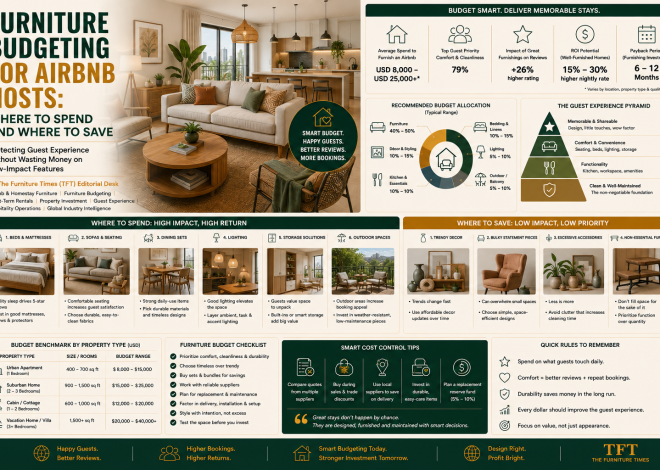
A thoughtfully furnished property can appear more valuable in listing photographs, accommodate guests more effectively, support a higher nightly rate and generate stronger reviews. Poor furniture choices can have the opposite effect: photographs look unconvincing, rooms feel smaller, guests sleep badly, items break frequently and maintenance costs increase.
As short-term rentals become more competitive and professionally managed, furniture is emerging as a distinct hospitality category—one that must combine residential warmth, visual identity, commercial durability and operational efficiency.
The Global Scale of Short-Term Accommodation Is Changing Furniture Demand
The enormous growth of platform-based accommodation has created a substantial furnishing and refurbishment market.
Airbnb reported more than 9 million active listings in over 150,000 cities and towns across more than 220 countries and regions as of May 2026. The platform also reported more than 2.5 billion cumulative guest arrivals and approximately 5.5 million hosts worldwide. Airbnb Newsroom
These figures represent millions of furnished bedrooms, living rooms, dining spaces, balconies, gardens, terraces and work areas.
And Airbnb is only one part of the wider short-term-accommodation economy. The market also includes properties listed through Booking.com, Vrbo and regional platforms, as well as independent homestays, serviced apartments, holiday villas, guesthouses, farm stays, corporate rentals and professionally operated vacation homes.
Each property creates at least two types of furniture demand:
- Initial furnishing demand when the property is prepared for guests.
- Recurring demand when products are repaired, replaced, upgraded or repositioned.
Unlike a private home, where furniture may remain unchanged for many years, a short-term rental operates in a public, competitive and review-driven environment. Its furniture must continuously meet the expectations of different guests.
That distinction is turning Airbnb and homestay furniture into a strategic hospitality category.
Furniture Begins Influencing the Guest Before Arrival
Guests often make booking decisions without visiting the property, speaking to the host or physically examining the accommodation. They rely on listing photographs, descriptions, reviews, prices and location information.
This means the furniture begins working before the guest arrives.
In a crowded online marketplace, a well-furnished room can communicate:
- Cleanliness
- Comfort
- Quality
- Space
- Functionality
- Lifestyle
- Local character
- Family suitability
- Work-from-anywhere readiness
- Premium positioning
An empty-looking or poorly coordinated interior may communicate the opposite—even when the property is structurally good.
A traveller comparing similar apartments may not consciously say, “I am choosing this property because of its furniture.” Yet the bed presentation, sofa arrangement, dining area and overall visual atmosphere can strongly shape the decision.
Furniture helps convert square metres into an experience guests can imagine themselves using.
The Listing Image Is the New Showroom
For conventional furniture retailers, the showroom allows customers to experience a product. For short-term accommodation, the listing page becomes the showroom for the entire property.
Photographs must quickly capture attention, particularly on mobile devices where travellers scroll through numerous competing properties.
Furniture plays a central role in that presentation.
A visually distinctive headboard can make a bedroom memorable. A properly proportioned dining table can make an apartment appear ready for family gatherings. A comfortable-looking sofa can communicate relaxation. A well-furnished balcony can transform a small outdoor area into a valuable booking feature.
The strongest short-term-rental furniture tends to be:
- Visually clear in photographs
- Proportionate to the room
- Coordinated without appearing overly staged
- Distinctive without becoming impractical
- Attractive under different lighting conditions
- Neutral enough to appeal to a broad audience
- Strong enough to remain presentable over time
Too little furniture can make a property feel unfinished. Too much can make it appear cramped. Oversized sofas, bulky wardrobes and poorly positioned dining tables may reduce the perceived size of a room.
Effective furnishing is therefore not about adding more objects. It is about making the property’s space, purpose and value immediately understandable.
Furniture Can Influence Booking Conversion
Booking conversion refers to the percentage of people who view a listing and proceed to make a reservation.
Many factors influence conversion, including location, availability, reviews, cancellation terms and price. Furniture cannot compensate for every weakness, but it can strengthen the overall proposition.
A guest may be more likely to book when the photographs clearly show:
- A comfortable and professionally presented bed
- Enough dining seats for the advertised occupancy
- A suitable workspace
- Comfortable living-room seating
- Practical luggage storage
- Outdoor seating where outdoor space is promoted
- Family-friendly arrangements
- Accessible furniture where accessibility is promised
- A consistent interior identity
Furniture also reduces uncertainty.
When guests can clearly understand where they will sleep, eat, work, store belongings and relax, they can evaluate whether the property meets their needs. Confusing layouts or missing furniture create unanswered questions that may send the traveller to another listing.
In highly competitive destinations, reducing this uncertainty can be commercially important.
Attractive Furniture Can Support Stronger Pricing
Furniture does not determine a property’s nightly rate by itself. Location, seasonality, property size, amenities, demand, reputation and local competition remain fundamental.
However, furnishing affects perceived value.
Two properties in the same building may have similar floor plans and views, yet achieve different market positions because one has a more coherent, comfortable and professionally presented interior.
A higher-quality furnishing scheme may help an operator:
- Position the property in a more premium segment
- Improve listing photography
- Attract design-conscious travellers
- Appeal to families or business guests
- Strengthen confidence in the property’s overall quality
- Create a more memorable identity
- Compete on experience instead of price alone
This does not mean every Airbnb should be furnished luxuriously. The furniture strategy must match the target guest and expected nightly rate.
A budget urban studio requires intelligent compact furniture and operational simplicity. A family beach house needs sufficient seating, durable outdoor products and practical storage. A premium villa may require custom pieces, stronger visual storytelling and higher levels of comfort.
Strategic furnishing means aligning the investment with the property’s market position.
Furniture Can Affect Occupancy as Well as Price
A beautifully furnished property may gain attention, but functional furniture can broaden the number of guests it can serve.
For example:
- A sofa bed can increase sleeping capacity.
- A flexible twin-to-king bed arrangement can serve couples or colleagues.
- An extendable dining table can support families and groups.
- A desk can attract business travellers and remote workers.
- A highchair and cot can improve suitability for young families.
- Accessible-height furniture can support guests with mobility limitations.
- Weather-resistant outdoor furniture can make a balcony or garden more valuable.
- Storage furniture can make longer stays more practical.
Furniture can therefore help a property appeal to multiple travel segments.
However, increasing advertised capacity without supporting it properly can damage satisfaction. A property listed for six guests should not provide comfortable seating for only three or a dining table for four. Extra sleeping capacity must be supported by adequate storage, dining and living arrangements.
Occupancy should be designed, not merely advertised.
Sleep Quality Remains One of the Most Important Considerations
A visually attractive bedroom may win the booking, but the bed and mattress help determine the review.
Guests may overlook a minor decorative imperfection, but they are less likely to forgive an uncomfortable night’s sleep. Mattress quality, bed stability, noise, pillow support, linen and temperature all contribute to the sleeping experience.
A strategic bedroom-furniture package should consider:
- Mattress support and comfort
- Bed-frame strength
- Noise-free construction
- Headboard stability
- Mattress protectors
- Accessible bedside tables
- Reading lights
- Power and charging access
- Luggage placement
- Clothes storage
- Blackout window treatments
- Safe circulation around the bed
- Ease of housekeeping
Mattress selection can be difficult because comfort preferences vary. However, an unsupportive, damaged or visibly low-quality mattress creates an avoidable risk.
Property operators should also monitor mattress age, cleanliness, sagging and repeated guest comments. A product may appear acceptable during a quick inspection while still creating discomfort during an entire night.
Reviews Turn Furniture Performance Into Public Information
In traditional accommodation, a furniture complaint might remain between the guest and the hotel. In the platform economy, it can become part of a permanent public review.
Guests frequently mention furniture-related issues such as:
- Uncomfortable beds
- Sagging mattresses
- Broken dining chairs
- Stained sofas
- Unstable tables
- Poor-quality sofa beds
- Insufficient seating
- Lack of bedside furniture
- Inadequate storage
- Damaged outdoor furniture
- Difficult-to-use convertible furniture
- Missing workspaces
- Furniture that does not match the photographs
These comments affect more than one stay. They can influence the decisions of future travellers.
Airbnb’s quality reporting illustrates the importance of guest confidence. The company said that more than 250 million nights had been booked at Guest Favourite listings following the programme’s launch, with those listings maintaining an average overall rating of 4.92 when the report was published in 2025. Furniture is only one part of the guest experience, but comfort, presentation and functionality contribute to the quality signals that reviews capture. Airbnb Global Quality Report
The commercial impact of one furniture failure can therefore extend beyond its repair cost.
A broken chair may require replacement, staff time and guest compensation. If it generates a negative review, it may also weaken future booking confidence. The true cost includes both operational and reputational consequences.
Guest Satisfaction Depends on Function, Not Decoration Alone
Interior styling can create the first impression, but functionality determines whether the property works during the stay.
Guests need practical answers to ordinary questions:
- Where can luggage be opened?
- Is there enough space to hang clothes?
- Can everyone sit together?
- Is there a comfortable place to work?
- Are bedside surfaces available?
- Can guests charge their devices conveniently?
- Is the balcony furniture usable?
- Can children safely move through the room?
- Does the sofa bed operate easily?
- Is the dining table stable?
- Are there hooks for towels and coats?
Small furniture decisions often create disproportionate guest value.
A modest luggage bench may be more useful than an expensive decorative sculpture. Bedside tables with accessible sockets may improve satisfaction more than elaborate wall art. An ergonomic desk chair may matter greatly to a guest attending online meetings.
Good furniture design anticipates behaviour rather than merely filling space.
Airbnb Furniture Must Serve Different Types of Guests
One of the challenges of short-term rentals is that the same property may accommodate very different people.
A studio apartment could host a solo business traveller during the week and a couple during the weekend. A villa might receive a family, a group of friends or several generations travelling together.
Furniture must therefore be flexible enough to support changing needs.
Families
Families need durable dining furniture, washable surfaces, sufficient seating, safer edges, storage, highchairs, cots and sometimes bunk beds.
Business Travellers
Business travellers value proper work surfaces, comfortable chairs, lighting, accessible charging and an uncluttered background for video calls.
Couples
Couples may prioritise bedroom comfort, dining atmosphere, outdoor seating and visually attractive interiors.
Groups
Groups require adequate sleeping arrangements, strong communal furniture, large dining surfaces and seating that matches the advertised capacity.
Longer-Stay Guests
Longer stays increase the importance of storage, workspace ergonomics, cooking-related furniture and comfortable everyday seating.
Luxury Travellers
Premium guests expect furniture quality to match the property’s rate, location and marketing. Visible wear or inexpensive materials can undermine the entire luxury proposition.
The furniture strategy should begin with the target guest—not with what the owner personally prefers.
Durability Must Be Designed Into the Product
Airbnb furniture often experiences more intensive and unpredictable use than conventional household furniture.
Guests may move chairs between rooms, drag luggage across surfaces, place wet items on tables or use sofas and beds beyond their intended capacities. Cleaning teams may also move products frequently and apply commercial cleaning chemicals.
Appropriate furniture should consider:
- Reinforced structural joints
- Reliable hinges and drawer slides
- Stable seating frames
- Clearly specified weight capacities
- Scratch-resistant finishes
- Moisture-resistant materials
- Stain-resistant fabrics
- Replaceable glides and feet
- Removable cushion covers
- Repairable components
- Secure wall fixings
- Commercially appropriate testing
- Availability of spare parts
Durability does not require furniture to look institutional. The design opportunity is to create products with the warmth of residential furniture and the performance of contract furniture.
This combination is central to the emerging category.
Cleanability Has Become a Purchasing Criterion
Short-term accommodation operates through repeated turnovers. Furniture must be inspected and cleaned quickly before the next guest arrives.
Complex stitching, deep crevices, delicate finishes, very low furniture clearance and permanently fixed upholstery can slow down housekeeping.
Operationally efficient products may include:
- Wipeable surfaces
- Removable and washable covers
- Stain-resistant upholstery
- Bed frames with adequate cleaning access
- Tables that tolerate approved cleaning products
- Open storage that can be inspected quickly
- Chairs without unnecessary dust traps
- Modular products with replaceable sections
- Moisture-resistant bathroom furniture
- Outdoor products that can be cleaned easily
The housekeeping team should be included in furniture evaluation. It often understands practical problems that are invisible during the initial design process.
A chair may look excellent in a showroom but become unsuitable if it requires extensive cleaning after every stay.
Maintenance and Replacement Affect Property Uptime
A hotel may keep spare furniture in storage. An independent Airbnb host may have no backup when a bed, sofa or dining chair fails.
If a critical product cannot be repaired or replaced quickly, the operator may face:
- Emergency purchasing
- Mismatched interiors
- Guest relocation
- Refunds or compensation
- Cancelled reservations
- Lower review scores
- Temporary property closure
Furniture availability is therefore part of operational resilience.
Suppliers serving the short-term-rental industry should consider offering:
- Fast replacement
- Local inventory
- Standardised product ranges
- Spare parts
- Repair support
- Replaceable upholstery
- Modular components
- Clear warranties
- Digital product records
- Continuity of key models
For professional operators managing multiple properties, these services may be as important as the initial product design.
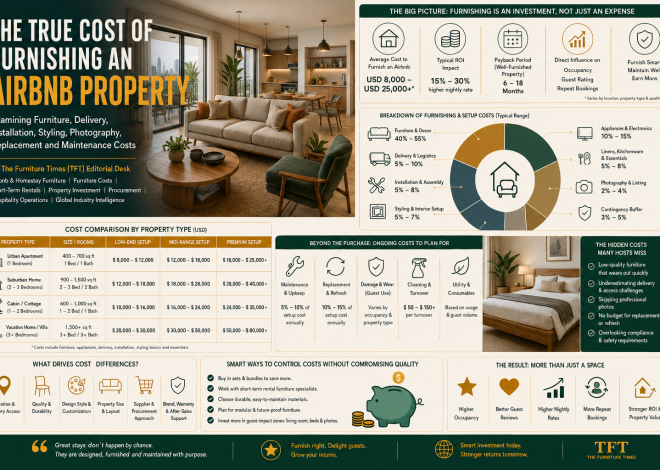
Lifecycle Cost Matters More Than Purchase Price
Many new hosts furnish properties under significant budget pressure. They may be paying deposits, renovation costs, platform fees, photography expenses, licences and utility connections at the same time.
Low-cost furniture can appear financially sensible. But if it fails quickly, the operator may pay much more over the property’s operating life.
The full cost of furniture includes:
- Purchase price
- Freight and delivery
- Assembly and installation
- Cleaning requirements
- Maintenance labour
- Repairs and parts
- Guest compensation after failure
- Replacement delivery
- Property downtime
- Disposal or resale value
A sofa that costs less initially but requires frequent cleaning and early replacement may have a higher lifecycle cost than a better-built alternative.
Furniture suppliers can strengthen their value proposition by explaining expected service life, maintenance requirements, repair options and warranty coverage—not merely the purchase price.
Standardisation Is Becoming Important for Professional Operators
The short-term-rental market includes individual hosts, but it also contains rapidly professionalising management companies and investment portfolios.
A manager operating numerous properties benefits from using standard furniture specifications because standardisation can improve:
- Procurement efficiency
- Bulk pricing
- Installation speed
- Interior consistency
- Staff familiarity
- Spare-parts management
- Maintenance planning
- Product replacement
- Inventory tracking
- Quality control
Operators may maintain several design packages rather than make every property identical. For example, they might have a standard package for city studios, another for family apartments and another for premium villas.
The objective is not to remove individuality. It is to reduce unnecessary operational complexity.
This creates an opportunity for manufacturers to develop repeatable but customisable furniture collections.
Local Character Can Increase Emotional Value
Standardisation should not result in every short-term rental looking the same.
One reason travellers select homestays and vacation rentals is the opportunity to experience a destination differently from a conventional hotel. Furniture can communicate local culture, materials, craftsmanship and lifestyle.
Examples include:
- Locally woven rattan
- Regional timber species from responsible sources
- Traditional textile patterns
- Artisan-made side tables
- Locally influenced headboards
- Destination-specific colours
- Regional outdoor-living styles
- Contemporary interpretations of cultural forms
Local character can help a listing become memorable and strengthen its visual storytelling.
However, authenticity must be supported by durability. A beautiful handmade product that cannot tolerate frequent use may be better suited as an accent rather than a heavily used operational item.
The strongest furnishing schemes combine local identity with commercial performance.
Outdoor Furniture Can Transform Property Value
Balconies, patios, terraces, gardens and pool areas can become powerful booking features when furnished correctly.
An unfurnished balcony may appear to be unused space. Add a properly proportioned table and two comfortable chairs, and it becomes a breakfast area, workspace or place to enjoy the view.
Outdoor furniture should be selected according to:
- Rainfall
- Humidity
- UV exposure
- Wind
- Salt air
- Pool chemicals
- Storage availability
- Cleaning requirements
- Theft or movement risk
Lightweight products may be easy to reposition but vulnerable to strong winds. Heavy products may be stable but difficult for staff to move. Natural materials may provide warmth and authenticity but require more maintenance.
Outdoor furnishing must balance the property’s climate, operating system and visual positioning.
Sustainability Is Becoming a Strategic Issue
Short product lifecycles create waste, replacement expense and reputational risk.
Furniture used in short-term accommodation should increasingly be designed for repair, refurbishment and component replacement. This is especially important because a damaged panel, cover or mechanism should not require disposal of the entire product.
More sustainable strategies include:
- Durable product construction
- Modular design
- Replaceable covers and components
- Refinishable surfaces
- Repair services
- Furniture take-back programmes
- Refurbished product channels
- Recycled or responsibly sourced materials
- Local procurement where practical
- End-of-life recovery plans
For hosts, durability and sustainability often support the same commercial objective: reducing the frequency and cost of replacement.
The most environmentally responsible product may be the one that stays in useful service for the longest time.
Data Will Influence Future Furniture Decisions
Property-management platforms already collect information about bookings, pricing, cleaning, maintenance and guest communication. Furniture performance may eventually become part of this data system.
Operators could track:
- Installation date
- Supplier and model
- Warranty period
- Maintenance history
- Guest complaints
- Repair expenses
- Replacement frequency
- Cleaning difficulty
- Expected service life
- Performance across locations
Artificial intelligence could analyse reviews and identify repeated references to beds, sofas, chairs, workspaces or storage. If several guests mention an uncomfortable mattress, the system could recommend inspection or replacement before the problem damages additional reviews.
This would shift furniture procurement from subjective preference toward measurable operational performance.
Furniture Manufacturers Need a New Sales Language
Manufacturers selling to the short-term-rental market should not communicate only through materials, colours and styles.
Professional buyers also need answers to operational questions:
- How long is the product expected to last?
- Has it been tested for repeated use?
- Can damaged components be replaced?
- Are covers removable?
- How quickly can the product be reordered?
- Is the finish resistant to common cleaning agents?
- What is the weight capacity?
- Is the product suitable for humid or coastal environments?
- Can it be supplied consistently across multiple properties?
- What warranty and after-sales support are available?
The strongest suppliers will explain how their products affect maintenance, property uptime, guest experience and lifecycle cost.
Furniture companies that understand the accommodation business will be better positioned than those that treat hosts like ordinary residential shoppers.
Future Opportunities Across the Furniture Ecosystem
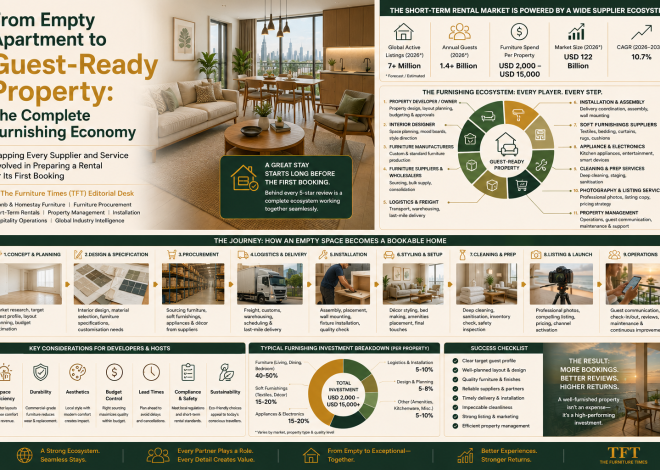
The growth of Airbnb and homestay furniture creates opportunities for multiple sectors.
Manufacturers
Dedicated short-term-rental collections can combine residential design with contract-level performance.
Interior Designers
Designers can create interiors that improve photography, space utilisation, guest comfort and operational efficiency.
Distributors
Regional stock availability and rapid replacement can become important competitive advantages.
Furniture Rental and Leasing Companies
Leasing can help operators reduce initial investment and refresh properties periodically.
Refurbishment Businesses
Repair, reupholstery and refinishing services can extend product life and reduce waste.
Technology Companies
Digital asset registers can connect furniture procurement with maintenance, warranties and guest feedback.
Property Developers
Developers can offer furnished, rental-ready units designed specifically for short-term accommodation.
Local Artisans
Distinctive local products can help properties communicate cultural identity and differentiate themselves online.
Logistics and Installation Companies
Coordinated delivery, assembly and installation services can help investors launch properties faster.
This is not a market for furniture alone. It is an ecosystem involving design, sourcing, installation, maintenance, replacement and asset management.
What Hosts and Property Managers Should Prioritise
A strategic furniture plan should begin with the property’s target guest, expected occupancy and operating model.
Operators should ask:
- Who is most likely to book this property?
- How many people can use the space comfortably?
- Which furniture appears most prominently in photographs?
- Which items will receive the heaviest use?
- How quickly can critical products be replaced?
- Can housekeeping clean around and beneath the furniture?
- Are replacement covers and parts available?
- Does the furniture support the advertised nightly rate?
- Is there enough dining, living and storage capacity?
- Can the property accommodate work, family or longer stays?
- What will the furniture cost over its full operating life?
The objective is not to buy the most expensive furniture. It is to purchase the most appropriate furniture for the property’s commercial purpose.
The Strategic Connection Between Furniture and Revenue
Furniture affects the short-term-rental business through a connected chain.
Strong furniture improves visual presentation. Better presentation can increase listing attention. Functional layouts can strengthen booking confidence. Comfortable furniture can improve the stay. A better stay can encourage positive reviews. Stronger reviews can support future bookings and pricing confidence.
The opposite chain is equally important.
Poor furniture weakens photographs, reduces perceived value, creates discomfort, increases maintenance and produces negative reviews. Those reviews can influence travellers who have never visited the property.
Furniture therefore connects marketing, operations and guest experience.
That is what makes it strategic.
Conclusion
Airbnb and homestay furniture is no longer a secondary branch of residential retail. It is becoming a specialised hospitality category shaped by digital booking, public reviews, intensive use and commercial performance.
A bed is not only a place to sleep; it can influence the property’s rating. A sofa is not only part of the décor; it affects photography, comfort and capacity. A dining table is not merely a surface; it helps determine whether the accommodation genuinely serves the number of guests it advertises.
The future belongs to furniture that performs across four dimensions:
- It must attract attention online.
- It must support comfort during the stay.
- It must withstand frequent use.
- It must simplify the work of operating the property.
For hosts, furniture should be treated as a revenue-supporting asset. For manufacturers, designers and suppliers, it represents a major opportunity to create products and services around one of the world’s most dynamic accommodation categories.
In the expanding short-term-rental economy, furniture does not simply fill the property. It helps sell the stay, deliver the experience and protect the reputation of the business.