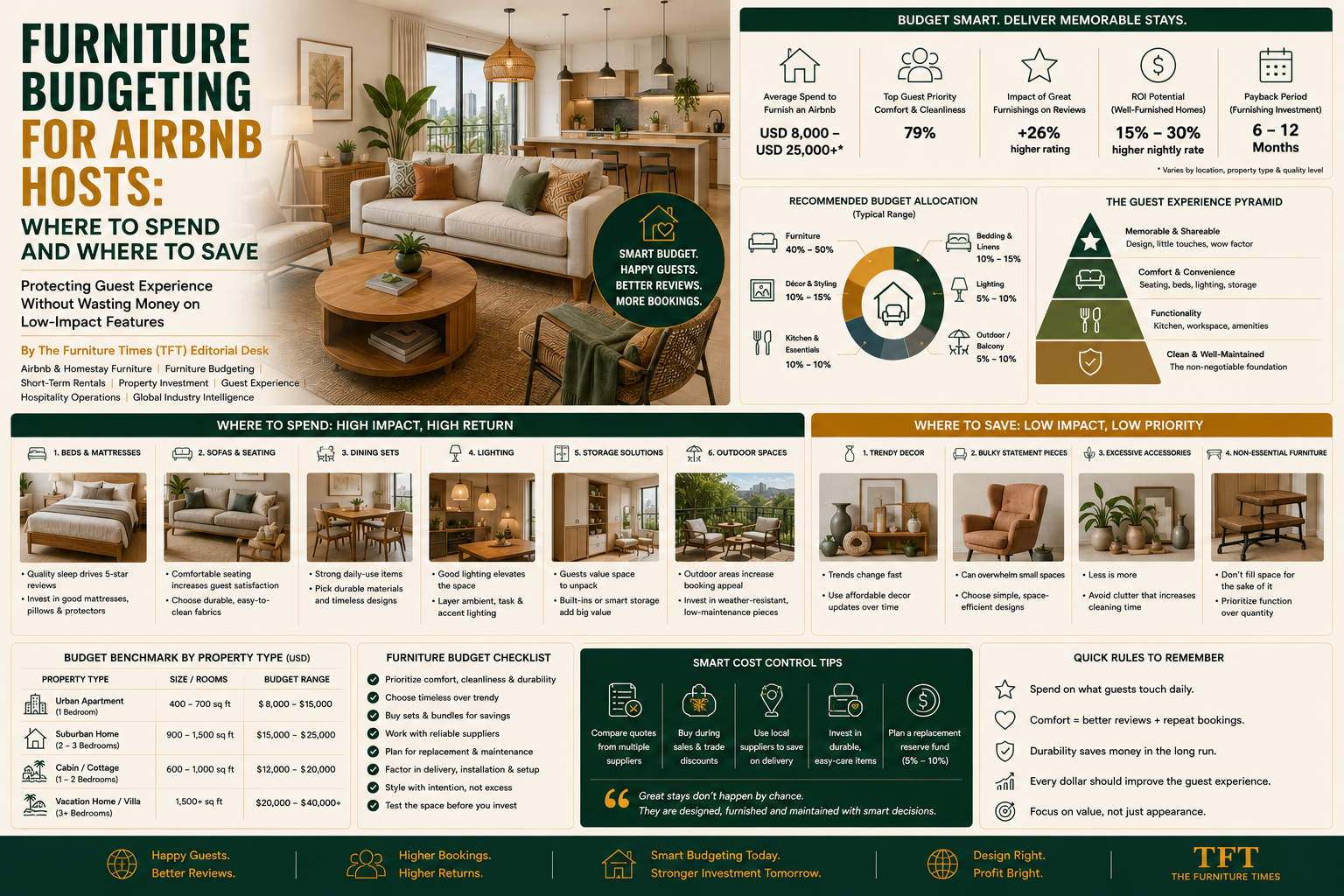
Furniture Budgeting for Airbnb Hosts: Where to Spend and Where to Save
Protecting Guest Experience Without Wasting Money on Low-Impact Features
By The Furniture Times (TFT) Editorial Desk | Airbnb & Homestay Furniture | Furniture Budgeting | Short-Term Rentals | Property Investment | Guest Experience | Hospitality Operations | Global Industry Intelligence
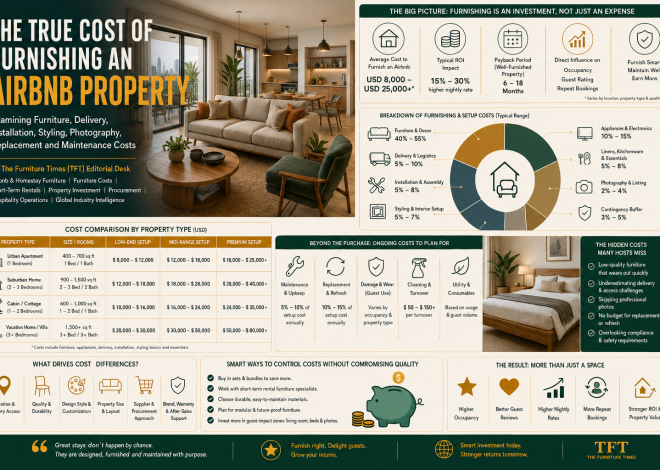
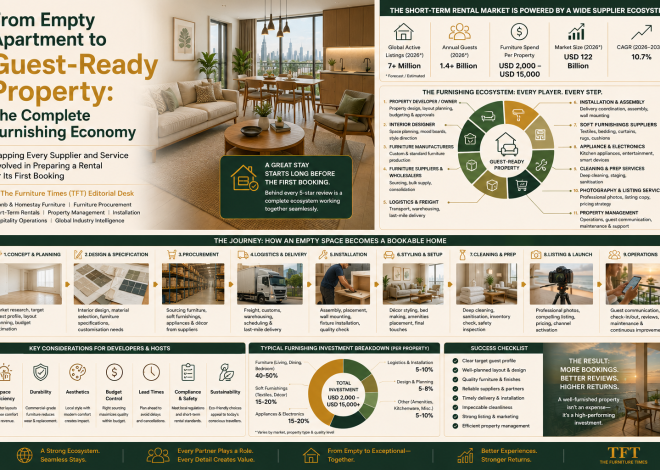
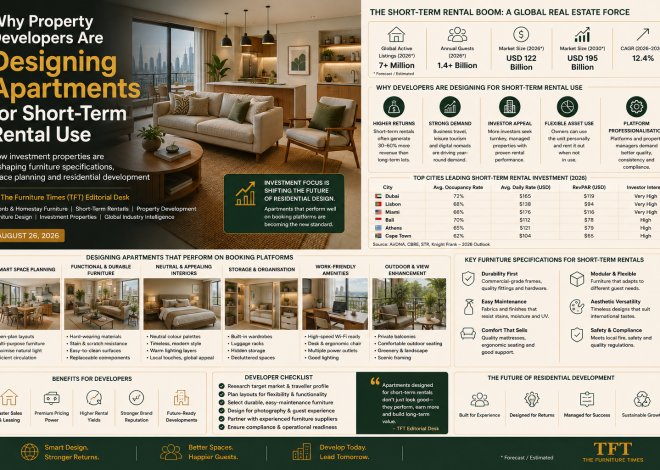
Furnishing an Airbnb property is not simply a choice between inexpensive and expensive furniture. It is a decision about where money can most effectively improve comfort, reviews, operational efficiency and the long-term performance of the property.
Many new hosts make one of two costly mistakes.
The first is underinvesting in products guests use most frequently—beds, mattresses, seating, blackout curtains and dining furniture—while spending heavily on decorative accessories that photograph well but contribute little to the actual stay.
The second is overspending throughout the property without considering durability, maintenance or the nightly rate the market can realistically support.
An Airbnb does not need the most expensive furniture available. It needs the right furniture in the right places, supported by a budget that reflects guest priorities and operating conditions.
The essential budgeting question is therefore not:
“How can the property be furnished as cheaply as possible?”
It is:
“Which purchases protect the guest experience, and which features consume money without producing meaningful value?”
Furniture budgeting begins with the rental strategy
A furniture budget should be developed around the property’s commercial position.
Before purchasing anything, the host should define:
- Target guest
- Expected occupancy
- Typical length of stay
- Realistic nightly rate
- Local competition
- Seasonal demand
- Property-management model
- Expected annual booking frequency
- Whether children or pets will be accepted
- Whether the owner will use the property
- Long-term alternative use
- Local delivery and replacement availability
A studio targeting solo business travellers requires a different budget from a family villa accommodating eight people. A premium city apartment must meet different expectations from a basic rural homestay. A beach rental requires greater investment in corrosion-resistant and washable materials than an apartment in a controlled indoor environment.
The budget must also match the likely revenue.
An owner should not furnish a mid-market property as though it were an ultra-luxury residence unless the location, building, service and target guest can support the higher price. At the same time, a premium property can damage its positioning by using visibly weak or uncomfortable furniture.
Spend according to guest contact—not room size
The most commercially important products are usually those guests touch, sit on, sleep in or operate repeatedly.
This creates a useful principle:
The greater the frequency of guest contact and the operational consequence of failure, the stronger the case for investment.
A mattress may not dominate listing photographs, but guests may use it for eight hours each night. A decorative sculpture may look impressive in one photograph yet provide no functional value during the stay.
Similarly, a reliable dining chair deserves more attention than an expensive object placed on a high shelf. The chair will be moved, loaded and cleaned repeatedly. The object may only collect dust.
Hosts should prioritise products according to:
- Guest use frequency
- Influence on comfort
- Safety importance
- Visibility in reviews
- Cost of failure
- Cleaning requirements
- Replacement difficulty
- Photographic impact
- Contribution to the target market
- Expected useful life
A practical Airbnb spending hierarchy
The following framework helps hosts distinguish between essential investment and lower-impact spending.
| Priority | Furniture or feature | Budget approach |
|---|---|---|
| Critical | Mattress, bed frame, safety equipment, locks | Spend for reliability and performance |
| High | Sofa, dining chairs, blackout curtains, lighting | Spend for comfort, durability and cleanability |
| Medium | Dining table, workspace, storage, outdoor furniture | Match investment to target guest and usage |
| Selective | Rugs, mirrors, feature chairs, artwork | Spend where visual impact is measurable |
| Low | Fragile décor, excessive accessories, luxury objects | Save or avoid |
| Avoidable | Duplicate furniture, oversized pieces, unnecessary technology | Remove from the budget |
This hierarchy is not universal. A mountain cabin with a fireplace, a pool villa or a property targeting remote workers may require different priorities. However, it provides a disciplined starting point.
Where Airbnb Hosts Should Spend
1. Spend on the mattress
The mattress is one of the strongest candidates for meaningful investment.
Guests may choose the property because of its location and photographs, but sleep quality influences how they remember the stay. An uncomfortable, noisy or visibly worn bed can undermine an otherwise attractive property.
The mattress should be:
- Appropriate for frequent use
- Supportive for a broad range of guests
- Made to a recognised safety standard
- Compatible with locally available linen
- Protected against stains and moisture
- Easy to rotate where recommended
- Supported by a stable base
Hosts do not necessarily need to purchase the most luxurious mattress. Extremely specialised firmness or premium materials may not appeal to every guest. A reliable, medium-comfort product from a supplier with local warranty and replacement support may provide better value.
The mattress budget should also include a high-quality protector. Replacing a protector is far less expensive than replacing a stained mattress.
Where to save
Save on exaggerated branding and sleep features that do not materially improve comfort, durability or serviceability. The objective is dependable sleep—not the most expensive mattress label.
2. Spend on a strong, quiet bed frame
A weak bed frame can create complaints, repairs and emergency downtime.
Beds in short-term rentals are assembled, stripped, remade and used by different guests throughout the year. Connections may loosen more quickly than in a private home.
The frame should have:
- Strong joints
- Reliable central support
- Adequate load capacity
- Replaceable slats or components
- Minimal noise
- Accessible fixings
- A design that allows cleaning
- A headboard that is stable and easy to maintain
Bed frames are operationally critical because a failure can make the entire bedroom unavailable.
Where to save
Hosts can save on elaborate carving, complex upholstery and oversized headboards unless these features are central to the property’s positioning. A simple, well-constructed frame is usually more valuable than a visually elaborate but structurally weak product.
3. Spend on blackout and privacy
Curtains and blinds directly affect sleep, privacy, temperature and the perceived completeness of the room.
A low-cost decorative curtain that fails to block streetlights or early sunlight may need to be replaced soon after opening. That means paying for fabric, labour and installation twice.
Hosts should invest in:
- Accurate measurement
- Strong curtain tracks
- Adequate fabric width
- Effective blackout lining
- Easy movement
- Secure installation
- Washable or maintainable materials
- Privacy during both day and night
In hot climates, suitable window treatments may also help reduce heat gain and improve comfort.
Where to save
Motorisation is unnecessary for many ordinary apartments. It adds motors, controls, wiring and future maintenance. Manual systems can be more economical unless large, high or inaccessible windows justify automation.
4. Spend on the principal sofa
The main sofa is highly visible in listing photographs and heavily used during stays.
It should be comfortable enough for actual sitting, scaled correctly for the room and constructed for repeated use. Upholstery should resist stains and permit cleaning or component replacement.
Useful features include:
- Strong internal frame
- Replaceable cushion covers
- Removable seat cushions
- Durable upholstery
- Stable legs
- Locally repairable construction
- Sufficient seating for the advertised occupancy
- Access for cleaning underneath
A low-priced sofa may lose shape, stain or loosen quickly. A fragile luxury sofa may be equally unsuitable.
Where to save
Do not automatically buy the largest sofa that fits. Oversized furniture makes rooms appear smaller, blocks circulation and increases delivery difficulties.
Hosts can also save by avoiding excessive numbers of occasional chairs when the principal sofa already provides adequate seating.
5. Spend on dining-chair strength
Dining chairs are frequently underestimated.
They are pulled, dragged, leaned on, moved to other rooms and sometimes used as luggage stands or temporary work chairs. Weak joints can loosen rapidly.
The ideal rental chair should offer:
- Stable construction
- Adequate load capacity
- Easy-clean surfaces
- Replaceable feet or glides
- No delicate decorative components
- Comfortable seating for meals
- Compatibility with the table height
- Local replacement availability
Where to save
Matching every chair perfectly is not always necessary. A controlled mix can create character, provided the seats have similar heights and remain visually coherent.
Avoid paying for delicate upholstery on dining chairs unless it is performance-rated and easy to clean.
6. Spend on lighting that supports real activities
Lighting affects photographs, safety, work, reading and the evening atmosphere.
A property needs more than one bright ceiling fixture. Hosts should consider:
- Bedside reading
- Dining
- Kitchen preparation
- Desk work
- Mirror use
- Night-time circulation
- Outdoor access
Accessible bedside switches and charging points can improve usability without requiring luxury fixtures.
Where to save
Save on designer lighting brands when a reliable, well-proportioned alternative provides the same illumination and appearance.
Avoid complicated fixtures with unusual bulbs that cannot be replaced quickly. Consistent colour temperature is more important than an expensive label.
7. Spend on safety and stability
Safety is not an appropriate category for aggressive cost cutting.
Relevant investment may include:
- Smoke alarms
- Carbon-monoxide alarms where applicable
- Fire extinguishers
- First-aid equipment
- Strong locks
- Furniture anchoring
- Balcony and window safety
- Pool-safety equipment
- Electrical inspection
- Secure outdoor furniture
- Emergency lighting and information
Requirements vary by jurisdiction and property type. Airbnb states that hosts must maintain a secure space, address known hazards and comply with applicable laws, including fire rules and occupancy limits. Airbnb safety requirements
Where to save
Hosts may save by choosing approved, functional equipment without unnecessary decorative upgrades. They should never save by omitting required safety devices or using unverified products.
8. Spend on cleanability
Cleanability affects every future booking.
Furniture with stain-resistant surfaces, removable covers and accessible floor clearance may reduce cleaning time and help the property remain presentable.
This is especially important for:
- Sofas
- Dining chairs
- Rugs
- Headboards
- Outdoor cushions
- Dining tables
- Bedside furniture
- Children’s furniture
- Pet-friendly properties
Airbnb’s quality guidance places strong emphasis on cleanliness, while its host resources recommend detailed attention to surfaces, floors, linen and high-traffic areas. Airbnb cleaning guidance
Where to save
Avoid expensive materials that require specialist cleaning unless the nightly rate supports the recurring care. An affordable washable fabric can deliver better long-term value than delicate luxury upholstery.
9. Spend on practical storage
Storage affects guests, cleaners, managers and owners.
Guests need space for clothing and luggage. Cleaners need organised access to linen and supplies. Owners may need a locked cabinet for personal possessions.
Useful storage includes:
- Wardrobe hanging space
- Shelves
- Luggage bench
- Bedside storage
- Entry hooks
- Bathroom shelving
- Kitchen storage
- Lockable owner cabinet
- Housekeeping cupboard
Where to save
A short-stay property may not need large wardrobes in every bedroom. Open hanging rails, shelves and luggage racks can be more practical and economical, particularly in compact apartments.
The decision should reflect typical stay length. Medium-term guests require more enclosed storage than weekend travellers.
10. Spend on a functional workspace when the market requires it
A real workspace can expand the property’s appeal to business travellers, remote workers and longer-stay guests.
It should include:
- Stable work surface
- Sufficient depth
- Comfortable chair
- Accessible power
- Good lighting
- Reliable Wi-Fi
- Suitable video-call background
- Adequate legroom
Airbnb’s guidance for remote-work amenities highlights reliable Wi-Fi, dedicated workspaces, lighting and ergonomic support. Airbnb amenities guidance
Where to save
Not every bedroom needs a separate desk. In a small apartment, a well-designed dining table may perform both functions.
Hosts should avoid buying a small decorative console and calling it a workspace if it cannot accommodate a laptop comfortably.
11. Spend on replacement availability
A product’s value depends partly on whether it can be replaced quickly.
Before purchasing, hosts should ask:
- Will this model remain available?
- Can one dining chair be purchased later?
- Are replacement covers sold separately?
- Can the finish be matched?
- Are spare hinges, legs or slats available?
- Is there a local service centre?
- How long will replacement delivery take?
Standard products from dependable suppliers may offer more value than unique products that become impossible to source after launch.
Where to save
A rental does not need every item to be custom-made. Customisation should be used where it solves a space problem or creates meaningful differentiation—not simply because it is available.
Where Airbnb Hosts Can Save
12. Save on excessive decorative accessories
Accessories can improve photographs, but too many objects increase purchasing, cleaning and replacement costs.
Hosts can reduce spending on:
- Decorative bowls
- Multiple vases
- Fragile sculptures
- Excessive cushions
- Artificial books
- Small ornaments
- Unnecessary table décor
- Valuable collectables
- Items with no permanent location
Every accessory should have a clear purpose:
- Does it create a focal point?
- Does it communicate local character?
- Does it improve a listing photograph?
- Can cleaners reset it consistently?
- Is it inexpensive to replace?
If the answer is no, the item may not deserve budget.
13. Save on matching furniture sets
An entire matching bedroom or living-room collection can appear generic and may force the owner to replace several items when one becomes unavailable.
A more flexible strategy is to coordinate:
- Colour
- Scale
- Material
- Shape
- Visual weight
Furniture does not need to come from one product family to look coherent.
Selective mixing can reduce costs, allow local sourcing and create a more distinctive interior.
14. Save on low-contact furniture
Some products receive little use and should not consume a large share of the budget.
Examples may include:
- Decorative console tables
- Occasional bedroom chairs
- Display shelves
- Entrance stools
- Accent tables
- Decorative benches without storage
These pieces can be sourced economically, purchased second-hand where appropriate or eliminated if they add clutter.
Savings should be redirected toward products with higher guest contact.
15. Save on expensive artwork
Artwork helps create identity, but it does not need to be financially valuable.
Hosts can use:
- Licensed prints
- Local photography
- Reproductions
- Textile art
- Framed maps
- Graphic compositions
- Work from local emerging artists
- Replaceable decorative panels
The installation should still be secure, well scaled and professionally presented.
Avoid unique or emotionally valuable pieces that would be difficult to replace after damage.
16. Save on rugs where maintenance is difficult
Rugs can add warmth, colour and acoustic comfort, but they also collect dirt, hair and stains.
In high-turnover, pet-friendly, coastal or allergy-conscious properties, a rug may create more maintenance than value.
If a rug is used, it should be:
- Appropriately sized
- Low pile
- Stain resistant
- Easy to vacuum
- Professionally cleanable
- Secured against slipping
- Replaceable at reasonable cost
Hosts can save by using one visually effective rug rather than placing rugs throughout the property.
17. Save on luxury materials in high-risk locations
Certain materials are attractive but operationally demanding.
Examples include:
- Delicate marble surfaces
- Unsealed natural stone
- Fragile glass
- High-maintenance timber
- Pale untreated upholstery
- Soft metals that scratch easily
- Hand-finished surfaces
- Irreplaceable natural variations
A convincing alternative may provide a similar visual effect with better durability and lower maintenance.
The goal is not to make the interior look inexpensive. It is to avoid paying a premium for a material that will deteriorate under rental conditions.
18. Save on complicated smart-home technology
Technology should simplify the guest journey.
Hosts may overspend on:
- Multiple incompatible applications
- Automated curtains without clear need
- Complex lighting scenes
- Voice-control systems
- Difficult thermostats
- Smart appliances guests cannot understand
- Subscription services with limited value
A reliable smart lock, strong Wi-Fi and simple climate controls may offer more value than a fully automated apartment.
Every technology system requires setup, support, updates and a backup plan.
19. Save on furniture for imaginary guests
Hosts sometimes furnish around rare scenarios instead of typical demand.
Examples include:
- Buying seating for ten when the property sleeps four
- Adding a large desk to every bedroom
- Installing multiple folding beds
- Purchasing children’s furniture for occasional family use
- Filling balconies with more furniture than the space can support
- Equipping kitchens for complex entertaining when guests mostly stay briefly
The budget should reflect the property’s principal guest—not every possible guest.
Special equipment such as travel cots or high chairs may sometimes be stored centrally and supplied only when requested.
20. Save through local sourcing
Local furniture and service providers can reduce:
- Freight
- Import duties
- Long delivery times
- Minimum order quantities
- Replacement delays
- Site-measurement errors
- Installation complexity
Local manufacturers may also customise dimensions and provide repair support more quickly.
However, “local” should not automatically mean suitable. Product quality, consistency, safety and commercial-use capability must still be evaluated.
21. Save through standardisation
Hosts managing multiple units can reduce costs by standardising selected products.
Suitable categories include:
- Mattresses
- Bed frames
- Linen sizes
- Dining chairs
- Lamps
- Kitchenware
- Locks
- Television models
- Appliance brands
- Curtain hardware
Standardisation makes training, stocking and replacement easier. It also creates opportunities for volume pricing.
Visual variation can be introduced through artwork, cushions, colour accents and locally relevant accessories.
22. Save through phased upgrades
Not every improvement must be completed before launch, provided the property is safe, complete and accurately described.
A phased strategy might be:
Launch phase
- Beds and mattresses
- Essential seating
- Dining furniture
- Window treatments
- Appliances
- Kitchen inventory
- Linen
- Safety equipment
- Lighting
- Internet and access
- Professional photography
Performance phase
- Additional artwork
- Upgraded outdoor furniture
- Enhanced workspace
- More storage
- Improved landscaping
- Premium amenities
Review phase
- Replace weak items
- Respond to guest feedback
- Improve frequently criticised areas
- Refresh photography
- Upgrade products affecting ratings
Phasing preserves cash and allows real guest behaviour to guide later investment.
It should not be used to launch an incomplete property. Guests should receive everything shown or promised in the listing.
A Value-Impact Matrix for Furniture Decisions
Hosts can evaluate purchases through four categories.
| Cost | Guest or operational impact | Recommended decision |
|---|---|---|
| Low cost | High impact | Buy or upgrade immediately |
| High cost | High impact | Evaluate lifecycle value and invest carefully |
| Low cost | Low impact | Add only if it strengthens the design |
| High cost | Low impact | Remove, simplify or postpone |
Low-cost, high-impact examples
- Mattress protector
- Luggage rack
- Bedside charging
- Wall hooks
- Blackout improvement
- Replacement chair glides
- Clear appliance instructions
- Extra lighting
- Furniture anchoring
- Spare keys or lock batteries
High-cost, high-impact examples
- Mattress
- Bed frame
- Principal sofa
- Air-conditioning system
- Major window treatments
- Outdoor furniture for a resort property
- Reliable appliances
- Custom storage in a small apartment
Low-cost, low-impact examples
- Small decorative objects
- Extra cushions
- Minor seasonal décor
- Display books
High-cost, low-impact examples
- Designer-labelled side tables
- Fragile statement furniture
- Complex automation
- Luxury objects not connected to guest needs
- Custom pieces hidden from listing photographs
- Furniture for unlikely occupancy scenarios
An Illustrative Initial Budget Allocation
The percentages below are a planning example, not a universal quotation. Actual allocations vary according to location, property type and existing equipment.
| Category | Illustrative allocation |
|---|---|
| Beds, mattresses and bedroom furniture | 25% |
| Living-room seating and tables | 15% |
| Appliances and electronics | 15% |
| Dining and workspace furniture | 8% |
| Curtains, blinds and lighting | 10% |
| Kitchenware, bathroom inventory and linen | 10% |
| Delivery and installation | 7% |
| Styling, accessories and artwork | 3% |
| Safety, access and technology | 3% |
| Photography and launch preparation | 2% |
| Contingency | 2% |
| Total | 100% |
The key lesson is that decorative spending should not displace sleep, seating, lighting, safety or installation quality.
Budget by property type
Studio apartment
Priorities should normally include:
- Excellent bed and mattress
- Space-efficient seating
- Dining and work surface
- Blackout curtains
- Luggage management
- Compact storage
- Strong lighting
- Minimal accessories
The main risk is overcrowding. Hosts should avoid filling the studio with too many furniture functions.
One-bedroom urban apartment
The budget should support:
- Separate living and sleeping comfort
- Reliable workspace
- Practical kitchen
- Sofa suitable for actual use
- Dining capacity matching occupancy
- Self-check-in
- Strong Wi-Fi
- Sufficient wardrobe and luggage space
Family apartment
Investment may need to increase in:
- Dining capacity
- Additional beds
- Laundry equipment
- Storage
- Durable upholstery
- Child-conscious furniture
- Kitchen inventory
- Multiple linen sets
Families use more of the property simultaneously, increasing pressure on furniture and equipment.
Coastal or tropical property
Spend more carefully on:
- Outdoor furniture
- Corrosion resistance
- UV-resistant materials
- Washable fabrics
- Moisture-resistant finishes
- Ventilation
- Protective storage
- Sand-conscious cleaning
Save on delicate indoor materials that cannot tolerate humidity, sunscreen, salt or wet clothing.
Luxury villa
The budget may need to support:
- Strong design identity
- Custom furniture
- Premium mattresses
- Large social areas
- Outdoor living
- Poolside furniture
- Higher-quality linen
- Coordinated lighting
- Professional styling
- Replacement stock
- More frequent maintenance
Luxury guests usually expect both appearance and performance. Expensive furniture that is uncomfortable or poorly maintained will not protect the property’s positioning.
Cheap furniture can be expensive furniture
A low purchase price can hide future costs.
Consider the complete lifecycle:
Purchase Price + Delivery + Installation + Cleaning + Repairs + Replacement + Downtime
A dining chair that costs half as much but must be replaced three times is not economical. A sofa that requires specialist cleaning after every stain may not be suitable. A custom bed that takes eight weeks to replace can expose the property to lost bookings.
Hosts should compare cost per year or cost per occupied night—not only the original price.
A simple comparison method
For each important product, record:
- Purchase price
- Delivery and installation
- Expected useful life
- Annual maintenance
- Likely repair cost
- Replacement lead time
- Estimated downtime risk
- Disposal cost
- Residual or resale value
This turns procurement from an emotional shopping exercise into an investment decision.
Protecting the replacement budget
Furniture deterioration is part of operating a rental.
Airbnb’s Host Damage Protection contains conditions and exclusions and does not cover normal wear and tear. It is also described by Airbnb as a protection program rather than a replacement for independent insurance. Airbnb Host Damage Protection
Hosts should therefore establish their own furniture reserve.
Possible methods include:
- Setting aside a percentage of booking revenue
- Assigning a fixed replacement amount per occupied night
- Creating an annual room-by-room budget
- Maintaining spare products
- Holding a portfolio-level repair fund
The reserve should cover:
- Linen replacement
- Kitchenware breakage
- Furniture repair
- Mattress replacement
- Appliance failure
- Upholstery cleaning
- Photography updates
- Major refurbishment
A property is not generating sustainable profit if its income calculation ignores the cost of keeping the interior guest-ready.
Spend on documentation
Documentation is a low-cost way to protect the furnishing investment.
Hosts and managers should maintain:
- Furniture inventory
- Supplier information
- Product codes
- Fabric references
- Finish specifications
- Warranty documents
- Appliance serial numbers
- Installation photographs
- Maintenance instructions
- Replacement history
- Condition photographs
- Cleaning guidance
When damage occurs, documentation helps determine what was affected, when it was installed and whether repair, warranty or replacement is appropriate.
It also enables faster purchasing when the property cannot wait for an extended product search.
Do not save by compromising listing accuracy
A budget interior can still perform well if it is clean, comfortable, thoughtfully planned and honestly represented.
Problems arise when photographs or descriptions create expectations the physical property cannot meet.
Airbnb’s review categories include cleanliness, accuracy and value, and the platform advises hosts to show spaces clearly and highlight the amenities that are actually available. Airbnb review guidance, Airbnb photography guidance
Hosts should not use borrowed décor for photography if it will be removed before guests arrive. Nor should editing make rooms appear dramatically larger or hide important limitations.
Accuracy protects reviews and helps the correct guests choose the property.
A Room-by-Room Spending Guide
Bedroom
Spend on:
- Mattress
- Stable bed frame
- Mattress protection
- Blackout curtains
- Bedside lighting
- Charging access
- Luggage space
Save on:
- Elaborate headboards
- Excessive cushions
- Decorative benches without storage
- Fragile bedside accessories
Living room
Spend on:
- Main sofa
- Cleanable upholstery
- Seating capacity
- Durable coffee table
- Functional lighting
Save on:
- Too many accent chairs
- Designer side tables
- Excessive ornaments
- Delicate rugs
Dining area
Spend on:
- Chair strength
- Table stability
- Cleanable finish
- Correct capacity
- Furniture glides
Save on:
- Formal dining sets
- Delicate upholstery
- Oversized tables
- Expensive decorative centrepieces
Kitchen
Spend on:
- Reliable appliances
- Functional cookware
- Adequate inventory
- Easy-clean products
- Replacement availability
Save on:
- Specialist appliances few guests use
- Oversized dinnerware collections
- Fragile glassware
- Duplicate gadgets
Bathroom
Spend on:
- Strong fittings
- Adequate towels
- Washable bathmats
- Proper lighting
- Safety where required
Save on:
- Luxury dispensers
- Fragile accessories
- Too many decorative objects
- Expensive disposable amenities without market justification
Balcony or terrace
Spend on:
- Weather resistance
- Stability
- UV resistance
- Washable cushions
- Secure parasols where appropriate
Save on:
- Indoor furniture used outdoors
- Excessive seating
- Lightweight décor
- Unprotected fabrics
- Large furniture that blocks circulation
Ten questions before approving any furniture purchase
- Will guests use this item frequently?
- Does it improve sleep, comfort, safety or functionality?
- Will it appear prominently in listing photographs?
- Can it tolerate repeated cleaning?
- Can it be repaired locally?
- Can individual components be replaced?
- How quickly can a matching replacement be obtained?
- Will it fit through the building and inside the room?
- Does its quality match the property’s nightly-rate position?
- Is there a less expensive product offering the same operational value?
If an item performs poorly against these questions, it may not deserve budget.
The Furniture Times Perspective
Good Airbnb furniture budgeting is not about making every room cheap. It is about making every expenditure accountable.
The strongest properties invest in the parts of the experience guests feel most directly:
Sleep, seating, privacy, lighting, cleanliness, safety, storage and functionality.
They save on features that add cost without improving the stay:
Excessive décor, fragile materials, unnecessary automation, oversized furniture and prestige products with little operational value.
This discipline protects both sides of the business.
Guests receive a comfortable and reliable property. Owners preserve cash, reduce replacement pressure and improve the useful life of their furnishing investment. Property managers gain interiors that are easier to clean and maintain. Furniture manufacturers gain a clearer understanding of the performance short-term-rental buyers actually require.
The most successful host is not necessarily the one who spends the most.
It is the one who understands where every furniture dollar, ringgit, pound, euro, rupee or dirham can create the greatest effect.
In short-term rentals, intelligent budgeting does not weaken design. It makes design commercially responsible.