
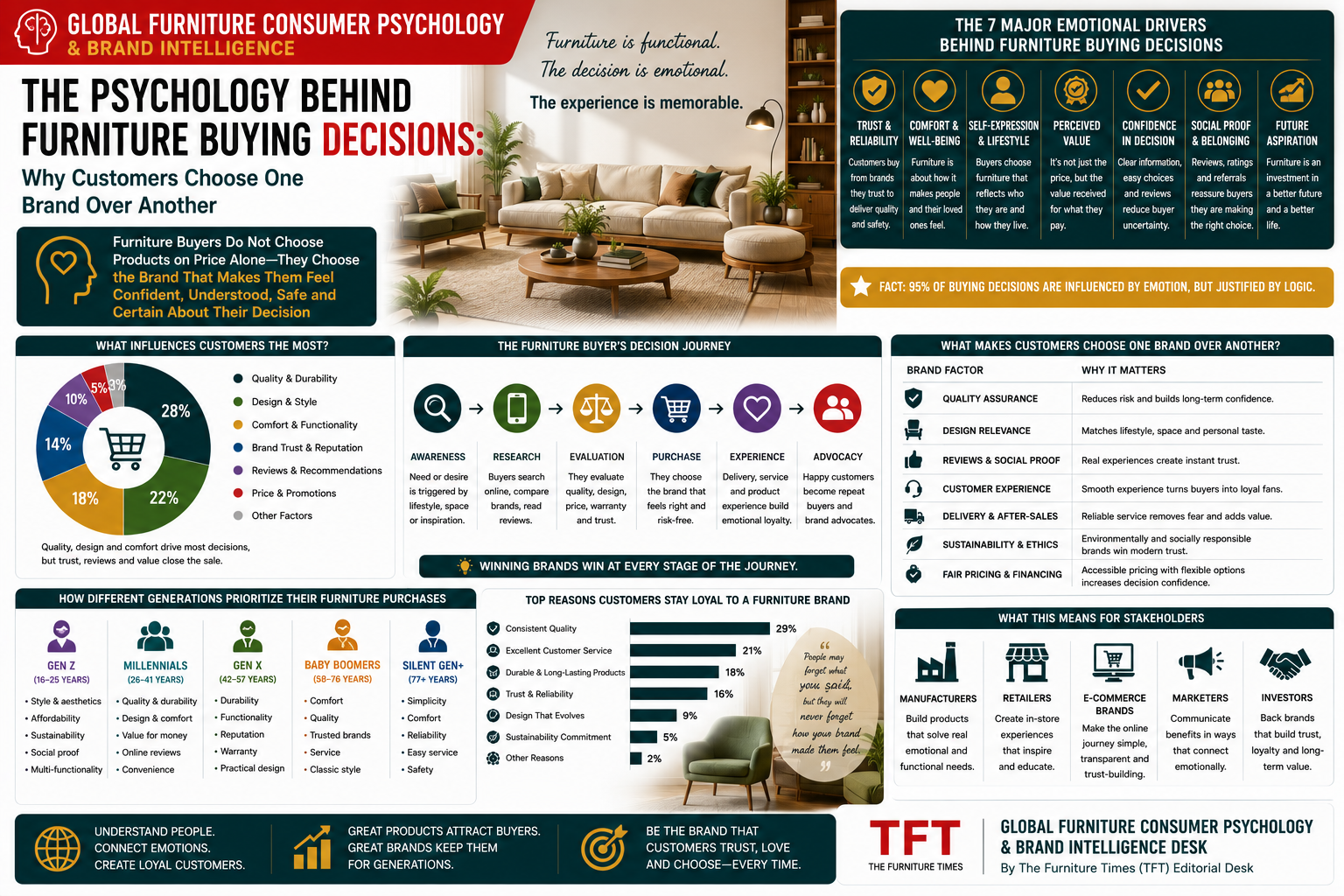
The Psychology Behind Furniture Buying Decisions: Why Customers Choose One Brand Over Another
Furniture Buyers Do Not Choose Products on Price Alone—They Choose the Brand That Makes Them Feel Confident, Understood, Safe and Certain About Their Decision
Global Furniture Consumer Psychology & Brand Intelligence Desk
By The Furniture Times (TFT) Editorial Desk
Furniture buying is both a practical and emotional decision.
Customers may begin by searching for a sofa, dining table, mattress, office chair, wardrobe or outdoor furniture set. However, beneath the visible product search lies a deeper collection of questions:
- Will this furniture make my home feel complete?
- Will it reflect my taste and identity?
- Is the price justified?
- Can I trust the material description?
- Will the product fit my space?
- Is it comfortable?
- Will it last?
- What happens if it arrives damaged?
- Will the company support me after the sale?
- Will I regret choosing this brand?
Furniture is different from many everyday consumer products.
It is usually more expensive, physically larger and expected to remain in use for years. It may be difficult to return, costly to transport and highly visible inside the home, workplace, hotel, restaurant or commercial property.
A customer choosing furniture is therefore not simply choosing an object.
The customer is choosing:
- A future living experience
- A level of comfort
- A visual identity
- A material promise
- A delivery experience
- A financial commitment
- A relationship with a brand
- A degree of purchasing risk
This explains why two companies can sell visually similar products at similar prices but achieve very different results.
One brand may create confidence, while the other creates doubt.
One retailer may make the buying process simple, while another makes the customer feel uncertain.
One manufacturer may explain materials honestly, while another uses vague claims.
One website may answer every important question, while another forces the buyer to search elsewhere.
The psychology of furniture buying is therefore one of the most important competitive subjects in the global furniture industry ecosystem.
Furniture Is a High-Consideration Purchase
A high-consideration purchase requires more thought, comparison and risk evaluation than a routine purchase.
Customers may spend days, weeks or even months researching furniture because the decision involves:
- Significant money
- Long-term use
- Personal taste
- Room dimensions
- Comfort
- Delivery logistics
- Material quality
- Household approval
- Warranty concerns
- Fear of making a mistake
The higher the price and the greater the difficulty of returning the product, the more psychological reassurance the customer requires.
A person buying a low-cost side table may decide quickly.
A customer buying a complete sofa set, customised kitchen, hotel furniture package or office fit-out may require extensive information, samples, quotations, approvals and personal support.
Furniture businesses must therefore understand that hesitation is not always a sign of weak interest.
It can be a sign that the customer is trying to reduce risk.
The Seven Psychological Questions Behind Most Furniture Purchases
Although customers may express their needs in different ways, most furniture decisions involve seven underlying questions.
1. Does This Product Solve My Problem?
The customer is rarely looking for furniture without a reason.
The problem may be:
- An empty room
- Insufficient storage
- An uncomfortable sofa
- A damaged dining table
- A growing family
- A new home
- A renovation
- A small apartment
- A hotel opening
- An office expansion
- A restaurant refurbishment
- An ageing parent
- A need for better sleep
The brand that understands the real problem can present a more convincing solution.
A customer searching for a wardrobe may actually be searching for better organisation.
A person buying an office chair may be searching for comfort during long working hours.
A hotel purchasing outdoor loungers may be searching for guest satisfaction, operational durability and stronger poolside revenue.
Furniture marketing becomes more powerful when it communicates the outcome rather than only the object.
2. Can I Trust the Brand?
Trust is one of the strongest drivers of furniture purchasing.
Customers must trust that:
- The product description is accurate
- The images represent the real product
- The dimensions are correct
- The materials are genuine
- Delivery will happen as promised
- The warranty will be honoured
- Customer service will respond
- The company will still exist after the sale
Trust is particularly important because furniture buyers may not understand technical differences between materials, construction methods or finishes.
A brand that explains products clearly reduces uncertainty.
A brand that hides information increases suspicion.
3. Does This Furniture Reflect Who I Am?
Furniture communicates identity.
Homes and commercial interiors express:
- Taste
- Social position
- Cultural values
- Lifestyle
- Professional image
- Hospitality standards
- Environmental values
- Family priorities
Customers may choose a brand because it represents:
- Modern living
- Luxury
- Minimalism
- Sustainability
- Craftsmanship
- Innovation
- Affordability
- Family comfort
- Local culture
- Professional credibility
A furniture brand becomes stronger when customers understand what it stands for.
If a company tries to represent luxury, discount pricing, sustainability, mass production, craftsmanship and trendiness all at once, its identity can become unclear.
Emotion Often Comes Before Logic
Furniture customers frequently feel first and justify later.
A sofa may create an immediate feeling of comfort.
A dining table may remind someone of family gatherings.
A handcrafted chair may communicate authenticity.
A minimalist bedroom may create calm.
A hotel lobby collection may make a property feel more prestigious.
After experiencing this emotional response, the customer begins looking for rational justification:
- The frame is strong
- The fabric is easy to clean
- The timber is certified
- The warranty is five years
- Delivery is included
- The reviews are positive
- The price is reasonable
This does not mean the rational information is unimportant.
It means emotion creates desire, while logic gives the customer permission to buy.
Strong furniture marketing should therefore combine:
Emotional aspiration + practical proof.
The Psychology of Comfort
Comfort is one of the most powerful but difficult furniture-buying factors.
Customers cannot always evaluate it through photographs.
Comfort involves:
- Seat height
- Seat depth
- Cushion firmness
- Back support
- Arm height
- Mattress support
- Table height
- Chair angle
- Body proportions
- Personal preference
A product may look comfortable but feel unsuitable.
This is why showrooms, trials, demonstrations, videos and clear measurements remain important.
Comfort Is Personal
A deep, soft sofa may appeal to a younger buyer who wants relaxed lounging.
The same sofa may be difficult for an older person to leave.
A firm mattress may feel supportive to one customer and uncomfortable to another.
Furniture businesses should avoid claiming that one product is universally comfortable.
A stronger approach is to explain:
- Who the product is designed for
- How firm or soft it feels
- What dimensions influence comfort
- Whether different options are available
- How customers can test it
Honest comfort communication reduces disappointment and returns.
The Psychology of Price
Customers do not always choose the cheapest furniture.
They choose the option that appears to offer the best value relative to their expectations, budget and risk.
Price psychology in furniture includes several different comparisons.
Absolute Price
Can the customer afford the product?
Relative Price
How does it compare with similar products?
Expected Lifespan
Will it last long enough to justify the cost?
Perceived Quality
Does it look and feel more valuable than the price?
Total Cost
Does the price include delivery, assembly, installation and warranty?
Social Meaning
Does the price support the customer’s desired identity or status?
A low price can attract attention, but it can also create doubt.
Customers may wonder:
- Is the frame weak?
- Is the wood genuine?
- Is the fabric low quality?
- Will it fail quickly?
- Is the warranty meaningless?
A higher price can signal quality, but only when the brand provides evidence.
Expensive furniture without credible differentiation can appear overpriced.
The Anchoring Effect
Customers often evaluate price relative to the first number they see.
This is known as anchoring.
A premium sofa displayed beside a more expensive designer model may appear affordable.
A mid-range dining set may appear expensive when placed next to a heavily discounted entry-level set.
Furniture retailers use price anchoring through:
- Original and sale prices
- Good, better and best collections
- Package comparisons
- Premium display products
- Monthly payment calculations
- Material upgrades
Anchoring should be used transparently.
Artificial discounts, permanently inflated “original” prices and misleading urgency may generate short-term sales but weaken trust.
Why Discounts Work—and Why They Can Damage Brands
Furniture discounts create urgency and reduce the psychological pain of spending.
Customers may act because they fear missing:
- A limited-time price
- Free delivery
- A bundle offer
- A clearance product
- An instalment promotion
- A seasonal sale
However, constant discounting teaches customers not to buy at full price.
It can also create doubts about:
- Product value
- Brand quality
- Price honesty
- Inventory freshness
Premium brands should be especially careful. If every product is always discounted, the listed price loses credibility.
The strongest promotions provide a clear reason:
- End-of-season clearance
- Discontinued finish
- Floor model
- Anniversary event
- Package purchase
- Limited production run
Social Proof Reduces Furniture-Buying Risk
Customers feel more confident when they see that others have purchased and approved the product.
Social proof includes:
- Customer reviews
- Star ratings
- Testimonials
- Project photographs
- Social-media posts
- Designer recommendations
- Hotel or corporate clients
- Awards
- Best-seller labels
- Case studies
- User-generated videos
Furniture buyers pay particular attention to reviews about:
- Comfort
- Material accuracy
- Durability
- Delivery
- Damage
- Assembly
- Customer service
- Warranty claims
A photograph from a real customer can sometimes create more confidence than a highly polished studio image because it shows how the product appears in an ordinary environment.
Negative Reviews Are Not Always Harmful
A brand with only perfect reviews can appear unrealistic.
Customers often trust businesses that respond professionally to criticism.
A good response should:
- Acknowledge the problem
- Avoid blaming the customer
- Explain the solution
- Provide a clear next step
- Show that the issue was taken seriously
The way a brand handles a problem can become stronger proof of trustworthiness than the absence of problems.
Brand Familiarity Creates Psychological Safety
Customers are often more comfortable buying from brands they recognise.
Familiarity reduces the mental effort required to evaluate risk.
A familiar brand may benefit from:
- Previous purchases
- Advertising exposure
- Search visibility
- Physical stores
- Recommendations
- Consistent visual identity
- Repeated social-media presence
- Industry reputation
This does not mean new brands cannot compete.
New brands must replace familiarity with stronger proof, such as:
- Detailed information
- Transparent materials
- Reviews
- Certifications
- Clear warranties
- Real project evidence
- Accessible customer support
- Samples or trials
Visibility creates recognition, and recognition creates confidence.
A furniture brand that appears consistently across search engines, marketplaces, directories, media and social platforms is more likely to be remembered when the customer is ready to buy.
The Importance of Brand Positioning
Customers must understand why one furniture brand is different from another.
Effective positioning may focus on:
- Affordable furniture for first homes
- Premium solid-wood craftsmanship
- Outdoor furniture for tropical climates
- Ergonomic workplace furniture
- Luxury hotel furniture
- Compact furniture for urban apartments
- Sustainable and repairable products
- Fast-delivery furniture
- Custom furniture for designers
- Age-inclusive furniture
A clear position helps customers decide whether the brand is relevant.
A vague brand that claims to serve everyone often becomes memorable to no one.
Design Creates Attraction, but Suitability Creates Conversion
Furniture design creates the first impression.
Customers notice:
- Shape
- Colour
- Proportion
- Material
- Texture
- Style
- Visual weight
- Details
However, attractive design does not guarantee purchase.
The customer must also believe the product will:
- Fit the room
- Match existing furniture
- Suit the household
- Support the intended use
- Remain practical
- Be easy to maintain
The most successful furniture products combine visual attraction with practical suitability.
A white sofa may look beautiful but appear risky to a family with young children.
A large dining table may create desire but be unsuitable for an apartment.
A sculptural chair may attract attention but fail to provide comfort.
Brands should show how design and daily use work together.
Colour Psychology in Furniture Buying
Colour influences mood, identity and perceived space.
Neutral Colours
White, beige, grey and natural timber tones can communicate:
- Calm
- Flexibility
- Safety
- Timelessness
- Easy coordination
They often attract buyers who fear making the wrong choice.
Dark Colours
Black, charcoal and dark wood can communicate:
- Luxury
- Strength
- Formality
- Sophistication
However, they may make small spaces appear heavier.
Warm Colours
Terracotta, brown, rust, red and warm natural tones can create:
- Comfort
- Energy
- Earthiness
- Hospitality
Cool Colours
Blue, green and cool grey can suggest:
- Calm
- Freshness
- Modernity
- Nature
Bold Colours
Bright upholstery or painted furniture can create individuality but may feel riskier because customers worry about future trends or coordination.
Offering swatches, visualisation tools and multiple finish options helps customers make confident colour decisions.
Material Psychology
Customers attach meanings to materials.
Solid Wood
Commonly associated with:
- Durability
- Nature
- Craftsmanship
- Authenticity
- Premium value
Engineered Wood
May be associated with:
- Affordability
- Modern production
- Practicality
- Flat-pack furniture
Its perception depends heavily on transparency and quality.
Metal
Can communicate:
- Strength
- Precision
- Industrial design
- Modernity
Glass
Often communicates:
- Visual lightness
- Modernity
- Cleanliness
- Luxury
It can also create concerns about fingerprints, safety and breakage.
Stone
Communicates:
- Permanence
- Luxury
- Natural uniqueness
- Architectural value
Plastic
Can represent:
- Affordability
- Portability
- Colour
- Ease of maintenance
Poor-quality plastic may be associated with disposability.
Rattan and Bamboo
Often communicate:
- Nature
- Relaxation
- Craftsmanship
- Resort living
- Sustainability
Upholstery
Fabric and leather create emotional responses through softness, texture, warmth and comfort.
Furniture brands should understand both the technical and psychological meaning of materials.
Transparency Builds Material Trust
Many furniture customers struggle to distinguish between:
- Solid wood
- Veneer
- Laminate
- Particleboard
- MDF
- Synthetic leather
- Natural leather
- Outdoor fabric
- Water-resistant fabric
- Waterproof material
When brands use unclear language, customers may feel deceived.
Material transparency should include:
- Correct material name
- Construction method
- Surface finish
- Frame material
- Cushion composition
- Maintenance requirements
- Expected natural variation
- Suitable environment
- Limitations
Honesty does not reduce sales.
It attracts customers whose expectations match the product.
The Fear of Regret
Furniture buyers often imagine the consequences of a wrong decision.
They fear that:
- The product will not fit
- The colour will look different
- The sofa will be uncomfortable
- The furniture will arrive damaged
- Delivery will be delayed
- The material will fail
- The product will look outdated
- A better deal will appear later
- Their family will dislike it
This fear can delay or prevent purchase.
Brands reduce regret through:
- Accurate dimensions
- Samples
- Room-planning tools
- Product demonstrations
- Clear returns
- Comfort trials
- Warranties
- Realistic photography
- Customer support
- Order confirmation
Reducing fear is often more effective than increasing persuasion.
Choice Overload Can Stop Customers From Buying
More choice does not always improve the shopping experience.
A customer facing hundreds of almost identical sofas may become overwhelmed.
Choice overload creates:
- Confusion
- Comparison fatigue
- Decision delay
- Fear of choosing incorrectly
- Abandonment
Furniture retailers can simplify choices by organising products around:
- Room size
- Lifestyle
- Budget
- Material
- Comfort level
- Household type
- Style
- Delivery speed
Helpful labels may include:
- Best for small apartments
- Best for families
- Best for pets
- Best for hotels
- Easy maintenance
- Premium craftsmanship
- Fast delivery
Guided selection helps customers feel supported rather than pressured.
The Role of the Showroom
Physical showrooms continue to play an important psychological role.
They allow customers to:
- Sit
- Touch
- Compare
- Measure
- Inspect materials
- Visualise scale
- Speak with an advisor
- Reduce uncertainty
The showroom is not merely a storage space for products.
It is a trust-building environment.
Lighting, cleanliness, layout, scent, staff behaviour and product presentation all influence perception.
A neglected showroom can make high-quality furniture appear less valuable.
A well-designed showroom can make the buying experience feel safe, professional and aspirational.
The Role of Salespeople
Furniture salespeople can either reduce or increase customer anxiety.
A strong salesperson:
- Asks questions
- Listens
- Understands the room
- Explains materials
- Respects the budget
- Avoids false pressure
- Confirms measurements
- Explains delivery
- Sets realistic expectations
A weak salesperson:
- Pushes the highest-priced product
- Uses vague claims
- Ignores customer concerns
- Creates artificial urgency
- Hides limitations
- Promises impossible delivery
Customers remember how the salesperson made them feel.
Trustworthy advice can create repeat business even when the customer does not purchase immediately.
Digital Furniture Psychology
Online furniture buying creates different psychological challenges from showroom purchasing.
The customer cannot easily:
- Test comfort
- Confirm scale
- Touch the material
- Inspect construction
- Judge colour accurately
Digital platforms must compensate with stronger information.
Effective Online Product Pages Should Include
- Multiple photographs
- Lifestyle images
- Close-up material images
- Video
- Exact dimensions
- Scale references
- Material composition
- Care instructions
- Delivery details
- Assembly information
- Warranty
- Reviews
- Frequently asked questions
A weak product page forces the buyer to imagine too much.
A strong product page reduces uncertainty.
Search Behaviour Reveals Customer Psychology
Furniture search queries often reveal the buyer’s emotional concern.
Fear-Based Searches
- Best sofa that does not sag
- Outdoor furniture that will not rust
- Mattress that will not become soft
- Furniture company with good warranty
- Durable furniture for children
Identity-Based Searches
- Luxury living-room furniture
- Minimalist bedroom design
- Scandinavian dining table
- Bohemian rattan furniture
- Modern executive office furniture
Affordability Searches
- Affordable furniture near me
- Furniture instalment plan
- Best sofa under a budget
- Cheap bedroom furniture with delivery
Trust Searches
- Best furniture brand
- Furniture company reviews
- Is this furniture brand reliable?
- Solid wood furniture manufacturer
Problem-Solving Searches
- Sofa for small apartment
- Dining table for narrow room
- Wardrobe for humid climate
- Chair for elderly parents
- Hotel furniture for coastal property
Brands that understand these psychological intentions can create more relevant content and product pages.
AI Search Will Change Furniture Choice
Customers are increasingly able to ask detailed questions through AI-assisted search.
They may request:
- The best material for a humid home
- A comparison between teak and aluminium
- A sofa suitable for pets and children
- Furniture recommendations for a studio apartment
- A hotel furniture supplier with installation
- A dining table size for eight people
AI systems depend on accessible, structured and credible information.
Furniture companies must publish:
- Product specifications
- Material details
- Dimensions
- Use cases
- Maintenance
- Warranty
- Location
- Delivery regions
- Customer reviews
- Certifications
Brands with incomplete information may become less visible in AI-generated recommendations.
Delivery Is Part of the Brand Psychology
The customer does not separate the product from the delivery experience.
Late delivery, damage, poor communication or careless installation can destroy trust created during the sale.
Customers judge:
- Was the delivery date accurate?
- Did the team communicate?
- Was the product protected?
- Was the home treated respectfully?
- Was assembly completed correctly?
- Was packaging removed?
- Were defects handled quickly?
Furniture businesses often invest heavily in showrooms and advertising but underinvest in the final stage of the customer journey.
Delivery is the moment when the brand promise becomes physical reality.
Warranty Psychology
A warranty creates confidence only when customers believe it will be honoured.
Strong warranties are:
- Easy to understand
- Appropriate to the product
- Clear about coverage
- Clear about exclusions
- Supported by accessible service
- Connected to available components
A very long warranty with complicated exclusions can create less trust than a shorter, clear and dependable warranty.
Brands should avoid using warranties merely as promotional numbers.
They should build service systems capable of supporting the promise.
After-Sales Service Creates Loyalty
Furniture relationships continue after delivery.
Customers may later need:
- Replacement cushions
- New covers
- Hardware
- Repair
- Reupholstery
- Refinishing
- Additional matching products
- Care advice
A company that supports the customer after the sale becomes more trustworthy.
A company that disappears after receiving payment teaches the customer never to return.
After-sales service can transform a one-time furniture buyer into a long-term brand advocate.
Why Customers Stay Loyal to Furniture Brands
Furniture loyalty is created when the brand consistently delivers:
- Reliable quality
- Familiar comfort
- Honest information
- Consistent style
- Easy purchasing
- Professional delivery
- Fair problem resolution
- Replacement availability
A loyal customer may return when:
- Moving
- Renovating
- Having children
- Buying a second property
- Furnishing an office
- Recommending furniture to family
The lifetime value of a customer can be much greater than the profit from one product.
Residential and Commercial Buyers Think Differently
Residential Buyers
Residential decisions are often driven by:
- Personal taste
- Household comfort
- Family approval
- Budget
- Identity
- Home size
- Emotional attachment
Commercial Buyers
Commercial buyers focus more heavily on:
- Durability
- Compliance
- Total lifecycle cost
- Delivery reliability
- Replacement availability
- Technical documentation
- Project coordination
- Brand standards
However, commercial decisions are not purely rational.
A hotel owner may choose furniture that creates prestige.
An office company may select a brand that communicates innovation.
A retailer may choose displays that strengthen customer perception.
Commercial purchasing also contains emotion, reputation and risk.
Cultural Psychology in Furniture Buying
Furniture meanings differ across cultures.
Family and Hospitality
In cultures where extended family gatherings are central, customers may prioritise:
- Large dining tables
- Additional seating
- Majlis furniture
- Guest bedrooms
- Formal living rooms
Marriage and Household Formation
In many societies, marriage creates a major furniture-purchasing event involving complete room packages.
Status and Social Identity
Premium brands, imported furniture and large statement pieces may communicate success.
Space and Urban Density
Compact cities create stronger demand for multifunctional furniture.
Climate
Customers in tropical, coastal, dry or cold regions develop different material expectations.
Global brands must localise the psychological message rather than assume one universal buying motivation.
Sustainability and Consumer Psychology
Customers increasingly encounter environmental claims such as:
- Sustainable
- Eco-friendly
- Green
- Recycled
- Natural
- Responsible
- Low carbon
These words can attract interest, but vague claims create suspicion.
Customers want to know:
- What material is recycled?
- How much recycled content is used?
- Is the timber certified?
- Can the product be repaired?
- How long will it last?
- Can parts be replaced?
- What happens at the end of its life?
Practical sustainability often creates more trust than broad environmental language.
A durable sofa with replaceable covers may be more convincing than a product labelled “eco” without further explanation.
Scarcity and Urgency
Customers act faster when they believe an opportunity is limited.
Furniture brands use urgency through:
- Limited stock
- Production deadlines
- Seasonal promotions
- Discontinued finishes
- Project opening dates
- Delivery cut-offs
- Limited editions
Urgency works only when it is credible.
False countdowns, permanently limited stock and repeated “final sales” can damage trust.
The strongest urgency is based on real operational conditions.
The Power of Personalisation
Customers value products that feel suited to their needs.
Personalisation can include:
- Fabric choice
- Colour
- Size
- Configuration
- Timber finish
- Cushion firmness
- Leg design
- Storage options
- Modular arrangements
Personalisation increases emotional ownership.
The customer begins to see the product as “my sofa” or “our dining table” before it is manufactured.
However, too many options can create confusion.
Brands should guide customers through structured choices rather than presenting unlimited combinations.
Furniture Packages Reduce Decision Fatigue
Room packages can appeal to customers who want coordination and simplicity.
Examples include:
- First-home package
- Studio apartment package
- Master-bedroom package
- Hotel room package
- Office startup package
- Restaurant dining package
- Student-room package
- Rental-property package
Packages reduce:
- Search time
- Style uncertainty
- Measurement risk
- Delivery coordination
- Price comparison
They also increase average order value.
The package should remain flexible enough for customers to replace unsuitable items.
Why Customers Abandon Furniture Purchases
Furniture buyers may leave without purchasing because of:
- Hidden prices
- Missing dimensions
- Unclear materials
- Expensive delivery
- Long lead times
- Weak reviews
- Complicated checkout
- Unresponsive staff
- Unclear warranty
- Too many choices
- Fear of incorrect size
- Lack of payment options
- Pressure from salespeople
Abandonment is often caused by uncertainty rather than lack of desire.
Furniture businesses should study where customers stop in the purchasing journey.
How Furniture Brands Can Become the Preferred Choice
1. Build a Clear Brand Promise
Customers should understand what the brand does best.
2. Explain Materials Honestly
Avoid vague and misleading descriptions.
3. Show Real Products in Real Spaces
Customers need context, not only isolated studio images.
4. Publish Complete Dimensions
Reduce fear of incorrect fit.
5. Provide Reviews and Case Studies
Allow customers to learn from others.
6. Make Pricing Transparent
Hidden costs create suspicion.
7. Offer Samples
Fabric, timber and finish samples reduce colour and material risk.
8. Explain Comfort
Describe firmness, depth, support and intended users.
9. Improve Delivery Communication
Keep customers informed from order to installation.
10. Build Real After-Sales Service
Support repairs, components and warranty claims.
11. Reduce Choice Overload
Guide customers according to space, lifestyle and budget.
12. Make the Brand Searchable
Visibility increases familiarity and trust.
Strategic Recommendations for Furniture Manufacturers
Manufacturers should:
- Design around customer problems, not only product categories.
- Test comfort with different body types.
- Publish transparent construction details.
- Create residential and commercial specifications.
- Offer replacement parts.
- Improve packaging.
- Maintain product consistency.
- Provide realistic lead times.
- Build clear warranties.
- Use customer complaints to improve design.
- Support retailers with training.
- Create product stories based on real value.
- Avoid unsupported durability claims.
- Show how materials perform over time.
- Prepare product data for AI discovery.
Strategic Recommendations for Furniture Retailers
Retailers should:
- Organise stores around customer needs.
- Train salespeople to listen before selling.
- Display complete prices.
- Provide room-planning support.
- Offer fabric and finish samples.
- Use real customer photographs.
- Explain delivery before checkout.
- Simplify product comparisons.
- Respond professionally to reviews.
- Offer responsible financing.
- Provide installation and removal services.
- Maintain accurate online inventory.
- Build customer follow-up systems.
- Promote repair and care services.
- Measure trust, not only conversion.
The Brand That Reduces Uncertainty Wins
Furniture buying involves desire, identity, financial pressure and fear of regret.
Customers want to imagine a better home, workplace, hotel or commercial environment.
At the same time, they want protection from making an expensive mistake.
The chosen brand is often the one that creates the strongest balance between aspiration and reassurance.
It inspires the customer through:
- Design
- Lifestyle
- Comfort
- Identity
- Possibility
It reassures the customer through:
- Information
- Reviews
- Materials
- Warranty
- Delivery
- Service
The furniture company that only creates desire may attract attention but fail to close the sale.
The company that only provides technical information may appear reliable but emotionally forgettable.
The strongest brands do both.
Furniture Buying Is a Decision About the Future
A customer purchasing furniture is imagining future moments.
Sleeping better.
Welcoming guests.
Working comfortably.
Watching children grow.
Enjoying a hotel stay.
Opening a restaurant.
Building an office.
Creating a home.
Furniture becomes part of the customer’s anticipated future.
That is why the psychological value of furniture is greater than its physical components.
A table is timber, metal, glass or stone—but it is also the place where people will gather.
A sofa is a frame, foam and fabric—but it is also the place where a household will rest.
A bed is a structure and mattress—but it represents sleep, privacy and wellbeing.
The most successful furniture brands understand both meanings.
They do not simply sell products.
They sell confidence in how the product will support the customer’s future life.
Customers choose one furniture brand over another when that brand makes the desired future feel attractive, achievable and safe.
