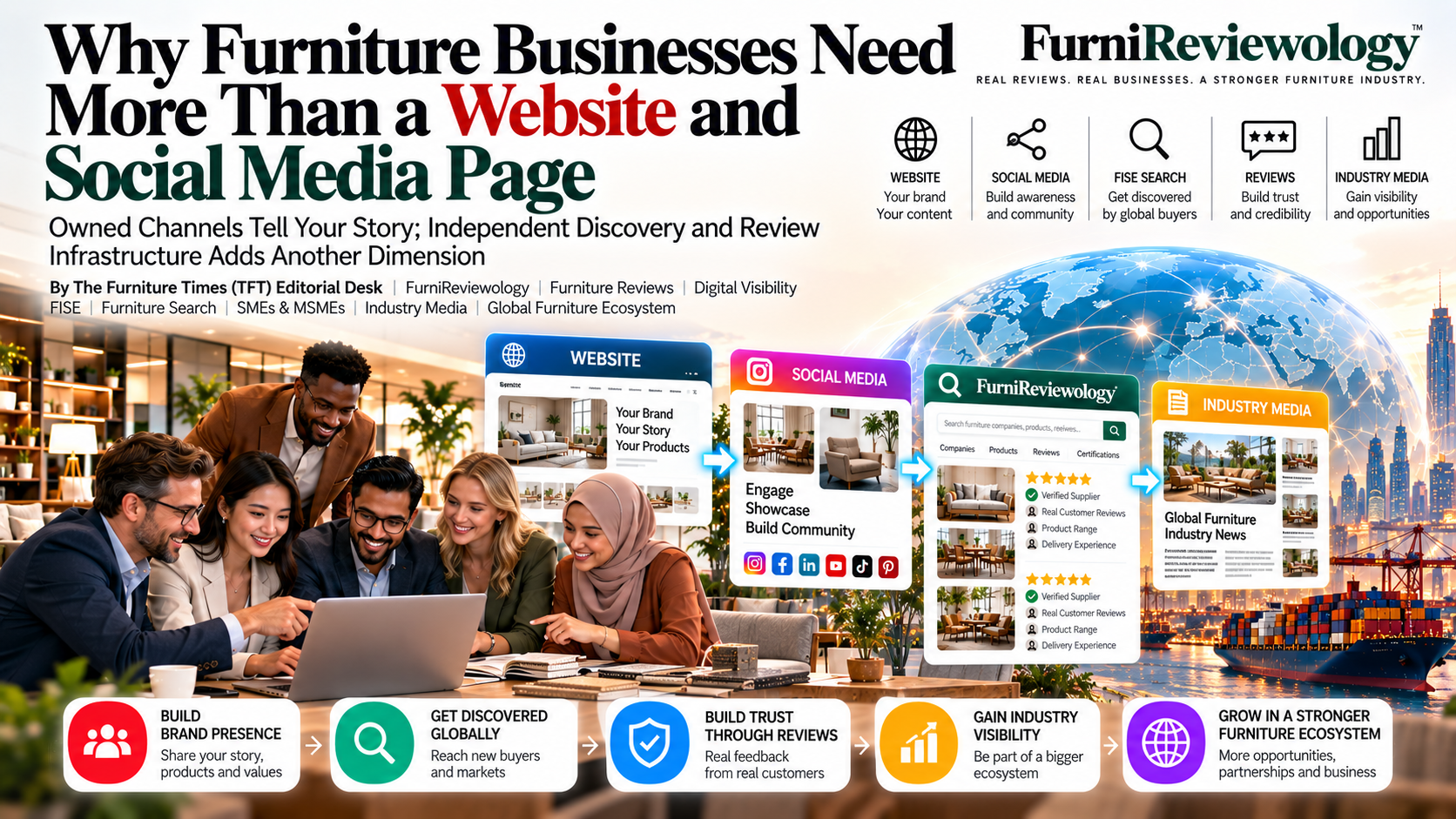
Why Furniture Businesses Need More Than a Website and Social Media Page
Owned Channels Tell Your Story; Independent Discovery and Review Infrastructure Adds Another Dimension
By The Furniture Times (TFT) Editorial Desk | FurniReviewology | Furniture Reviews | Digital Visibility | FISE | Furniture Search | SMEs & MSMEs | Industry Media | Global Furniture Ecosystem
Ask a furniture company whether it has a digital presence and the answer will often be:
“Yes, we have a website.”
Or:
“Yes, we are on Facebook and Instagram.”
That is important.
Every serious furniture business should have a professional website where appropriate.
Social media can be extremely valuable for displaying products, communicating with customers, building audiences and demonstrating what a company does.
But there is an important distinction furniture businesses need to understand:
Having Your Own Digital Channels Is Not the Same as Having a Complete Digital Footprint.
Your website is your property.
Your social pages are your voice.
You decide what to publish.
You choose the photographs.
You write the descriptions.
You select the products.
You tell the company story.
That is exactly what owned channels are supposed to do.
But today’s buyers may want something more.
They may want to discover you independently.
They may want to research you beyond your website.
They may want to read customer experiences.
They may want to find industry references.
They may want to understand your wider reputation.
They may want to know what the rest of the digital ecosystem says about the business.
That is why furniture companies increasingly need more than:
Website + Social Media.
They need a broader digital presence built around:
Owned Presence + Searchability + Reviews + Industry Visibility + Reputation.
Your Website Is Your Digital Headquarters
The importance of a website should not be underestimated.
A strong furniture website can explain:
who you are,
what you manufacture or sell,
your product categories,
your services,
your locations,
your history,
your manufacturing capabilities,
your projects,
your catalogues,
your contact information,
and your brand positioning.
For many buyers, the company website remains one of the first places they visit.
It should therefore be:
accurate,
professional,
mobile-friendly,
easy to navigate,
current,
clear,
and useful.
But there is one limitation.
Your Website Is Written by You.
That does not make it unreliable.
It simply means the buyer understands that it represents the company’s own perspective.
Your Social Media Is Your Conversation
Social media performs another important role.
Furniture is highly visual.
Instagram, Facebook, LinkedIn, Pinterest, YouTube, TikTok and other platforms can help companies showcase:
new products,
showrooms,
factories,
projects,
installations,
design ideas,
collections,
trade fairs,
customer stories,
behind-the-scenes activity,
and company culture.
Social platforms can humanize a furniture business.
They can create community.
They can generate enquiries.
They can keep existing customers engaged.
But again, social media has limitations.
Followers are not the same as buyers.
Likes are not the same as reputation.
Views are not the same as trust.
And social-media reach is partly controlled by platforms and algorithms the furniture company does not own.
Followers Are Useful — Discoverability Is Different
Imagine a furniture manufacturer has 100,000 social-media followers.
That sounds impressive.
But an international buyer searching for a specialized supplier may never see that company’s posts.
Now imagine another manufacturer with only 3,000 followers.
But its company information is:
well structured,
searchable,
listed in relevant industry environments,
supported by genuine customer experiences,
and connected to relevant industry information.
Which business is easier for the right buyer to research?
Follower count alone cannot answer that question.
This is the distinction between audience and discoverability.
Social media helps you communicate with people who encounter your content.
Search infrastructure helps people find you when they have a specific need.
Both matter.
The Buyer May Never Follow You
This is particularly important in B2B furniture.
A hotel procurement manager may never follow your Instagram page.
An importer may never like your Facebook post.
An architect may never subscribe to your YouTube channel.
A retailer may never comment on your LinkedIn update.
But one day they may search:
“outdoor furniture manufacturer”
“hotel furniture supplier”
“office chair manufacturer”
“custom furniture factory”
“furniture hardware supplier”
“contract furniture manufacturer”
“rattan furniture exporter”
or another highly specific requirement.
At that moment, follower count matters less.
Searchability Matters More.
Owned Media Answers: “What Do We Say About Ourselves?”
Your website and social channels allow you to say:
We manufacture quality furniture.
We have 20 years of experience.
We serve hospitality.
We export internationally.
We specialize in outdoor furniture.
We provide custom manufacturing.
We care about our customers.
All of this information is valuable.
But the buyer may then ask another question:
“What Else Can I Find About This Company?”
That is where the wider digital footprint begins.
Independent Discovery Answers: “Can I Find You Outside Your Own Channels?”
A digitally mature furniture business should ideally be discoverable beyond its own website.
The buyer should be able to encounter the company through relevant:
search environments,
industry platforms,
business listings,
review platforms,
industry media,
trade-event references,
professional networks,
and other credible digital sources.
This creates multiple discovery paths.
That matters because buyers do not all begin in the same place.
One may start with Google.
Another with FISE.
Another with an AI assistant.
Another with industry media.
Another with a review platform.
Another with a recommendation.
Another with social media.
The stronger the digital footprint, the more routes can potentially lead back to the company.
Think of Your Digital Presence as a Network, Not a Page
Many companies still think:
Website = Digital Presence.
A better model is:
Your Website
Your digital headquarters.
Social Media
Your conversation and audience.
Search
Your discoverability.
Reviews
Your customer-experience layer.
Industry Media
Your business story and wider context.
Structured Listings
Your industry identity.
Together, these create a much broader presence.
FurniReviewology Adds the Review and Reputation Dimension
This is where FurniReviewology can add another layer.
A company’s own website may publish testimonials.
Those can be valuable.
But buyers may also want to research customer experiences within an environment focused on furniture businesses.
FurniReviewology is being developed around:
furniture company listings,
company profiles,
reviews,
customer experiences,
reputation,
and industry-specific context.
This creates a different relationship from the company website.
The company tells its own story through owned channels.
Customers can contribute their experiences through the review layer.
One Is Company Voice. The Other Adds Customer Voice.
Both can be valuable.
A Testimonial and an Independent Review Are Not Exactly the Same
Furniture companies often publish customer testimonials on their websites.
They should continue doing so where those testimonials are genuine and appropriately presented.
But buyers understand that businesses normally select which testimonials appear on their own sites.
Independent review infrastructure adds another dimension.
The company does not completely control the conversation.
That can make the feedback more informative.
Positive experiences can strengthen confidence.
Critical experiences can reveal improvement opportunities.
Professional company responses can demonstrate how problems are handled.
The result can be more useful than a page containing only selected praise.
FISE Adds the Discovery Dimension
Then comes another question:
How does a buyer find the business in the first place?
That is where FISE — Furniture Industry Search Engine becomes important.
The furniture ecosystem is highly fragmented.
There are:
manufacturers,
brands,
retailers,
wholesalers,
distributors,
exporters,
importers,
designers,
component suppliers,
material companies,
machinery businesses,
service providers,
and many specialized categories.
General search serves the entire internet.
FISE focuses on the furniture-industry ecosystem.
Its role is simple:
Make Furniture Businesses Easier to Find.
Search Intent Is Commercially Powerful
There is a major difference between:
someone casually seeing your furniture post,
and someone actively searching for:
“hospitality furniture supplier.”
The second person has intent.
They are looking for something.
That makes search visibility strategically important.
Social media can create demand.
Search can capture existing demand.
Furniture businesses need to understand both.
TFT Adds the Industry Storytelling Dimension
Then there is another question:
What is your company doing?
A website may describe your business.
Reviews may describe customer experiences.
Search may help buyers find you.
But meaningful company developments deserve a wider industry record.
Perhaps your company:
opened a new factory,
introduced a collection,
expanded into another country,
developed sustainable furniture,
invested in machinery,
completed a major hotel project,
received certification,
appointed leadership,
entered a partnership,
participated in an exhibition,
or introduced new manufacturing technology.
These developments are part of your business story.
The Furniture Times — TFT provides the industry media and intelligence dimension.
This creates another layer of searchable context around the company.
Website + Social + FISE + FurniReviewology + TFT
The ecosystem can therefore be understood as complementary rather than competitive.
Your Website
What we say about ourselves.
Your Social Media
What we show and discuss with our audience.
FISE
How furniture-industry buyers can discover us.
FurniReviewology
What customers experience and how our reputation develops.
The Furniture Times
What our company is doing within the wider industry.
These layers answer different questions.
Together, they create a stronger digital footprint.
A Furniture Business Should Not Depend on One Digital Door
Imagine your website is your showroom.
Would you build a showroom in the middle of nowhere and simply hope people discover it?
Probably not.
You would want:
roads,
signage,
maps,
directions,
recommendations,
advertising,
and visibility.
The same logic applies digitally.
A website without external discoverability can become an isolated showroom.
A social page without search visibility can become a conversation happening inside one room.
The goal is to create multiple digital roads leading to the business.
Platform Dependence Is a Business Risk
There is another reason not to depend entirely on social media.
Algorithms change.
Organic reach changes.
Platforms rise and fall.
Accounts can experience technical problems.
Advertising costs fluctuate.
Audience behavior changes.
A business that depends on one social platform for nearly all its visibility is exposed to platform risk.
Diversifying the digital footprint is therefore not only a marketing strategy.
It can also be a resilience strategy.
Your Website Should Remain the Foundation
This does not mean furniture businesses should abandon websites.
Quite the opposite.
Your website should remain a central digital asset.
But instead of expecting the website to perform every function, build an ecosystem around it.
Search can lead buyers to the website.
FISE can help buyers discover the company.
FurniReviewology can provide reputation context.
TFT coverage can document relevant business developments.
Social media can distribute stories and products.
Each layer can reinforce the others.
SMEs and MSMEs Need This Strategy Most
Large furniture brands can spend heavily on:
advertising,
SEO,
influencers,
marketplaces,
public relations,
trade exhibitions,
content production,
and digital campaigns.
Many SMEs and MSMEs cannot.
But smaller companies still need discoverability.
This is why industry infrastructure matters.
A small furniture manufacturer may not have a huge marketing department.
But it can:
maintain a professional website,
create a free FurniReviewology listing,
become searchable through FISE,
encourage genuine customer reviews,
share meaningful business developments with TFT,
and maintain relevant social channels.
This creates a broader footprint without requiring the company to behave like a multinational advertising organization.
Twenty Years of Business Should Not Be Hidden Behind One Facebook Page
This problem is common.
A furniture company has operated since 2006.
It has completed thousands of orders.
Its founder has decades of experience.
It has loyal customers.
Its products are respected locally.
But digitally, the entire business history is represented by:
one Facebook page,
an old website,
and a few product photographs.
That digital identity does not reflect the real business.
Twenty Years of Experience Deserves More Than Twenty Social Posts.
Furniture companies should document their history.
Milestones.
Projects.
Products.
Capabilities.
Customer experiences.
Expansion.
Leadership.
Achievements.
Industry participation.
Digital reputation should accumulate as the company grows.
Do Not Confuse Posting With Building a Digital Asset
A social post can disappear from attention within hours or days.
A structured company profile can remain useful much longer.
A review can influence future buyers months later.
An industry article can become part of searchable business history.
A categorized listing can help discovery repeatedly.
This is why businesses should think beyond content production.
The question is not merely:
“What should we post today?”
It is:
“What Digital Assets Are We Building for Tomorrow?”
Reviews Can Become Long-Term Reputation Assets
A genuine customer review can continue helping future buyers long after it is published.
A detailed review discussing:
quality,
delivery,
communication,
durability,
or after-sales service
can provide information repeatedly.
This makes customer experience part of the company’s long-term digital footprint.
Businesses should therefore stop treating reviews as a marketing campaign that happens once a year.
Reputation should be built continuously.
Industry Coverage Can Become Searchable Corporate History
The same applies to industry media.
Imagine a furniture manufacturer has meaningful coverage documenting:
a 2026 factory expansion,
a 2027 sustainability initiative,
a 2028 export-market entry,
a 2029 technology investment,
and a 2030 product innovation.
Over time, these stories form a digital timeline.
A buyer researching the company years later can understand its evolution.
That is much richer than a static “About Us” page saying:
“We are a leading furniture company.”
Independent Information Can Strengthen Your Own Story
Some businesses fear that external platforms weaken control over their brand.
A better perspective is that credible external information can reinforce the company’s own communications.
Your website says:
“We serve hospitality projects.”
Industry coverage documents a hospitality project.
Customer feedback discusses the experience.
FISE categorizes the company within relevant furniture segments.
Now several independent information layers point in a consistent direction.
That creates a stronger digital picture.
Consistency Across Platforms Is Essential
There is one important condition.
Your information should be consistent.
If your website says one thing,
your social page says another,
your company listing contains an old address,
and another profile uses an outdated phone number,
the digital footprint becomes confusing.
Furniture businesses should regularly audit:
company name,
website,
phone numbers,
email,
location,
business description,
product categories,
leadership information,
and other important company details.
A wider digital footprint only works well when the information is maintained.
The AI Era Makes External Digital Presence Even More Important
Furniture discovery is entering another phase.
People increasingly use AI tools to research companies, products and markets.
They may ask:
“Find furniture manufacturers suitable for hotel projects.”
“Which companies manufacture outdoor furniture in Asia?”
“Who supplies ergonomic office furniture?”
“Compare furniture suppliers for a residential project.”
AI systems attempt to understand businesses through available digital information.
A company represented only by a thin website and a lightly maintained social page may provide limited context.
A richer digital footprint gives digital systems more structured information through which the business can potentially be understood.
This is another reason companies need to think beyond isolated channels.
You Are Increasingly Building for Two Audiences
Furniture businesses now have to communicate with:
Humans
Buyers, architects, retailers, consumers, designers, procurement professionals and partners.
And increasingly:
Machines
Search engines, AI systems, recommendation engines and digital discovery tools.
Both need clarity.
What does the company do?
Where does it operate?
Which categories does it serve?
What products does it provide?
What reputation signals exist?
What industry context exists?
Structured digital presence is becoming increasingly important.
The New Furniture Digital Visibility Stack
A modern furniture business can think about visibility in layers.
Layer 1 — Website
Your digital headquarters.
Layer 2 — Social Media
Your audience, community and communication.
Layer 3 — Search
Your discoverability.
Layer 4 — Industry Listing
Your structured furniture-business identity.
Layer 5 — Reviews
Your customer-experience and reputation layer.
Layer 6 — Industry Media
Your company story and wider visibility.
Layer 7 — AI Discoverability
How machines understand and potentially surface your business.
The companies that intentionally develop these layers will create much stronger digital footprints than those relying on a single website or social page.
Free FurniReviewology Listing: Start With the Next Layer
For furniture companies asking:
“Where should we start?”
The answer does not have to be complicated.
If you already have a website and social presence, add another layer.
Get your furniture business listed on FurniReviewology.
Build the company profile.
Make the business understandable.
Keep the information accurate.
Encourage genuine customer experiences.
Then strengthen FISE searchability.
Share meaningful company developments with TFT.
Build progressively.
Manufacturers Should Be There
Whether you manufacture:
home furniture,
office furniture,
outdoor furniture,
hospitality furniture,
school furniture,
healthcare furniture,
kitchen furniture,
mattresses,
upholstered furniture,
wood furniture,
metal furniture,
or specialist products,
your company should become easier to discover and research.
Suppliers Should Be There
Components matter.
Hardware matters.
Foam matters.
Fabric matters.
Leather matters.
Panels matter.
Finishes matter.
Machinery matters.
Packaging matters.
Logistics matters.
The furniture ecosystem extends far beyond finished furniture.
These companies also need digital visibility.
Retailers and Brands Should Be There
Consumers increasingly research before buying.
Your reputation should not depend only on advertising.
Build:
searchability,
reviews,
industry context,
and a wider digital footprint.
SMEs and MSMEs Must Not Miss the Opportunity
Smaller businesses should not wait until every large competitor has established years of digital history.
Start now.
A digital footprint compounds.
One company profile becomes part of your identity.
One genuine review adds experience.
One industry article adds context.
One searchable listing adds another discovery route.
One company update adds history.
Over time, the footprint becomes stronger.
Digital Reputation Is Built Layer by Layer.
Your Website Tells Your Story — The Ecosystem Helps the World Discover It
This is the central distinction.
Your website remains essential.
Your social media remains valuable.
Keep investing in both.
But do not stop there.
The modern furniture buyer moves across an information ecosystem.
They search.
They compare.
They read.
They investigate.
They check reviews.
They study companies.
They follow industry developments.
They ask AI.
Then they decide whom to contact.
Furniture businesses therefore need to be present at more than one point in that journey.
Don’t Build a Digital Island
A website without discovery is an island.
A social account without wider visibility is an island.
A company profile without updated information is an island.
The future opportunity is connectivity.
Connect:
your website to search,
search to your company profile,
your profile to reputation,
reputation to genuine customer experience,
your company developments to industry media,
and all of it to a structured digital identity.
That is how a furniture business begins moving from simply being online to becoming digitally discoverable.
Your Business Deserves More Than a Website Address
A furniture company is more than its homepage.
It is:
its history,
its people,
its products,
its customers,
its reputation,
its projects,
its expertise,
its service,
its achievements,
and its contribution to the furniture ecosystem.
Your digital footprint should reflect that.
So keep your website.
Keep your social media.
Improve them.
But add the missing layers.
Get listed.
Become searchable.
Encourage genuine reviews.
Build your reputation.
Tell your company story.
Document your achievements.
Create multiple paths through which buyers can discover you.
Because the question is no longer simply:
“Does Your Furniture Business Have a Website?”
The more important question is:
“Can the World Find, Understand, Research and Trust the Business Behind It?”
The Global Furniture Ecosystem
The Furniture Industry is a $1 Trillion USD Ecosystem in the world
Furniture Industry Search Engine – FISE helps the world find them.
The Furniture Times – TFT tells their story.
FurniReviewology helps the world trust them.