North America’s Decking Economy: Why Outdoor Living Remains Big Business
Understanding renovation, suburban homes, composite materials, contractor networks and the continuing commercial importance of backyard investment
By The Furniture Times (TFT) Editorial Desk | Decking & Fencing | North America | Outdoor Living | Residential Renovation | Building Materials | Global Market Intelligence
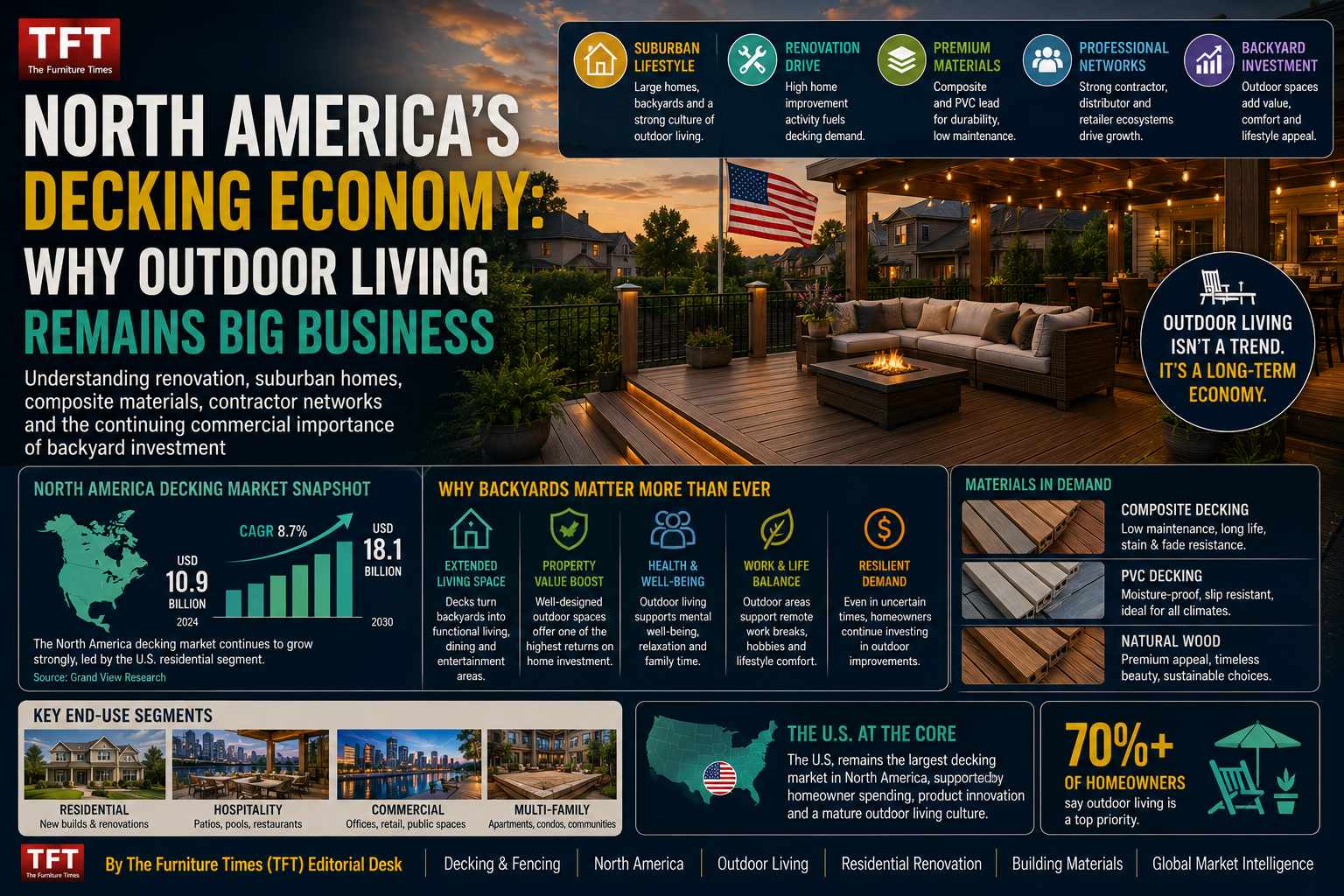
North America remains one of the world’s most influential decking markets.
Across the United States and Canada, decks are deeply connected to suburban housing, gardens, pools, outdoor dining, family entertainment and residential renovation. Mexico adds a different but increasingly important opportunity through tourism, hospitality, premium housing, coastal development and expanding urban markets.
The North American decking economy is considerably larger than the value of deck boards alone.
It includes timber producers, composite manufacturers, railing companies, fastener suppliers, distributors, home-improvement retailers, builders, specialist contractors, architects, landscape designers, outdoor furniture brands, lighting companies, pergola suppliers, repair businesses and property-maintenance providers.
Every residential deck can trigger spending on multiple surrounding categories:
- Outdoor dining furniture
- Lounge seating
- Barbecues and outdoor kitchens
- Parasols and shade structures
- Pergolas
- Railings and balustrades
- Privacy screens
- Planters and landscaping
- Lighting and electrical systems
- Pool equipment
- Cleaning and maintenance
- Stairs, gates and access systems
This helps explain why decking remains strategically important even when housing markets become uncertain. A slowdown in new-home construction does not eliminate the enormous installed base of existing homes requiring repair, renovation, replacement and lifestyle upgrades.
Outdoor living has become part of the long-term North American home-improvement economy.
A market supported by the scale of American housing
The United States provides the central economic engine.
The country has an extensive stock of detached and single-family homes, many with gardens, patios, porches or existing decks. These properties generate recurring demand over decades.
New construction creates the first installation. Weathering, material deterioration and changing homeowner preferences create later repair and replacement cycles. Property sales can trigger further upgrades as new owners renovate outdoor areas.
The broader U.S. construction market remains enormous despite softer conditions in parts of the sector. U.S. Census Bureau data placed total construction spending at a seasonally adjusted annual rate of approximately US$2.17 trillion in June 2026. Private residential construction accounted for approximately US$877.1 billion of that rate. These figures cover the overall construction market rather than decking specifically, but they illustrate the economic foundation surrounding residential building products. U.S. Census Bureau
Decking demand is influenced by new housing, but the category is not fully dependent upon it.
Existing-home renovation, deferred maintenance, storm damage, resale preparation and outdoor-lifestyle investment create separate demand streams.
Why renovation matters more than one year of housing starts
Decking manufacturers often monitor new residential construction because new homes create direct material demand. But focusing only on housing starts can understate the sector’s resilience.
A deck is a long-life home component with recurring intervention points:
- Initial installation
- Cleaning and inspection
- Staining, sealing or surface treatment
- Board repair
- Railing replacement
- Stair or substructure repair
- Resurfacing
- Complete replacement
- Expansion or redesign
- Addition of furniture, shade or an outdoor kitchen
Even when households are reluctant to move, they may invest in their present homes. High relocation costs, limited housing supply or expensive financing can encourage owners to improve the property they already occupy.
A relatively modest deck upgrade can also appear more achievable than a major interior extension. It can increase usable living space without creating a fully enclosed room.
This makes decking part of both the construction economy and the lifestyle-upgrade economy.
The backyard has become an outdoor room
The North American deck has evolved from a basic timber platform into a carefully planned residential environment.
Homeowners increasingly expect outdoor areas to perform functions previously associated with interiors:
- Dining
- Cooking
- Entertaining
- Relaxing
- Working
- Exercising
- Hosting children
- Poolside recreation
- Watching television
- Seasonal gatherings
This changes purchasing behaviour.
The homeowner is no longer buying square metres of decking in isolation. The homeowner is buying the foundation of an experience.
The deck must coordinate with furniture, lighting, shade, landscaping and the architecture of the home. It may require separate cooking, dining and lounge zones. Electrical outlets, drainage, privacy and movement become important.
As decks become more sophisticated, the economic value of each project can rise beyond the surface material.
Suburban housing remains the industry’s structural advantage
North America’s suburban geography is one of the decking industry’s greatest advantages.
Detached housing frequently offers:
- Rear gardens
- Side access
- Pools
- Sloped sites
- Raised entrances
- Basements opening onto outdoor areas
- Space for additions
- Privacy requirements
- Outdoor entertaining traditions
Decking can solve several physical problems at once.
A raised deck can connect an elevated interior floor with the garden. A multi-level deck can address sloping terrain. A pool deck can provide safer circulation and furniture placement. A privacy screen can make neighbouring homes feel more separated.
This housing pattern is difficult to reproduce in dense global cities where most households live in high-rise apartments. It gives North America a deep, structurally established addressable market.
New-home construction still creates important demand
Although renovation is essential, new housing remains a meaningful source of decking activity.
Home builders may include decks, patios or porches as standard features, upgrades or post-completion additions. Developers can use outdoor-living packages to differentiate properties in competitive markets.
The National Association of Home Builders’ 2024 construction-cost study recorded outdoor structures—including decks, patios and porches—as a distinct component of single-family home construction costs. In the study’s representative home, this category averaged US$4,722, or 1.1% of total construction cost. Actual project costs can vary substantially according to size, material and region. National Association of Home Builders
For developers, a deck can be more than a cost item. It can strengthen the emotional appeal of a property by helping potential buyers imagine gatherings, meals and leisure.
The composite-material transformation
One of the most important changes in North American decking has been the growth of wood-plastic composites and other engineered alternatives.
Traditional timber remains significant, particularly pressure-treated lumber, cedar, redwood and hardwood products. Yet composites have expanded by addressing consumer concerns over staining, sealing, splinters, checking, decay and routine maintenance.
A 2026 market estimate identified North America as the largest regional market for composite railing and decking in 2025, with a 29.2% share of the global category. The same report projected strong global expansion through 2033. As with all commercial market forecasts, its definitions and assumptions should be reviewed before using the figures for investment decisions. Grand View Research
Another 2026 industry study estimated that North America represented 49.4% of the global composite decking and railing market by value in 2025 and that residential applications accounted for 72.4% of the market. The difference between published shares demonstrates how methodology and market definitions can produce materially different results. MarketsandMarkets
The consistent conclusion is that North America remains a major centre of composite-material demand.
Why consumers choose composites
Composite decking can appeal to homeowners seeking:
- Lower routine maintenance
- Consistent colour and texture
- Resistance to splintering
- Hidden-fastener installation
- Long warranties
- Coordinated railing systems
- Broad design choices
- Reduced need for staining or sealing
- A cleaner contemporary appearance
However, “low maintenance” should never be presented as “no maintenance.”
Composite decks still require cleaning and inspection. They can be affected by staining, scratching, mould on surface debris, heat, movement and installation errors. Individual products vary in their resistance to fading, moisture and wear.
Customers should compare technical evidence rather than assume that every composite performs equally.
Timber remains commercially important
Composite growth does not mean timber is disappearing.
Wood remains attractive because it offers:
- Natural appearance
- Familiar installation
- Established contractor knowledge
- Wide distribution
- Repairability
- Multiple species and price levels
- The ability to refinish or change colour
- Strong connection with traditional home design
A 2026 wooden-decking market estimate placed North America at 38% of global revenue in 2025. It identified pressure-treated timber as the largest material segment within its definitions. Fortune Business Insights
Timber’s disadvantages depend heavily on species, treatment, design and maintenance. Poor drainage, unsealed cuts, inadequate ventilation and unsuitable fasteners can shorten service life.
The real competition is not simply wood versus composite. It is properly designed, installed and maintained systems versus poorly executed ones.
The material decision is becoming a lifecycle decision
Homeowners increasingly compare more than purchase price.
They may consider:
- Initial material cost
- Installation labour
- Substructure requirements
- Cleaning frequency
- Staining and sealing
- Expected service life
- Replacement-board availability
- Warranty exclusions
- Surface temperature
- Colour retention
- Repairability
- Resale appeal
- End-of-life options
Timber may have a lower initial price in some markets but require periodic treatment. Composite materials may cost more initially but reduce certain maintenance tasks.
No universal answer applies to every homeowner. The correct choice depends on climate, exposure, usage, budget, aesthetic preference and willingness to maintain the product.
The contractor economy behind every deck
Decking is not merely a materials market. It is a skilled-service economy.
A complete project can involve:
- Site surveyors
- Designers
- Permit specialists
- Excavation contractors
- Carpenters
- Deck builders
- Electricians
- Gas installers
- Landscapers
- Pool contractors
- Railing installers
- Painters and finishers
- Inspectors
- Waste carriers
- Repair technicians
The quality of installation can determine whether a premium product performs successfully.
Common causes of failure include:
- Inadequate foundations
- Incorrect joist spacing
- Poor flashing
- Trapped moisture
- Insufficient ventilation
- Incorrect fasteners
- Failure to allow expansion
- Weak railing connections
- Unsafe stairs
- Poor ledger-board attachment
- Inaccessible utilities
- Non-compliant structural alterations
The contractor is therefore one of the most influential participants in the customer experience.
Manufacturers must treat installer training as part of product quality.
Skilled-labour availability can limit market growth
Homeowners may want to build or replace a deck but struggle to find qualified contractors.
Labour shortages can create:
- Long waiting periods
- Higher quotations
- Inconsistent installation quality
- Limited geographic service
- Reduced adoption of unfamiliar systems
- Difficulty obtaining repairs
- Consumer mistrust
Products that simplify installation may gain attention, but simplification cannot remove structural responsibility.
Modular systems, pre-cut components, digital estimating, installation guides and contractor certification can improve efficiency. However, decks remain load-bearing structures, and safety must not be compromised for speed.
Railings, stairs and components multiply project value
Decking boards receive much of the attention, but complete projects depend on an extensive component economy.
This includes:
- Joists and beams
- Posts and foundations
- Ledger systems
- Flashing
- Hidden clips
- Screws and connectors
- Railings
- Balusters
- Handrails
- Gates
- Stairs
- Fascia
- Drainage systems
- Lighting
- Skirting
- Privacy screens
Railings can represent a meaningful share of project expenditure, particularly when homeowners select aluminium, composite, cable or glass systems.
Integrated product families give manufacturers an advantage because customers can coordinate boards, railings, fascia, lighting and accessories from a compatible system.
Outdoor furniture completes the economic cycle
A deck without furniture is an unfinished platform.
Once the surface is constructed, customers may purchase:
- Dining tables and chairs
- Lounge sets
- Daybeds
- Rocking chairs
- Benches
- Bar furniture
- Storage boxes
- Parasols
- Fire tables
- Outdoor kitchens
- Planters
- Decorative accessories
This connects the decking economy directly with the furniture ecosystem.
Deck specifications should consider furniture before construction begins. Heavy tables, large planters and outdoor kitchens may create concentrated loads. Furniture arrangements determine circulation, electrical requirements and the placement of stairs or railings.
Decking and furniture companies could create stronger value through coordinated displays, shared project guides and cross-category retail partnerships.
Climate creates multiple North American submarkets
North America cannot be served with one climate strategy.
Humid and wet regions
The Pacific Northwest, southeastern United States, parts of Canada and coastal areas require strong moisture management.
Priorities include:
- Drainage
- Ventilation
- Decay resistance
- Corrosion-resistant fasteners
- Surface cleaning
- Mould management
- Proper flashing
Cold and snowy regions
Canada and the northern United States require products that tolerate freeze-thaw cycles, snow, ice and seasonal temperature movement.
Designers must consider snow loads, safe access, surface conditions and winter maintenance practices.
Hot and sunny regions
The southern United States and Mexico require attention to UV resistance, fading, thermal movement and surface temperature.
A dark-coloured deck can become extremely uncomfortable under direct sun, regardless of how attractive it appears in a showroom.
Coastal regions
Salt exposure can accelerate corrosion in fasteners, railings and hardware. The complete assembly—not only the deck board—must be suitable for the environment.
Wildfire-prone areas
Parts of the western United States and Canada require consideration of fire exposure, vegetation management, material selection, under-deck debris and local construction requirements.
Claims of fire resistance must be supported by relevant testing and must not be generalised beyond the tested assembly.
Canada’s renovation and replacement opportunity
Canada represents an important and technically demanding decking market.
Detached homes, cottages, lake properties and a strong summer outdoor culture support demand. The shorter outdoor season does not eliminate investment; it can make summer space especially valuable.
Canada’s extensive existing housing stock creates recurring repair and renovation requirements. Statistics Canada reported in 2024 that more than one in fourteen households needed major repairs, while nearly one in four required minor repairs. The figures refer to overall dwelling conditions rather than decks specifically, but they illustrate the scale of property-maintenance needs. Statistics Canada
Statistics Canada also maintains a Residential Renovation Price Index measuring changes in what contractors charge for renovation projects, including materials, labour, equipment, overhead and profit. The index’s continued publication reflects the economic importance of renovation services. Statistics Canada
Canadian customers need products and installation systems adapted to severe temperature variations. Replacement-component availability is particularly important because discontinued boards or colours can make partial repairs difficult.
Mexico’s distinct decking economy
Mexico is sometimes overlooked in discussions of North American decking, but it offers valuable opportunities.
The market differs significantly from the United States and Canada. Demand is concentrated in:
- Resorts and hotels
- Coastal properties
- Premium residences
- Gated communities
- Restaurants
- Pools
- Rooftop terraces
- Tourism infrastructure
- Landscape developments
Fencing may have a broader addressable market through residential security, industrial facilities, agriculture, logistics and infrastructure.
Mexico’s warm and coastal environments create strong outdoor-living potential but also technical demands involving UV exposure, heat, hurricanes, humidity and salt air.
Price sensitivity, regional economic differences and local contractor networks shape market entry. Products designed for northern U.S. climates cannot simply be transferred without adaptation.
The effect of higher construction and material costs
The North American decking sector is not insulated from affordability pressures.
The National Association of Home Builders has reported that building-material costs rose substantially after 2020 and that tariffs added further cost pressure for builders. Its April 2025 survey estimated a typical tariff-related effect of US$10,900 per new home, although the amount was a builder estimate and not decking-specific. National Association of Home Builders
Higher costs can affect decking in several ways:
- Homeowners reduce project size
- Construction is divided into phases
- Premium railings are substituted
- Timber gains advantage over composites—or the reverse, depending on local prices
- Repair is chosen instead of replacement
- DIY participation increases
- Financing becomes more important
- Buyers demand clearer lifecycle value
Manufacturers must therefore offer more than premium branding. They need product tiers, transparent performance information and systems that reduce installation waste.
Repair, resurfacing and deck renewal
Not every ageing deck requires complete replacement.
The growing installed base creates opportunity for:
- Inspection
- Structural repairs
- Board replacement
- Railing upgrades
- Stair reconstruction
- Resurfacing
- Cleaning
- Staining and sealing
- Under-deck drainage
- Lighting installation
- Expansion and redesign
Resurfacing can be attractive when the substructure remains safe and serviceable. However, placing new boards over an inadequately inspected structure can conceal serious problems.
The industry needs clearer distinction between cosmetic renewal and structural rehabilitation.
Qualified inspection should evaluate foundations, posts, beams, joists, ledgers, connections, stairs and railings—not only visible deck boards.
Safety and compliance cannot be treated as optional
Deck failures can cause serious injuries.
Projects must address relevant building requirements, permits, structural loads, guard heights, stair geometry, handrails, fasteners, foundations and connections to the building.
Pool decks may also involve barrier and gate requirements. Commercial decks face different occupancy, accessibility and fire considerations from private residential installations.
Homeowners may focus on colour and appearance, but the hidden structure determines safety.
Manufacturers, retailers and contractors should communicate this clearly. DIY accessibility must not create the impression that every deck project is a simple decorative installation.
Sustainability and circularity questions are increasing
North American customers and professional buyers are asking more questions about:
- Timber sourcing
- Recycled content
- Chemical treatment
- Product durability
- Maintenance requirements
- Repairability
- End-of-life recovery
- Plastic content
- Warranty length
- Manufacturing waste
- Local production
Sustainability comparisons require nuance.
Natural timber may be renewable when responsibly sourced and appropriately managed. Composite products may incorporate recycled materials and offer long service life. However, mixed-material products can be difficult to recycle. Chemically treated wood requires appropriate handling and disposal.
No material should be declared universally sustainable without examining sourcing, service life, maintenance, transport and end-of-life conditions.
The strongest products will provide transparent lifecycle information rather than rely on vague environmental language.
Digital tools are changing the sales process
Deck buyers increasingly begin online.
They search for:
- Deck builders near me
- Composite versus wood decking
- Deck cost per square foot
- Best decking for hot climates
- Low-maintenance deck materials
- Pool-deck options
- Deck railing ideas
- Outdoor kitchen deck design
- How to repair an old deck
- Decking warranties
- Financing options
Digital visualisation can help customers compare colours, board directions, railings and furniture layouts. Online estimating tools can support budgeting, while photographs and case studies help buyers understand the final environment.
AI-assisted tools may eventually support:
- Preliminary layouts
- Material quantities
- Climate-based product recommendations
- Maintenance forecasts
- Contractor matching
- Furniture-space planning
- Compliance checklists
These tools can improve decisions, but structural design and local compliance still require qualified human judgement.
The business opportunity extends beyond large brands
North America’s decking economy includes thousands of small and medium-sized participants:
- Local lumber dealers
- Independent deck builders
- Carpenters
- Railing fabricators
- Landscape contractors
- Repair specialists
- Designers
- Cleaning businesses
- Outdoor furniture retailers
- Component suppliers
Many of these businesses are highly capable but poorly discoverable.
A homeowner may find national product brands while struggling to identify a reliable installer. A contractor may find deck boards but not compatible hardware. A hotel may require a specialist in commercial outdoor refurbishment.
The industry needs better digital connections between products, professionals and locations.
Strategic outlook: why the market should remain significant
North America’s decking economy is supported by durable structural advantages:
- A large installed base of detached homes
- An established renovation culture
- Strong backyard and outdoor-entertaining lifestyles
- Mature distribution and contractor networks
- Significant timber and composite manufacturing
- Recurring repair and replacement cycles
- Integration with furniture, pools, kitchens and landscaping
- Growing interest in lower-maintenance systems
- High-value hospitality and commercial applications
- Product innovation in railings, lighting and accessories
The market will still move with interest rates, housing activity, material prices and consumer confidence. Some years will be stronger than others.
But outdoor living is no longer a temporary trend. It has become part of how many North American households evaluate and use their homes.
TFT, FISE and FurniReviewology: connecting the complete decking economy
The North American decking market is highly developed but remains fragmented across manufacturers, contractors, retailers, component suppliers, furniture businesses and repair professionals.
The Furniture Times can document material innovation, market movements, contractor challenges, installation practices and emerging outdoor-living opportunities.
Furniture Industry Search Engine can make manufacturers, distributors, installers and service businesses searchable by country, state, province, city, material and capability.
FurniReviewology can help customers evaluate products and professionals through credible experiences and transparent business information.
The Furniture Times tells their story.
Furniture Industry Search Engine helps the world find them.
FurniReviewology helps the world trust them.
The furniture industry ecosystem is a $1 trillion industry ecosystem, and North America’s decking economy connects housing, renovation, construction, landscaping and outdoor furniture within that larger commercial system.
The deck is the platform. Furniture creates the experience. Contractors deliver the structure. Components protect its performance. Reviews determine trust.
That is why North American outdoor living remains big business.
Be the next one. Be part of the movement.