
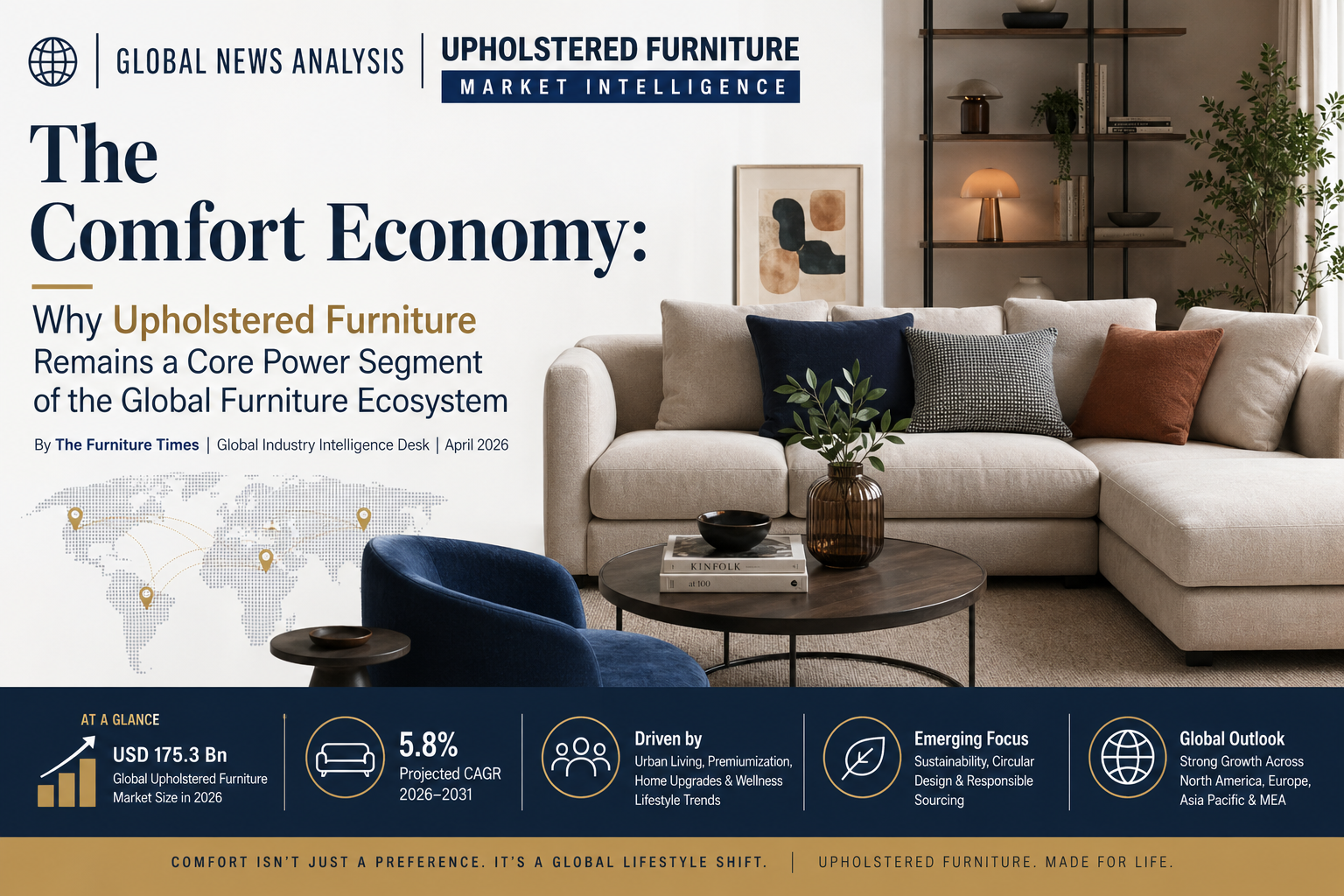
The Comfort Economy: Why Upholstered Furniture Remains a Core Power Segment of the Global Furniture Ecosystem
Global News Analysis | Upholstered Furniture Market Intelligence
By The Furniture Times | Global Industry Intelligence Desk | April 2026
Introduction: The Segment That Defines Comfort
Upholstered furniture remains one of the most important categories in the global furniture industry. Sofas, armchairs, recliners, sectionals, lounge seating, upholstered beds, and hospitality seating are not just products — they shape how people live, relax, work, host, and experience interiors.
The global upholstered furniture market is forecast to grow by USD 18.71 billion from 2026 to 2030, expanding at a 5.0% CAGR, according to Research and Markets. Fortune Business Insights also estimates the global upholstered furniture market at USD 73.71 billion in 2026, projected to reach USD 122.45 billion by 2034.
This makes upholstered furniture a high-value, design-sensitive, and globally competitive segment.
The Big Picture: Why Upholstered Furniture Matters
Upholstered furniture sits at the center of several major demand zones:
Residential living rooms
Hospitality lounges
Office breakout spaces
Luxury interiors
Outdoor comfort seating
Healthcare and assisted living
Commercial waiting areas
Retail and lifestyle environments
It is one of the few categories where comfort, design, material science, branding, and emotional lifestyle value all meet.
Market Direction: Growth with Pressure
The industry is growing, but not without challenges. Research and Markets forecasts steady expansion through 2030, while Lectra’s 2026 upholstered furniture industry analysis identifies uneven recovery, product variety pressure, smaller production runs, rising costs, labor shortages, global competition, and sustainability expectations as key trends.
This means the upholstered furniture industry is not only growing — it is becoming more complex.
Key Growth Drivers
1. Lifestyle Demand for Comfort
Consumers are investing in spaces that feel comfortable, warm, and personal. Sofas and lounge seating remain central to modern homes, while hotels, offices, and public spaces increasingly use upholstered furniture to create welcoming experiences.
2. Premiumization and Design Differentiation
Upholstered furniture is highly visible in interiors. Buyers are paying more attention to fabric quality, stitching, shape, durability, modularity, and comfort engineering.
3. Hospitality and Commercial Demand
Hotels, restaurants, offices, lounges, airports, and healthcare facilities all require upholstered seating. This makes the segment important beyond residential retail.
4. Outdoor Comfort Trend
Outdoor furniture is becoming softer and more lounge-like, with designers highlighting super-plump outdoor seating and indoor-style comfort for gardens and terraces.
5. E-Commerce and Customization
Online furniture buying is increasing, but upholstered furniture requires stronger digital product presentation because buyers want to understand fabric, size, comfort, color, and durability before purchase.
The Hidden Challenges
1. Rising Material Costs
Foam, fabric, leather, wood frames, metal mechanisms, and logistics costs affect margins. Upholstered furniture has many components, making it sensitive to cost movement.
2. Labor and Skill Pressure
Upholstery requires craftsmanship. Cutting, sewing, stitching, shaping, and finishing are skill-based processes. Labor shortages can directly affect quality and delivery.
3. Product Variety Complexity
Consumers want more colors, fabrics, shapes, sizes, and modular options. This increases production complexity and reduces the efficiency of large standard runs.
4. Sustainability Expectations
Buyers increasingly expect recycled fabrics, responsible wood frames, low-emission foam, repairability, and longer product life.
5. Business Failure Risk
The sector is not immune to financial pressure. Recent UK reporting noted that Westbridge Furniture entered administration, with nearly 300 jobs affected, showing how cost pressure and weak demand can hit even established suppliers.
The Search Bottom Line in Upholstered Furniture
The deeper issue is not only production. It is a discovery.
Buyers searching for upholstered furniture suppliers often struggle to find:
Sofa manufacturers
Contract seating suppliers
Hotel lounge furniture producers
Recliner manufacturers
Upholstered bed suppliers
Fabric and foam suppliers
Custom upholstery workshops
Export-ready upholstered furniture factories
The market has demand. The market has suppliers. But the global discovery system is still fragmented.
TFT Deep Analysis: The Upholstered Furniture Industry Is Entering a New Phase
Phase 1: Comfort Product
The traditional focus was sofas, chairs, and beds.
Phase 2: Lifestyle Statement
Upholstered furniture became part of interior identity and brand expression.
Phase 3: Comfort Intelligence
The next phase will be defined by ergonomics, materials, customization, sustainability, digital visibility, and faster buyer-supplier matching.
Role of FISE: Solving the Upholstered Furniture Discovery Gap
Furniture Industry Search Engine (FISE) can become the missing search infrastructure for upholstered furniture.
FISE can support:
Global upholstered furniture supplier listings
Category-based search for sofas, recliners, lounge seating, and upholstered beds
Country and city-level supplier discovery
Verified manufacturer profiles
Material and certification filters
Hospitality and contract furniture supplier discovery
AI-powered buyer-supplier matching
Example Use Case
A hotel developer searching for:
“Upholstered lounge seating suppliers for a 300-room hotel in Dubai”
Today, that search may involve scattered websites, trade contacts, catalogues, and manual verification.
With FISE, the buyer could compare verified suppliers by category, location, project capability, materials, export readiness, and contact availability.
Strategic Recommendations
For Manufacturers
Build clear category pages for sofas, recliners, modular seating, upholstered beds, and contract seating. Add fabric options, frame materials, production capacity, certifications, and project experience.
For Retailers
Use better supplier intelligence to manage inventory, diversify sourcing, and respond faster to changing consumer preferences.
For Hospitality Buyers
Prioritize suppliers with contract experience, durability standards, fire-safety compliance, and clear delivery capability.
For FISE
Create dedicated upholstered furniture vertical pages:
Global sofa manufacturers
Hotel upholstered furniture suppliers
Recliner manufacturers
Upholstered bed suppliers
Contract lounge seating suppliers
Sustainable upholstery material suppliers
Key Takeaways
1. Upholstered Furniture Remains a Core Growth Category
The market is forecast to grow steadily through 2030 and beyond.
2. Comfort Is Becoming a Strategic Selling Point
Consumers and commercial buyers want furniture that looks good and feels good.
3. Production Is Becoming More Complex
More customization, smaller batches, rising costs, and labor pressure are reshaping manufacturing.
4. Sustainability Is Becoming a Market Requirement
Eco-conscious materials, longer product life, and responsible sourcing are becoming important.
5. Search and Supplier Discovery Remain Weak
FISE can solve this by organizing upholstered furniture suppliers into a searchable, verified, global category system.
Conclusion: Upholstery Is the Comfort Engine of the Industry
Upholstered furniture is not just another category. It is one of the emotional centers of the furniture industry.
It defines comfort.
It shapes interiors.
It drives lifestyle decisions.
It supports hospitality experiences.
It reflects design identity.
But its future will depend on more than style. The next phase will be defined by:
Search + Trust + Materials + Sustainability + Intelligence
Final Thought
The future of upholstered furniture belongs to companies that combine comfort with visibility, craftsmanship with data, and design with trust.
