
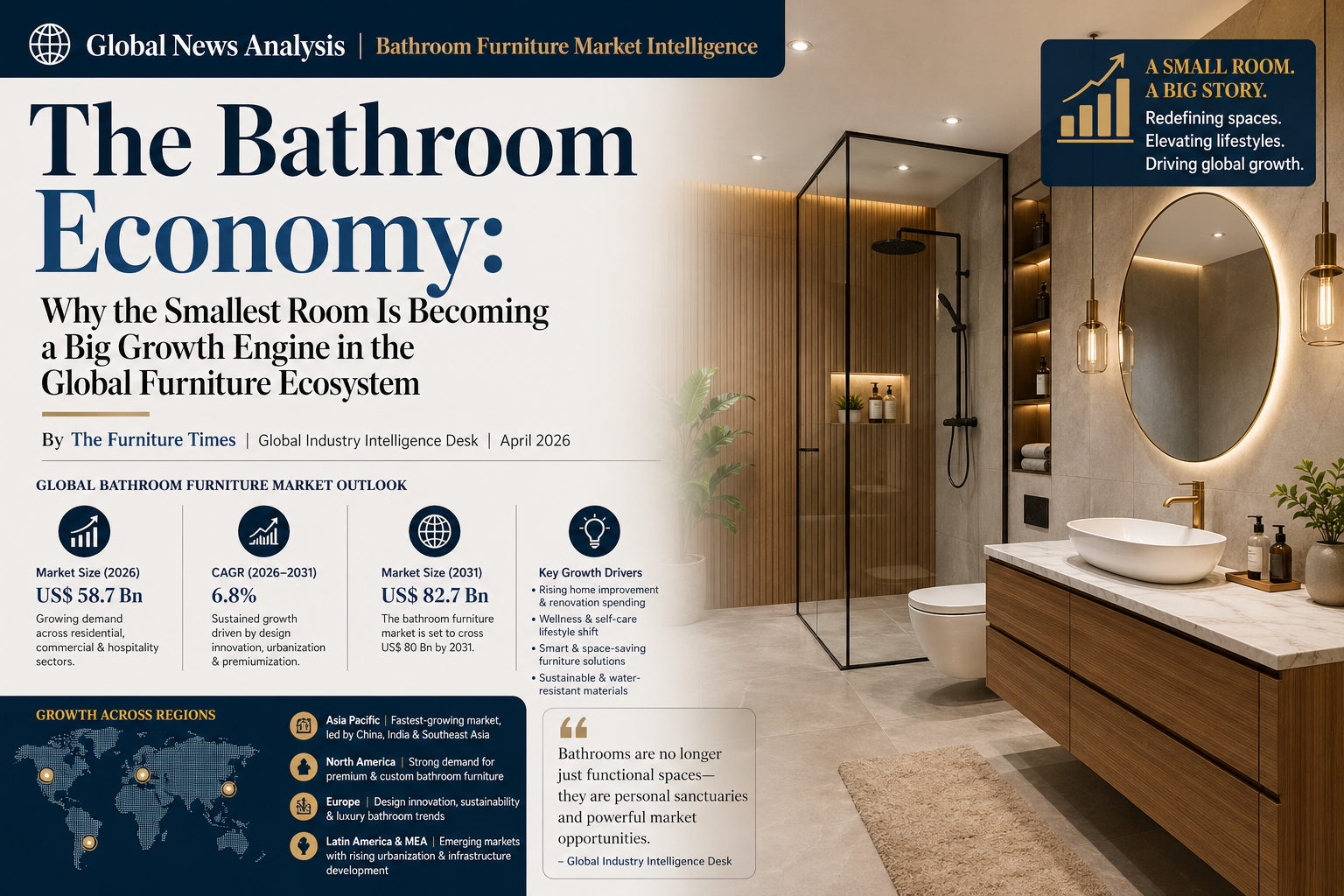
The Bathroom Economy: Why the Smallest Room Is Becoming a Big Growth Engine in the Global Furniture Ecosystem
Global News Analysis | Bathroom Furniture Market Intelligence
By The Furniture Times | Global Industry Intelligence Desk | April 2026
Introduction: A Strategic Segment Hidden in Plain Sight
The bathroom has quietly transformed from a purely functional space into a design, wellness, and lifestyle zone—and this shift is driving a powerful evolution in the global furniture industry.
According to recent market intelligence, the global bathroom furniture market was valued at $135.1 billion in 2024 and is projected to reach $180.9 billion by 2030, growing at a steady ~5% CAGR.
This positions bathroom furniture as one of the largest and most stable segments within the broader $1 trillion furniture ecosystem.
The Big Picture: Why Bathroom Furniture Is Growing
1. The Rise of the “Wellness Bathroom”
Bathrooms are no longer just utility spaces—they are becoming:
- Personal wellness zones
- Spa-inspired environments
- Design-driven interiors
Consumers are investing in:
- Premium vanities
- Storage systems
- Mirrors and lighting
- Organized, aesthetic layouts
The bathroom is evolving into a daily lifestyle experience, not just a necessity.
2. Renovation & Remodelling Are Driving Demand
Unlike many furniture segments, bathroom furniture is heavily tied to:
- Home renovation cycles
- Property upgrades
- Real estate value enhancement
Rising remodelling activity globally is a key growth driver, as homeowners upgrade outdated bathrooms into modern, functional spaces.
Key Insight:
Bathroom furniture demand grows even without new home construction.
3. Urban Living & Space Optimization
With increasing urbanization:
- Bathrooms are becoming smaller
- Space efficiency is critical
This drives demand for:
- Wall-mounted vanities
- Compact storage units
- Multi-functional furniture
The market is shifting toward smart, space-saving solutions.
4. Commercial & Hospitality Demand
Beyond residential, growth is coming from:
- Hotels and resorts
- Commercial real estate
- Healthcare facilities
- Public infrastructure
The revival of global tourism and hospitality projects is boosting demand for high-quality bathroom furniture solutions.
Market Structure: Where Opportunities Exist
Product Segments
The market includes:
- Vanities (dominant category)
- Storage cabinets
- Mirrors
- Shelving systems
Vanities and storage solutions are key because they combine:
- Functionality
- Design
- Space optimization
Installation Trends
- Wall-mounted furniture → fastest-growing
- Freestanding units → still dominant in traditional markets
Wall-mounted systems are gaining popularity due to:
- Minimalist design
- Space efficiency
- Modern aesthetics
Distribution Channels
- Offline retail remains strong
- Online sales are growing rapidly
Digital discovery is becoming increasingly important, especially for design-led products.
The Hidden Challenges
Despite strong growth, the bathroom furniture market faces key issues:
1. High Fragmentation
Thousands of manufacturers operate globally with:
- Similar product offerings
- Limited differentiation
2. Complex Buying Decisions
Bathroom furniture purchases involve:
- Design compatibility
- Installation requirements
- Budget constraints
- Material durability
This slows down decision-making.
3. Supply Chain & Cost Pressure
Manufacturers face:
- Rising raw material costs
- Logistics challenges
- Tariff-related pressure
4. Discovery & Visibility Gap
Here is the deeper issue:
The market is large—but discovery is still inefficient.
Buyers struggle to:
- Find the right suppliers
- Compare global options
- Verify quality and capability
Suppliers struggle to:
- Stand out
- Reach international buyers
- Position themselves effectively
The Real Problem: The Search Bottom Line
The bathroom furniture segment reflects a broader industry issue:
High demand + high supply ≠ efficient connection
This results in:
- Delayed procurement
- Missed opportunities
- Inefficient sourcing
- Weak global visibility
TFT Deep Analysis: The Bathroom Industry Is Entering a New Phase
The bathroom furniture market is evolving through three stages:
Stage 1: Functional Growth
Driven by housing and infrastructure
Stage 2: Design & Lifestyle Transformation
Driven by wellness and aesthetics
Stage 3: Intelligence & Discovery (Next Phase)
Driven by:
- Search systems
- Verified suppliers
- Data-driven decision-making
Strategic Solutions: What the Industry Must Do
1. Build Category-Based Visibility
Suppliers must clearly define their positioning:
- Bathroom vanity manufacturers
- Bathroom storage specialists
- Luxury bathroom furniture brands
- Commercial bathroom solution providers
Without clear categorization → lost visibility
2. Move Toward Solution-Based Selling
The future is not just selling products—but offering:
- Complete bathroom solutions
- Design + installation packages
- Custom layouts
3. Focus on Design + Function + Durability
Winning products will combine:
- Aesthetic appeal
- Space efficiency
- Water resistance
- Long-term durability
4. Strengthen Digital Discovery Infrastructure
This is the biggest gap.
The industry needs:
- Structured supplier databases
- Category-based search
- Verified business profiles
- Global visibility systems
Role of FISE: The Missing Infrastructure
The bathroom furniture market clearly shows:
There is no dedicated global search engine for furniture discovery.
Furniture Industry Search Engine (FISE) can solve this by enabling:
- Global bathroom furniture supplier listings
- Category-based search (vanities, cabinets, mirrors)
- Country-level discovery
- Verified supplier profiles
- AI-powered buyer-supplier matching
Example Use Case
A property developer searching for:
“Bathroom vanity suppliers for 300 apartments in Malaysia”
Today:
- Time-consuming sourcing
- Limited verification
With FISE:
- Structured supplier discovery
- Verified profiles
- Faster procurement decisions
Key Takeaways (April 2026)
1. Bathroom Furniture Is a Large & Stable Market
Projected to reach $180B+ by 2030
2. Renovation Is a Major Growth Driver
Not dependent only on new construction
3. Lifestyle & Wellness Trends Are Reshaping Demand
Bathrooms are becoming experience spaces
4. Urbanization Is Driving Compact Design
Space efficiency is critical
5. Discovery & Decision-Making Are Still Weak
Search and supplier visibility remain inefficient
Conclusion: The Smallest Room, A Big Opportunity
Bathroom furniture may not always dominate headlines—but it is one of the most strategically important segments in the furniture industry.
It connects:
- Real estate
- Lifestyle
- Design
- Functionality
But to unlock its full potential, the industry must evolve from:
Product-driven → Intelligence-driven
Final Thought
The bathroom is no longer just a room.
It is becoming a strategic category in the global furniture ecosystem.
And the future will be defined by:
Search + Trust + Intelligence
