
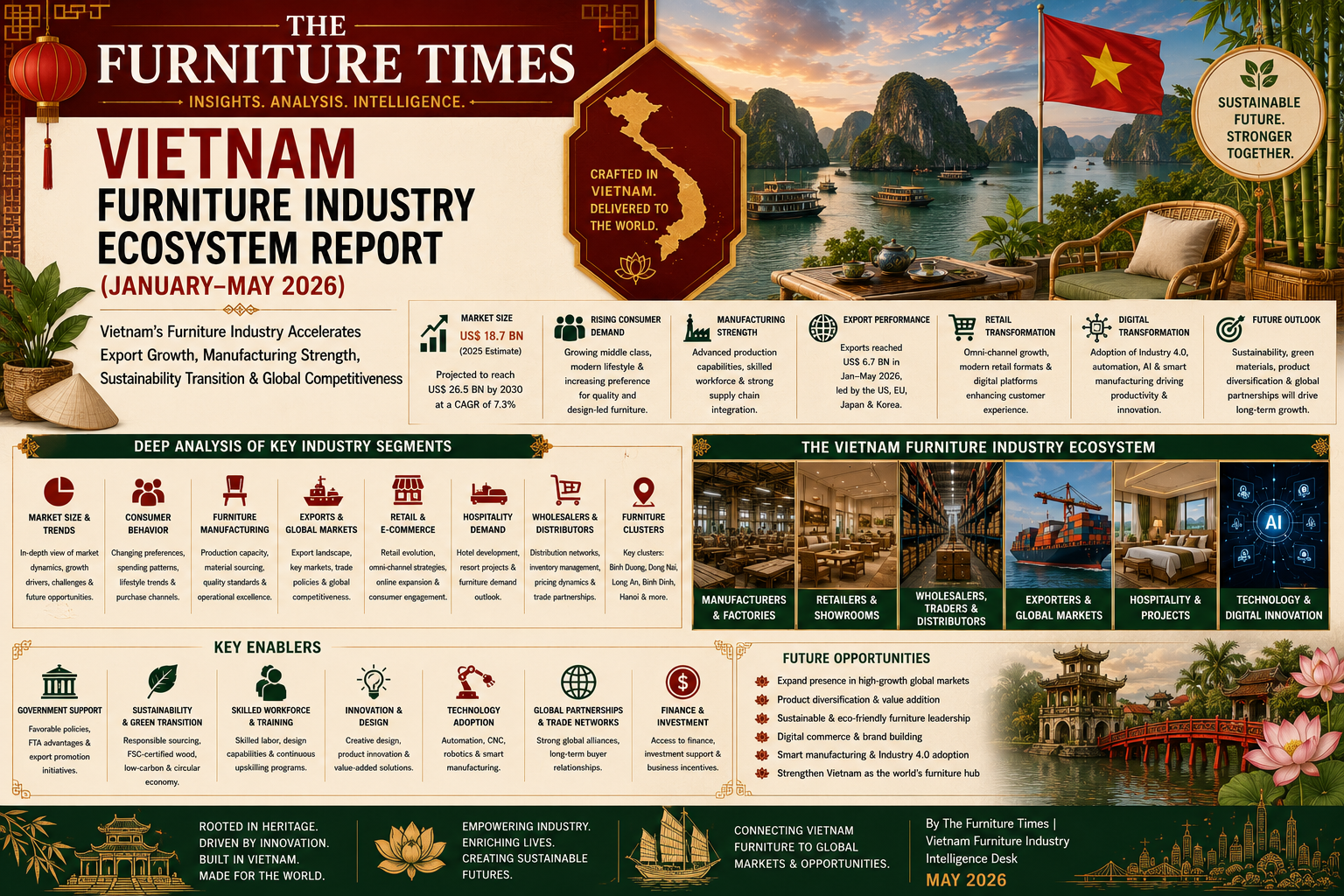
Vietnam’s Furniture Industry Accelerates Export Growth, Manufacturing Strength, Sustainability Transition & Global Competitiveness
Vietnam Furniture Industry Ecosystem Report (January–May 2026)
Deep Analysis of Market Size, Consumer Behavior, Furniture Manufacturing, Exports, Retail, Hospitality Demand, Wholesalers, Furniture Clusters, Technology & Future Opportunities
By The Furniture Times | Vietnam Furniture Industry Intelligence Desk | May 2026
Vietnam’s furniture industry entered 2026 as one of the strongest and fastest-moving furniture ecosystems in the world.
Between January and May 2026, the industry continued gaining global attention because of its export strength, manufacturing capacity, skilled workforce, improving infrastructure, and rising position as a preferred sourcing destination for international buyers.
Vietnam’s furniture market is estimated at USD 10.47 billion in 2026 and is projected to reach USD 14.87 billion by 2031, reflecting continued growth across domestic and export channels. Vietnam’s wood and furniture export sector also remains highly strategic, with the country targeting USD 18–19 billion in wood exports in 2026 after reaching about USD 17.2 billion in 2025.
January–May 2026 Industry Overview
The first five months of 2026 showed strong industry momentum.
Positive drivers included:
strong export recovery
rising global sourcing demand
furniture manufacturing modernization
VIFA EXPO 2026 visibility
growing hospitality and residential demand
sustainability-led production upgrades
increasing B2C e-commerce export opportunity
Key challenges included:
tariff pressure
dependence on major export markets
rising compliance requirements
logistics cost volatility
competition from China, Indonesia, Malaysia, India, and Türkiye
need for stronger design and branding
Vietnam’s furniture ecosystem is no longer only a production base.
It is becoming:
A Global Furniture Manufacturing Powerhouse
Market Size & Growth Outlook
Vietnam’s furniture market continues growing due to urbanization, rising income levels, housing development, hospitality growth, and export-led manufacturing.
The domestic furniture market is supported by:
apartment living
middle-class growth
modern home interiors
office expansion
hospitality projects
e-commerce furniture sales
The wider furniture manufacturing and export ecosystem remains much larger because Vietnam serves global buyers across North America, Europe, Japan, South Korea, Australia, and the Middle East.
Vietnam’s Export Strength Remains the Industry Backbone
Vietnam is one of the world’s most important wood and furniture exporters.
The country’s wood and wood product exports reached around USD 17.2 billion in 2025, with industry expectations targeting USD 18–19 billion in 2026.
Major export destinations include:
United States
Japan
China
South Korea
Europe
Australia
Middle East
The United States remains Vietnam’s most important furniture export market, but the industry is increasingly working to diversify into other regions.
Binh Duong: Vietnam’s Furniture Manufacturing Capital
Binh Duong remains one of Vietnam’s most important furniture production regions.
The province is known for:
export furniture factories
industrial parks
woodworking plants
upholstery manufacturing
OEM furniture production
international buyer networks
Binh Duong’s proximity to Ho Chi Minh City, ports, logistics routes, and industrial zones makes it one of the strongest furniture manufacturing clusters in Asia.
Ho Chi Minh City: Trade, Design & Export Gateway
Ho Chi Minh City remains a strategic center for:
furniture trading
export coordination
design development
buyer meetings
showrooms
wholesale activity
international sourcing
The city acts as a gateway between Vietnam’s manufacturing clusters and global furniture buyers.
VIFA EXPO 2026 Strengthened Vietnam’s Global Visibility
One of the biggest furniture industry events during early 2026 was:
VIFA EXPO 2026
The fair returned in March 2026 with strong international attention, showcasing Vietnam’s furniture, home accessories, handicrafts, wood products, and export manufacturing capabilities.
VIFA EXPO 2026 supported:
buyer discovery
factory visits
international networking
export promotion
brand visibility
sourcing opportunities
Trade fairs remain important because they show that Vietnam is not only manufacturing furniture but also building global industry credibility.
Consumer Behavior Is Changing in Vietnam
Vietnamese consumers are becoming more design-conscious and digitally influenced.
Demand is increasing for:
modern home furniture
compact apartment furniture
multifunctional products
minimalist furniture
natural wood furniture
affordable premium furniture
home office furniture
Young consumers increasingly discover furniture through:
social media
online stores
marketplaces
design inspiration platforms
digital catalogues
The buying journey increasingly follows:
Search → Compare → Review → Buy
Residential Demand Remains Strong
Vietnam’s growing urban population continues supporting residential furniture demand.
Key product categories include:
Living Room Furniture
sofas
coffee tables
TV cabinets
lounge chairs
Bedroom Furniture
beds
wardrobes
storage systems
dressing tables
Dining Furniture
dining sets
compact tables
wooden chairs
Home Office Furniture
work desks
ergonomic chairs
shelving systems
Urban apartments are increasing demand for furniture that is compact, stylish, affordable, and multifunctional.
Hospitality Furniture Demand Is Growing
Vietnam’s tourism and hospitality industry continues supporting furniture demand.
Hotels, resorts, restaurants, cafés, serviced apartments, and beach destinations are driving demand for:
hotel room furniture
resort furniture
restaurant seating
outdoor furniture
lounge systems
FF&E supply
Strong hospitality markets include:
Da Nang
Nha Trang
Phu Quoc
Hanoi
Ho Chi Minh City
Hoi An
Hospitality remains one of Vietnam’s strongest long-term furniture opportunities.
Outdoor Furniture Is a Strong Export Segment
Vietnam has become a major producer of outdoor furniture.
Demand is strong for:
garden furniture
patio sets
outdoor dining furniture
poolside furniture
aluminium furniture
wooden outdoor furniture
woven outdoor seating
Global outdoor living trends are helping Vietnam expand export opportunities.
Wholesalers & Traders Remain Important
Wholesalers remain a critical part of Vietnam’s furniture ecosystem.
They connect:
factories
exporters
retailers
project buyers
interior designers
hospitality clients
However, the wholesale model is changing.
Traditional wholesalers now need:
digital catalogues
searchable websites
online inquiry systems
stronger product photography
export-ready communication
The future wholesaler will be both physical and digital.
Retail Transformation Is Accelerating
Vietnam’s furniture retail market is becoming more digital.
Retailers increasingly use:
showrooms
e-commerce
social media
livestream selling
online marketplaces
digital product catalogues
Vietnam’s wider consumer economy has become more digitally active, and furniture retail is following that shift.
The future furniture retailer must be visible online before the customer walks into the store.
Manufacturing Modernization Is Moving Fast
Vietnamese furniture manufacturers continue investing in:
CNC machinery
automated cutting systems
digital production planning
better finishing technology
improved packaging systems
quality control systems
export compliance processes
This is helping factories improve:
productivity
consistency
speed
international buyer confidence
Vietnam’s next stage of growth will increasingly depend on technology-supported manufacturing.
Sustainability Is Becoming a Market Requirement
Global buyers increasingly demand:
legal timber
FSC-certified materials
traceable supply chains
low-emission production
responsible sourcing
sustainable packaging
Vietnam’s industry is increasingly focused on greener production because sustainability is no longer optional.
It is becoming a requirement for access to premium export markets.
Tariffs & Trade Pressure Remain Key Risks
Despite strong growth, Vietnam’s export-oriented model faces tariff and trade risks.
Because the industry depends heavily on global markets, policy changes in the United States and other major destinations can affect:
pricing
order flow
sourcing strategy
buyer confidence
export margins
This is why market diversification is becoming a priority.
Dependence on Major Markets Is a Structural Concern
Vietnam’s wood and furniture exports remain concentrated in a small group of major destinations.
This creates risk if demand weakens or trade policies change in one major market.
Future growth will require stronger expansion into:
Middle East
India
ASEAN
Latin America
Africa
Europe
Diversification will strengthen resilience.
Design & Branding Must Improve
Vietnam has already proven itself as a manufacturing powerhouse.
The next challenge is moving from:
OEM Manufacturing
to
Brand & Design Value Creation
Vietnamese manufacturers need to invest more in:
original design
product storytelling
brand identity
direct buyer relationships
global visibility
digital catalogues
The future furniture economy rewards not only manufacturers but also brands.
Skilled Workforce Remains a Competitive Advantage
Vietnam’s furniture industry benefits from a skilled workforce in:
woodworking
assembly
upholstery
sanding
finishing
packaging
factory operations
However, as factories modernize, workers will need new skills in:
CNC operation
digital production systems
quality control
export compliance
design support
The future workforce must combine traditional skill with technical capability.
Digital Visibility Is Becoming More Important
One of the biggest opportunities for Vietnam is digital discoverability.
Many manufacturers are export-ready but still need stronger:
websites
SEO
digital profiles
AI-search visibility
product catalogues
content marketing
international storytelling
The future buyer increasingly searches online before contacting suppliers.
This means visibility is becoming part of export competitiveness.
Competition Is Increasing
Vietnam competes with:
China
Indonesia
Malaysia
India
Türkiye
Poland
Vietnam’s strength lies in:
export capability
manufacturing scale
workforce skill
improving infrastructure
buyer confidence
cost competitiveness
But future success requires continuous upgrading.
The Furniture Times Industry Insight
Vietnam’s furniture industry between January and May 2026 revealed one powerful reality:
The country has moved beyond being an alternative sourcing destination.
Vietnam is now one of the central players in the global furniture ecosystem.
The next growth phase will depend on:
Sustainability
Technology
Market Diversification
Design Capability
Digital Visibility
Export Trust
The factories that win will not only be those that produce more.
They will be those that produce better, cleaner, faster, smarter, and more visibly.
Final Thought
Vietnam’s furniture industry entered 2026 with strong momentum.
The country has:
export scale
skilled workforce
strong manufacturing clusters
trade fair visibility
hospitality demand
global buyer confidence
But it must continue solving:
tariff risk
market concentration
sustainability compliance
design upgrading
digital discoverability
competition pressure
The future Vietnamese furniture industry will not only be measured by export volume.
It will be measured by how successfully Vietnam becomes:
Sustainable
Innovative
Visible
Trusted
Globally Connected
Because the future of furniture manufacturing is no longer only about factories.
It is about ecosystems.
And Vietnam is becoming one of the most important furniture ecosystems in the world.
