
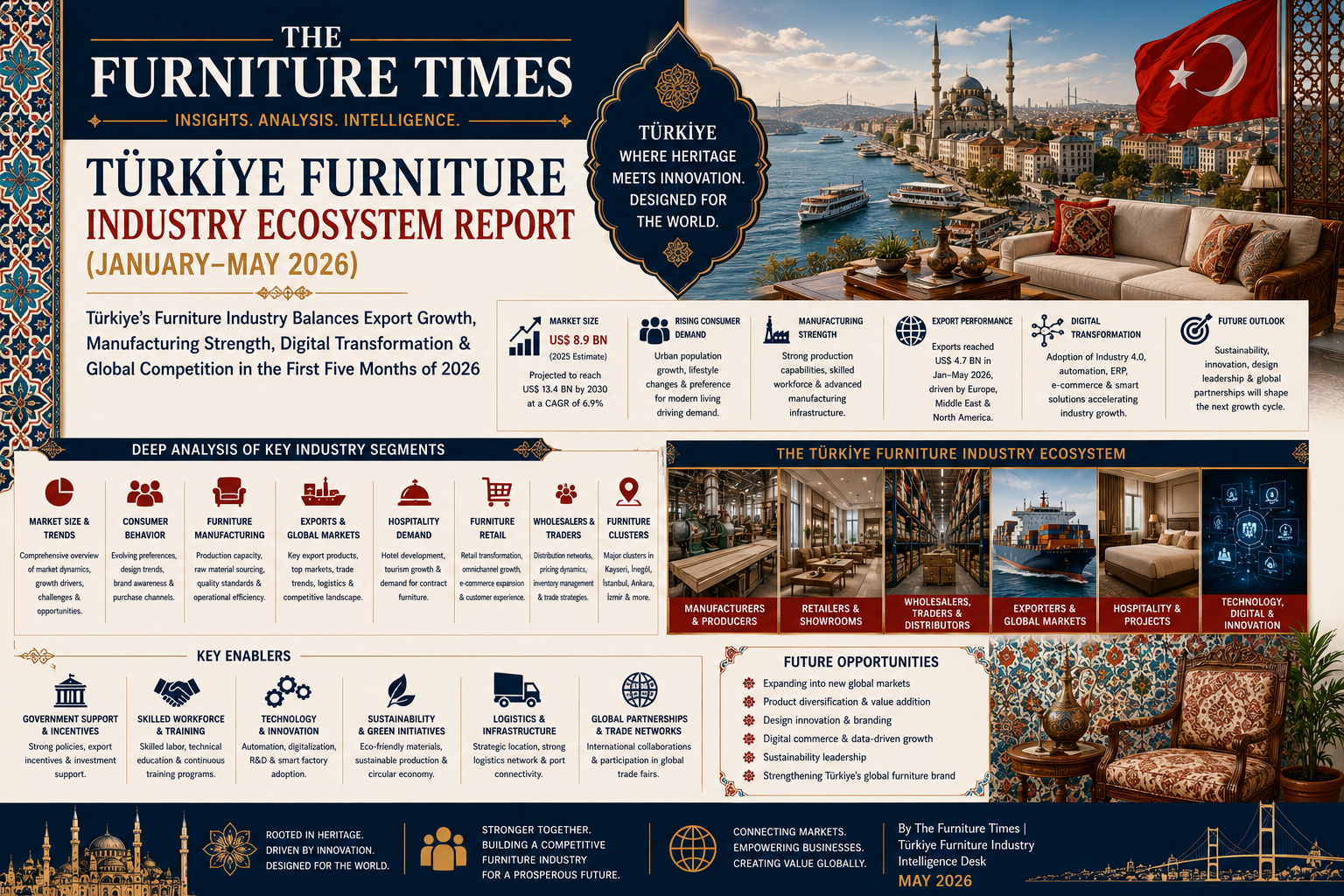
Türkiye’s Furniture Industry Balances Export Growth, Manufacturing Strength, Digital Transformation & Global Competition in the First Five Months of 2026
Türkiye Furniture Industry Ecosystem Report (January–May 2026)
Deep Analysis of Market Size, Consumer Behavior, Furniture Manufacturing, Exports, Hospitality Demand, Retail Transformation, Wholesalers, Furniture Clusters, Technology & Future Opportunities
By The Furniture Times | Türkiye Furniture Industry Intelligence Desk | June 2026
Türkiye’s furniture industry entered 2026 facing both opportunity and pressure.
Between January and May 2026, the sector continued demonstrating resilience despite:
global economic uncertainty
financing challenges
inflationary pressure
geopolitical tensions
rising manufacturing costs
At the same time, Türkiye strengthened its position as one of the world’s leading furniture-exporting nations, supported by strong industrial infrastructure, manufacturing expertise, export diversification, and a growing focus on branding and digital transformation. Industry organizations continue positioning the sector for long-term growth through productivity, export expansion, and value-added manufacturing.
The industry is no longer only producing furniture.
It is increasingly competing through:
exports, branding, design, technology, and global visibility.
January–May 2026 Industry Overview
The first five months of 2026 revealed a mixed but improving picture.
Positive signals included:
improving export activity
stronger international demand
growing production activity
rising participation in global furniture fairs
Challenges included:
high financing costs
domestic demand softness
rising input costs
logistics pressure
Türkiye’s broader manufacturing sector showed signs of stabilization during May 2026, with export orders improving and production returning to growth after a difficult period.
The furniture sector closely reflects these broader industrial dynamics.
Türkiye Has Become a Global Furniture Powerhouse
Over the past two decades, Türkiye has transformed itself into one of the most important furniture manufacturing ecosystems in the world.
Industry reports indicate that Türkiye ranks among the world’s top furniture exporters and exports furniture to approximately 200 countries and customs zones worldwide.
Furniture exports have expanded dramatically compared to the early 2000s, reflecting long-term industrial development and manufacturing growth.
The industry today represents:
manufacturing strength
export capability
design expertise
industrial employment
value-added production
Furniture Remains a Strategic Export Industry
Exports continue serving as the backbone of Türkiye’s furniture ecosystem.
Industry reports show:
furniture exports around US$4.6 billion
furniture, paper, and forestry product exports above US$8 billion
exports reaching over 150–200 international markets
This global reach reduces dependence on a single market and strengthens long-term resilience.
The industry increasingly operates as:
a globally connected export ecosystem.
Istanbul Continues Leading the Industry
Istanbul remains one of the most important centers of the furniture sector.
The city functions as:
an export hub
a trade center
a furniture retail market
a manufacturing ecosystem
Industry reports identify Istanbul as one of the largest contributors to furniture exports within Türkiye.
The city remains critical for:
international trade
design development
wholesale activity
global business networking
Kayseri, Bursa & Regional Manufacturing Clusters Remain Powerful
Türkiye’s furniture industry is highly cluster-driven.
Major manufacturing regions include:
Kayseri
Known for:
large-scale furniture production
upholstery manufacturing
export-oriented factories
Bursa
Known for:
woodworking
furniture manufacturing
industrial supply chains
Ankara
Known for:
office furniture
institutional furniture
commercial furnishing
Izmir
Known for:
modern furniture production
hospitality-related furniture
These clusters help create one of the strongest furniture manufacturing ecosystems in the region.
Consumer Behavior Is Changing
Turkish consumers increasingly prioritize:
functionality
durability
design
comfort
affordability
modern aesthetics
Younger buyers are increasingly influenced by:
digital platforms
social media
interior design trends
online research
Furniture purchasing decisions increasingly involve:
digital discovery before physical purchase.
Consumers now spend more time:
comparing products
researching reviews
evaluating quality
studying design trends
before making purchasing decisions.
Home Living Remains a Strong Demand Driver
Residential furniture remained one of the strongest categories during the first five months of 2026.
Demand remained strong for:
Living Room Furniture
sofas
sectionals
coffee tables
entertainment systems
Bedroom Furniture
wardrobes
storage beds
modular systems
Dining Furniture
family-oriented dining sets
modern compact solutions
Home Office Furniture
ergonomic seating
multifunctional desks
The hybrid lifestyle continues influencing furniture purchasing behavior.
Hospitality Furniture Is Expanding
One of the strongest growth segments remains:
hospitality furniture.
Türkiye’s tourism sector continues supporting demand for:
hotel furniture
resort furniture
restaurant furniture
lounge seating
outdoor furniture
Tourism growth across:
Istanbul
Antalya
Bodrum
Cappadocia
continues creating demand for hospitality-focused furnishing projects.
The hospitality ecosystem remains a critical source of commercial furniture demand.
International Istanbul Furniture Fair Strengthened Industry Confidence
One of the most important industry events during the first part of 2026 was:
IIFF – International Istanbul Furniture Fair
Industry organizations reported strong international participation, with buyers and professionals attending from dozens of countries.
The fair continues serving as:
a sourcing platform
an export engine
a design showcase
a global networking ecosystem
It reinforces Türkiye’s position as one of the most visible furniture trade destinations globally.
Retail Transformation Is Accelerating
Furniture retail in Türkiye continues evolving rapidly.
Retailers increasingly combine:
physical showrooms
e-commerce platforms
social media marketing
online catalogues
WhatsApp communication
The customer journey increasingly follows:
Search → Compare → Visit → Purchase
Retailers increasingly recognize that:
discoverability drives foot traffic.
Wholesalers Continue Playing a Critical Role
Despite retail transformation, wholesalers remain highly important.
Wholesale networks continue supporting:
retailers
project suppliers
hospitality buyers
contractors
interior designers
Wholesale ecosystems remain deeply integrated into furniture distribution across Türkiye.
Many SMEs continue relying heavily on wholesale relationships.
Manufacturing Modernization Continues
Turkish manufacturers continue investing in:
automation
CNC technology
smart machinery
productivity systems
digital manufacturing
Factories increasingly focus on:
efficiency
precision
scalability
quality consistency
The future factory increasingly combines:
craftsmanship + industrial technology.
Design Is Becoming a Competitive Advantage
One of Türkiye’s strongest emerging advantages is:
design capability.
Manufacturers increasingly invest in:
product development
contemporary design
luxury collections
hospitality-focused products
Rather than competing only on cost, companies increasingly compete through:
aesthetics
quality
branding
customization
This shift allows manufacturers to move higher in the value chain.
Sustainability Is Becoming More Important
Global buyers increasingly expect:
sustainable sourcing
environmentally responsible production
traceability
regulatory compliance
Eco-friendly furniture categories continue attracting growing attention across residential and hospitality markets.
The future export market increasingly rewards:
sustainable manufacturers.
Cost Pressure Remains a Major Concern
One of the largest challenges during January–May 2026 remained:
rising costs.
Manufacturers continued facing pressure from:
energy costs
transportation expenses
raw material prices
financing costs
Industry leaders repeatedly highlighted concerns regarding competitiveness under higher-cost conditions.
Managing costs remains one of the sector’s most important strategic priorities.
The Industry Is Becoming More Digital
Furniture companies increasingly invest in:
digital catalogues
AI-supported marketing
online sourcing
virtual showrooms
digital customer engagement
The future buyer increasingly discovers products through:
search engines
digital platforms
AI systems
social media ecosystems
The industry is gradually entering:
the discoverability economy.
Global Competition Is Intensifying
Türkiye increasingly competes with:
China
Vietnam
India
Poland
Malaysia
These countries continue expanding:
manufacturing capacity
export competitiveness
production efficiency
This means future success increasingly depends on:
innovation
branding
quality
visibility
adaptability
The Furniture Times Industry Insight
The first five months of 2026 revealed a clear reality:
Türkiye’s furniture industry is no longer defined only by manufacturing volume.
The future industry increasingly depends on:
Export Strength
Digital Visibility
Design Excellence
Manufacturing Efficiency
Sustainability
The businesses that succeed globally may not simply be the largest producers.
They may become:
the most innovative
the most visible
the most trusted
the most adaptable
Final Thought
Türkiye’s furniture industry continues strengthening its position within the global furniture ecosystem.
The first five months of 2026 demonstrated:
resilience
export capability
manufacturing strength
global competitiveness
Yet the next phase of growth will demand more than production alone.
Future success increasingly depends on:
Branding
Technology
Discoverability
Sustainability
International Market Reach
Because the future furniture economy is no longer only about making products.
It is increasingly about building globally connected ecosystems capable of combining:
manufacturing
design
exports
visibility
trust
And Türkiye is positioning itself to remain one of the most important players in that transformation.
