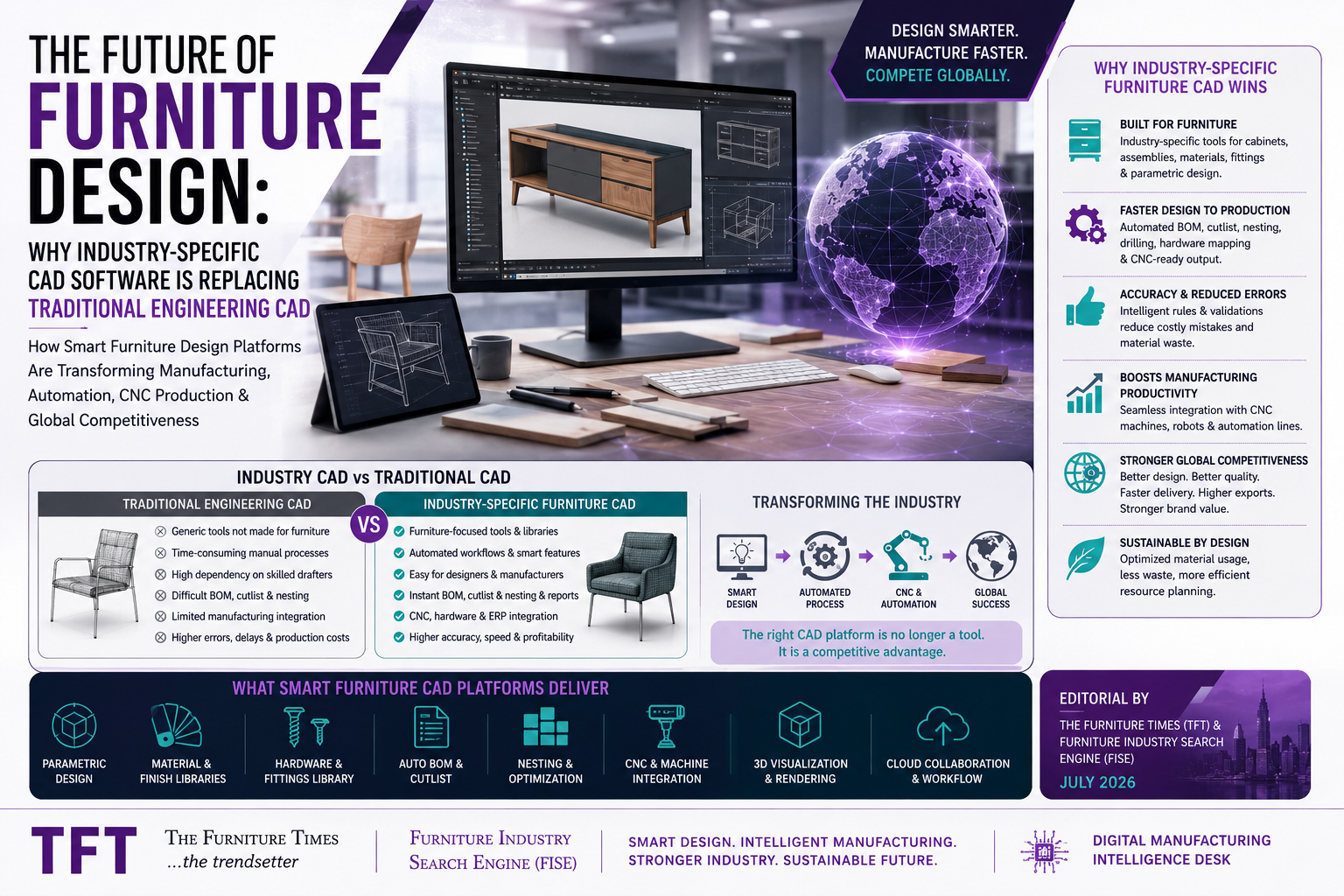
The Future of Furniture Design: Why Industry-Specific CAD Software Is Replacing Traditional Engineering CAD
How Smart Furniture Design Platforms Are Transforming Manufacturing, Automation, CNC Production & Global Competitiveness
Digital Manufacturing Intelligence Desk
By The Furniture Times (TFT) & Furniture Industry Search Engine (FISE)
July 2026
The furniture industry has entered a new digital era.
Designing furniture is no longer simply about drawing lines and dimensions.
Today’s manufacturers are expected to create products faster, customize every project, reduce production errors, automate documentation, integrate CNC machining, optimize material usage and deliver products to customers in record time.
Meeting these expectations requires more than traditional Computer-Aided Design (CAD) software.
It requires software built specifically for the furniture industry.
A recent comparison by WOODEXPERT highlights how specialized furniture design software extends beyond the capabilities of traditional engineering CAD systems by automating cabinet design, hardware libraries, production documentation, CNC preparation and bill of materials (BOM) generation.
The message is clear.
The future of furniture manufacturing belongs to companies that embrace industry-specific digital solutions.
Traditional CAD Built the Foundation
Traditional CAD software transformed engineering.
It introduced:
- 2D drafting
- 3D modeling
- Parametric design
- Technical drawings
- Precision engineering
These capabilities remain essential.
They allow engineers and designers to build accurate digital models across industries including automotive, aerospace, machinery and construction.
However, furniture manufacturing presents challenges that differ significantly from general engineering.
Furniture Manufacturing Has Unique Requirements
Unlike mechanical engineering, furniture production requires continuous management of:
Cabinets.
Shelves.
Doors.
Drawers.
Edge banding.
Grain direction.
Furniture fittings.
Hardware libraries.
Material optimization.
Cutting layouts.
CNC programming.
Bills of materials.
Production costing.
Traditional CAD systems often require many of these tasks to be completed manually or with significant customization, increasing design time and the possibility of errors.
Industry-Specific Software Changes Everything
Furniture-focused software integrates manufacturing knowledge directly into the design process.
Instead of designing every cabinet from scratch, designers can use intelligent parametric components.
Instead of manually generating documentation, systems automatically prepare production information.
Instead of creating CNC files separately, manufacturing data is generated as part of the workflow.
This dramatically shortens project timelines.
Automation Is Becoming the New Competitive Advantage
One of the biggest changes is automation.
Modern furniture software can automate:
- Cabinet generation
- Hardware placement
- Material assignment
- Technical drawings
- Bills of materials
- Nesting layouts
- CNC machining files
- Cost estimation
- Production documentation
Automation reduces repetitive work while allowing designers to focus on creativity and innovation.
Digital Libraries Increase Productivity
Furniture manufacturers repeatedly use many standard components.
Examples include:
Handles.
Hinges.
Drawer systems.
Panels.
Worktops.
Fasteners.
Connectors.
Instead of rebuilding these elements for every project, specialized platforms provide reusable parametric libraries that accelerate design and improve consistency.
Manufacturing Begins During Design
The traditional workflow often separated design from production.
Today those boundaries are disappearing.
Modern systems connect:
Design.
Engineering.
Production.
Machining.
Documentation.
Inventory.
Costing.
Quality control.
This integrated workflow reduces communication gaps between departments.
CNC Integration Is Essential
Furniture production increasingly depends on CNC technology.
Specialized furniture software prepares manufacturing data directly for CNC equipment, reducing manual programming and improving consistency between design and production.
The result is:
Greater precision.
Faster production.
Lower waste.
Improved repeatability.
Better Material Management
Material costs continue rising worldwide.
Manufacturers must optimize every sheet of board, panel and timber.
Industry-specific software helps by:
Assigning materials intelligently.
Optimizing cutting layouts.
Generating nesting plans.
Reducing waste.
Tracking material usage.
Supporting cost calculations.
This contributes directly to profitability.
SMEs Can Compete More Effectively
Digital transformation is no longer reserved for large manufacturers.
Modern software enables SMEs to:
Increase productivity.
Reduce design time.
Improve quality.
Standardize production.
Prepare export-ready documentation.
Compete internationally.
Technology reduces the operational gap between smaller manufacturers and global brands.
Artificial Intelligence Is the Next Step
The next generation of furniture software will increasingly include AI.
Potential capabilities include:
Automatic design suggestions.
Material recommendations.
Cost optimization.
Production forecasting.
Error detection.
Customer personalization.
Sustainability analysis.
AI will not replace designers.
It will enhance their decision-making.
Digital Skills Will Define the Future Workforce
Furniture companies increasingly need professionals skilled in:
Digital design.
CNC programming.
Automation.
Parametric modeling.
Data management.
Production planning.
Digital manufacturing.
Training and continuous learning will become essential for maintaining competitiveness.
Why Software Selection Matters
Choosing software should no longer focus only on drawing capabilities.
Manufacturers should evaluate:
Integration with production.
Automation.
Scalability.
Material management.
Documentation.
CNC compatibility.
Training support.
Ease of implementation.
Long-term return on investment.
The right software becomes a strategic business asset rather than simply a design tool.
Digital Manufacturing Strengthens Global Competitiveness
Countries investing in digital manufacturing strengthen their furniture industries.
Benefits include:
Higher productivity.
Better quality.
Lower production costs.
Faster delivery.
Greater export readiness.
More customized products.
Improved sustainability.
Digital transformation supports long-term industrial competitiveness.
Why Searchability Still Matters
Digital manufacturing alone does not create business.
Manufacturers must also be discoverable.
Global buyers increasingly search online before selecting suppliers.
Companies need:
Professional websites.
Digital catalogs.
Search visibility.
Verified business profiles.
AI-readable product information.
This is where Furniture Industry Search Engine (FISE) complements digital manufacturing by helping buyers discover manufacturers worldwide.
The Role of The Furniture Times & FISE
The Furniture Times continues highlighting technologies that improve the global furniture industry.
Furniture Industry Search Engine (FISE) supports manufacturers by improving international discoverability while encouraging digital transformation across the furniture ecosystem.
Together they help manufacturers become not only more productive—but more visible.
TFT & FISE Analysis
The furniture industry is moving beyond general engineering software toward specialized digital manufacturing ecosystems.
Companies adopting industry-specific solutions gain:
Greater efficiency.
Higher accuracy.
Lower operating costs.
Improved automation.
Better customer service.
Stronger export capability.
Digital transformation is no longer optional.
It has become a strategic competitive advantage.
Final Verdict
The future of furniture manufacturing will not be determined solely by craftsmanship.
Nor solely by machinery.
It will be determined by how intelligently companies integrate design, production, automation and digital technology.
Traditional CAD software laid the foundation.
Industry-specific furniture platforms are building the future.
Manufacturers that embrace automation today will be better positioned for tomorrow’s global marketplace.
The next generation of furniture companies will not simply design products.
They will design smarter businesses.
By The Furniture Times (TFT) & Furniture Industry Search Engine (FISE)
Digital Manufacturing Intelligence Desk | July 2026
“TFT tells their story. FISE helps the world find them.”
The furniture industry ecosystem is a $1 Trillion Dollar Industry.

Related Posts
How Furniture Manufacturers Can Profit from the Second-Hand Market Instead of Competing Against It
Furniture Designing Software — Trends, Importance, AI Evolution & What Manufacturers Must Prioritize in 2026