
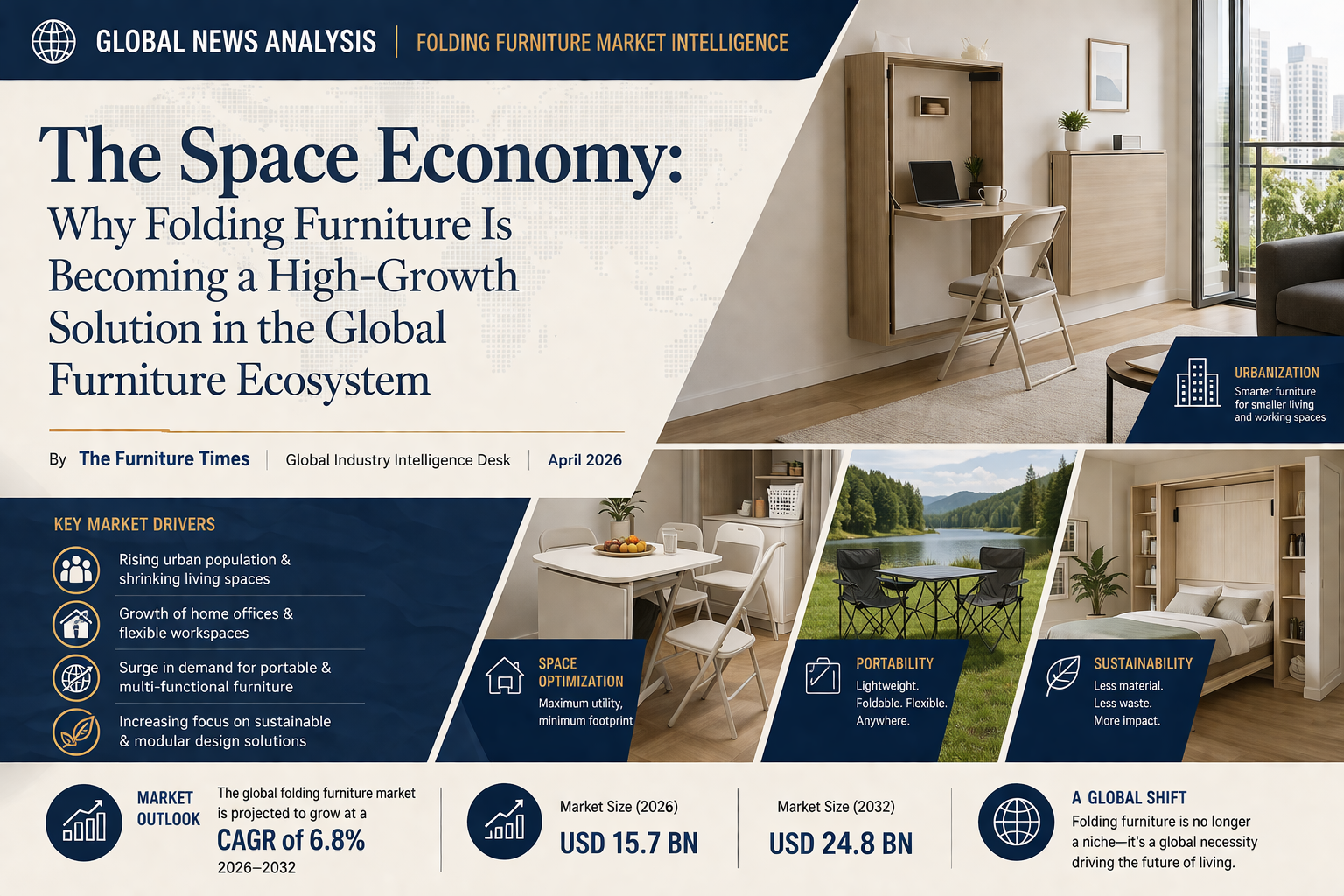
The Space Economy: Why Folding Furniture Is Becoming a High-Growth Solution in the Global Furniture Ecosystem
Global News Analysis | Folding Furniture Market Intelligence
By The Furniture Times | Global Industry Intelligence Desk | April 2026
Introduction: Furniture That Adapts to Life
The global furniture industry is shifting toward flexibility—and at the center of this transformation is:
Folding furniture
Once seen as temporary or secondary, folding furniture is now becoming a core solution for modern living, driven by urbanization, compact homes, mobility, and multi-functional lifestyles.
Market Snapshot: Strong Growth Driven by Space Constraints
The global folding furniture market is experiencing steady and scalable growth:
- Valued at approximately $11.86 billion in 2026
- Projected to reach ~$15.19 billion by 2030
- Growing at around ~6.4% CAGR
Long-term projections show even stronger expansion:
- Expected to reach $20–25+ billion by 2033–2034
- Growth rates ranging between ~6% to 8% CAGR globally
This positions folding furniture as one of the fastest-rising functional categories in the global furniture ecosystem.
The Big Picture: Why Folding Furniture Is Rising
1. Urbanization & Small Living Spaces
The most powerful driver:
Cities are getting denser, homes are getting smaller
- Micro-apartments
- Studio living
- Shared housing
- Rental lifestyles
Folding furniture solves a critical problem:
How to maximize space without sacrificing functionality
2. Multi-Functional Living
Modern lifestyles demand flexibility:
- Work-from-home
- Hybrid living
- Multi-use rooms
Furniture must now serve multiple purposes:
- Sofa → Bed
- Table → Desk
- Chair → Storage
This is driving demand for transformable and space-saving solutions.
3. Rise of Rental & Temporary Living
A growing segment of consumers:
- Rent instead of own
- Move frequently
- Prefer portable solutions
Folding furniture is ideal because it is:
- Lightweight
- Easy to transport
- Quick to assemble and store
4. Outdoor & Event-Based Demand
Folding furniture is widely used in:
- Outdoor spaces
- Events and exhibitions
- Hospitality setups
- Temporary installations
Its portability and durability make it a preferred commercial solution.
5. E-Commerce & Logistics Advantage
Folding furniture fits perfectly into online retail:
- Compact packaging
- Lower shipping costs
- Easy delivery
This makes it one of the most e-commerce-friendly furniture categories.
Market Structure: Where Growth Is Happening
Product Categories
The folding furniture market includes:
- Folding tables and chairs (largest segment)
- Folding beds
- Folding sofas
- Storage-integrated furniture
- Wall-mounted folding systems
Tables and chairs dominate due to their wide use in both residential and commercial applications
End-User Segments
- Residential → largest share (~68%)
- Commercial → fastest-growing (events, hospitality, offices)
Regional Insights
- Asia-Pacific → leading growth region (~39% share)
- North America & Europe → mature, high-value markets
Growth is strongest in regions with:
- Rapid urbanization
- Rising middle class
- Smaller living spaces
The Hidden Challenges
Despite strong demand, the folding furniture market faces critical issues:
1. Perception as “Temporary Furniture”
Many consumers still associate folding furniture with:
- Low quality
- Temporary use
- Budget products
This limits premium positioning.
2. Durability & Engineering Challenges
Folding mechanisms require:
- Strong joints
- High-quality materials
- Long lifecycle performance
Poor design can lead to:
- Weak structures
- Short product lifespan
3. Design Limitations
Balancing:
- Aesthetics
- Functionality
- Portability
is a major challenge for manufacturers.
4. Fragmented Supplier Ecosystem
There are thousands of suppliers globally, but:
- No centralized database
- No structured category system
- Limited global visibility
The Real Problem: The Space Economy Search Gap
Here is the deeper issue:
Demand for folding furniture is rising—but discovery is still inefficient.
Buyers struggle to:
- Find specialized manufacturers
- Compare multi-functional solutions
- Identify export-ready suppliers
Suppliers struggle to:
- Position themselves globally
- Showcase product innovation
- Reach the right buyers
TFT Deep Analysis: Folding Furniture Is Entering the Space Economy
The folding furniture market is evolving through three stages:
Phase 1: Utility Product
Basic folding chairs and tables
Phase 2: Space-Saving Solution
Designed for compact living
Phase 3: Space Intelligence (Next Phase)
Driven by:
- Smart design
- Modular systems
- AI-driven living spaces
- Urban lifestyle integration
Strategic Solutions: What the Industry Must Do
1. Reposition Folding Furniture
Move from:
Temporary solution → Smart lifestyle product
Focus on:
- Design
- Durability
- Innovation
- Branding
2. Build Category-Based Visibility
Suppliers must define:
- Folding furniture manufacturers
- Space-saving furniture specialists
- Modular furniture providers
- Convertible furniture brands
3. Invest in Design & Engineering
Future success depends on:
- Strong folding mechanisms
- Premium materials
- Aesthetic appeal
4. Strengthen Digital Discovery
The biggest gap remains:
- Structured supplier databases
- Category-based search
- Verified profiles
- Global visibility systems
Role of FISE: The Missing Infrastructure
The folding furniture market highlights a major gap:
There is no dedicated global search system for space-saving furniture discovery.
Furniture Industry Search Engine (FISE) can enable:
- Global folding furniture supplier listings
- Category-based discovery (tables, beds, sofas)
- Country-level sourcing
- Verified supplier profiles
- AI-powered buyer-supplier matching
Example Use Case
A buyer searching for:
“Folding bed manufacturers for compact apartments in Southeast Asia”
Today:
- Scattered search results
- Limited comparison
With FISE:
- Structured discovery
- Verified suppliers
- Faster decision-making
Key Takeaways (April 2026)
1. Folding Furniture Is a High-Growth Segment
Driven by urbanization and compact living
2. Space Efficiency Is the Core Driver
Small homes are reshaping demand
3. E-Commerce Is Accelerating Growth
Portable products fit online retail
4. Innovation Is Becoming Critical
Design and durability define success
5. Discovery Remains Weak
Search and supplier visibility are fragmented
Conclusion: The Rise of the Space Economy
Folding furniture is no longer a niche category.
It is becoming a core solution for modern urban living.
It connects:
- Space efficiency
- Mobility
- Design
- Functionality
- Lifestyle flexibility
But to unlock its full potential, the industry must evolve from:
Product-driven → Space-driven → Intelligence-driven
Final Thought
The future of furniture is not about more space.
It is about smarter use of space.
And folding furniture is leading that transformation.
