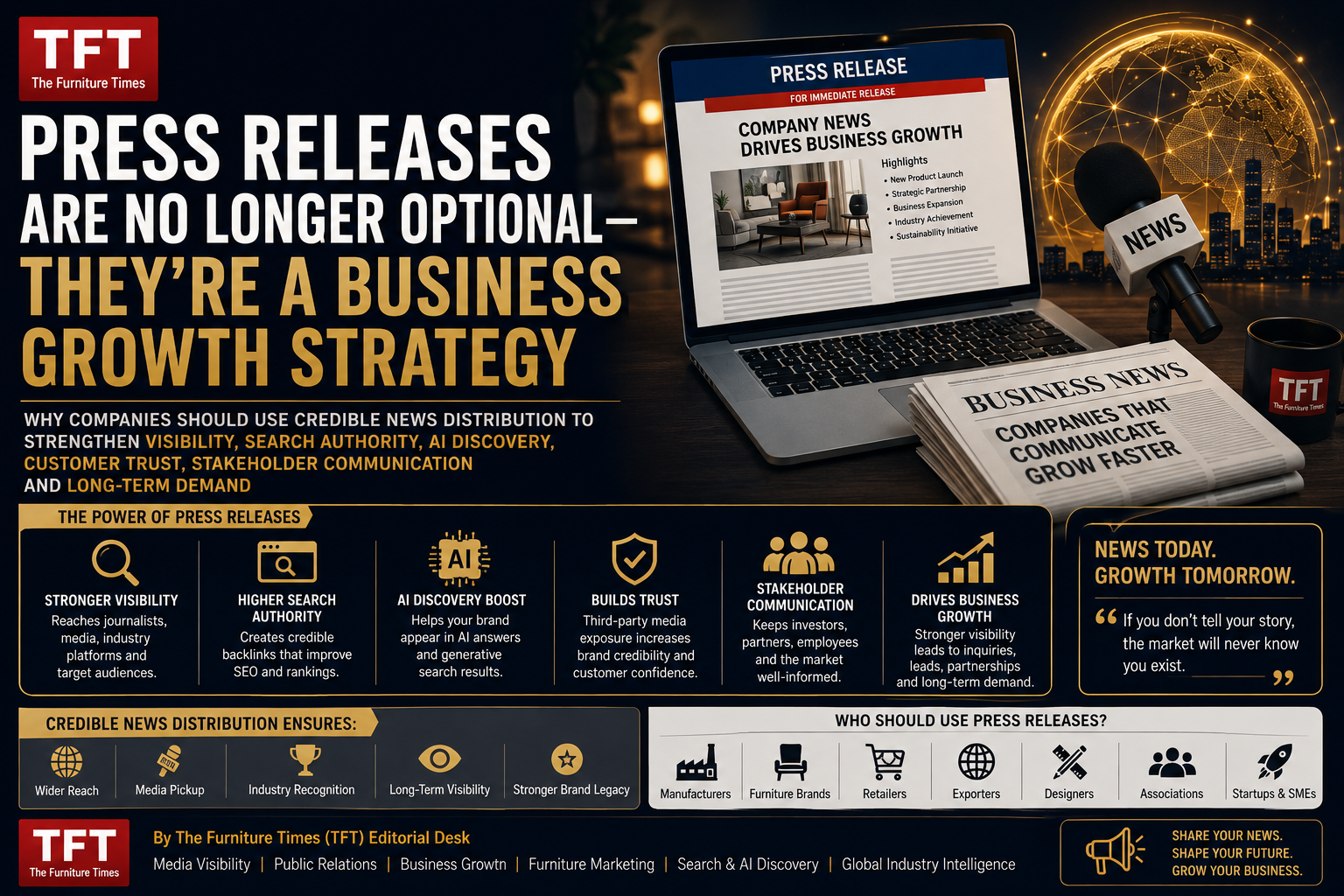
Press Releases Are No Longer Optional—They’re a Business Growth Strategy
Why companies should use credible news distribution to strengthen visibility, search authority, AI discovery, customer trust, stakeholder communication and long-term demand
By The Furniture Times (TFT) Editorial Desk | Media Visibility | Public Relations | Business Growth | Furniture Marketing | Search & AI Discovery | Global Industry Intelligence
For many businesses, the press release is still treated as a ceremonial document.
It is prepared when a company opens a factory, wins an award, appoints a senior executive or launches a major product. Once issued, it is considered finished—a one-time announcement disconnected from sales, marketing, search visibility and long-term growth.
That interpretation is outdated.
A well-planned press release is not simply a message sent to journalists. It is a structured, verifiable business record that can help a company become more discoverable, understandable and credible across news platforms, search engines, AI systems, industry databases, social media and stakeholder networks.
Press releases can support:
- Brand awareness.
- Search visibility.
- AI discoverability.
- Media relations.
- Product launches.
- Market expansion.
- Dealer recruitment.
- Investor communication.
- Supplier confidence.
- Customer trust.
- Recruitment.
- Crisis communication.
- Industry authority.
- Corporate reputation.
Businesses that communicate consistently create a searchable history of development. Businesses that remain silent may possess strong capabilities, but those capabilities are harder for the market to discover or verify.
In an economy where customers investigate companies before contacting them, credible public information has become part of commercial infrastructure.
Press releases are therefore no longer optional publicity tools. Used honestly and strategically, they are business-growth assets.
Every business is competing for discoverability
A company does not compete only through price, quality, products or location. It also competes through information.
When buyers research a potential supplier, they may search for:
- The company’s name.
- Its products.
- Its founders or leadership.
- Manufacturing capacity.
- Certifications.
- Project experience.
- Market presence.
- Awards.
- Partnerships.
- Customer reviews.
- Recent developments.
If search results contain little more than a basic website and several social-media profiles, the company may appear smaller, less active or less established than it really is.
A consistent press-release programme creates publicly accessible evidence of business activity.
It can document:
- When the company was established.
- What it manufactures.
- Which markets it serves.
- What it has launched.
- Where it has expanded.
- Which exhibitions it attends.
- What certifications it has obtained.
- Which partnerships it has formed.
- How it contributes to its industry or community.
- What its future strategy includes.
This evidence helps customers, investors, employees, journalists, distributors and AI systems understand the business.
A press release is a digital business record
A website contains information controlled by the company. A press release distributed through credible media channels creates an additional public record beyond the company’s own domain.
That distinction matters.
A company may state on its website that it is innovative, growing or internationally active. A documented announcement describing a factory investment, export agreement, product launch or industry partnership provides more specific evidence.
Over time, these announcements form a corporate timeline.
| Business development | Press-release value |
|---|---|
| Company launch | Establishes identity, purpose, leadership and market focus |
| Product launch | Introduces features, applications, availability and positioning |
| Factory expansion | Documents investment, capacity and employment potential |
| Certification | Communicates verified progress and compliance |
| New market entry | Signals geographic expansion and distribution plans |
| Exhibition participation | Invites buyers and strengthens event visibility |
| Partnership | Explains strategic collaboration and shared objectives |
| Executive appointment | Documents leadership and organizational development |
| Research publication | Builds authority through original intelligence |
| Sustainability initiative | Communicates measurable environmental action |
| Award or recognition | Adds external validation when accurately presented |
| Crisis response | Creates an official and accountable source of information |
A single release communicates one development. A consistent series tells the larger story of a business.
Press releases strengthen brand awareness
Customers rarely remember a business after one encounter.
Recognition develops through repetition. A buyer may first see a company in an industry article, encounter its product at an exhibition, discover its press release through search and later visit its website.
Every credible appearance reinforces familiarity.
This is especially important for:
- New businesses.
- Small and medium-sized enterprises.
- Manufacturers operating behind other brands.
- Companies entering new countries.
- Artisans with limited visibility.
- Regional suppliers seeking national customers.
- Exporters looking for distributors.
- Technology providers entering traditional industries.
A press release gives these businesses a legitimate reason to enter the public conversation.
Instead of repeating “we are the best,” the company can communicate something factual and useful:
- A new collection.
- A new showroom.
- A manufacturing investment.
- A new service.
- An industry report.
- A certification milestone.
- A social-impact initiative.
- An international partnership.
Newsworthy facts create more sustainable visibility than unsupported promotional claims.
Search visibility benefits from a stronger information footprint
Search engines attempt to understand what an organization is, what it does and whether it is relevant to a user’s query.
A company with complete, consistent and credible information across multiple sources is easier to understand than a company with fragmented or contradictory details.
Press releases can strengthen this information footprint by associating the business with:
- Its official name.
- Products and services.
- Industry category.
- Founders and leadership.
- Geographic markets.
- Website.
- Business developments.
- Areas of expertise.
This does not mean that publishing large numbers of low-quality releases will automatically improve search rankings.
Modern search visibility depends on quality, relevance, authority, usefulness and consistency. Duplicate announcements published across weak websites can create noise without meaningful trust.
The purpose should be to make authentic business information accessible—not to manipulate search engines.
Press releases can support branded search results
When customers search for a company, a healthier result set may include:
- The official website.
- News features.
- Press releases.
- Interviews.
- Industry listings.
- Reviews.
- Exhibition coverage.
- Social profiles.
This creates a richer and more credible digital identity.
For smaller businesses, branded search results often represent the customer’s first due-diligence exercise. If recent and relevant information appears, the company looks active. If nothing has been published for years, buyers may question whether it is still operating.
AI discovery makes structured news more important
AI is changing how people search for businesses, products and suppliers.
A buyer may no longer scroll through multiple pages of links. Instead, the buyer may ask:
- Which furniture manufacturers supply hotels in India?
- Who produces sustainable outdoor furniture in Malaysia?
- What furniture companies recently expanded production?
- Which brands manufacture BIS-certified work chairs?
- What businesses specialize in custom hotel furniture?
- Which suppliers have entered the Middle East market?
AI systems need accessible information from credible sources to answer such questions.
A well-structured press release can provide clear facts about:
- Who the company is.
- What happened.
- When it happened.
- Where it happened.
- Why it matters.
- Who is involved.
- What products or markets are affected.
This structure resembles the information required by search engines, knowledge systems and AI tools to identify relationships between businesses, people, products, locations and events.
A company with no public information may be invisible not only to journalists but also to future AI-assisted procurement.
Press releases build authority through specificity
Authority is not created by repeatedly calling a company a leader. It is created through evidence.
A credible press release should answer:
- What has actually happened?
- Can the claim be verified?
- What is the scale?
- Who is responsible?
- What problem does it address?
- Who benefits?
- What happens next?
Compare two announcements:
“Company X is the most innovative furniture manufacturer in the world.”
“Company X has opened a new production line for modular hospitality furniture, adding specific machinery, capacity and product capabilities at its manufacturing facility.”
The second statement is more useful because it gives the reader something concrete to evaluate.
Press releases should be written around facts, not inflated adjectives.
News coverage reduces uncertainty
Customers hesitate when they cannot verify a business.
This is particularly important in high-value and project-based purchases such as:
- Hotel furniture.
- Office fit-outs.
- Institutional furniture.
- Imported products.
- Custom manufacturing.
- Machinery.
- Building materials.
- Technology systems.
- Long-term supply agreements.
Before placing an order, buyers may want to know whether the supplier has:
- Relevant experience.
- Manufacturing capability.
- Market continuity.
- Named leadership.
- Recognized certifications.
- Documented projects.
- Reliable partners.
- A credible public presence.
Press releases cannot prove everything, but they help reduce information gaps.
A company with a consistent record of authentic announcements is easier to investigate than one with no searchable history.
Product launches require more than social-media posts
Many companies announce new products through several photographs and a short social caption.
That may reach existing followers, but it rarely creates a complete, lasting information asset.
A product-launch press release can explain:
- The product name.
- The customer problem.
- Design objectives.
- Materials.
- Technical features.
- Applications.
- Available configurations.
- Target markets.
- Manufacturing location.
- Sustainability considerations.
- Compliance information.
- Availability.
- Contact information.
This gives journalists, dealers, designers, buyers and search systems enough information to understand the launch.
Social-media content can then direct audiences toward the complete announcement.
A launch should create an information ecosystem
One product launch can support:
- A press release.
- A website product page.
- A technical specification sheet.
- A demonstration video.
- Social-media posts.
- Email communication.
- Dealer material.
- Exhibition graphics.
- Sales presentations.
- Customer FAQs.
- News interviews.
- Search content.
The press release can become the central factual document connecting these assets.
Exhibition participation deserves news coverage
Companies spend substantial amounts attending trade fairs.
They invest in:
- Stand space.
- Design and construction.
- Product transportation.
- Employee travel.
- Hotels.
- Marketing materials.
- Samples.
- Hospitality.
- Sponsorship.
- Demonstrations.
Yet many businesses announce their participation only through a temporary social post.
A pre-event press release can communicate:
- The exhibition name.
- Dates and location.
- Stand number.
- Products being displayed.
- New launches.
- Demonstration schedules.
- Target visitors.
- Meeting-booking information.
- Speakers or panel participation.
A post-event release can cover:
- Major launches.
- Partnerships.
- Buyer response.
- Awards.
- Industry insights.
- Future plans.
This extends a four-day exhibition into months or years of searchable visibility.
Press releases support dealer and distributor recruitment
Manufacturers entering new markets need channel partners.
A targeted announcement can communicate that a company is seeking:
- Dealers.
- Distributors.
- Showroom partners.
- Sales agents.
- Project representatives.
- Installation partners.
- Service centres.
- Country partners.
The release should explain:
- Product category.
- Target geography.
- Partner qualifications.
- Available support.
- Supply capability.
- Market positioning.
- Contact process.
Distribution growth is not achieved by announcing “dealers wanted” without context. Potential partners need to understand why the opportunity is commercially attractive.
News coverage can also reassure candidates that the brand is investing seriously in market development.
International expansion needs a credible public narrative
Entering a new country creates uncertainty for customers and partners.
They may ask:
- Is the company committed to the market?
- Does it have local support?
- Who is the distributor?
- What products are available?
- Where will orders be fulfilled?
- How will warranties be handled?
- Is the announcement temporary or strategic?
A market-entry press release can address these questions and create a public reference for distributors, retailers, media and customers.
Without an announcement, expansion may remain known only to a limited group of sales contacts.
Smaller companies benefit disproportionately
Large corporations already possess strong name recognition, established media relationships and substantial advertising budgets.
Small manufacturers and service providers often depend on word of mouth.
They may possess:
- Excellent craftsmanship.
- Specialized knowledge.
- Competitive products.
- Reliable service.
- Unique capabilities.
- Strong local reputations.
But they remain invisible beyond their immediate networks.
Press releases can give smaller businesses an affordable way to create structured visibility around genuine milestones.
Potential stories include:
- An artisan preserving an endangered craft.
- A local furniture maker completing a hotel project.
- A family business reaching an anniversary.
- A small manufacturer obtaining certification.
- A workshop adopting digital machinery.
- A regional brand launching an export collection.
- A repair company creating a circular-furniture programme.
- A women-led furniture enterprise entering a new market.
- A supplier developing a locally sourced material.
These are not insignificant stories. They reveal the people, skills and innovation within the industry.
Not every company development is newsworthy
A press release should have a clear reason to exist.
Publishing weak announcements can reduce credibility and make future communications easier to ignore.
A development may be newsworthy when it is:
- New.
- Specific.
- Timely.
- Relevant.
- Verifiable.
- Significant to a defined audience.
- Connected to a wider industry issue.
Strong release subjects include:
- Major product launches.
- Market entries.
- Investments.
- Factory openings.
- Leadership appointments.
- Certifications.
- Strategic partnerships.
- Research.
- Events.
- Measurable sustainability achievements.
- Awards from credible organizations.
- Important business milestones.
- Crisis responses.
Weak subjects may include:
- Routine sales claims.
- Unverified leadership statements.
- Repackaged website copy.
- Minor internal updates.
- Artificial awards.
- Unsupported market forecasts.
- Promotional language without an event or development.
The goal is not to manufacture news. It is to recognize, document and distribute real developments.
The essential structure of a strong press release
A professional release should make the key information easy to understand.
Headline
The headline should state the development directly. It should avoid excessive adjectives, vague claims and unnecessary length.
Subheadline
The subheadline can explain why the development matters, who benefits or what market it affects.
Dateline
The location and publication date establish context.
Opening paragraph
The first paragraph should summarize:
- Who.
- What.
- When.
- Where.
- Why.
Supporting details
The body should explain the development, background, scale, products, market implications and next steps.
Quotation
A meaningful quote should add perspective. It should not merely repeat the announcement.
Company background
The boilerplate should explain what the company does, where it operates and what distinguishes it.
Contact information
Journalists, buyers and partners need a clear contact route.
Supporting assets
Useful additions may include:
- High-resolution images.
- Product specifications.
- Executive photographs.
- Videos.
- Fact sheets.
- Relevant links.
The headline must communicate news, not advertising
A headline should tell readers what happened.
Weak:
“Leading Innovative Furniture Brand Creates Amazing New Solutions for Customers.”
Stronger:
“ABC Furniture Opens Modular Production Facility to Serve Hotel and Residential Projects Across Northern India.”
The stronger version identifies:
- The company.
- The action.
- The capability.
- The market.
Journalists, customers and search engines can understand it immediately.
Quotes should add intelligence
Many press releases contain quotations that sound artificial:
“We are delighted and excited about this incredible journey.”
This adds little information.
A stronger quotation could explain:
- Why the investment was made.
- What customer problem is being addressed.
- What market change the company has observed.
- How the development supports future strategy.
- What measurable outcome is expected.
Quotes should sound like something a real executive would say and be prepared to defend publicly.
Distribution quality matters
Writing a press release is only the first step.
The company must decide where the announcement should appear.
Potential channels include:
- Industry publications.
- National media.
- Regional news platforms.
- Trade associations.
- Newswire services.
- The company newsroom.
- LinkedIn.
- Email newsletters.
- Dealer networks.
- Investor communications.
- Searchable industry directories.
The best distribution strategy depends on the story.
A local showroom opening may be most relevant to regional media. A new manufacturing technology may interest trade publications. A major investment may justify wider business coverage.
Publishing everywhere indiscriminately is not necessarily effective. Relevance is more important than volume.
A press release is not guaranteed editorial coverage
Distribution does not mean that every journalist will publish the announcement.
Editors evaluate:
- News value.
- Accuracy.
- Audience relevance.
- Timing.
- Evidence.
- Originality.
- Credibility.
A release may be published as submitted, rewritten, used as background, developed into an interview or ignored.
Businesses should respect editorial independence.
They should not assume that paying for distribution guarantees favorable independent reporting. Sponsored content and editorial coverage should be distinguished clearly.
Trust depends on transparency.
Press releases and news articles are not identical
A press release communicates the company’s official announcement.
A news article may:
- Verify claims.
- Add external context.
- Interview additional sources.
- Compare competitors.
- Examine market implications.
- Present critical analysis.
Both have value, but they serve different purposes.
Businesses should aim for credible press releases that can support genuine journalism—not promotional documents disguised as independent reporting.
The most common press-release mistakes
No real news
The release contains marketing language but no clear development.
Excessive self-praise
Claims such as “world-leading,” “best” and “revolutionary” appear without evidence.
Missing facts
The reader cannot determine the date, location, scale, availability or responsible organization.
Poor headline
The headline is too long, vague or focused on slogans.
No audience relevance
The release explains what happened but not why anyone should care.
Weak quotations
The quote repeats the opening paragraph.
Inconsistent company information
Business name, leadership, location or website details differ across platforms.
No media assets
Journalists cannot access suitable photographs, specifications or supporting material.
Publishing once and disappearing
The company announces one event and remains silent for years.
No follow-up
Media enquiries and buyer interest are not answered promptly.
Keyword stuffing
The release repeats phrases unnaturally in an attempt to manipulate search rankings.
Misleading claims
Unverified awards, certifications, statistics or environmental claims create legal and reputational risk.
Press releases should connect with sales
Public relations and sales should not operate in isolation.
After publication, a release can be used by sales teams to:
- Reconnect with prospects.
- Support quotations.
- Introduce a new product.
- Reassure dealers.
- Explain an investment.
- Demonstrate industry involvement.
- Strengthen proposals.
- Start conversations.
For example, after announcing a new hospitality collection, salespeople can send the release to hotel designers and procurement professionals with a personalized message.
The release provides context. The salesperson creates the relationship.
Press releases should connect with search strategy
A release should link readers naturally to relevant information, such as:
- The official company website.
- A product page.
- An event-registration page.
- A report.
- A media kit.
- Contact information.
The company website should also maintain a newsroom or media section containing original announcements.
This creates a clear source of truth.
The newsroom should organize releases by:
- Date.
- Topic.
- Product.
- Market.
- Company development.
Old releases should remain accessible unless they contain information requiring correction. A historical archive helps demonstrate business continuity.
Press releases should connect with reviews and reputation
Visibility increases scrutiny.
After reading an announcement, buyers may search for customer experiences. If the company’s public promises conflict with repeated complaints, the release may fail to create trust.
Press releases and review management should therefore operate together.
A company announcing premium service should ensure that:
- Enquiries are answered.
- Deliveries are managed.
- Complaints are addressed.
- Warranty processes work.
- Customer feedback is monitored.
FurniReviewology can help the furniture sector connect public claims with real customer experience.
Trust grows when a company’s announcements and performance support each other.
Crisis communication requires an established news system
Companies often discover the importance of official communication only after a problem occurs.
Potential crises include:
- Product failure.
- Recall.
- Factory accident.
- Delivery disruption.
- Data breach.
- Leadership dispute.
- Environmental complaint.
- Misleading advertisement.
- Certification issue.
- Social-media controversy.
During a crisis, silence creates an information vacuum. Rumours, assumptions and third-party interpretations may fill it.
A responsible statement should explain:
- What is known.
- What remains under investigation.
- What action is being taken.
- Who may be affected.
- Where updates will be published.
- How customers can obtain help.
Companies that already maintain credible communication channels are better prepared to respond.
A press release should never conceal serious information or mislead the public. Crisis communication must prioritize accuracy, accountability and timely updates.
A 12-month press-release strategy
Press releases should form part of a planned editorial calendar rather than being written only when someone remembers public relations.
A company could structure its year as follows:
| Period | Possible announcement |
|---|---|
| January | Annual strategy, market outlook or expansion priorities |
| February | New collection or product-development announcement |
| March | Sustainability, materials or manufacturing initiative |
| April | Exhibition participation or dealer programme |
| May | Project completion or hospitality case study |
| June | Certification, quality or technology investment |
| July | Market expansion or distribution partnership |
| August | Research, consumer insight or industry report |
| September | New showroom, facility or digital service |
| October | Workforce, apprenticeship or community initiative |
| November | Export milestone or international partnership |
| December | Annual progress review and next-year direction |
A company should issue only releases supported by genuine developments. The calendar helps identify stories; it should not force the creation of artificial news.
Measuring press-release performance
Success should not be judged solely by the number of websites reproducing an announcement.
Useful measures include:
- Relevant media placements.
- Quality of publications.
- Branded search growth.
- Referral traffic.
- Product-page visits.
- Journalist enquiries.
- Distributor interest.
- Sales leads.
- Backlinks.
- Social engagement.
- Newsletter sign-ups.
- Speaking invitations.
- AI and search visibility.
- Long-term discovery.
A release appearing on ten relevant industry platforms may be more valuable than appearing automatically on hundreds of low-quality sites.
Measurement should focus on commercial and reputational relevance.
Press releases should be treated as durable assets
A well-prepared release can continue delivering value after the announcement date.
It can be:
- Quoted in future articles.
- Found through branded search.
- Referenced by salespeople.
- Included in proposals.
- Used in corporate profiles.
- Discovered by investors.
- Reviewed by job candidates.
- Processed by AI systems.
- Added to media kits.
- Linked from business directories.
This long-term utility distinguishes a strategic press release from a disposable social post.
The furniture industry needs stronger public communication
The global furniture ecosystem includes:
- Manufacturers.
- Artisans.
- Retailers.
- Designers.
- Component suppliers.
- Machinery companies.
- Material businesses.
- Logistics providers.
- Installers.
- Repair specialists.
- Technology companies.
- Associations.
- Training institutions.
- Exhibition organizers.
Much of this ecosystem remains publicly invisible.
Factories make important investments without announcing them. Artisans preserve valuable skills without documentation. Suppliers develop new materials but fail to explain them. Retailers open locations without creating searchable news. Manufacturers obtain certifications that buyers never discover.
This silence weakens the entire industry’s information infrastructure.
The sector needs more credible reporting on:
- Manufacturing capacity.
- Product innovation.
- Workforce development.
- Quality.
- Compliance.
- Sustainability.
- Export growth.
- Technology.
- Market expansion.
- Business leadership.
- Customer experience.
TFT, FISE and FurniReviewology create a connected growth model
The Furniture Times can help businesses communicate authentic developments through news, features, interviews and analysis.
Furniture Industry Search Engine can connect those stories with searchable company, product and supplier information.
FurniReviewology can add customer-experience and reputation signals.
The three platforms represent a connected journey:
TFT tells their story.
FISE helps the world find them.
FurniReviewology helps the world trust them.
A press release becomes more valuable when it is connected to a complete business profile, accurate product information and credible customer experience.
Silence is not neutrality
When a company does not communicate, the market does not automatically assume that it is quietly excellent.
The market may assume:
- The company is inactive.
- Nothing is changing.
- The product is unavailable.
- The business is too small.
- The organization lacks credibility.
- A competitor is more established.
Competitors continue publishing, appearing in search results, entering media databases and building recognizable histories.
Silence allows other businesses to define the category.
Press releases help a company participate in that definition.
From announcement to business-growth system
A press release should not be judged only by whether it creates immediate sales.
Its broader value lies in how it contributes to:
- Awareness.
- Credibility.
- Searchability.
- AI visibility.
- Media relationships.
- Market education.
- Sales confidence.
- Distribution development.
- Corporate history.
- Reputation.
- Future demand.
The press release is not the entire growth strategy. It is one important component within a connected system of advertising, content, search, sales, reviews and customer experience.
Used without strategy, it can become noise.
Used with truth, relevance, consistency and strong distribution, it becomes an asset.
Businesses should stop asking, “Do we have something important enough for a press release?”
They should ask:
What genuine developments are happening inside our company, and why are we allowing the market to remain unaware of them?
The Furniture Times (TFT) & Furniture Industry Search Engine (FISE)
“TFT tells their story. FISE helps the world find them.”
FurniReviewology helps the world trust them.
The furniture industry ecosystem is a $1 trillion industry ecosystem.
Your business is already creating stories. Publish them, distribute them, become searchable and turn every genuine milestone into an asset for future growth.