
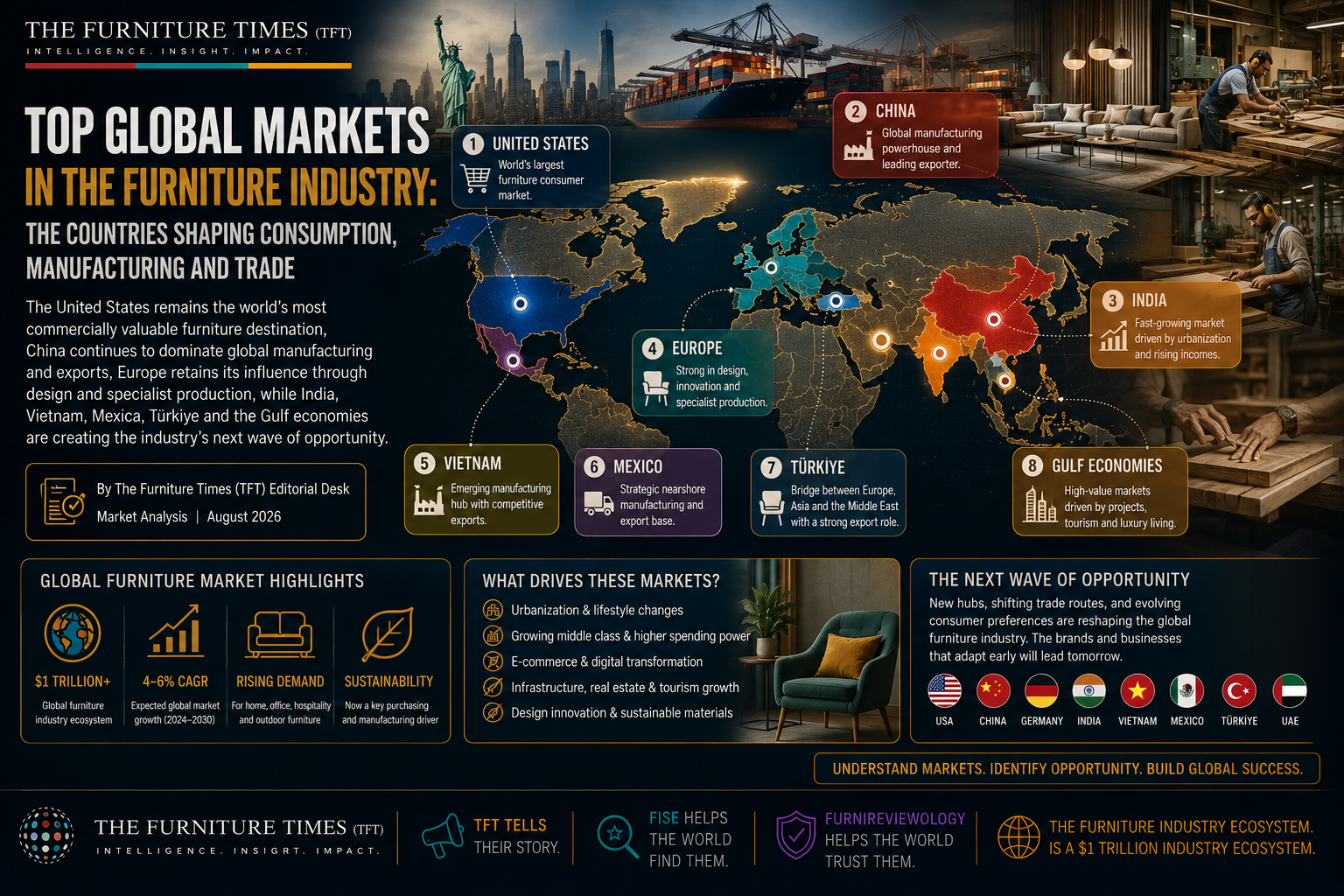
Top Global Markets in the Furniture Industry: The Countries Shaping Consumption, Manufacturing and Trade
The United States remains the world’s most commercially valuable furniture destination, China continues to dominate global manufacturing and exports, Europe retains its influence through design and specialist production, while India, Vietnam, Mexico, Türkiye and the Gulf economies are creating the industry’s next wave of opportunity.
By The Furniture Times (TFT) Editorial Desk
Market Analysis | August 2026
The global furniture industry is entering a period of significant transformation. Its traditional foundations—housing construction, home ownership, population growth, disposable income and commercial development—remain important. However, the industry is now also being reshaped by digital commerce, artificial intelligence, sustainability requirements, geopolitical tensions, changing trade policies, urbanisation and the movement toward local or regional manufacturing.
Furniture is no longer simply a collection of finished products sold through showrooms. It is an interconnected international ecosystem incorporating timber, panels, metals, textiles, foam, leather, coatings, machinery, components, accessories, logistics, software, retail, installation, repair, recycling and interior-design services.
Different research organisations calculate the size of this market differently. Some measure manufacturer revenues, while others include retail sales, contract furniture, outdoor products or related furnishings. Consequently, current estimates vary considerably. Market Research Future values the global furniture market at approximately US$783.13 billion in 2026, while Statista projects worldwide furniture revenue of approximately US$737.91 billion in 2026. Grand View Research produces a higher estimate of approximately US$831.6 billion for the year. These numbers should not be treated as directly interchangeable because their definitions, product coverage and research methodologies differ. Market Research Future, Statista Market Forecast, Grand View Research
When materials, components, machinery, logistics, property-related demand, design, installation, digital services and after-sales activity are considered, the broader furniture industry ecosystem can reasonably be described as approaching or exceeding the US$1 trillion economic threshold.
But the most important question is not simply how large the industry is. It is: Where are the strongest markets, who controls production, which countries dominate trade, and where will future growth come from?
There Is No Single Definition of a “Top Furniture Market”
A country may qualify as a leading furniture market in several different ways.
The United States is exceptionally important because of its consumer spending and import demand. China is vital because of its production capacity, domestic market and export infrastructure. Italy is influential because of design, premium manufacturing and brand value. Vietnam and Poland are significant export centres. India is becoming one of the industry’s most promising long-term consumer and production markets.
For that reason, global opportunities should be assessed across four dimensions:
- Consumption: How much furniture households, companies and institutions purchase.
- Production: How much furniture is manufactured within the country.
- Exports: How successfully domestic manufacturers sell abroad.
- Future potential: How demographics, housing, urbanisation and investment may influence growth.
The distinction matters. A large consumer country may depend heavily on imports, while an export powerhouse may have a comparatively smaller domestic market.
01 — United States: The World’s Most Important Furniture Consumer Market
The United States remains one of the largest and most commercially influential furniture markets in the world. Its importance comes from the size of its economy, high household consumption, large residential property base, extensive retail network and continuing demand from offices, hotels, schools, hospitals and public institutions.
The country is also the world’s largest furniture importer. According to CSIL-related reporting, American furniture imports reached approximately US$41 billion in 2024, representing around one-quarter of global furniture imports. That purchasing power makes the United States an essential destination for manufacturers in China, Vietnam, Mexico, Canada, Malaysia, Indonesia, India and Europe. World Furniture Outlook 2025/2026
American consumers participate in a mature but constantly changing market. Demand includes:
- Upholstered sofas and recliners
- Bedroom and dining-room furniture
- Mattresses and sleep products
- Ready-to-assemble and flat-pack furniture
- Home-office products
- Outdoor and garden furniture
- Kitchen cabinets and storage systems
- Luxury and custom-made furniture
- Senior-living, healthcare and institutional products
Housing turnover is especially important. When people purchase, sell, renovate or relocate to a home, furniture spending generally rises. When mortgage rates are high and existing homeowners delay moving, demand for large furniture purchases can weaken.
The American market is also becoming more regionalised. Tariffs, freight disruption and supply-chain concerns are encouraging retailers to investigate production closer to the consumer. This creates possibilities for manufacturers in the United States, Mexico and Canada, as well as overseas suppliers capable of providing transparent, resilient and diversified sourcing.
For international suppliers, the United States offers enormous opportunity—but also demanding requirements. Delivery reliability, product safety, regulatory compliance, replacement-part availability, digital product information and after-sales service can be as important as price.
02 — China: The Manufacturing Centre of the Global Furniture Economy
China remains the world’s most influential furniture-manufacturing country. Its power comes from industrial scale and the concentration of almost every element required to produce furniture efficiently.
Major Chinese furniture clusters combine:
- Finished-furniture factories
- Panel and veneer suppliers
- Hardware and component manufacturers
- Upholstery and textile operations
- Machinery and automation companies
- Packaging businesses
- Ports, warehouses and freight networks
- Product-development and export services
This industrial density enables factories to move rapidly from product development to high-volume production. China is especially competitive in ready-to-assemble furniture, office furniture, upholstered products, metal furniture, outdoor furniture, components and mass-market home furnishings.
China is also a large domestic consumer market. However, slower property activity, demographic change and cautious consumer spending have placed pressure on some parts of domestic demand. At the same time, Chinese manufacturers face tariffs, trade investigations and growing competition from Southeast Asia, Mexico, Eastern Europe and other emerging production locations.
Despite these challenges, it would be inaccurate to describe China as simply losing its position. The country is shifting toward:
- Automated manufacturing
- Advanced machinery
- Smart-factory systems
- Original product development
- Branded furniture
- Domestic e-commerce
- Customised whole-home solutions
- Smart and connected furniture
- Sustainable materials
- Higher-value exports
Recent trade analysis continues to identify China as the largest individual furniture-exporting country. One current estimate places its latest 12-month exports at approximately US$68.2 billion, although some exporter-reported data remain subject to reporting lags. Furnilytics export analysis
China will therefore remain indispensable—not merely as a low-cost supplier, but as an increasingly sophisticated centre for furniture technology, materials and production.
03 — India: One of the Most Promising Long-Term Growth Markets
India combines several characteristics that make it strategically important: a huge population, rapid urbanisation, expanding middle-class consumption, residential development and a gradual transition from informal carpentry to organised manufacturing and branded retail.
Much of India’s furniture economy has historically operated through local workshops and independent carpenters. That traditional sector remains important, particularly for customised wooden furniture. However, the organised market is expanding through:
- National furniture retailers
- Online marketplaces
- Modular-kitchen companies
- Branded mattress businesses
- Office-furniture manufacturers
- Interior-design platforms
- Hardware and fittings suppliers
- Automated panel-processing operations
India’s growth is not limited to finished products. It is becoming increasingly attractive to international component, machinery, panel, adhesive, hardware and surface-material companies.
Hettich’s leadership has publicly indicated that India could become the hardware group’s largest market within five years, reflecting the country’s transition toward organised furniture production and the expanding middle class. The Economic Times
The central challenge is fragmentation. Quality standards, logistics, installation reliability, professional training and consumer education vary widely. Businesses that help formalise these systems may capture value beyond manufacturing alone.
India should consequently be viewed as both a major future consumer market and a potential manufacturing alternative for selected global product categories.
04 — Germany: Europe’s Industrial and Commercial Furniture Powerhouse
Germany is one of Europe’s largest furniture markets and a major centre for engineering, machinery, components, kitchens and office furniture.
German consumers generally place considerable importance on:
- Product durability
- Functional design
- Material quality
- Ergonomics
- Safety and certification
- Sustainability
- Repairability
- Reliable warranties
Germany has a substantial domestic manufacturing base, but it is also one of the world’s largest furniture importers. Poland is a particularly important supplier, followed by countries including China, Italy, the Czech Republic and Austria. In 2024, Germany imported approximately US$2.11 billion of the “other furniture” category from Poland and approximately US$1.64 billion from China, illustrating the strength of both regional European trade and Asian sourcing. Observatory of Economic Complexity
The country’s competitive strength extends beyond finished furniture. German companies are globally recognised in woodworking machinery, production systems, fittings, adhesives, surfaces, testing and factory automation.
Germany is therefore simultaneously a consumer market, manufacturing location, technology provider and distribution gateway into Europe.
05 — United Kingdom: A Large Import-Dependent Retail Market
The United Kingdom remains among the world’s leading furniture-importing countries. Its demand is supported by a large urban population, established home-improvement culture, strong e-commerce adoption and an extensive network of furniture and interiors retailers.
Important categories include upholstered furniture, beds and mattresses, storage, dining furniture, home-office products, kitchens and garden furniture.
The British market is highly competitive. National chains, specialist retailers, department stores, online marketplaces and direct-to-consumer brands compete for the same customer. Price transparency is therefore high, and consumers can compare products rapidly.
For suppliers, the UK offers scale but requires careful management of:
- Currency movements
- Customs procedures
- Delivery expenses
- Product compliance
- Returns
- Warranty service
- Final-mile logistics
British consumers increasingly expect retailers to provide room images, accurate measurements, customer reviews, finance options, stock visibility and precise delivery dates before purchase. This makes digital merchandising a central competitive capability.
06 — France: Design Culture Combined with Mass-Market Demand
France is another major European furniture consumer and importer. The country combines a strong design tradition with significant demand for affordable household furniture, mattresses, storage, kitchens, outdoor products and decorative furnishings.
French consumers show growing interest in sustainable materials, locally made products, second-hand furniture and product traceability. At the same time, price remains important, particularly when household budgets are under pressure.
The French market provides opportunities across several levels:
- Affordable urban furniture
- Mid-market branded collections
- Premium French and European design
- Hospitality and restaurant furniture
- Refurbished and circular products
- E-commerce and omnichannel retail
- Eco-designed furniture
France’s hotel, tourism and food-service industries also create recurring contract-furniture demand. Suppliers that combine attractive design, regulatory compliance and reliable delivery are well positioned to serve this market.
07 — Italy: The Global Capital of Furniture Design and Premium Value
Italy may not match China’s production volume or America’s consumer scale, but it possesses extraordinary influence over global furniture design.
Italian strength is concentrated in:
- Luxury residential furniture
- Kitchens and wardrobes
- Upholstered furniture
- Lighting
- Contract interiors
- Premium materials
- Woodworking machinery
- Architectural and interior-design services
Italian furniture demonstrates that market influence cannot be measured only by volume. A product developed in Milan, Brianza, Veneto, Friuli-Venezia Giulia or Pesaro may influence trends worldwide even when it is manufactured in comparatively limited quantities.
Italian companies often compete through craftsmanship, brand heritage, product development, finishing and emotional value rather than the lowest price. The country is also among the leading furniture exporters, with recent estimates placing exports at approximately US$13.1 billion over the latest reported 12-month period. Furnilytics
Italy’s continued challenge is protecting authentic design and craftsmanship while adapting to digital product discovery and the expectations of younger international buyers.
08 — Poland: Europe’s High-Volume Export Champion
Poland has developed into one of the world’s most important furniture exporters. It benefits from an established industrial base, skilled labour, proximity to major European markets and integration into regional supply chains.
Polish factories manufacture:
- Upholstered furniture
- Casegoods
- Bedroom furniture
- Flat-pack products
- Components and semi-finished goods
- Private-label furniture for European retailers
Recent trade analysis estimates Polish furniture exports at approximately US$15.3 billion over the latest 12-month period, placing Poland ahead of Germany and Italy among individual European exporters. Furnilytics
A significant portion of Polish production is made for international retail brands. As a result, consumers may own Polish-made furniture without recognising its country of manufacture.
Poland’s next opportunity is to move further from contract and private-label production toward original brands, proprietary designs and greater international recognition.
09 — Vietnam: Asia’s Leading Alternative Export Platform
Vietnam has become one of the world’s largest furniture exporters and a preferred alternative sourcing destination for North American and European buyers.
Its strengths include:
- Wooden indoor furniture
- Bedroom and dining products
- Upholstered furniture
- Outdoor furniture
- Established export factories
- Access to shipping routes
- Competitive production capabilities
Vietnam’s exports have expanded significantly over the last decade. Current analysis estimates exports of approximately US$10.7 billion over the latest 12 months, compared with around US$5.1 billion in 2015. Because some trade reporting is delayed, these figures should be understood as directional rather than perfectly finalised. Furnilytics
The country’s future competitiveness will depend on responsible timber sourcing, domestic component capacity, workforce development, automation and the ability to reduce dependency on imported intermediate materials.
Vietnam is no longer merely an alternative to China. It is an established global manufacturing centre in its own right.
10 — Mexico: The Nearshoring Bridge to North America
Mexico’s location gives it a strategic advantage in serving the enormous American market. Shorter shipping distances, established road networks and regional trade relationships support its position as a nearshoring destination.
Mexico is competitive in:
- Upholstered furniture
- Mattresses
- Wooden furniture
- Metal products
- Hospitality furniture
- Components
- Custom and small-batch manufacturing
For North American retailers, sourcing from Mexico can reduce ocean-shipping exposure and shorten replenishment times. It can also support smaller order quantities and closer supplier collaboration.
Mexico’s long-term opportunity is to build a more integrated furniture ecosystem, including textiles, foam, hardware, panels, packaging, machinery support, design and testing.
11 — Canada: A Stable High-Value Consumer Market
Canada combines a relatively affluent population with strong demand for residential, office, hospitality and outdoor furniture.
The country maintains domestic manufacturing capabilities, particularly in upholstered, wooden, office and institutional products. However, it also imports heavily from the United States, China, Vietnam, Italy and other international suppliers.
Canadian consumers are increasingly attentive to sustainable forestry, low-emission materials, durability and products suited to smaller urban homes. Large distances between population centres make logistics and delivery economics especially important.
Canada should not be viewed only as an extension of the American market. Its regulatory environment, bilingual requirements, climate, housing conditions and regional preferences require a dedicated strategy.
12 — Japan: A Mature Market Focused on Quality and Compact Living
Japan is a sophisticated market where craftsmanship, precision, functionality and efficient use of space are highly valued.
Compact apartments create demand for:
- Multifunctional furniture
- Foldable and stackable products
- Modular storage
- Space-saving dining solutions
- Lightweight furniture
- Senior-friendly and ergonomic products
Japan also has an ageing population, which increases interest in accessible furniture, supportive seating, adjustable beds and products suitable for care environments.
International companies entering Japan must understand that product size, packaging, instructions, service quality and cultural fit can be decisive. Products developed for large Western homes cannot simply be transferred without adaptation.
13 — South Korea: Digital Retail and Design-Led Urban Demand
South Korea is a highly connected consumer market with strong e-commerce usage and considerable interest in interior design.
Apartment living drives demand for modular storage, compact dining furniture, home-office products and flexible room solutions. Consumers are digitally informed and frequently encounter brands through social media, content creators, online marketplaces and mobile commerce.
South Korea is also influential in lifestyle presentation. Furniture is marketed not only as a functional object but as part of a coordinated personal environment.
Brands entering this market need excellent photography, detailed product pages, rapid customer communication and dependable installation.
14 — Indonesia: Natural Materials and Export Potential
Indonesia possesses significant furniture-manufacturing potential because of its craftsmanship, timber resources and expertise in teak, rattan and woven materials.
Its international identity is especially strong in:
- Outdoor furniture
- Solid-wood furniture
- Rattan products
- Handmade furniture
- Resort and hospitality collections
- Decorative accessories
The domestic market is also growing through urban development, rising incomes and expansion in hospitality.
Indonesia’s challenge is to improve production consistency, certification, logistics, design development and international marketing while protecting forests and traditional skills. Greater visibility for small and medium-sized workshops could allow more value to remain with craftspeople instead of being captured primarily by intermediaries.
15 — Malaysia: An Established Export Manufacturing Base
Malaysia is a recognised furniture exporter, particularly in rubberwood products, dining sets, bedroom furniture, ready-to-assemble products and office furniture.
The country benefits from established industrial clusters, export experience, ports and access to Asian supply chains. Malaysian manufacturers have traditionally served the United States, Europe, Japan and regional markets.
Future competitiveness will depend on automation, design ownership, skilled labour, responsible material sourcing and movement beyond original-equipment manufacturing.
Malaysia also has the potential to become a regional centre for furniture technology, certification, halal-conscious lifestyle products, tropical materials and cross-border e-commerce.
16 — Türkiye: A Strategic Link Between Europe, Asia and the Middle East
Türkiye has become an increasingly important furniture producer and exporter. It combines a large domestic market with proximity to Europe, Central Asia, North Africa and the Middle East.
Its strengths include upholstered furniture, panel furniture, mattresses, office furniture, decorative products and complete furnishing packages.
Turkish manufacturers can serve nearby markets faster than distant Asian suppliers, creating an advantage in urgent hospitality, residential and commercial projects.
However, inflation, currency volatility and financing conditions can complicate planning. Companies capable of maintaining quality, delivery reliability and transparent international pricing can still use Türkiye’s location as a powerful strategic asset.
17 — Brazil: Latin America’s Largest Domestic Furniture Opportunity
Brazil has one of the world’s largest populations, a substantial domestic furniture industry and significant raw-material resources.
The country manufactures products across almost every category, from mass-market panel furniture to premium solid wood and design-led collections. Important production clusters support domestic distribution and exports.
Brazil’s opportunities are connected to urbanisation, housing, retail development and the formalisation of furniture sales. Its challenges include taxation, logistics, economic cycles and the difficulty of transporting bulky products across a vast territory.
Brazil also has the potential to increase the international recognition of its designers, sustainable materials and modernist design heritage.
18 — Gulf Cooperation Council: A High-Value Project and Import Market
Saudi Arabia, the United Arab Emirates, Qatar, Kuwait, Bahrain and Oman form one of the most commercially important import-oriented furniture regions.
Demand is supported by:
- Residential construction
- Hotels and resorts
- Offices and mixed-use developments
- Retail and entertainment projects
- Schools and universities
- Healthcare facilities
- Government infrastructure
- Luxury residential interiors
Saudi Arabia is particularly significant because of its scale and development pipeline. The UAE remains a major trading, exhibition and distribution centre, serving both domestic buyers and customers throughout the Middle East, Africa and South Asia.
The Gulf market values imported products, but opportunities for local manufacturing and assembly are increasing. Suppliers must be prepared for project specifications, fire-safety requirements, custom finishes, installation management and demanding completion schedules.
19 — Australia: An Affluent and Highly Import-Dependent Market
Australia is a high-income furniture market with strong demand for residential, outdoor and lifestyle furniture. Its detached housing, outdoor-living culture and renovation activity support spending across multiple categories.
Because domestic production costs are comparatively high, the country imports considerable volumes from China, Vietnam, Malaysia, Indonesia and Europe.
Its geographic distance creates challenges involving freight, inventory planning, returns and replacement parts. Reliable suppliers can differentiate themselves by offering clear lead times, durable packaging and local service support.
20 — Africa: The Long-Term Frontier of Furniture Demand
Africa cannot be evaluated as one uniform market. South Africa, Egypt, Morocco, Nigeria, Kenya, Ethiopia, Ghana and other countries have different incomes, manufacturing structures, regulations and consumer preferences.
Nevertheless, the continent’s long-term fundamentals are important:
- Rapid population growth
- Urbanisation
- Housing demand
- Expansion of education and healthcare
- Hotel and tourism development
- Growing digital commerce
- Increasing need for affordable furniture
South Africa has one of the continent’s most developed formal retail markets. Egypt and Morocco combine domestic production with access to regional export markets. Nigeria represents enormous potential because of its population, although infrastructure, currency and import restrictions can make business difficult. East African markets are attracting interest as cities and institutional demand expand.
The most successful strategies are likely to emphasise local assembly, locally appropriate materials, repairability, affordability and distribution rather than importing expensive products designed for unrelated markets.
The Global Furniture Trade Map Is Being Redrawn
World furniture trade is no longer organised around one simple route from China to Western consumers. Production is becoming more distributed.
China remains the dominant exporter, but Vietnam, Poland, Italy, Germany, Mexico, Türkiye, Malaysia, Indonesia and India are gaining strategic importance.
Meanwhile, the United States, Germany, the United Kingdom, France and the Netherlands remain leading import markets. The Netherlands also operates as a European logistics and redistribution hub rather than representing only domestic consumption. CSIL-related reporting identifies these countries as leading importers and expects global furniture trade to have faced pressure during 2025. World Furniture Outlook 2025/2026
The new model is becoming regional:
- Mexico serves North America.
- Poland and Eastern Europe serve the European Union.
- Türkiye connects Europe, the Middle East and Central Asia.
- Vietnam and Southeast Asia serve the United States, Europe and Asia-Pacific.
- The UAE acts as a distribution centre for the Gulf, Africa and South Asia.
This does not mean globalisation is ending. It means globalisation is becoming more diversified, risk-aware and regionally connected.
What Will Determine the Winners?
The strongest furniture markets of the future will not necessarily be the countries with the lowest labour costs. Competitiveness will increasingly depend on the strength of the entire ecosystem.
Winning countries and companies will need:
Reliable supply chains
Retailers want alternatives when ports close, shipping costs increase, tariffs change or one supplier experiences difficulty.
Digital product information
Search engines, marketplaces and AI recommendation systems require structured information about dimensions, materials, colours, certifications, availability, care, warranties and delivery.
Sustainable and traceable materials
Customers and regulators increasingly expect evidence supporting environmental claims. Vague statements will become less convincing than documented sourcing, emissions information and repairability.
Manufacturing flexibility
Demand is moving toward more styles, faster cycles and smaller production batches. Flexible factories may outperform facilities designed only for enormous identical orders.
Strong components and accessories
Furniture quality depends on hinges, slides, connectors, castors, mechanisms, foam, adhesives, surfaces and fasteners. A visually attractive product can still fail if its hidden components are unreliable.
Efficient logistics
Furniture is bulky, damage-sensitive and expensive to return. Packaging, warehousing, route planning, assembly and final-mile service directly influence profitability.
Trust and reputation
Consumers increasingly compare reviews before purchasing. Brands that make exaggerated promises or provide weak after-sales service may lose visibility and customer confidence.
The Next Competition Will Be for Digital Visibility
Thousands of furniture manufacturers possess strong production skills but remain almost invisible online. Their websites may contain incomplete information, outdated photographs or no searchable product catalogue.
This creates a new divide. Some businesses are visible to search engines, marketplaces and AI systems; others remain digitally absent even when they produce excellent furniture.
Digital visibility requires more than social-media activity. A manufacturer, retailer or artisan needs:
- A verified business identity
- Accurate location and contact details
- Searchable product categories
- Detailed product specifications
- Original photographs
- Certifications and capabilities
- Export-market information
- Customer and trade reviews
- Consistent information across platforms
- Regular editorial coverage
This is especially important for artisans, small workshops, component manufacturers and regional suppliers that cannot afford expensive advertising or international exhibitions.
Conclusion: The Furniture Industry’s Future Will Be Multipolar
The United States will continue to be a crucial consumer and import market. China will remain the central global manufacturing power. Germany, Italy, Poland, France and the United Kingdom will preserve Europe’s commercial and design importance. Vietnam, Mexico and Türkiye will benefit from supply-chain diversification. India offers exceptional long-term potential, while the Gulf, Africa and Southeast Asia provide important opportunities linked to development and demographic growth.
There will not be one winner.
The future furniture economy will be multipolar: products may be designed in Italy, engineered in Germany, use hardware from Austria, panels from Türkiye, textiles from India, be manufactured in Vietnam, sold by an American retailer and delivered through a technology-enabled logistics company.
The companies that understand these connections will be better prepared than those that look only at finished furniture sales.
For manufacturers, retailers, suppliers and investors, the message is clear: do not select a market by headline size alone. Examine consumption, imports, local competition, logistics, regulations, customer behaviour and digital discoverability.
And for the thousands of talented businesses that remain unseen, the next phase of industry development must create a fairer path to discovery.
The Furniture Times (TFT) & Furniture Industry Search Engine (FISE)
“TFT tells their story. FISE helps the world find them.”
FurniReviewology helps the world trust them.
The furniture industry ecosystem is a $1 trillion industry ecosystem. Be visible. Be trusted. Be part of the movement.
