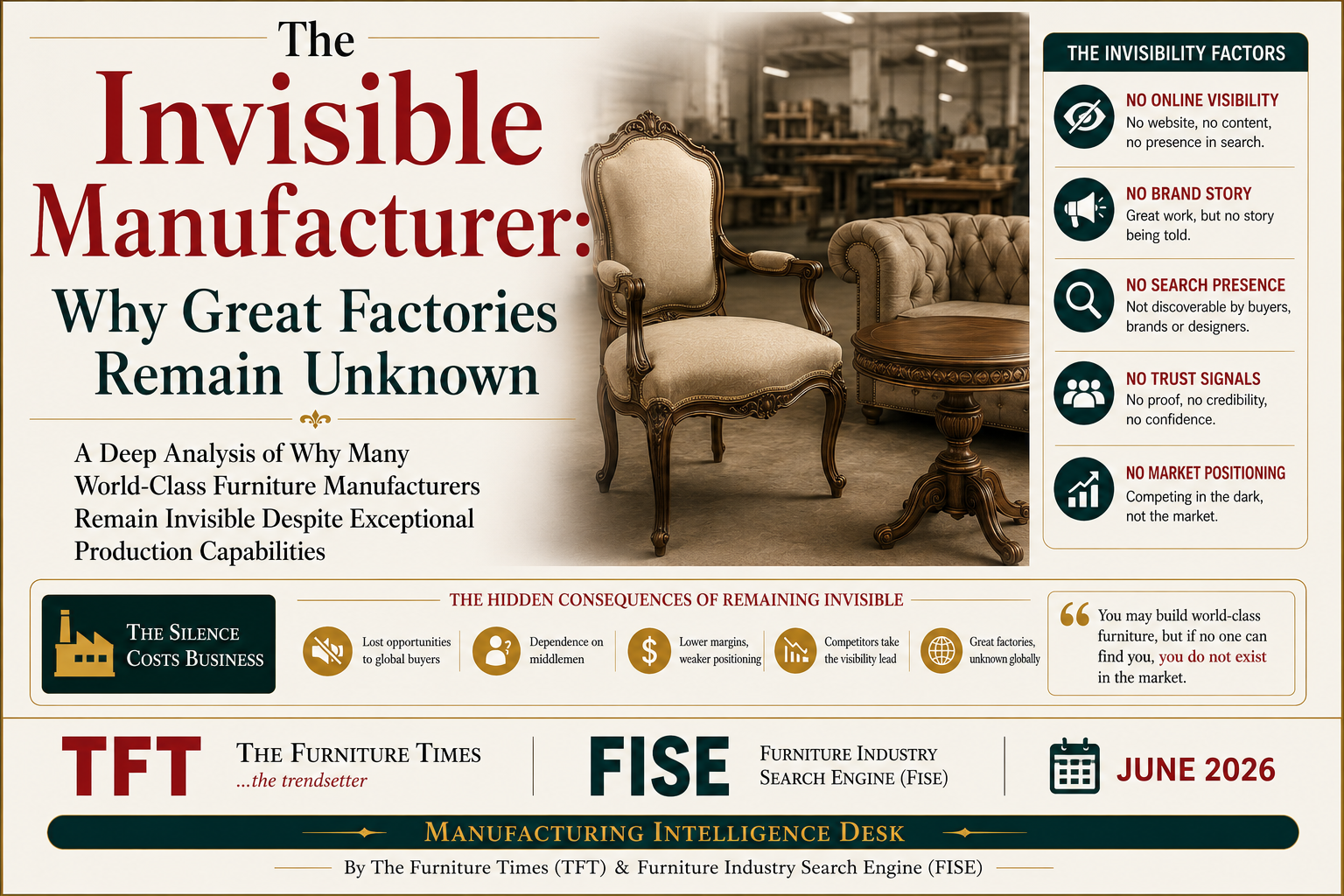
The Invisible Manufacturer: Why Great Factories Remain Unknown
A Deep Analysis of Why Many World-Class Furniture Manufacturers Remain Invisible Despite Exceptional Production Capabilities
Manufacturing Intelligence Desk
By The Furniture Times (TFT) & Furniture Industry Search Engine (FISE)
June 2026
The global furniture industry is filled with invisible giants.
Factories producing world-class products.
Manufacturers supplying international brands.
Craftsmen creating extraordinary work.
Production facilities capable of serving global markets.
Yet outside their immediate business circles, few people know they exist.
No industry recognition.
No global visibility.
No meaningful media presence.
No discoverable digital footprint.
No strong search presence.
No consistent storytelling.
No public authority.
This is one of the greatest paradoxes in the modern furniture industry.
Some of the world’s most capable manufacturers remain almost entirely unknown.
Not because they lack quality.
Not because they lack capacity.
Not because they lack experience.
But because they lack visibility.
And in today’s economy, invisibility can be as dangerous as inefficiency.
The World’s Largest Invisible Workforce
Across Asia, Europe, Africa, the Middle East, and the Americas, millions of workers contribute to the furniture industry every day.
They design.
Manufacture.
Assemble.
Finish.
Package.
Export.
Innovate.
Yet the companies behind much of this work often remain hidden.
The world knows the retail brands.
The world knows the showroom names.
The world often does not know the factories behind them.
This imbalance has created a visibility gap throughout the industry.
Manufacturing Excellence Does Not Guarantee Recognition
One of the biggest misconceptions in business is:
“If we produce quality products, recognition will naturally follow.”
Historically, this may have worked.
Today, it often does not.
The marketplace has changed.
Recognition increasingly follows visibility.
Visibility increasingly follows discoverability.
Discoverability increasingly follows communication.
A manufacturer can be exceptional.
Yet remain invisible.
The Silent Factory Syndrome
Many furniture manufacturers operate under what can be described as:
The Silent Factory Syndrome.
The company focuses almost entirely on:
- Production
- Quality control
- Machinery
- Operations
- Logistics
- Delivery
These functions are critical.
But communication receives little attention.
The result?
The factory becomes highly efficient internally.
But largely unknown externally.
Why Great Manufacturers Remain Hidden
Several factors contribute to this phenomenon.
Legacy Business Models
Many manufacturers built businesses through:
- Referrals
- Existing customers
- Trade networks
- Long-term relationships
Visibility was not considered essential.
Today, buyer behavior has changed.
Yet many manufacturers still operate according to old rules.
OEM Culture
Many factories manufacture products for other brands.
The products become visible.
The factory does not.
Over time, manufacturers become comfortable remaining behind the scenes.
This limits recognition and authority.
Lack of Communication
Many factories have stories worth sharing.
Yet they rarely publish:
- News
- Press releases
- Industry insights
- Product launches
- Sustainability initiatives
- Factory achievements
As a result, the market remains unaware of their capabilities.
Underinvestment in Visibility
Manufacturers often invest heavily in:
- Machinery
- Facilities
- Production systems
But invest very little in:
- Branding
- Searchability
- Discoverability
- Media visibility
This creates an imbalance.
The factory grows.
The visibility does not.
The Discovery Problem
The modern buyer journey begins with discovery.
Before contacting suppliers, buyers search.
They investigate.
They compare.
They evaluate.
A manufacturer that cannot be discovered is often excluded before the evaluation process even begins.
This is one of the hidden costs of invisibility.
Opportunities are lost before conversations start.
The Search Economy Has Changed Manufacturing
For decades, factories relied on exhibitions and networks.
Today, buyers increasingly search online.
A hotel developer searches for:
- Hospitality furniture manufacturers
- Outdoor furniture specialists
- Contract furniture suppliers
An architect searches for:
- Sustainable furniture producers
- Custom manufacturing partners
A distributor searches for:
- Reliable export factories
Visibility influences who enters the conversation.
The Rise of the Visibility Economy
The world is entering a Visibility Economy.
In this economy:
Visibility creates awareness.
Awareness creates trust.
Trust creates opportunities.
Opportunities create growth.
Manufacturers that remain invisible lose access to this cycle.
The consequences can be significant.
Why Searchability Matters
The question is no longer:
“Can we manufacture?”
The question is:
“Can buyers find us?”
Searchability has become a business asset.
Factories that are easy to discover gain advantages in:
- Exports
- Partnerships
- Dealer recruitment
- Hospitality projects
- International expansion
The ability to be found increasingly influences business growth.
The AI Challenge
Artificial Intelligence is accelerating the importance of visibility.
Buyers increasingly ask AI:
- Who are the leading manufacturers?
- Which suppliers specialize in hospitality furniture?
- Which factories have strong reputations?
AI systems rely on information.
Factories with limited public information become difficult to understand.
Difficult to recommend.
Difficult to discover.
This creates a new challenge:
AI Invisibility.
Why Manufacturing Stories Matter
Every factory has stories worth telling.
Stories about:
Innovation
Craftsmanship
Sustainability
Export Success
Technology Adoption
Workforce Development
Product Excellence
These stories help transform manufacturers from unknown suppliers into recognized industry players.
Visibility begins with storytelling.
The Cost of Remaining Invisible
The cost of invisibility rarely appears on financial statements.
Yet it exists.
Invisible manufacturers may lose:
- Export opportunities
- Strategic partnerships
- Hospitality projects
- Dealer inquiries
- Investor interest
- Industry recognition
These losses are difficult to measure.
But they are real.
Every day.
Why the Best Factory Does Not Always Win
This is one of the hardest truths in modern business.
The best manufacturer does not always win.
The most discoverable manufacturer often does.
This does not mean quality is unimportant.
Quality remains essential.
But quality without visibility creates limitations.
The market cannot reward what it cannot find.
From Invisible Manufacturer to Industry Authority
The transition requires a shift in mindset.
Manufacturers must move beyond production-focused thinking.
Visibility should become part of strategy.
This includes:
Press Releases
Thought Leadership
Search Strategy
Industry Content
Product Announcements
Media Participation
Digital Discoverability
These activities help manufacturers become known.
The Future Belongs to Visible Manufacturers
The next generation of manufacturing leaders will not be defined solely by capacity.
They will also be defined by discoverability.
The factories that combine:
- Production excellence
- Visibility
- Authority
- Trust
will gain significant advantages.
Visibility amplifies capability.
Why TFT & FISE Matter
The furniture industry contains thousands of world-class factories.
Many remain invisible.
TFT exists to tell their stories.
FISE exists to help buyers find them.
Because great manufacturers deserve visibility.
And visibility creates opportunity.
TFT & FISE Analysis
The furniture industry does not suffer from a shortage of manufacturing excellence.
It suffers from a shortage of manufacturing visibility.
Many factories have already solved production challenges.
The next challenge is discoverability.
The next challenge is authority.
The next challenge is becoming known.
The manufacturers that solve this problem will be among the industry’s future leaders.
Final Verdict
The world is filled with invisible manufacturers.
Factories producing exceptional products.
Factories capable of serving global markets.
Factories worthy of recognition.
Yet recognition does not happen automatically.
The marketplace rewards visibility.
Not merely capability.
In the modern furniture economy:
Being excellent is important.
Being discoverable is essential.
Because buyers cannot choose suppliers they cannot find.
And factories that remain invisible risk remaining overlooked, regardless of how extraordinary their capabilities may be.
The future belongs to manufacturers that not only build products.
But also build visibility.
By The Furniture Times (TFT) & Furniture Industry Search Engine (FISE)
Manufacturing Intelligence Desk | June 2026
“TFT tells their story. FISE helps the world find them.”
The furniture industry ecosystem is a $1 Trillion Dollar Industry.