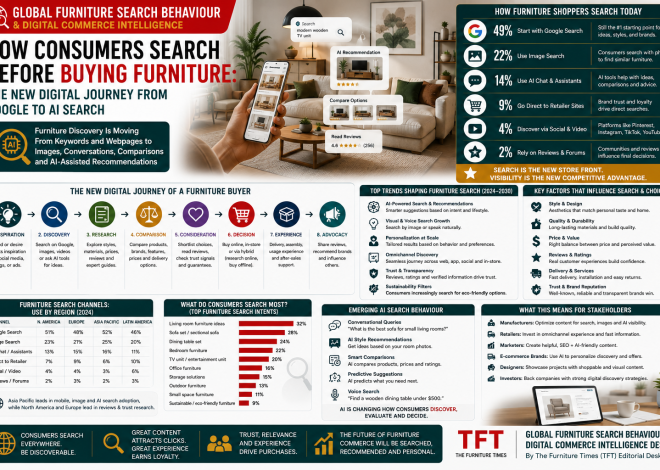
Global Furniture Consumer Search Intelligence Report 2026
What furniture consumers search for, how they behave, who influences purchasing decisions, and how patterns vary across age groups, genders, countries and digital platforms
By The Furniture Times (TFT) Editorial Desk | Consumer Intelligence | Search Behaviour | Furniture Retail | Global Market Analysis
The global furniture consumer is no longer following a simple journey from advertisement to showroom to purchase.
Today’s buyer may discover a room idea on social media, search for a product on Google, compare prices on a marketplace, read reviews, watch an assembly video, use a 3D room planner, visit a physical showroom and then return online to complete the transaction.
Other consumers begin in the opposite direction. They visit a store, test the furniture, photograph the label and search online for reviews, alternative colours, better prices or faster delivery.
This means furniture shopping is not exclusively online or offline. It is increasingly hybrid, visual, research-intensive, location-sensitive and driven by the consumer’s need to reduce risk.
The furniture industry ecosystem must understand more than what consumers eventually buy. It must understand what people search before purchasing, what prevents them from moving forward and what information increases their confidence.
01 — Important Research Limitation
There is no single global database containing every furniture search performed across Google, Facebook, Instagram, LinkedIn, marketplaces, retailer websites and AI platforms.
Available evidence comes from different sources:
- Consumer surveys
- Retailer studies
- Search-engine trends
- E-commerce data
- Website-user testing
- Renovation research
- Public social-media discussions
- Product-configurator behaviour
- Market-revenue estimates
- Industry interviews
- Platform-specific reports
These sources use different countries, age ranges, sample sizes and definitions.
For example, the 2026 3D Cloud study surveyed 400 American furniture purchasers aged 25–69 who had recently spent at least $500 and had household incomes of at least $50,000. Its findings are valuable for understanding active, higher-intent American furniture purchasers, but they should not be treated as a survey of every global consumer. 3D Cloud Furniture Shopping Trends Study 2026
Similarly, public LinkedIn posts mainly represent industry professionals, technology companies, researchers and business decision-makers. They provide useful qualitative signals but do not represent the entire consumer population.
The findings below should therefore be treated as a structured intelligence framework—not a claim that every consumer behaves identically.
02 — The Furniture Search Journey
Furniture consumers usually move through several stages.
Stage 01 — Need Recognition
A need may be triggered by:
- Moving into a new home
- Marriage or household formation
- Renovation
- A damaged or uncomfortable product
- A new child
- Remote work
- Downsizing
- Starting a business
- Opening a hotel or restaurant
- Seasonal outdoor living
- Disability or accessibility requirements
- A change in income
- A social-media inspiration image
At this point, the search may be broad:
- “living-room ideas”
- “small-bedroom furniture”
- “home-office setup”
- “best furniture for apartment”
- “modern dining-room inspiration”
Stage 02 — Category Discovery
Consumers begin identifying a suitable product:
- Sectional sofa
- Dining table
- Wardrobe
- Adjustable desk
- Outdoor dining set
- Storage bed
- Recliner
- Mattress
- Bookshelf
- Hotel furniture supplier
Stage 03 — Comparison
Searches become more specific:
- “solid wood vs veneer dining table”
- “fabric vs leather sofa”
- “memory foam vs spring mattress”
- “modular sofa advantages”
- “teak vs aluminium outdoor furniture”
- “custom wardrobe price”
- “best office chair for long working hours”
Stage 04 — Risk Reduction
The buyer searches for reassurance:
- Reviews
- Complaints
- Warranty terms
- Delivery time
- Return policy
- Assembly requirements
- Product dimensions
- Material quality
- Cleaning instructions
- Replacement components
- Brand reputation
Stage 05 — Transaction
The search becomes commercial and local:
- “sofa shop near me”
- “furniture delivery today”
- “buy dining table online”
- “furniture sale Malaysia”
- “custom cabinet quotation”
- “office furniture supplier Kuala Lumpur”
Stage 06 — Post-Purchase Support
Search continues after the sale:
- Assembly instructions
- Cleaning methods
- Furniture care
- Warranty claims
- Replacement parts
- Repair services
- Resale value
- Disposal or recycling
The furniture company that publishes useful information across all six stages can remain visible throughout the complete customer journey.
03 — What Furniture Consumers Search For
Furniture searches can be divided into several major intent groups.
Product Searches
These describe the item:
- Sofa
- Bed
- Mattress
- Dining table
- Wardrobe
- Cabinet
- Desk
- Office chair
- Outdoor furniture
- TV unit
- Bookshelf
- Storage bench
- Recliner
- Coffee table
- Sideboard
Attribute Searches
These describe a desired feature:
- Solid wood
- Foldable
- Extendable
- Waterproof
- Scratch-resistant
- Pet-friendly
- Stain-resistant
- Ergonomic
- Modular
- Lightweight
- Adjustable
- Space-saving
- Eco-friendly
- Easy to assemble
- Child-safe
Style Searches
These focus on appearance:
- Modern furniture
- Minimalist furniture
- Scandinavian furniture
- Traditional furniture
- Luxury furniture
- Mid-century modern
- Rustic furniture
- Industrial furniture
- Japandi furniture
- Contemporary furniture
- Vintage furniture
- Coastal interiors
Material Searches
These indicate quality, appearance or maintenance concerns:
- Teak
- Oak
- Walnut
- Pine
- Rubberwood
- Bamboo
- Rattan
- Aluminium
- Stainless steel
- Leather
- Performance fabric
- Bouclé
- Marble
- Glass
- MDF
- Plywood
Size and Fit Searches
These are extremely important because furniture is spatial.
- Sofa for small living room
- Dining table for six people
- Wardrobe for narrow bedroom
- Desk for small apartment
- Furniture measurements
- Sofa that fits through door
- Compact balcony furniture
- King-size bed dimensions
- Corner sectional measurements
- Custom-size cabinet
Baymard’s 2026 furniture and home-decor research found that written dimensions and dimension images were among the most important types of product-page information for helping online shoppers determine whether an item would fit. Written dimensions were selected by 49% of respondents and dimension images by 42%. Baymard Furniture and Home Décor Insights
Price and Value Searches
- Affordable furniture
- Furniture under $500
- Luxury sofa price
- Furniture sale
- Clearance furniture
- Best-value mattress
- Furniture financing
- Instalment furniture
- Free-delivery furniture
- Factory-direct furniture
- Second-hand furniture
- Refurbished furniture
Location Searches
- Furniture shop near me
- Local furniture manufacturer
- Sofa store in [city]
- Cabinetmaker near me
- Furniture repair near me
- Office furniture supplier [country]
- Outdoor furniture showroom
- Mattress shop open now
Trust Searches
- Best furniture brands
- Furniture brand reviews
- Is this furniture company reliable?
- Warranty complaints
- Delivery reviews
- Customer-service rating
- Furniture store scam
- Product durability
- Return experience
These trust searches demonstrate why FurniReviewology can become an important part of the ecosystem.
04 — The Most Important Consumer Purchase Criteria
A December 2025 furniture-shopping survey involving 320 participants found that the leading purchase considerations included:
- High quality
- Reasonable price
- Delivery
- Fast availability
- Product selection
- Ability to test furniture
- Assembly services
- Detailed advice
- Customer reviews
The respondents were almost evenly divided by gender—50.9% female and 49.1% male—with an average age of 42.9. This makes the findings useful for illustrating that furniture decisions involve more than appearance or price alone. Talk Group Furniture Shopping Survey
The practical implication is that a product page should not merely show a beautiful photograph. It should answer:
- What is it made from?
- How large is it?
- Is it available?
- How quickly can it be delivered?
- Does assembly cost extra?
- Can it be returned?
- What does the warranty cover?
- What do previous customers say?
- Can it be viewed in a showroom?
- Can colours, fabrics or sizes be changed?
05 — Furniture Shopping Is Now a Hybrid Journey
The strongest repeated finding across recent furniture research is the importance of hybrid shopping.
The 2026 3D Cloud study reported:
- 42% shopped both online and in-store
- 25% shopped online only
- 33% shopped in-store only
The study also found that 62% considered it difficult to visualise how furniture would look in their homes. 3D Cloud 2026 study
The 2025 wave had similarly reported that 45% of shoppers used a mixture of online and in-store channels. 3D Cloud 2025 findings
This means the industry should not ask, “Will customers shop online or in-store?”
The better question is, “How do we connect the online and in-store journey?”
A customer should be able to:
- Save a product online
- Check showroom availability
- Carry a saved configuration into the store
- View the same prices and specifications
- Speak with an informed salesperson
- Request samples
- Complete the purchase through either channel
- Track delivery digitally
- Access support after purchase
06 — Online Research Often Comes Before the Showroom
Publicly indexed LinkedIn research posts reinforce the digital-first trend.
HomeByMe Enterprise reported findings from research involving 9,000 American consumers:
- 63% began their design journey online
- 76% wanted to use a 3D configurator for a future project
- 53% said they would select a brand offering a configurator over one without it
- 31% identified personalisation as an important purchase criterion
These numbers were published through HomeByMe’s professional LinkedIn communications and should be interpreted within the context of that company’s research audience. HomeByMe Enterprise LinkedIn findings
The implication is clear: even when the final transaction occurs in a showroom, the retailer’s website may already have influenced whether the customer visits.
07 — Why Consumers Still Visit Furniture Showrooms
Digital research has not eliminated the showroom.
Consumers still want to:
- Test comfort
- Feel fabric and finishes
- Examine colour under real lighting
- Assess construction quality
- Compare mattress support
- Test recliner mechanisms
- Speak with knowledgeable staff
- Understand delivery access
- Confirm product scale
- Reduce purchase anxiety
Furniture is expensive, physically large and costly to return. A sofa that is slightly uncomfortable or too large for a doorway can become a major problem.
The showroom therefore functions as a confidence centre, while digital channels function as discovery, comparison and preparation tools.
08 — Visualisation Is Becoming a Purchase Requirement
Consumers struggle to imagine furniture in an empty or existing room.
The 2026 3D Cloud study reported that 78% believed 3D gave them greater control over purchasing decisions. The research also found that 3D room-planner use had shifted younger, becoming most popular among people aged 25–34, hybrid shoppers and male participants within that particular sample.
It further reported that shoppers using 3D tools with an in-store salesperson were more likely to make higher-value purchases and express greater satisfaction. However, these results show association within the surveyed group and should not automatically be interpreted as proof that 3D alone caused every increase. 3D Cloud research
Consumers increasingly want to:
- Rotate the product
- Change colours
- Select fabrics
- Adjust configurations
- View dimensions
- Place furniture inside a room image
- Compare alternative layouts
- Check whether several pieces work together
Meta has also introduced a “View in Room” capability for selected home-décor objects on Facebook Marketplace, illustrating the wider platform movement toward spatial product visualisation. Meta SAM 3D announcement
09 — Personalisation Interests
Furniture is becoming more configurable.
The 2025 3D Cloud study reported strong interest in customising:
- Colour: 83%
- Fabric: 72%
- Size: 53%
- Leg style: 30%
The same research series reported that 72% of surveyed buyers customised their furniture purchases and that 88% of users found a 3D configurator helpful. 3D Cloud LinkedIn summary
Personalisation is especially important for:
- Modular sofas
- Wardrobes
- Kitchens
- Storage systems
- Office furniture
- Beds
- Dining tables
- Outdoor sectional furniture
However, too many options can overwhelm buyers. Configurators should therefore guide rather than merely display every possible combination.
10 — Search Patterns by Age Group
Age affects furniture needs, budgets, channels and risk tolerance, but age alone does not determine behaviour.
Teenagers and Young Adults
Most members of this group are not yet independent household furniture buyers, but they influence family decisions and form early style preferences.
Common interests include:
- Bedroom organisation
- Gaming desks and chairs
- Study furniture
- Affordable décor
- Compact storage
- Social-media-inspired rooms
- Second-hand products
- Easy assembly
Brands should treat under-18 audiences responsibly and avoid presenting credit or unaffordable consumption as a social requirement.
Gen Z Adults
Common life stages include renting, entering employment and becoming first-time homeowners.
Likely searches include:
- Affordable furniture
- Small-apartment furniture
- Modular sofas
- Storage beds
- Home-office furniture
- Second-hand furniture
- Sustainable furniture
- Furniture delivery
- Furniture assembly
- Buy-now comparisons
- Visual room-planning tools
Houzz’s 2026 American study defined Gen Z homeowners as ages 18–29. They represented a small but growing share of renovating homeowners in that dataset and were especially likely to renovate after recently purchasing a home. They also showed stronger interest in smaller functional spaces, such as laundry rooms and closets. 2026 Houzz & Home Study
Millennials
Millennials commonly search around:
- First or second homes
- Family-friendly furniture
- Nursery furniture
- Home offices
- Storage
- Modular products
- Dining and entertaining
- Pet-friendly fabrics
- Outdoor living
- Value and financing
- Product reviews
- Customisation
They frequently combine digital research with showroom validation.
Gen X
Gen X households may have stronger income and larger furnishing or renovation requirements.
Searches can include:
- Premium sofas
- Kitchen renovations
- Larger dining tables
- Replacement furniture
- Home-office upgrades
- Teen bedroom furniture
- Outdoor living
- Durable materials
- Custom cabinetry
- Quality and warranty
Houzz reported that Gen X renovation spending exceeded Baby Boomer median spending in its 2026 American study, though seniors recorded the highest median spend. This demonstrates the importance of mature, higher-value customer groups.
Baby Boomers
Common interests may include:
- Comfort
- Recliners
- Adjustable beds
- Durable furniture
- Easy-clean surfaces
- Reliable delivery
- Assembly services
- Replacement furniture
- Downsizing
- Furniture for long-term homes
- Showroom testing
- Trustworthy service
Seniors
Searches may focus on:
- Supportive seating
- Appropriate seat height
- Accessible storage
- Easy-to-operate mechanisms
- Stable furniture
- Delivery and installation
- Clear warranty information
- Long-term durability
- Local service
Older customers should not be assumed to be digitally inactive. Many use search, reviews and retailer websites but may value simple navigation, readable specifications and human support.
11 — Age Does Not Produce One Simple Online Hierarchy
One broad e-commerce study cited by Furniture Today found relatively small differences between age groups in naming furniture and décor among their three most frequently purchased online categories:
- Baby Boomers: 11%
- Millennials: 11%
- Gen X: 10%
- Gen Z: 9%
The study also found that furniture and décor remained much less frequently purchased online than clothing, electronics or beauty products. Furniture Today report
This is an important warning: younger consumers may be highly active in digital discovery without necessarily purchasing large furniture online more frequently than everyone else.
Search activity, online influence and completed online transactions are different measurements.
12 — Gender Patterns: Use Evidence, Not Stereotypes
Gender analysis must be handled carefully.
Furniture decisions are often shared within households. Search engines, retailers and researchers may record a profile’s gender, but this does not prove who made the final decision, who influenced it or who paid.
One e-commerce survey found furniture and décor among the most frequently purchased online categories for 12% of women compared with 8% of men. However, this was not a furniture-only study and should not be universalised.
The 2025 3D Cloud report indicated that online-only furniture shopping had increased particularly among female shoppers, while the 2026 study found 3D room-planner use strongest among men within its sample.
These findings suggest channel and tool preferences may differ in particular datasets. They do not support simplistic conclusions such as “women care about design” and “men care about technology.”
A better segmentation system uses:
- Purchase role
- Household type
- Life stage
- Budget
- Room or project
- Design confidence
- Product knowledge
- Urgency
- Digital confidence
- Need for customisation
Gender can remain one analytical variable, but it should not replace behavioural evidence.
13 — Household Decision-Making
Furniture purchases are frequently negotiated between:
- Couples
- Parents and children
- Adult children and older parents
- Flatmates
- Designers and clients
- Employers and employees
- Retail buyers and management
- Hotel owners and operators
Houzz research involving couples found furniture among the design choices capable of producing disagreement. Respondents wanted better price transparency, communication and timelines during renovation processes.
This supports the use of collaborative tools such as:
- Saved idea boards
- Shareable product links
- Side-by-side comparisons
- Room planners
- Sample ordering
- Joint wish lists
- Downloadable quotations
- Clear product visualisation
Furniture companies should design for group decisions, not only individual clicks.
14 — Country and Regional Search Patterns
United States
The United States is one of the largest furniture and online home-furnishing markets.
Common demand drivers include:
- Homeownership
- Moving
- Renovation
- Large living spaces
- Home offices
- Outdoor living
- Replacement cycles
- Financing
- Fast delivery
- Reviews
- Custom sectionals
Statista’s estimates placed the United States as the largest furniture e-commerce revenue market in 2025, followed by China, Germany, the United Kingdom and France. These figures are market estimates rather than direct search-volume measurements. Statista country estimates
China
China is both a manufacturing centre and a highly digital consumer market.
Consumers commonly use integrated marketplaces, social commerce, mobile payments and live commerce. Urban customers may search for:
- Compact furniture
- Storage
- Multifunctional products
- Smart furniture
- Children’s furniture
- Gaming furniture
- Local delivery
- Value comparisons
IKEA expanded its Chinese digital distribution through JD.com after previously joining Tmall. The company said one in five new Chinese customers in the previous financial year came through Tmall, illustrating the importance of third-party platforms. Reuters
Germany
German consumers frequently place strong emphasis on:
- Product quality
- Detailed dimensions
- Materials
- Sustainability
- Certification
- Delivery
- Assembly
- Warranty
- Kitchen and storage solutions
United Kingdom
Important search themes include:
- Small-space furniture
- Sofas
- Beds and mattresses
- Garden furniture
- Flat-pack furniture
- Delivery
- Finance
- Local showrooms
- Reviews
- Used furniture
France and Italy
Design, aesthetics, heritage, materials and brand identity remain important. Consumers may search by style, designer, collection or manufacturing origin alongside conventional product and price terms.
India
India’s search market is highly diverse and mobile-led.
Common search patterns include:
- Furniture near me
- Wooden furniture
- Sofa price
- Bed with storage
- Modular kitchen
- Office chair
- Custom furniture
- Furniture on instalment
- Local carpenter
- Furniture manufacturer
- Wedding furniture packages
Language, city tier, housing type and income significantly influence behaviour.
Southeast Asia
Markets including Malaysia, Indonesia, Thailand, Vietnam and the Philippines combine local manufacturing, imported products, marketplaces and social commerce.
Strong interests may include:
- Space-saving furniture
- Teak and wood furniture
- Rattan
- Outdoor furniture
- Affordable packages
- Local delivery
- Custom furniture
- Marketplace reviews
- Furniture for condominiums
- Hospitality furniture
Japan and South Korea
Urban density encourages demand for:
- Compact furniture
- Modular storage
- Foldable products
- Multifunctional rooms
- Minimalist design
- Smart furniture
- Delivery precision
- High-quality product information
Middle East
Markets such as Saudi Arabia, the UAE and Qatar include strong demand from residential development, expatriate households, hospitality and commercial projects.
Searches may involve:
- Luxury furniture
- Imported furniture
- Custom interiors
- Majlis furniture
- Hotel furniture
- Outdoor furniture
- Fast delivery
- Project suppliers
- Interior-design services
- Furniture packages
Africa
African markets cannot be treated as one consumer group.
Important variables include local manufacturing, imported products, urbanisation, mobile commerce, informal retail, payment systems and logistics.
Search interests may include:
- Furniture prices
- Local carpenters
- Beds and mattresses
- Office furniture
- School furniture
- Sofa sets
- Custom furniture
- Imported furniture
- Used furniture
- Delivery
Country-based FISE platforms could help users find businesses currently hidden outside major cities and formal digital marketplaces.
15 — Leading Furniture E-Commerce Markets
Based on Statista’s estimated 2025 furniture e-commerce revenue, the leading markets included:
| Country | Estimated 2025 furniture e-commerce revenue |
|---|---|
| United States | $120.93 billion |
| China | $23.03 billion |
| Germany | $16.89 billion |
| United Kingdom | $10.24 billion |
| France | $8.46 billion |
These values measure estimated revenue, not the number of searches or individual buyers. The United States’ lead may reflect market size, spending levels, category definitions and online retail maturity.
Search intelligence should combine revenue data with:
- Search volume
- Population
- Internet penetration
- Household formation
- Housing activity
- Average order value
- Local product availability
- Marketplace adoption
- Delivery infrastructure
16 — Search Patterns by Room
Living Room
- Sofa
- Sectional
- Recliner
- TV unit
- Coffee table
- Side table
- Rug
- Storage
- Accent chair
Consumers focus on comfort, size, fabric, layout and appearance.
Bedroom
- Bed
- Mattress
- Wardrobe
- Bedside table
- Dresser
- Storage bed
- Adjustable bed
Consumers focus on comfort, storage, dimensions, health-related support and delivery.
Dining Room
- Dining table
- Dining chairs
- Extendable table
- Sideboard
- Bar stools
Consumers focus on seating capacity, size, durability and ease of cleaning.
Kitchen
- Kitchen cabinets
- Pantry storage
- Kitchen island
- Cabinet hardware
- Custom kitchen
Houzz’s 2026 kitchen research found that 84% of surveyed renovators upgraded cabinets, while specialty built-in storage remained a major priority. Houzz Kitchen Trends
Home Office
- Ergonomic chair
- Adjustable desk
- Compact desk
- Filing storage
- Cable management
- Standing desk
Outdoor
- Outdoor sofa
- Patio dining
- Balcony furniture
- Teak furniture
- Weather-resistant furniture
- Pool loungers
- Garden swing
Houzz reported that 83% of surveyed American outdoor renovators created lounge or seating areas, showing how outdoor spaces are increasingly treated as extensions of the home. Houzz Outdoor Trends
17 — Search Patterns by Price Position
Budget Consumers
They search for:
- Affordable
- Discount
- Sale
- Clearance
- Under a price limit
- Free delivery
- Flat-pack
- Used
- Refurbished
- Instalment
Mid-Market Consumers
They compare:
- Quality versus price
- Warranty
- Materials
- Reviews
- Delivery
- Customisation
- Brand reputation
Premium Consumers
They search for:
- Designer furniture
- Bespoke furniture
- Solid wood
- Handcrafted
- Luxury interiors
- Made-to-order
- Italian furniture
- Sustainable luxury
- White-glove delivery
Premium buyers still examine value. They may be less price-sensitive, but they require stronger proof of materials, craftsmanship, service and authenticity.
18 — Search Patterns by Purchase Urgency
Immediate Need
- In stock
- Same-day delivery
- Furniture shop open now
- Mattress available today
- Ready-made furniture
Planned Purchase
- Best sofa
- Furniture comparison
- Dining-table buying guide
- Furniture brands
- Materials
- Reviews
Long-Term Project
- Custom kitchen
- Hotel furniture supplier
- Office fit-out
- Bespoke wardrobe
- Furniture manufacturer
- Interior designer
The content, advertising and call to action should match the buyer’s timing.
19 — Seasonal Search Behaviour
Furniture interest can rise around:
- New-year home improvement
- Spring renovation
- Summer outdoor living
- Back-to-school periods
- House-moving seasons
- Major shopping festivals
- Black Friday
- Holiday hosting
- Year-end clearances
- Wedding seasons
- Tax-refund periods in some countries
However, seasonality differs by climate, culture and retail calendar.
Outdoor-furniture searches may rise before summer in Europe or North America but follow different patterns in tropical markets. Wedding-related furniture demand may be significant in some countries and less important in others.
Businesses should build country-level seasonal calendars rather than copying one global marketing schedule.
20 — Public LinkedIn Signals
Publicly indexed LinkedIn discussions repeatedly emphasise several themes:
- Hybrid shopping
- 3D visualisation
- Personalisation
- Material transparency
- Sustainability
- Multifunctional furniture
- Warm natural colours
- Tactile materials
- Smaller, curated assortments
- AI-assisted research
- Supply-chain resilience
- Value and margin pressure
A Las Vegas Market commentary highlighted warm woods, tactile fabrics, layered neutrals and stronger assortment discipline rather than excessive trend chasing. This is a professional observer’s interpretation, not a scientific consumer survey. Public LinkedIn market commentary
Another public industry post identified outdoor living, sustainable minimalism and hybrid home spaces as important lifestyle themes. Again, this should be treated as professional opinion rather than population-level evidence. Public LinkedIn furniture trends post
LinkedIn is most useful for understanding what industry professionals are discussing—not for determining exact consumer percentages.
21 — AI Is Entering Furniture Discovery
Consumers increasingly ask AI systems questions such as:
- What sofa is best for a small apartment?
- Which furniture brands offer good warranties?
- What dining-table size fits six people?
- Is teak suitable for outdoor use?
- Which mattress type is best for side sleepers?
- Find sustainable furniture brands in Malaysia.
- Compare solid wood and MDF.
- Suggest furniture for a minimalist bedroom.
AI changes search from isolated keywords to complete questions.
Furniture businesses must publish information that AI systems can understand:
- Clear company identity
- Accurate product categories
- Dimensions
- Materials
- Prices or price ranges
- Locations
- Delivery areas
- Warranty terms
- Reviews
- Frequently asked questions
- Structured product information
- Independent media coverage
If a brand has incomplete or inconsistent information, AI systems may struggle to understand or recommend it.
22 — Reviews Are Part of Search Behaviour
Consumers frequently search a brand name together with:
- Reviews
- Complaints
- Warranty
- Delivery
- Quality
- Scam
- Return policy
- Customer service
This means reviews are not only a post-purchase reputation issue. They are part of product discovery and conversion.
FurniReviewology should help consumers evaluate:
- Product quality
- Comfort
- Durability
- Delivery
- Assembly
- Customer service
- Warranty response
- Value
- Product accuracy
- Problem resolution
Review systems should verify genuine experiences where possible and allow businesses to respond fairly.
23 — The Information Consumers Need Before Buying
An effective furniture product page should include:
- Product name
- Several clear photographs
- Lifestyle images
- Written dimensions
- Dimension diagrams
- Materials
- Construction details
- Colour and fabric options
- Weight
- Seating capacity
- Care instructions
- Assembly requirements
- Delivery estimate
- Delivery access requirements
- Warranty
- Return policy
- Stock status
- Customer reviews
- Frequently asked questions
- 360-degree or 3D view
- Showroom availability
A beautiful photograph attracts attention. Complete information creates confidence.
24 — What Furniture Brands Should Stop Doing
Brands should stop:
- Publishing vague product descriptions
- Hiding dimensions
- Using only one image
- Removing negative reviews without justification
- Showing unavailable products
- Advertising prices that exclude major fees
- Separating online and showroom information
- Ignoring mobile users
- Assuming every customer is ready to buy
- Treating demographics as stereotypes
- Focusing only on high-volume keywords
- Publishing content that AI cannot interpret
25 — What the Furniture Ecosystem Should Build
The global furniture industry needs a connected discovery infrastructure.
Manufacturers
Publish capabilities, certifications, capacity, materials, markets and product information.
Retailers
Connect search, product availability, showrooms, reviews, delivery and after-sales support.
Component Suppliers
Publish technical specifications, compatibility, testing, quantities and lead times.
Designers
Show project types, design services, style expertise and locations.
Artisans
Document craft, materials, location, commissions and authentic work.
Logistics Providers
Explain coverage, delivery types, assembly and specialised furniture handling.
Technology Companies
Support search, product information, configuration, visualisation and market intelligence.
FISE
Organise the ecosystem by country, category, product, service, location and capability.
TFT
Tell the stories behind businesses, clusters, innovation and industry change.
FurniReviewology
Help buyers understand reputation, experience and trust.
26 — Strategic Consumer Segments
Furniture businesses should build segments around needs rather than demographics alone.
The First-Home Furnisher
Needs affordability, guidance, delivery and coordinated room packages.
The Small-Space Optimiser
Needs dimensions, storage, modularity and visualisation.
The Quality Replacer
Needs durability, materials, warranties and trusted reviews.
The Style-Led Buyer
Needs inspiration, collections, colours, textures and designer stories.
The Family Buyer
Needs durability, safety, cleaning and practical storage.
The Accessibility-Focused Buyer
Needs clear functional information, support and appropriate product design.
The Sustainable Buyer
Needs evidence of materials, repairability, certifications and product life.
The Project Buyer
Needs capacity, specifications, quotations, lead times and installation.
The Urgent Buyer
Needs stock, local availability and delivery certainty.
These behavioural segments can be more actionable than simply targeting “men aged 25–34” or “women aged 35–44.”
27 — Major Conclusions
The evidence supports several broad conclusions:
01 — Furniture discovery is digital-first but not necessarily digital-only.
02 — Hybrid shopping is now a central path to purchase.
03 — Size, fit and visualisation are major consumer concerns.
04 — Quality, price, delivery and availability remain fundamental.
05 — Reviews influence discovery, comparison and trust.
06 — Younger consumers show strong interest in visual and interactive tools, but older groups remain commercially important.
07 — Gender differences appear in some datasets, but behaviour and life stage are more reliable targeting variables.
08 — Country patterns depend on housing, income, culture, climate, digital infrastructure and logistics.
09 — AI is turning furniture search into conversational questions.
10 — Brands with weak product information risk disappearing from both conventional and AI-assisted search.
28 — Final Industry Message
The furniture industry does not have one consumer. It has millions of consumers operating across different countries, cultures, ages, household types, budgets and life stages.
Some customers search for affordable beds. Others search for bespoke hotel furniture. Some want a product delivered immediately. Others research a custom project for months.
The winning companies will not be those that make the most assumptions. They will be those that organise the best information, understand purchase intent, reduce uncertainty and remain visible across every stage of discovery.
The future of furniture search belongs to businesses that can be found, understood, compared, visualised and trusted.
The Furniture Times (TFT) & Furniture Industry Search Engine (FISE)
“TFT tells their story. FISE helps the world find them.”
FurniReviewology helps the world trust them.
The furniture industry ecosystem is a $1 trillion industry ecosystem.