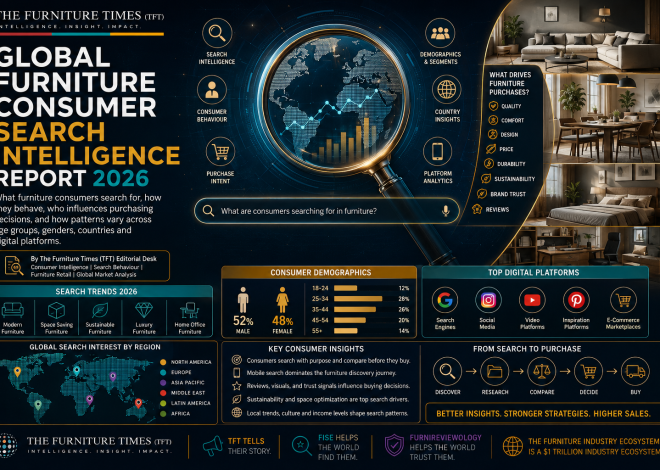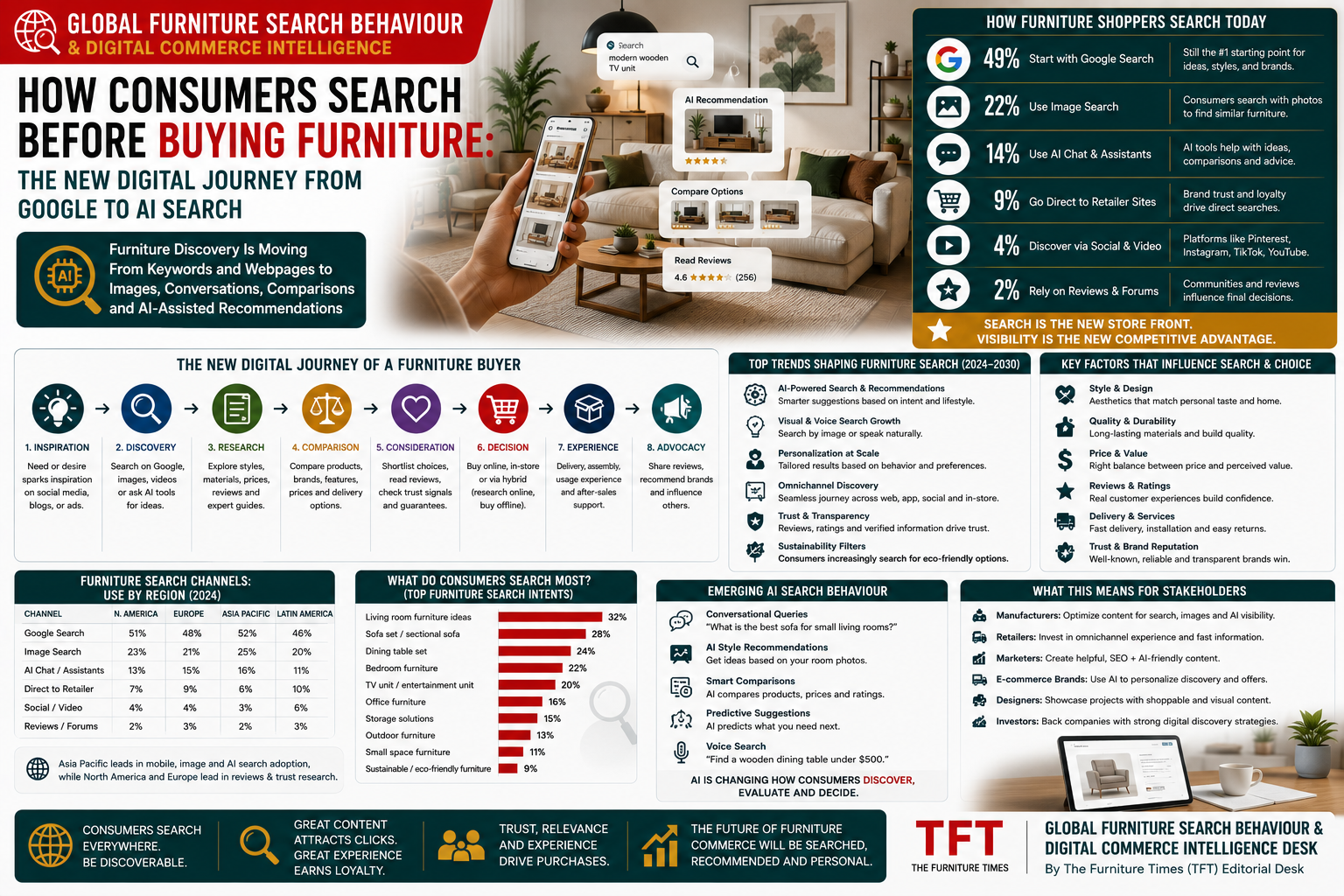
How Consumers Search Before Buying Furniture: The New Digital Journey from Google to AI Search
Furniture Discovery Is Moving From Keywords and Webpages to Images, Conversations, Comparisons and AI-Assisted Recommendations
Global Furniture Search Behaviour & Digital Commerce Intelligence Desk
By The Furniture Times (TFT) Editorial Desk
The furniture-buying journey increasingly begins before a customer enters a showroom, speaks with a salesperson or visits a manufacturer.
It begins with a search.
A homeowner may search Google for the best sofa for a small apartment. A hotel procurement manager may look for an outdoor furniture manufacturer capable of supplying a coastal resort. A young renter may discover a storage bed through a short video. An interior designer may save reference images before requesting samples. A restaurant operator may ask an AI assistant to compare commercial dining-chair materials.
Customers are no longer following one predictable path.
They may move between:
- Google Search
- Google Images
- Google Maps
- AI-generated search results
- ChatGPT and other AI assistants
- Furniture marketplaces
- Social-media platforms
- Video platforms
- Brand websites
- Online reviews
- Interior-design publications
- Physical showrooms
- Messaging applications
- Friends, family and professional advisers
The traditional furniture-marketing funnel suggested a relatively simple sequence:
Awareness → consideration → purchase.
The modern journey is more complex:
Inspiration → search → comparison → doubt → review → showroom → more search → AI consultation → price check → household discussion → purchase.
A customer may repeat this cycle several times before deciding.
This matters because furniture is a high-consideration purchase. It is often expensive, large, visible and difficult to return. Customers need confidence about dimensions, comfort, materials, durability, colour, delivery, installation and warranty.
The brand that provides the clearest and most credible information throughout this journey has a stronger chance of being selected.
Search Has Become the New Furniture Showroom Entrance
In the past, consumers depended heavily on nearby stores, printed catalogues, exhibitions and word-of-mouth recommendations.
Those channels remain important, but digital search now gives buyers access to a much larger market.
A customer can compare:
- Local and international brands
- Factory-direct sellers
- Large retailers
- Independent craftspeople
- Custom manufacturers
- Second-hand sellers
- Online-only companies
- Marketplace vendors
This has expanded customer choice but also increased decision difficulty.
The buyer must determine:
- Which company is genuine?
- Which material description is accurate?
- Which reviews are trustworthy?
- Which product will fit?
- Which supplier will deliver reliably?
- Which warranty has real value?
- Which price represents fair value?
Search platforms are therefore doing more than helping customers find products.
They are helping customers manage risk.
The Furniture Search Journey Begins With a Trigger
Consumers do not usually search for furniture without a reason.
Search demand is created by life events, business needs or product problems.
Residential Search Triggers
- Buying a home
- Moving into rented accommodation
- Marriage
- Family growth
- Renovation
- Starting remote work
- Replacing damaged furniture
- Improving storage
- Downsizing
- Preparing a guest room
- Furnishing an outdoor area
- Supporting an older family member
Commercial Search Triggers
- Opening a hotel
- Renovating an office
- Launching a restaurant
- Building a school
- Expanding a healthcare facility
- Updating a retail store
- Replacing damaged commercial furniture
- Preparing a property tender
- Meeting new brand standards
- Creating flexible workspaces
The trigger determines the urgency and the search language.
A household casually exploring living-room ideas may spend months gathering inspiration.
A hotel opening in six weeks may search immediately for a supplier with inventory, project experience and installation capability.
Stage One: Inspiration and Problem Recognition
The first stage is not always a product search.
The customer may begin with a feeling:
- My living room feels incomplete.
- My wardrobe has insufficient storage.
- My office looks outdated.
- My hotel pool area is underused.
- My restaurant chairs are uncomfortable.
- My child needs a study area.
At this stage, customers may browse:
- Interior photographs
- Before-and-after renovations
- Hotel designs
- Room tours
- Lifestyle videos
- Property listings
- Influencer content
- Design publications
The customer is learning what is possible.
Typical Inspiration Searches
- Modern living-room ideas
- Small-bedroom storage ideas
- Luxury hotel lobby design
- Outdoor café inspiration
- Home-office setup
- Minimalist apartment furniture
- Modern restaurant interior
- Children’s study-room design
Furniture brands frequently make the mistake of publishing only product pages.
A customer at the inspiration stage may not yet know the correct product name. Helpful room guides, project stories and design explanations can introduce the brand before the final purchasing criteria are established.
Stage Two: Broad Product Search
Once the customer recognises the need, the search becomes more specific.
Examples include:
- Sofa for apartment
- Dining table for six people
- Hotel room furniture
- Office workstation supplier
- Outdoor furniture for resort
- Wardrobe with sliding doors
- Hospital waiting chairs
- Classroom furniture manufacturer
These searches are still broad.
The customer is learning:
- Available product types
- Typical prices
- Common materials
- Major brands
- Local suppliers
- Design possibilities
At this stage, visibility is essential.
A company that does not appear in broad category searches may never enter the customer’s shortlist.
Stage Three: Search Becomes More Detailed
As buyers learn, their searches become longer and more precise.
A broad search such as “outdoor furniture” may develop into:
- Best outdoor furniture for tropical rain
- Aluminium outdoor sofa for coastal hotel
- Teak dining set for covered terrace
- Commercial pool loungers with replacement slings
- Outdoor furniture supplier with installation in Malaysia
This progression reveals a major change in search behaviour.
Customers do not simply search for products. They search for products within a particular:
- Climate
- Property
- Budget
- Lifestyle
- Material
- Location
- Delivery condition
- Commercial application
The company that publishes detailed information around these conditions can outperform a larger competitor with generic product descriptions.
Google Search Remains a Major Starting Point
Google continues to connect users with websites, products, maps, images, reviews and shopping information.
However, Google Search is becoming more conversational and AI-assisted.
In May 2026, Google announced new AI capabilities in Search designed to help users ask more complex questions, use conversational features and complete certain tasks through agents. Google has also expanded AI shopping experiences that organise product details, visuals, pricing, reviews and availability in response to natural-language shopping questions.
This means a furniture customer may no longer search using only a short phrase such as:
outdoor sofa
The customer may ask:
Find a weather-resistant outdoor sofa suitable for a small coastal balcony, with removable cushions and a budget below my limit.
The search system may then organise products, information and comparisons rather than simply display ten conventional links.
Google Search Results Are Becoming More Visual
Furniture is a visual category.
Customers need to understand:
- Shape
- Proportion
- Colour
- Material
- Texture
- Style
- Scale
- Relationship with the room
Search experiences increasingly combine text with product images, shoppable visuals, reviews and inventory information. Google’s AI shopping features can present visually organised responses and product information based on conversational queries.
This increases the value of:
- Original photography
- Accurate image descriptions
- Multiple product angles
- Lifestyle images
- Close-up material images
- Consistent product data
- High-resolution photographs
- Clear variant information
A furniture company using low-quality, copied or incomplete images may be less competitive in visual discovery.
Google Images Is a Furniture Discovery Engine
Many consumers know the appearance they want before they know the brand or product name.
They may search through images for:
- Curved sofas
- Fluted cabinets
- Teak dining tables
- Minimalist wardrobes
- Hotel bedroom furniture
- Rattan lounge chairs
- Modern office pods
- Restaurant booth seating
Image search allows customers to move from visual inspiration to product investigation.
Brands should ensure that images are connected to pages containing:
- Product name
- Material
- Dimensions
- Price or quotation process
- Availability
- Location
- Delivery information
- Alternative finishes
An attractive image without useful supporting information may generate interest but fail to generate a sale.
Visual Search Changes the Meaning of Competition
Visual-search tools allow customers to search using an image instead of words.
A shopper may photograph:
- A chair in a hotel
- A sofa in a showroom
- A table in a restaurant
- A cabinet seen online
- A furniture detail in a magazine
The customer can then look for visually similar products.
Google has continued expanding visual-discovery tools, including Lens and Circle to Search, that help users identify or locate similar products and ask follow-up questions.
This creates both opportunity and risk.
Opportunity
Smaller furniture brands can be discovered because their product looks relevant, even when the customer does not know the brand name.
Risk
Customers can compare visually similar products and prices immediately.
Design alone may attract the customer, but the brand still needs to prove:
- Material quality
- Construction
- Authenticity
- Delivery
- Warranty
- Service
Google Maps and Local Furniture Search
Furniture frequently requires physical inspection, delivery and installation.
This makes local search especially important.
Customers may search:
- Furniture store near me
- Sofa showroom near me
- Custom wardrobe manufacturer in Shah Alam
- Outdoor furniture supplier Kuala Lumpur
- Hotel furniture manufacturer Malaysia
- Kitchen cabinet company near me
- Furniture repair service nearby
Local results can help customers evaluate:
- Distance
- Opening hours
- Reviews
- Photographs
- Contact details
- Directions
- Showroom availability
Furniture businesses should maintain accurate business profiles, locations, operating hours and contact information.
A customer arriving at an outdated address or calling an inactive number may lose trust immediately.
Marketplaces Have Become Furniture Search Engines
Many customers begin or continue their research on large online marketplaces.
Marketplaces allow them to compare:
- Prices
- Reviews
- Delivery times
- Product variations
- Sellers
- Promotions
They can be especially influential for:
- Entry-level furniture
- Small-space furniture
- Home-office products
- Storage
- Children’s furniture
- Mattresses
- Flat-pack products
- Decorative furniture
However, marketplace environments can create intense price competition.
Products may appear side by side with visually similar alternatives, encouraging customers to focus on:
- Lowest price
- Highest rating
- Fastest delivery
- Promotion
- Number of sales
Furniture brands should avoid becoming dependent on marketplaces without building their own identity.
A marketplace can create sales, but the brand website, customer service and after-sales system build long-term relationships.
Social Media Creates Furniture Desire
Social platforms are powerful at the inspiration stage.
Consumers may discover furniture through:
- Room transformations
- Designer projects
- Home tours
- Product demonstrations
- Furniture-making videos
- Hotel and restaurant interiors
- Customer posts
- Creator recommendations
Social content can make a product feel desirable before the customer understands its specifications.
This creates an emotional advantage.
However, attractive content must connect to accurate purchasing information.
A customer who sees a sofa in a video should be able to determine:
- Product name
- Dimensions
- Material
- Price
- Availability
- Delivery region
- Where to buy
Without that connection, attention may not become revenue.
Video Reduces Furniture Uncertainty
Static photographs cannot show every important detail.
Video can demonstrate:
- Sofa cushion response
- Recliner mechanisms
- Extendable tables
- Storage-bed operation
- Wardrobe interiors
- Chair stacking
- Outdoor drainage
- Product assembly
- Scale within a room
- Material texture under changing light
Video helps customers imagine use.
A strong furniture video should answer practical questions rather than simply present cinematic images.
Useful demonstrations may include:
- A person sitting on the chair
- Doors and drawers opening
- Modules being rearranged
- Covers being removed
- Water draining from an outdoor cushion
- A table extending
- A bed storage mechanism lifting
Reviews Are a Search Stage of Their Own
Many furniture customers do not rely only on reviews shown on the product page.
They search separately for:
- Brand name reviews
- Sofa model reviews
- Furniture company complaints
- Delivery experiences
- Warranty problems
- Product durability
- Customer photographs
Furniture is difficult to return and often purchased without long-term performance evidence. Reviews help reduce this uncertainty.
Buyers pay particular attention to comments concerning:
- Comfort after several months
- Cushion sagging
- Fabric cleaning
- Frame noise
- Colour accuracy
- Delivery damage
- Assembly
- Customer service
- Warranty response
Brands should not treat reviews as a marketing decoration.
They are a form of product and service intelligence.
The Brand Website Becomes the Verification Centre
The customer may discover a product through Google, an AI assistant, social media or a marketplace.
The brand website often becomes the place where the customer verifies the decision.
A credible furniture website should explain:
- Who the company is
- Where it operates
- What it manufactures or sells
- Product specifications
- Materials
- Dimensions
- Customisation
- Lead times
- Delivery regions
- Warranty
- Returns
- Contact information
- Previous projects
- Certifications
A website that provides only photographs and promotional language may fail to answer the customer’s real questions.
Furniture Product Pages Must Become Digital Sales Consultants
A strong product page should do more than list a product name and price.
It should help the customer decide whether the product is suitable.
Essential Information
- Product title
- Clear category
- Multiple images
- Exact dimensions
- Material composition
- Colour and finish options
- Product weight
- Intended use
- Assembly requirements
- Care instructions
- Warranty
- Delivery information
- Availability
- Reviews
Furniture-Specific Information
Depending on the category, the page may also require:
- Seat height
- Seat depth
- Cushion firmness
- Mattress dimensions
- Table clearance
- Number of seats
- Wardrobe internal layout
- Load capacity
- UV suitability
- Commercial or residential grade
- Suitable climate
- Replacement-part availability
Incomplete data creates hesitation.
Structured Product Data Helps Search Platforms Understand Furniture
Search platforms cannot reliably interpret every product detail from photographs or unstructured page text.
Google recommends product structured data to provide machine-readable information about products and merchant listings. Product markup can help clarify details such as price, availability, reviews and offers, while variant markup can distinguish sizes, colours and other related versions.
For furniture businesses, structured data may include:
- Product name
- Brand
- SKU
- Price
- Currency
- Availability
- Condition
- Ratings
- Reviews
- Colour
- Size or variant
- Return policy
Google also provides structured-data guidance for merchant return policies, allowing retailers to communicate return conditions more clearly in machine-readable form.
Structured data does not guarantee rankings or enhanced search displays, but it can help search systems interpret product information more accurately.
AI Assistants Are Becoming Furniture Research Partners
AI-assisted search changes the customer journey from a sequence of separate keyword searches into a conversation.
A customer can describe:
- Room dimensions
- Budget
- Climate
- Preferred style
- Household needs
- Materials to avoid
- Delivery location
The AI can then help refine the requirement.
Example Conversation
A customer might begin with:
I need an outdoor dining set.
The AI may help clarify:
- How many people?
- Covered or uncovered location?
- Coastal or inland climate?
- Available floor space?
- Preferred maintenance level?
- Budget?
The final recommendation can become much more relevant than a broad category search.
OpenAI introduced shopping research in ChatGPT in November 2025 to help users explore, compare and discover products through personalised buyer guides. In March 2026, OpenAI expanded product discovery with richer visual browsing, side-by-side comparisons and current product information.
ChatGPT’s shopping experience may use merchant and product metadata from third-party providers or directly from merchants, with merchant ordering influenced by factors such as availability, price, quality and whether the seller is the maker or primary seller.
This reinforces the importance of accurate product feeds and merchant information.
AI Search Changes the Shape of the Query
Traditional search queries are often short:
- teak outdoor furniture
- hotel chair supplier
- sofa Malaysia
AI queries can contain many constraints:
Compare teak, aluminium and synthetic woven outdoor dining furniture for a humid coastal hotel that needs 80 seats, easy maintenance and replacement parts.
This creates an opportunity for specialist companies.
A smaller manufacturer with detailed expertise may be recommended over a larger general retailer when its information clearly matches the requirement.
AI Can Reduce Search Time but Not Purchasing Risk
AI can help customers:
- Understand materials
- Compare options
- Create shortlists
- Estimate suitable dimensions
- Identify suppliers
- Summarise reviews
- Prepare questions for retailers
However, furniture still requires verification.
AI cannot always confirm:
- Real comfort
- True colour
- Construction quality
- Current inventory
- Delivery reliability
- Whether reviews are genuine
- Site-specific installation conditions
OpenAI’s shopping-research guidance notes that the experience is designed for decisions involving comparisons, trade-offs and multiple constraints. Buyers should still confirm important details with merchants before purchasing.
AI is therefore likely to become a powerful research assistant rather than eliminate the need for showrooms, samples and human expertise.
Agentic Commerce Could Shorten the Journey
AI commerce is moving beyond recommendations toward actions.
Google announced an open standard for agentic commerce in January 2026 and continued expanding its Universal Commerce Protocol to help retailers connect products, carts and transactions with AI-driven shopping experiences.
OpenAI introduced the Agentic Commerce Protocol and initial checkout capabilities in September 2025, representing early steps toward allowing users and AI agents to shop together.
For furniture, agentic commerce could eventually assist with:
- Product comparisons
- Stock checks
- Delivery quotations
- Sample requests
- Showroom bookings
- Cart creation
- Payment
- Installation scheduling
Complex custom and commercial projects will still require direct coordination, but standard furniture purchases may become significantly faster.
Omnichannel Behaviour Remains Essential
Digital search does not mean physical stores are becoming irrelevant.
Furniture customers often move between online and offline channels.
Google has documented furniture retailers using omnichannel systems to connect website activity, inventory, showrooms and physical purchasing. IKEA has described its focus on seamless omnichannel experiences, while Homebox has measured how online marketing contributes to offline store visits and sales.
A customer may:
- Discover a sofa online.
- Check availability.
- Visit a showroom.
- Test the comfort.
- Photograph the product.
- Compare reviews at home.
- Ask an AI assistant for alternatives.
- Return to the website.
- Purchase through messaging or online checkout.
The business should recognise this as one connected journey.
Online Research Frequently Influences Offline Purchases
A furniture customer who purchases in a showroom may have been influenced by:
- Search advertising
- Organic search
- A product guide
- Social content
- Reviews
- Maps
- AI recommendations
The final sales channel does not reveal the full journey.
Google research on omnichannel retail in India found that 96% of surveyed shoppers researched products online before completing purchases either online or offline, and 46% checked inventory online before visiting a store. This study is not furniture-specific or globally universal, but it demonstrates the wider importance of online research in physical retail decisions.
Furniture companies should avoid judging digital marketing only by immediate website purchases.
The Showroom Is Becoming a Verification Space
In the digital era, customers may enter the showroom with substantial prior knowledge.
They may already know:
- Product name
- Price
- Dimensions
- Reviews
- Competing products
- Material claims
- Available colours
The showroom’s role is increasingly to verify:
- Comfort
- Scale
- Finish
- Construction
- Colour
- Brand trust
- Service quality
Salespeople should be prepared for informed customers.
Contradicting information published online damages confidence.
Messaging Applications Are Becoming Sales Channels
Furniture purchases frequently involve questions that are difficult to resolve through standard checkout.
Customers may ask:
- Can this sofa fit through my door?
- Do you deliver to my city?
- Can I change the fabric?
- Is installation included?
- Do you have stock?
- Can you supply 100 hotel chairs?
- Can I see a real photograph?
Messaging allows customers to continue the research journey with a human adviser.
However, businesses need systems to ensure that:
- Responses are timely
- Information is accurate
- Quotations are recorded
- Leads are followed up
- Product links are provided
- Promises are documented
Messaging should support the customer journey rather than become an unstructured replacement for a proper website.
Search Behaviour Differs by Furniture Category
Sofas
Customers search for:
- Comfort
- Fabric
- Durability
- Dimensions
- Family and pet suitability
- Delivery
- Reviews
Mattresses
Customers search for:
- Support
- Firmness
- Sleep position
- Trial period
- Warranty
- Health and comfort claims
Dining Furniture
Customers search for:
- Seating capacity
- Dimensions
- Material
- Extendability
- Style
- Surface maintenance
Wardrobes and Kitchens
Customers search for:
- Customisation
- Storage capacity
- Material
- Moisture resistance
- Installation
- Local manufacturers
Outdoor Furniture
Customers search for:
- Weather resistance
- Climate suitability
- Maintenance
- UV exposure
- Rust and corrosion
- Replacement cushions
Commercial Furniture
Buyers search for:
- Volume
- Certification
- Commercial grade
- Previous projects
- Installation
- Lead times
- Warranty
- Replacement support
Each category needs its own content and search strategy.
Residential and Commercial Buyers Search Differently
Residential Search Language
Residential buyers often use emotional and problem-solving terms:
- Comfortable
- Beautiful
- Affordable
- Small space
- Family friendly
- Easy to clean
- Modern
- Luxury
Commercial Search Language
Commercial buyers use technical and operational terms:
- Manufacturer
- Supplier
- Commercial grade
- Tender
- Specification
- Bulk order
- Custom
- Installation
- Warranty
- Certification
A furniture company serving both markets should create separate pathways.
A homeowner should not need to navigate project tender information, and an architect should not need to search through consumer promotions to find technical files.
Search Behaviour Varies by Age Group
Gen Z
Often begins through visual, social, mobile and creator-led discovery.
Millennials
Frequently combines search, reviews, social inspiration, websites and showrooms.
Generation X
Often performs detailed online research before seeking expert advice or visiting a store.
Baby Boomers
May use search and reviews confidently but place greater importance on direct service, showrooms and delivery assurance.
Businesses should not assume that older customers are absent from digital search or that younger buyers never want physical inspection.
Search Behaviour Varies by Region
North America
Strong use of search engines, marketplaces, reviews and retailer websites.
Europe
Greater attention to materials, sustainability, delivery conditions and consumer protections in many markets.
Asia-Pacific
High mobile usage, marketplaces, messaging, live commerce and social discovery coexist with physical retail.
Middle East
Customers may combine social discovery, search, premium showrooms and direct messaging.
Africa
Mobile-first search and social commerce can be important, but digital payment, logistics and reliable product information vary by market.
Latin America
Marketplaces, social platforms, messaging and instalment options can play major roles.
Furniture companies must localise channels, payment systems, language and search terminology.
Why Furniture Websites Fail to Convert Search Traffic
Common problems include:
- Slow pages
- Poor mobile design
- Missing prices
- Missing dimensions
- Unclear materials
- Low-quality images
- No delivery information
- No local contact details
- Weak reviews
- Broken forms
- Outdated inventory
- No commercial project pages
- No warranty explanation
Traffic has little value when the website does not reduce customer uncertainty.
Search Visibility Requires More Than Keywords
Furniture SEO is often misunderstood as repeating phrases such as “best furniture” or “furniture supplier.”
Modern visibility depends on overall usefulness.
Businesses need:
- Clear site structure
- Original product content
- Fast mobile performance
- Relevant images
- Accurate local information
- Structured product data
- Helpful buying guides
- Reviews
- Strong internal linking
- Clear policies
- Technical accessibility
Google continued updating AI Search in 2026 to highlight original and influential content, including new ways for users to choose preferred sources and identify highly cited material. This increases the value of distinctive reporting and genuine expertise rather than copied content.
Content Must Answer Real Furniture Questions
Effective content topics include:
- Teak vs aluminium outdoor furniture
- Best sofa fabrics for pets
- How to measure a room for a dining table
- Solid wood vs veneer
- Commercial vs residential furniture
- How to clean outdoor cushions
- What makes a hotel chair durable
- Furniture for small apartments
- Choosing office chairs for long working hours
- How to evaluate a furniture warranty
These articles should connect naturally to relevant products and services.
The objective is not to attract unrelated traffic.
It is to assist the right customer at the right stage.
Furniture Brands Need AI-Readable Information
AI systems need structured, clear and consistent data.
Furniture businesses should publish:
- Exact product names
- Categories
- Dimensions
- Materials
- Colours
- Prices
- Availability
- Service areas
- Delivery conditions
- Maintenance requirements
- Warranty
- Reviews
- Commercial applications
- Certifications
- Replacement options
A vague product title such as “Modern Collection 08” provides little context.
A descriptive title such as “Six-Seat Solid Teak Outdoor Dining Set for Covered Patios” is more useful to customers and machines.
Product Feeds Will Become Strategic Assets
As AI shopping and agentic commerce expand, companies will need reliable product feeds connecting their inventory with digital platforms.
A product feed may include:
- Product ID
- Title
- Description
- Price
- Currency
- Availability
- Images
- Brand
- Condition
- Variants
- Shipping
- Returns
Inaccurate feeds can result in:
- Wrong prices
- Out-of-stock recommendations
- Broken product links
- Customer disappointment
- Reduced platform trust
Product-data management is becoming a core commercial function.
Furniture Businesses Must Protect Trust in AI Search
AI can summarise information published across the web.
If a brand has:
- Conflicting prices
- Inconsistent addresses
- Unresolved complaints
- Vague material descriptions
- Outdated product pages
- Duplicate information
These weaknesses may influence how customers perceive it.
Furniture companies should regularly review their digital footprint across:
- Website
- Search listings
- Maps
- Marketplaces
- Reviews
- Social profiles
- Trade directories
- Media coverage
Digital trust is built through consistency.
The New Furniture Search Funnel
The modern furniture journey can be represented through nine stages.
Stage 1: Need
The customer recognises a problem or opportunity.
Stage 2: Inspiration
The customer gathers visual and lifestyle ideas.
Stage 3: Education
The customer learns about materials, dimensions and categories.
Stage 4: Discovery
Search engines, AI and platforms reveal brands and products.
Stage 5: Comparison
The customer compares price, quality, reviews and specifications.
Stage 6: Verification
The customer visits websites, showrooms, maps or contacts suppliers.
Stage 7: Risk Reduction
The customer checks warranties, returns, delivery and support.
Stage 8: Purchase
The order occurs online, in-store, through messaging or through a commercial quotation.
Stage 9: Post-Purchase Search
The customer may search for:
- Assembly instructions
- Cleaning guidance
- Replacement parts
- Warranty support
- Matching furniture
The search journey continues after the sale.
Strategic Priorities for Furniture Brands
Furniture companies should:
- Map the complete customer search journey.
- Create content for inspiration, comparison and purchase stages.
- Publish exact dimensions and materials.
- Use original, high-quality photography.
- Create furniture demonstration videos.
- Optimise local business information.
- Implement relevant product structured data.
- Maintain accurate product feeds.
- Build separate residential and commercial pages.
- Collect and respond to reviews.
- Explain delivery, returns and warranties clearly.
- Prepare content for conversational searches.
- Use descriptive product titles.
- Create comparison guides.
- Build AI-readable product information.
- Connect websites, showrooms and messaging.
- Track online influence on offline sales.
- Publish authentic project case studies.
- Maintain consistent information across platforms.
- Treat search visibility as permanent business infrastructure.
The Journey From Google to AI Is Not the Death of Search
AI is not eliminating furniture search.
It is changing how search works.
Customers are moving from:
- Short keywords to detailed questions
- Lists of links to organised answers
- Text searches to visual discovery
- Isolated pages to conversations
- Product browsing to personalised comparison
- Manual transactions toward agent-assisted commerce
Search engines, AI assistants, marketplaces, social platforms and showrooms will coexist.
The customer may use all of them during one purchase.
The Most Searchable Furniture Brand Gains the First Opportunity
A company cannot be selected if the customer cannot find it.
But visibility alone is not enough.
After discovery, the brand must prove:
- Relevance
- Credibility
- Quality
- Availability
- Value
- Service
The future furniture customer will expect immediate answers.
What material is it?
Will it fit?
Is it available?
Can it survive my climate?
Can I see reviews?
What does delivery cost?
Can parts be replaced?
The company that answers these questions clearly will reduce search time, uncertainty and purchasing risk.
The company that hides information will force the customer to continue searching—and may lose the sale to a competitor that provides better answers.
Search Is Becoming the Operating System of Furniture Commerce
Furniture discovery once depended heavily on physical location.
A retailer with a prominent showroom could attract nearby customers even if its product information was limited.
The digital economy changes that advantage.
A small manufacturer with a detailed catalogue, verified business information, strong reviews, useful content and accurate product data can become visible to buyers far beyond its local market.
At the same time, a large manufacturer with weak digital information can remain invisible.
Google helps consumers discover.
Images help them imagine.
Reviews help them trust.
Marketplaces help them compare.
Showrooms help them verify.
AI helps them understand and decide.
Every channel contributes to the journey.
The future will belong to furniture brands that are not only beautifully designed and professionally manufactured, but also searchable, understandable, comparable and trusted by both people and intelligent digital systems.