
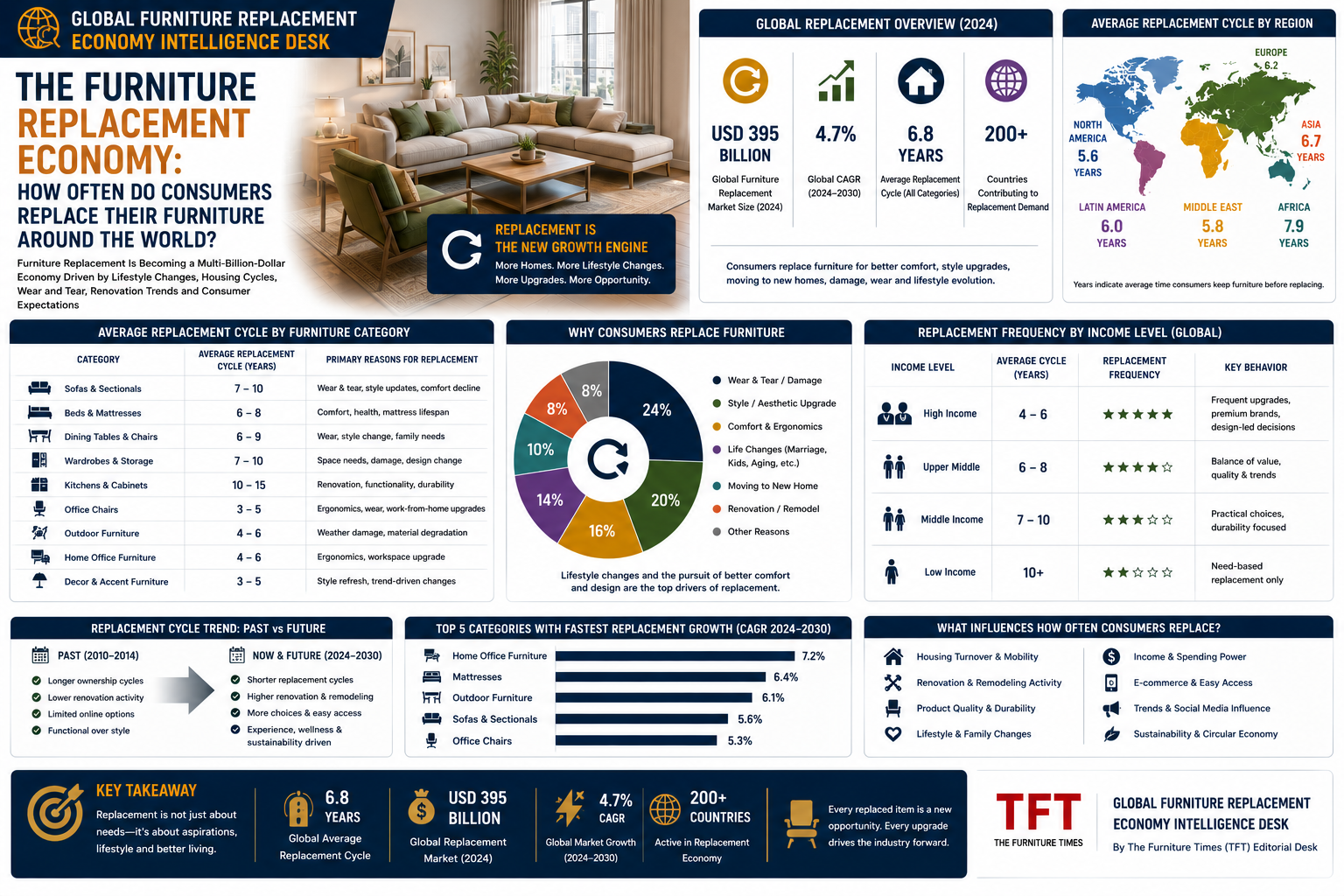
The Furniture Replacement Economy: How Often Do Consumers Replace Their Furniture Around the World?
Furniture Replacement Is Becoming a Multi-Billion-Dollar Economy Driven by Lifestyle Changes, Housing Cycles, Wear and Tear, Renovation Trends and Consumer Expectations
Global Furniture Replacement Economy Intelligence Desk
By The Furniture Times (TFT) Editorial Desk
Most furniture businesses measure success by new furniture sales.
However, one of the largest and least understood opportunities in the global furniture industry is not first-time purchases—it is replacement demand.
Every year, millions of households, hotels, offices, restaurants, schools, hospitals and commercial buildings replace furniture that has reached the end of its useful life, no longer fits changing lifestyles, has become outdated, or no longer meets modern comfort, sustainability or safety expectations.
Replacement purchases now represent one of the most stable revenue streams within the global furniture economy.
Unlike first-time buyers, replacement customers already understand the value of furniture. They already own beds, sofas, wardrobes, dining tables and office chairs. Their buying decision is no longer “Do I need furniture?” but rather “Is it time to replace what I already have?”
Understanding this replacement cycle allows manufacturers, retailers, designers, suppliers and investors to forecast future demand far more accurately than relying only on housing construction or population growth.
What Is the Furniture Replacement Economy?
The furniture replacement economy refers to all purchases made to replace existing furniture rather than furnish a property for the first time.
Replacement demand includes:
- Worn-out furniture
- Broken furniture
- Outdated designs
- Lifestyle upgrades
- Home renovation
- Office refurbishment
- Hotel renovation
- Restaurant redesign
- Healthcare modernization
- School refurbishment
- Furniture damaged by weather
- Furniture damaged by relocation
- Smart furniture upgrades
- Sustainability-driven replacement
In mature economies, replacement demand frequently exceeds demand generated by new household formation.
Why Consumers Replace Furniture
Furniture replacement is driven by several overlapping factors.
Physical Wear
Every product experiences:
- Daily use
- Friction
- Moisture
- Heat
- UV exposure
- Weight loading
- Fabric wear
- Foam compression
- Hardware fatigue
Eventually repair becomes uneconomical.
Lifestyle Change
Consumers replace furniture because:
- Marriage
- Divorce
- Children
- Empty-nest living
- Working from home
- Retirement
- Moving house
- Downsizing
- Upsizing
Furniture requirements evolve with every life stage.
Home Renovation
Kitchen renovation often creates demand for:
- Dining furniture
- Storage
- Lighting
- Counter seating
Bedroom renovation encourages replacement of:
- Beds
- Wardrobes
- Side tables
- Mattresses
Living-room renovation often includes:
- Sofas
- Coffee tables
- TV units
- Accent chairs
Fashion and Interior Trends
Consumers increasingly replace furniture because styles change.
Popular trends include:
- Minimalism
- Scandinavian design
- Japandi
- Contemporary luxury
- Natural wood
- Curved furniture
- Smart furniture
- Sustainable materials
Although existing furniture may still function well, changing aesthetic preferences influence replacement decisions.
Comfort Improvements
Consumers frequently replace:
- Mattresses
- Office chairs
- Recliners
- Dining chairs
because newer products offer improved ergonomics and comfort.
Sustainability
An increasing number of buyers replace furniture with products that offer:
- Certified timber
- Recycled materials
- Low-emission panels
- Replaceable components
- Longer lifespan
- Repairability
Replacement is therefore no longer driven only by appearance.
Average Replacement Cycles by Product Category
Replacement frequency varies considerably by product type.
Mattresses
Typical replacement cycle:
7–10 years
Main reasons:
- Hygiene
- Comfort
- Support
- Health
- Foam fatigue
Sofas
Typical replacement cycle:
8–15 years
Replacement reasons:
- Fabric wear
- Cushion sagging
- Style
- Moving house
Dining Tables
Typical replacement cycle:
15–25 years
Reasons:
- Renovation
- Family growth
- Damage
Dining Chairs
Typical replacement cycle:
10–15 years
Reasons:
- Upholstery wear
- Structural fatigue
- Style
Beds
Typical replacement cycle:
15–25 years
Often replaced during:
- Renovation
- Marriage
- House relocation
Wardrobes
Typical replacement cycle:
15–20 years
Drivers include:
- New homes
- Storage needs
- Interior upgrades
Office Chairs
Typical replacement cycle:
5–10 years
Commercial replacement often occurs earlier because of intensive daily use.
Outdoor Furniture
Typical replacement cycle:
5–12 years
Depends heavily on:
- UV exposure
- Rain
- Humidity
- Coastal corrosion
- Maintenance
These ranges are indicative and vary by material quality, climate, maintenance and intensity of use.
Residential Replacement vs Commercial Replacement
Residential
Replacement decisions are usually emotional.
Consumers consider:
- Appearance
- Comfort
- Family needs
- Budget
- Home value
Commercial
Commercial replacement is usually strategic.
Businesses evaluate:
- Brand image
- Maintenance costs
- Safety
- Productivity
- Customer experience
- Return on investment
Hotels, offices and restaurants frequently replace furniture before it completely fails because appearance influences customer perception.
Regional Replacement Behaviour
North America
Replacement demand is driven by:
- Home renovation
- Large housing stock
- Consumer financing
- Interior trends
- Frequent relocation
Strong categories include:
- Mattresses
- Upholstery
- Outdoor furniture
- Home offices
Europe
European consumers increasingly evaluate:
- Repair versus replacement
- Sustainability
- Circular economy
- Material certification
Products designed for refurbishment can remain commercially valuable for much longer.
Asia-Pacific
Replacement demand is accelerating because of:
- Growing middle class
- Urban apartment upgrades
- Rising disposable income
- Digital influence
Large numbers of households are moving from first-time purchases toward second and third replacement cycles.
Middle East
Replacement is closely connected with:
- Hospitality
- Luxury housing
- Tourism
- Commercial refurbishment
Hotels often renovate interiors to maintain competitiveness.
Africa
Replacement cycles are generally longer because affordability encourages:
- Repair
- Reuse
- Refurbishment
Demand for durable furniture remains strong.
Latin America
Replacement is influenced by:
- Housing improvement
- Consumer finance
- Urban renovation
- Local manufacturing
Economic conditions may extend replacement cycles.
Age Groups and Replacement Behaviour
Gen Z
Replacement is often associated with:
- Rental housing
- Compact furniture
- Flexible lifestyles
Millennials
Major replacement drivers include:
- Marriage
- Children
- First homes
- Home offices
Generation X
Often purchases:
- Higher-quality replacements
- Premium mattresses
- Kitchens
- Outdoor furniture
Baby Boomers
Replacement focuses on:
- Comfort
- Accessibility
- Ergonomics
- Downsizing
Replacement by Housing Type
Apartments
Higher replacement frequency because of:
- Moving
- Limited space
- Changing layouts
Landed Homes
Replacement often accompanies:
- Renovation
- Family expansion
- Outdoor living
Rental Housing
Landlords replace furniture because of:
- Tenant turnover
- Damage
- Property upgrades
Holiday Homes
Replacement focuses on:
- Outdoor furniture
- Mattresses
- Dining
- Weather exposure
Commercial Replacement Cycles
Hotels
Guest-room furniture commonly follows renovation programmes designed to maintain brand standards.
Offices
Replacement is influenced by:
- Hybrid work
- Employee wellbeing
- Corporate branding
- Technology integration
Restaurants
Replacement often reflects:
- Customer experience
- Durability
- Brand refresh
Healthcare
Replacement prioritises:
- Hygiene
- Safety
- Accessibility
Education
Furniture replacement supports:
- Student growth
- Safety
- Modern learning environments
What Triggers Immediate Replacement?
Consumers are more likely to replace furniture after:
- Buying a home
- Renovating
- Marriage
- Divorce
- Birth of a child
- Retirement
- Flood
- Fire
- Storm damage
- Major sales promotions
These life events frequently generate several furniture purchases simultaneously.
The Rise of the Replacement Services Economy
The replacement economy includes much more than selling new furniture.
Businesses can generate revenue through:
- Cushion replacement
- Furniture covers
- Mattress toppers
- Replacement hardware
- Drawer runners
- Hinges
- Table leaves
- Upholstery
- Furniture repair
- Refinishing
- Furniture cleaning
These services extend customer relationships while creating recurring income.
The Circular Replacement Economy
Many consumers no longer discard furniture immediately.
Growing opportunities include:
- Refurbishment
- Resale
- Trade-in
- Donation
- Rental
- Upcycling
- Recycling
Manufacturers that design furniture with replaceable components can participate in multiple revenue cycles.
Technology Is Changing Replacement Decisions
Consumers increasingly use:
- Google Search
- AI search
- Online reviews
- Interior visualisation
- Virtual room planners
- Social media
before deciding whether to repair or replace furniture.
AI can also recommend products based on:
- Room dimensions
- Existing furniture
- Budget
- Lifestyle
- Climate
- Material preference
Search Behaviour Before Replacement
Common searches include:
- Best time to replace sofa
- How long should a mattress last?
- Replace or repair dining table?
- Best replacement outdoor cushions
- Wardrobe renovation ideas
- Comfortable office chair
- Furniture trade-in
- Sustainable furniture replacement
Businesses that publish educational content around these questions can capture high-intent buyers.
Sustainability Will Extend Some Replacement Cycles
Consumers increasingly expect furniture that:
- Lasts longer
- Can be repaired
- Uses certified materials
- Offers replacement components
- Produces less waste
This creates opportunities for manufacturers that design products with longevity in mind.
Business Opportunities in the Replacement Economy
Manufacturers should develop:
- Modular furniture
- Replaceable cushions
- Replaceable upholstery
- Spare parts
- Upgrade programmes
Retailers should offer:
- Trade-ins
- Delivery of replacement products
- Removal of old furniture
- Extended warranties
Hospitality suppliers should create:
- Planned refurbishment programmes
- Standardised replacement collections
- Long-term maintenance contracts
Future Trends
By 2035, furniture replacement will increasingly be driven by:
- AI-assisted purchasing
- Predictive maintenance
- Smart furniture diagnostics
- Circular economy
- Subscription furniture
- Furniture-as-a-Service
- Carbon reporting
- Modular upgrades
- Digital product passports
The replacement economy will become more predictable as manufacturers use connected products and customer data to anticipate replacement demand.
Strategic Recommendations
Furniture companies should:
- Measure replacement demand separately from first-time purchases.
- Publish recommended product lifespans.
- Offer replacement components.
- Build refurbishment programmes.
- Develop trade-in initiatives.
- Design repairable furniture.
- Create maintenance services.
- Build customer lifetime value instead of one-time sales.
- Educate consumers on furniture care.
- Use AI and search insights to identify replacement intent.
Furniture Companies Should Stop Thinking in Single Sales
The first sale is only the beginning of the customer relationship.
A sofa can generate future revenue through:
- Replacement cushions
- New covers
- Repair
- Cleaning
- Matching furniture
- Accessories
- Trade-in
- Replacement purchase
The same principle applies to beds, wardrobes, office furniture and outdoor collections.
Companies that understand the replacement economy will not simply sell furniture.
They will manage the entire lifecycle of furniture ownership.
The future leaders of the global furniture industry will be those that transform one-time buyers into lifelong customers by supporting products long after the initial purchase.
Caption
Furniture replacement has become one of the world’s largest hidden furniture markets. Discover how often consumers replace sofas, beds, mattresses, office furniture, outdoor furniture and commercial interiors across different regions and age groups.
Excerpt
The global furniture replacement economy is reshaping demand. Learn how replacement cycles, renovation trends, lifestyle changes, sustainability and commercial refurbishment are creating long-term opportunities for manufacturers and retailers.
Meta Description
Explore the global furniture replacement economy, including replacement cycles, consumer behaviour, commercial refurbishment and future market opportunities.
Slug
global-furniture-replacement-economy-consumer-replacement-cycles
Focus Keywords
furniture replacement economy, furniture replacement cycle, replace furniture, furniture lifespan, sofa replacement, mattress replacement, office furniture replacement, commercial furniture refurbishment, furniture lifecycle, furniture maintenance, furniture repair, replacement furniture market, global furniture demand, furniture renovation, sustainable furniture, furniture trade in, furniture industry analysis, furniture replacement trends,
Hashtags
#FurnitureReplacement, #FurnitureLifecycle, #FurnitureEconomy, #FurnitureDemand, #FurnitureRepair, #FurnitureRefurbishment, #FurnitureRetail, #FurnitureManufacturing, #CommercialFurniture, #ResidentialFurniture, #FurnitureMarket, #CircularEconomy, #FurnitureInnovation, #FurnitureBusiness, #MarketIntelligence, #GlobalFurnitureIndustry, #FurnitureIndustryEcosystem, #TheFurnitureTimes,
