Why Most Companies Cut Advertising in Hard Times—and Who Wins When They Go Silent
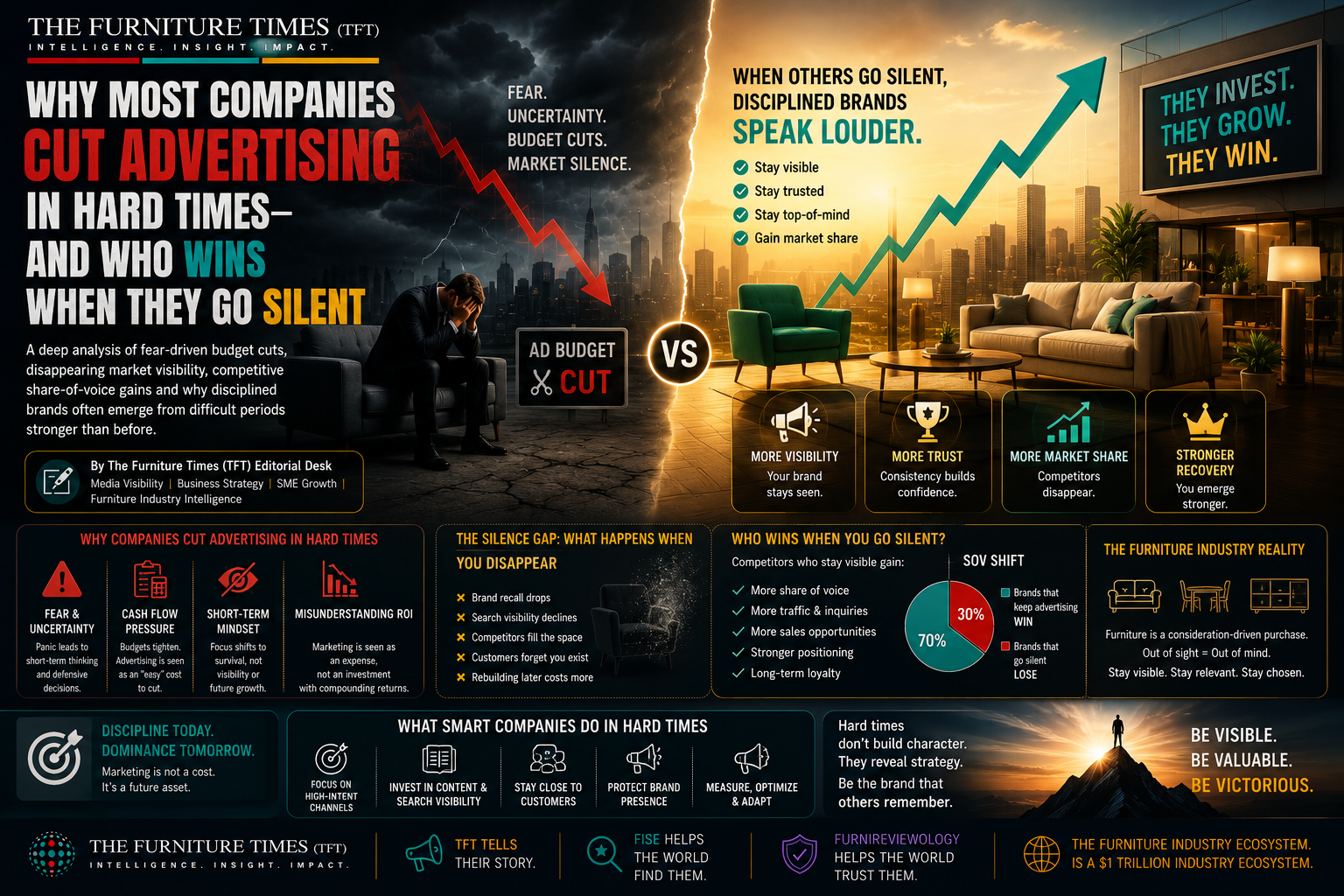
A deep analysis of fear-driven budget cuts, disappearing market visibility, competitive share-of-voice gains and why disciplined brands often emerge from difficult periods stronger than before
By The Furniture Times (TFT) Editorial Desk | Media Visibility | Business Strategy | SME Growth | Furniture Industry Intelligence
When business conditions become difficult, advertising is often one of the first budgets placed on the chopping block.
Sales decline. Customers postpone orders. Cash flow tightens. Inventory moves more slowly. Management becomes cautious, and every expenditure is questioned. Under this pressure, advertising can appear easier to cut than salaries, rent, utilities, raw materials, loan repayments or logistics.
The reasoning sounds practical: if consumers are spending less, why continue paying to reach them?
Yet this apparently defensive decision can create a much larger strategic problem. When a company reduces visibility at the same time that customers become more cautious, it becomes less likely to enter the customer’s consideration set. Competitors that remain visible gain more attention, more search presence and a greater opportunity to shape purchasing decisions.
The company may save cash today while quietly weakening tomorrow’s revenue.
This does not mean every business should blindly maintain every advertising campaign during a downturn. Companies facing immediate survival threats must protect payroll, essential operations and solvency. Wasteful campaigns should be stopped, and spending that cannot be measured or justified must be challenged.
The critical distinction is between eliminating waste and eliminating visibility.
A downturn demands better marketing decisions—not automatic silence.
Research collected by the UK’s Institute of Practitioners in Advertising continues to examine how advertising during recessions can support recovery. The IPA updated its collection of downturn evidence in March 2026, emphasizing the value of learning from previous periods of uncertainty. IPA’s advertising-in-recession evidence hub
The lesson is not simply “spend more.” It is that brands should protect the commercial capabilities that create future demand, preserve memory and support recovery.
The Psychology Behind Advertising Cuts
Companies do not cut advertising only because of financial analysis. They also cut because of human psychology.
Hard times produce uncertainty, and uncertainty encourages defensive behavior.
Fear makes immediate savings more attractive than future growth
The financial benefit of cutting an advertising campaign appears immediately in the budget. The cost of disappearing from the market may take months to become visible.
This timing difference creates a management bias.
The finance team can show exactly how much money will be saved this quarter. It is much harder to calculate how many future customers will forget the brand, how many distributors will choose another supplier or how much additional spending will be required to rebuild awareness.
The savings are visible. The lost opportunity is largely invisible.
Management wants to demonstrate control
During uncertainty, business leaders feel pressure to take decisive action. Cutting discretionary spending creates the appearance of discipline.
But not every visible action is strategically useful.
A business may reduce advertising without addressing more serious problems such as:
- Poor product positioning
- Excessive inventory
- Inefficient production
- Weak customer service
- High return rates
- Uncompetitive pricing
- Outdated product information
- Low digital visibility
- Slow quotation processes
- Poor market diversification
Advertising becomes an easy target because it can be cut quickly, even when it is not the main cause of weak performance.
Marketing is often treated as an expense rather than an asset
Factories classify machinery as an investment because it supports production. Warehouses are considered essential infrastructure. Sales employees are seen as necessary because they communicate directly with buyers.
Marketing is often treated differently.
Its purpose is to create and maintain demand, yet many companies view it as optional promotion. When conditions weaken, they pause this “expense,” expecting awareness and reputation to remain unchanged.
But market visibility does not stay frozen when advertising stops. It can gradually decline while competitors continue communicating.
Many companies do not understand what marketing produces
Some organizations cannot connect advertising with commercial outcomes because they have weak measurement systems.
They may track impressions, likes or website visits without knowing whether those activities contribute to:
- Qualified enquiries
- Showroom appointments
- Distributor interest
- Product sampling
- Quotation requests
- Repeat purchasing
- Branded search
- Revenue
- Market expansion
When marketing cannot explain its value, the budget becomes difficult to defend.
Past waste creates distrust
Some businesses have previously spent money on poor campaigns, unsuitable agencies or vanity projects. During a downturn, management remembers those disappointments.
However, the correct response to ineffective marketing is not necessarily to stop communicating. It is to improve targeting, creative quality, measurement and accountability.
A company should not abandon the entire function because one campaign failed.
Why Furniture Companies Are Particularly Cautious
The furniture sector contains several characteristics that make companies highly sensitive to economic uncertainty.
Furniture is frequently a postponable purchase. Consumers may delay replacing a sofa, bed or dining table when household confidence declines. Commercial clients may postpone office renovations, hotel projects or restaurant openings. Property slowdowns can reduce demand for new furnishings.
Furniture businesses also carry substantial operating pressures:
- High inventory costs
- Large warehouse requirements
- Material-price volatility
- Freight expenses
- Long production lead times
- Showroom rental
- Product damage risk
- Seasonal collections
- Credit given to customers
- Export uncertainty
- Currency fluctuations
When sales weaken, protecting cash becomes understandable.
SMEs may not have large reserves or access to affordable financing. A small manufacturer cannot always follow the same strategy as a multinational corporation.
The danger arises when short-term cash preservation becomes long-term market disappearance.
What Happens When a Company Stops Advertising?
The impact is rarely immediate and dramatic. That is precisely why it can be dangerous.
1. Brand memory begins to weaken
People do not remember every company indefinitely.
Memory is reinforced through repeated exposure—advertising, news coverage, search results, showroom signs, social content, recommendations and customer experience.
When those signals disappear, the brand becomes less mentally available.
Customers may still recognize the name when prompted, but they become less likely to recall it independently when they are ready to buy.
2. Competitors occupy the empty space
A company does not operate in isolation.
If one furniture retailer stops advertising, competitors continue appearing in:
- Google results
- Social feeds
- News articles
- Marketplaces
- Industry directories
- Trade publications
- Email campaigns
- AI-generated recommendations
The customer does not see an empty market. The customer sees other brands.
3. Share of voice declines
Share of voice refers broadly to how much visibility a brand has relative to its competitors.
When category advertising falls during a downturn, a company maintaining its activity may achieve a larger relative presence without increasing its absolute budget.
WARC’s marketing-effectiveness glossary explains the concept of excess share of voice: when a brand’s share of advertising visibility is greater than its existing market share, this has historically been associated with long-term growth potential. WARC’s explanation of excess share of voice
The principle is not a guarantee, but it explains why downturns can create unusual competitive opportunities.
4. Branded search can weaken
When fewer people encounter a company’s name, fewer may search for it directly.
This affects more than website traffic. Branded search is often an indicator of awareness and purchase consideration.
A business that depends entirely on generic product searches must compete against every other company selling similar items.
5. Retailers become more dependent on discounts
Strong brands can compete through reputation, design, reliability and trust. Invisible brands often need to compete through price.
Reduced advertising can therefore produce a damaging cycle:
- Visibility declines.
- Demand weakens.
- Management introduces discounts.
- Profit margins fall.
- Less money remains for marketing.
- Visibility declines further.
Google’s research on profitable growth argues that reducing marketing investment can weaken brand differentiation, increase customer price sensitivity and damage profitability. Google’s “Unlocking Profitable Growth” report
6. Product launches become harder
A company may continue developing products during the downturn but struggle to attract attention because it has allowed its communication infrastructure to weaken.
Journalist relationships, audience engagement, search visibility and customer databases cannot always be reactivated instantly.
7. Sales teams receive fewer warm opportunities
Advertising does not replace salespeople. It makes sales activity more effective by creating familiarity.
A distributor who recognizes a manufacturer from credible industry coverage may respond differently from one receiving an unexpected message from an unknown company.
Without marketing support, sales teams must create awareness, trust and conversion simultaneously.
8. The company can become invisible to AI
In 2026, market visibility is no longer limited to advertisements and traditional search.
AI assistants increasingly help customers identify brands, compare products and shortlist suppliers. These systems need current, accessible and credible information.
A company that stops publishing, updating product data, earning reviews and maintaining listings may become more difficult for AI systems to understand and recommend.
Going Dark Creates a Recovery Debt
Advertising cuts are often justified as temporary. Management expects to resume marketing once conditions improve.
But rebuilding visibility may cost more than maintaining a sensible presence.
Nielsen has reported that recovering from extended periods without advertising can require years of consistent brand-building activity. Its analysis emphasizes that long-term marketing supports business longevity and that disappearing for a prolonged period can create a difficult recovery burden. Nielsen’s analysis of sustained brand building
This creates what may be called a recovery debt.
A company returning after a long silence may need to:
- Reintroduce its brand
- Explain whether it remained active
- Rebuild search demand
- Restore customer confidence
- Reconnect with distributors
- Re-establish media relationships
- Relaunch social channels
- Repair neglected listings
- Collect new reviews
- Retrain advertising algorithms
- Compete against brands that gained momentum
The company did not merely pause spending. It borrowed visibility from its future.
Who Wins When Most Companies Cut Advertising?
Several groups benefit when competitors retreat.
1. Brands That Maintain Consistent Visibility
The first winners are companies that continue communicating without appearing insensitive or wasteful.
They gain a larger relative presence because fewer brands are competing for attention.
These companies may not dramatically increase spending. They may simply maintain a disciplined baseline while others disappear.
Their advantage can include:
- Stronger recall
- Greater search presence
- More media opportunities
- Better distributor confidence
- Higher share of consideration
- Faster recovery when demand returns
Consistency can itself become a signal of stability.
2. Challenger Brands
Economic uncertainty can create opportunities for smaller, ambitious competitors.
During strong markets, established brands may dominate attention through large budgets. When leading companies retreat, challenger brands can enter conversations that were previously difficult to access.
A smaller furniture retailer may focus on:
- One product category
- One city
- One material
- One customer group
- One design problem
- One commercial segment
Specialization allows challengers to spend more precisely.
For example, a local outdoor-furniture specialist does not need to compete for every furniture-related search. It can build authority around weather-resistant materials, garden planning and regional delivery.
3. Digitally Prepared SMEs
Many small furniture businesses assume only large companies can advertise during hard times.
Digital platforms have lowered some entry barriers. SMEs can use:
- Local search optimization
- Industry listings
- Educational content
- Retargeting
- Short-form video
- Customer reviews
- Press releases
- Search advertising
- Marketplace optimization
The winning SME is not necessarily the one spending the most. It is the one that communicates clearly, targets accurately and responds quickly to enquiries.
4. Companies With Strong First-Party Data
Businesses that maintain customer records, consent-based email lists, enquiry histories and loyalty programs can communicate without purchasing every interaction from an external platform.
During difficult conditions, this can reduce marketing costs and improve relevance.
A furniture retailer can segment communication by:
- Previous purchase
- Product category
- Location
- Commercial or residential customer
- Showroom visit
- Incomplete quotation
- Product interest
- Replacement cycle
Data must be collected and used responsibly, but it can create a significant resilience advantage.
5. Businesses That Continue Publishing News
When competitors become silent, genuine business news gains greater attention.
A company can communicate:
- New products
- Export milestones
- Showroom developments
- Sustainability initiatives
- Manufacturing investments
- Partnerships
- Certifications
- Customer solutions
- Market research
- Training programs
News coverage and press releases can create public records that remain searchable beyond the campaign period.
This is particularly valuable for furniture SMEs that need credibility but cannot afford continuous mass-media advertising.
6. Brands That Understand the Customer’s New Reality
Winning during hard times does not mean repeating the same message more loudly.
Consumers may become more price-sensitive, cautious and focused on durability. Commercial buyers may require flexible payment, reliable lead times and lower lifecycle costs.
Nielsen recommends analyzing changing consumer behavior and adapting media plans and messaging during recessionary periods. Communication should reinforce relevant value rather than ignore economic reality. Nielsen’s marketing-during-a-recession guidance
Furniture messages during challenging conditions might emphasize:
- Durability
- Repairability
- Warranty
- Multifunctionality
- Space efficiency
- Total cost of ownership
- Local availability
- Replacement parts
- Delivery reliability
- Financing where responsibly available
- Honest value
Tone matters. Advertising that appears disconnected from customer pressure can damage trust.
When Cutting Advertising Is Rational
It would be irresponsible to argue that every company must preserve every campaign regardless of financial reality.
Cutting or pausing advertising may be justified when:
- The business cannot meet payroll
- Essential operations are at risk
- The company cannot fulfill additional orders
- Product quality problems remain unresolved
- Inventory information is inaccurate
- Customer service cannot handle enquiries
- The campaign produces no relevant outcomes
- The audience is incorrectly targeted
- The creative message is unsuitable
- Measurement is absent
- The channel is consistently unprofitable
- The product is unavailable
- Legal or safety concerns require correction
Advertising should not accelerate demand that the business cannot serve.
The correct response may be to pause a specific channel, reduce frequency, change the target audience or redirect resources toward customer retention.
A financially distressed company should protect solvency first. Marketing cannot compensate for an unsustainable cost structure indefinitely.
The Difference Between Cutting Waste and Cutting Visibility
This distinction should guide every downturn decision.
Cutting waste means:
- Stopping irrelevant placements
- Removing duplicate tools
- Renegotiating agency agreements
- Improving targeting
- Reducing low-quality content
- Pausing campaigns for unavailable products
- Eliminating vanity metrics
- Fixing poor conversion pages
- Prioritizing profitable markets
Cutting visibility means:
- Disappearing from search
- Stopping all customer communication
- Abandoning news coverage
- Neglecting product information
- Closing social channels
- Ignoring reviews
- Removing all brand-building activity
- Allowing listings to become outdated
- Losing contact with past customers
The first action improves efficiency. The second may weaken future demand.
Advertising Is More Than Paid Media
Companies sometimes equate advertising with expensive television, billboards or large digital campaigns.
Modern visibility includes many activities with different costs and objectives:
Paid visibility
- Search advertisements
- Social advertising
- Display
- Video
- Sponsored content
- Marketplace advertising
- Trade-publication placements
Owned visibility
- Website
- Product pages
- Email newsletters
- Showroom displays
- Blog articles
- Buying guides
- Videos
- Customer databases
Earned visibility
- Independent news coverage
- Reviews
- Media interviews
- Customer recommendations
- Industry citations
- Awards
- Partner mentions
Search and AI visibility
- Structured product information
- Business listings
- Local search
- Search-engine optimization
- Industry-directory profiles
- News releases
- Reviews
- Authoritative references
A company with limited funds can maintain visibility through a deliberate combination of these channels.
Why Complete Silence Is Especially Dangerous for SMEs
Large corporations may remain recognizable after reducing advertising because they have accumulated years of awareness.
An SME does not always have that protection.
If a smaller furniture manufacturer disappears for six months, prospective buyers may assume:
- The company has closed
- It is no longer exporting
- Products are unavailable
- The website is abandoned
- Customer service is inactive
- The company is financially unstable
These assumptions may be incorrect, but perception influences decisions.
SMEs should therefore maintain a minimum viable visibility system even when budgets are tight.
The Minimum Viable Visibility Strategy
A furniture company facing difficult conditions can prioritize the following.
1. Keep business information accurate
Update opening hours, addresses, product availability, telephone numbers and delivery areas.
2. Protect high-intent search
Maintain visibility for searches closely connected with purchasing, such as product type, location and commercial service.
3. Communicate with existing customers
Retention is often less expensive than acquiring completely new customers.
4. Maintain reviews and reputation
Respond professionally to feedback and resolve recurring service problems.
5. Publish genuine developments
Use news articles and press releases when the company has meaningful information.
6. Improve product pages
Clear dimensions, materials, warranties and delivery information can improve conversion without increasing media spending.
7. Retarget interested visitors selectively
Reach people who have already shown genuine interest, while controlling frequency and cost.
8. Measure enquiries and sales
Track which activities generate commercial outcomes.
9. Preserve core brand communication
Continue reminding the market what the company provides and why it is credible.
10. Prepare for recovery
Build content, customer lists and product data before demand returns.
A Three-Budget Model for Difficult Conditions
Companies can organize marketing into three levels.
Survival Budget
Used when cash pressure is severe.
Priorities include:
- Accurate website
- Business listings
- Existing-customer communication
- Reputation management
- High-intent search
- Essential news
- Basic measurement
The goal is to avoid complete disappearance.
Stability Budget
Used when the business can operate but needs caution.
Priorities include:
- Survival activities
- Retargeting
- Local SEO
- Regular content
- Press releases
- Product-page improvement
- Focused campaigns
- Distributor communication
The goal is to protect demand and maintain market presence.
Opportunity Budget
Used by financially stable companies capable of taking share.
Priorities include:
- Stability activities
- Expanded brand advertising
- Competitor-gap targeting
- New market entry
- Research and thought leadership
- Larger media campaigns
- Product launches
- Strategic partnerships
The goal is to grow relative visibility while competitors retreat.
Brand Building and Sales Activation Must Work Together
During hard times, companies frequently move all spending toward immediate sales activity.
They prioritize:
- Discounts
- Limited-time promotions
- Lead-generation advertisements
- Retargeting
- Direct-response campaigns
These activities can support cash flow, but relying on them alone can create problems.
Short-term activation helps capture existing demand. Brand building helps ensure customers think about the company before they are ready to purchase.
Furniture has long purchase cycles. A customer may research a sofa months before ordering. A hotel may investigate suppliers long before issuing a formal request.
If a company advertises only when it wants an immediate sale, it may arrive too late in the customer’s decision process.
The stronger strategy balances:
- Immediate conversion
- Future awareness
- Customer retention
- Reputation
- Search visibility
- Category education
Discounting Is Not a Substitute for Advertising
When advertising budgets are cut, many businesses rely on discounts to stimulate demand.
Discounts can work, but repeated reductions teach customers to wait.
They can also:
- Lower perceived value
- Damage margins
- Create channel conflict
- Upset previous customers
- Encourage price-only comparisons
- Make normal pricing difficult to restore
Advertising should explain why the product is valuable. Discounting simply changes what it costs.
During hard times, furniture companies can communicate value through:
- Longer product life
- Better construction
- Replaceable components
- Warranty coverage
- Lower maintenance
- Multifunctionality
- Space savings
- Reliable delivery
- Customization
- After-sales support
Price remains important, but it should not become the company’s only story.
Media Costs and Competitive Noise
When many advertisers withdraw, media markets may become less crowded. This can sometimes create more favorable buying conditions, although pricing varies by platform, country, audience and period.
The strategic benefit is not only lower cost. It is reduced competitive noise.
If five competing furniture retailers normally advertise and four disappear, the remaining brand may receive more attention even without increasing its spending.
Kantar has highlighted historical evidence connecting maintained or increased spending during downturns with greater market-share opportunities, while noting that the possibility of gaining share can be stronger when the overall market is weak. Kantar’s analysis of recession marketing budgets
This does not mean every impression becomes valuable. Creative quality and relevance still determine effectiveness.
The Role of Press Releases During Hard Times
Press releases can be especially useful when advertising budgets are constrained.
A genuine release can:
- Document business activity
- Support search visibility
- Provide material to journalists
- Reassure stakeholders
- Strengthen the sales team
- Create industry awareness
- Supply verifiable information to AI systems
- Generate referral traffic
- Contribute to the public history of a company
Businesses should not distribute releases merely to create artificial backlinks. The announcement must contain genuine news and accurate claims.
During difficult periods, credible communication can signal action:
- “We entered a new market.”
- “We launched a lower-maintenance collection.”
- “We reduced delivery lead times.”
- “We introduced a repair program.”
- “We invested in local production.”
- “We secured a new contract.”
- “We opened a smaller-format showroom.”
Media visibility can become a cost-efficient component of the wider strategy.
How CEOs and CFOs Should Evaluate Advertising
Advertising decisions should not be made by marketing departments alone.
Leadership should evaluate five questions.
1. What commercial problem are we solving?
Is the goal awareness, leads, showroom visits, distributor recruitment, customer retention or product launch?
2. Which customers still have demand?
A downturn does not affect every segment equally. Residential, hospitality, institutional, healthcare, education and export markets may behave differently.
3. Which channels produce evidence of value?
Use sales data, enquiries, search trends, experiments and attribution carefully.
4. What happens if we stop?
Estimate the potential effect on awareness, search, customer relationships and recovery cost.
5. What is the minimum level required to remain visible?
A business may reduce activity without disappearing completely.
The decision should consider both immediate liquidity and future revenue.
A Practical 90-Day Downturn Advertising Plan
Days 1–15: Diagnose
- Review cash position
- Identify profitable categories
- Analyze sales and enquiries
- Stop clearly wasteful campaigns
- Audit website conversion
- Review competitor visibility
- Confirm inventory and fulfillment capacity
Days 16–30: Prioritize
- Select high-value customer segments
- Define the minimum visibility budget
- Protect branded and high-intent search
- Improve core product pages
- Update business listings
- Contact existing customers
- Prepare relevant messaging
Days 31–60: Communicate
- Launch focused campaigns
- Publish useful content
- Distribute genuine company news
- Request authentic reviews
- Retarget qualified audiences
- Equip sales teams with updated materials
- Test several messages
Days 61–90: Measure and Adjust
- Compare enquiries with spending
- Review lead quality
- Analyze conversions by category
- Evaluate customer acquisition cost
- Identify underpriced media opportunities
- Increase spending only where evidence supports it
- Continue baseline brand visibility
Who Ultimately Wins?
The winners in hard times are not always the companies spending the most.
They are usually the companies that:
- Preserve sufficient cash
- Understand changing customer needs
- Remove inefficient expenditure
- Remain consistently visible
- Communicate relevant value
- Protect customer relationships
- Continue building trust
- Measure performance
- Respond quickly
- Prepare for recovery before it arrives
The losers are not simply companies that reduce spending. They are companies that cut without strategy, disappear without understanding the consequences and attempt to restart only after competitors have occupied the market.
Final Analysis: Hard Times Do Not Eliminate Demand—They Redistribute It
Economic pressure can reduce overall spending, but it rarely eliminates every purchase.
Homes still need furniture. Hotels continue renovating. Offices replace worn equipment. Schools, hospitals, restaurants, property developers and public institutions continue procuring products. Consumers still move, marry, renovate, downsize, work from home and replace damaged items.
Demand becomes more selective.
Customers evaluate value more carefully. They compare more options, delay decisions and look for evidence of quality and reliability.
That is precisely why visibility matters.
A company that goes silent during difficult conditions may be absent when the remaining demand is allocated. A company that communicates responsibly can demonstrate stability, relevance and value.
The strategic lesson is not “never cut advertising.”
It is:
Never cut visibility without calculating what the silence will cost.
Businesses should remove waste, renegotiate costs, improve targeting and protect cash. But they should not assume that the market will patiently remember them until they return.
Competitors are not waiting.
Search engines are not waiting.
AI recommendation systems are not waiting.
Customers are not waiting.
When most companies retreat, the brands that remain useful, credible and visible have an opportunity to gain attention that would be much more expensive during stronger times.
In hard times, advertising is not simply about selling more today. It is about remaining part of the customer’s decision tomorrow.
Key Findings
- Companies usually cut advertising because the savings are immediate while the cost of lost visibility is delayed.
- Marketing is vulnerable when management treats it only as an expense and lacks reliable measurement.
- Complete silence can weaken brand memory, search demand, pricing power and distributor confidence.
- Brands maintaining consistent visibility may gain relative share of voice as competitors withdraw.
- SMEs can compete through specialization, local search, reviews, news coverage and high-intent digital campaigns.
- Advertising should be reduced when survival, product quality or fulfillment is at risk—but visibility should still be protected where possible.
- Discounting cannot replace long-term brand building.
- Extended periods without advertising can create a costly recovery debt.
- Downturn communication must reflect the customer’s financial reality and emphasize credible value.
- The strongest strategy balances cash preservation, customer retention, short-term sales and future demand.
The Furniture Times (TFT) & Furniture Industry Search Engine (FISE)
“TFT tells their story. FISE helps the world find them.”
FurniReviewology helps the world trust them.
The furniture industry ecosystem is a $1 trillion industry ecosystem.