AI Search Optimization for Furniture Retailers: The Next Competitive Advantage in the Global Furniture Industry
Why Furniture Retailers Must Optimize Not Only for Google but Also for Artificial Intelligence to Remain Discoverable, Trusted and Recommended in the New Era of Digital Commerce
By The Furniture Times – TFT | CEO Voice | August 2026
Featuring Insights, Togbega Dortor Dr. Bilal Ahmad Bhat
Artificial Intelligence is fundamentally changing how customers search for products, compare brands and make purchasing decisions. For furniture retailers, this transformation represents one of the most significant shifts in digital commerce since the introduction of search engines.
For nearly three decades, businesses focused on Search Engine Optimization (SEO) to improve rankings on Google and other search platforms. Success was measured by keywords, backlinks, page rankings and website traffic.
Today, a new frontier has emerged.
Customers are increasingly asking AI-powered assistants instead of typing keywords into traditional search engines.
Instead of searching:
“Modern sofa Malaysia”
Customers now ask:
“Which furniture retailer offers premium Scandinavian sofas with home delivery and good customer reviews?”
Instead of typing:
“Dining table showroom near me”
They ask:
“Recommend trusted furniture retailers selling solid wood dining tables suitable for families with young children.”
This evolution from keyword search to conversational AI is creating an entirely new discipline:
AI Search Optimization (AISO).
For furniture retailers, understanding and investing in AI Search Optimization is no longer optional—it is becoming essential for long-term business growth.
What Is AI Search Optimization?
AI Search Optimization is the process of making your business easy for artificial intelligence systems to discover, understand, verify and confidently recommend.
Unlike traditional SEO, which focuses primarily on improving rankings in search engine results, AI Search Optimization focuses on helping AI systems accurately interpret your business.
AI attempts to understand:
- Who you are.
- What products you sell.
- Which customers you serve.
- Why your business is different.
- Whether your information is accurate.
- Whether your brand is trusted.
- Whether your expertise is supported by credible sources.
The goal is no longer simply to appear in search results.
The goal is to become the retailer AI recommends when customers ask for advice.
Why AI Search Matters More Than Ever
Artificial intelligence is rapidly becoming the first step in the customer journey.
Consumers increasingly use AI to:
- Compare furniture brands.
- Research materials.
- Find nearby retailers.
- Evaluate prices.
- Read product summaries.
- Understand warranties.
- Discover interior design ideas.
- Shortlist suppliers before visiting a showroom.
This means that the buying journey often begins before a customer reaches your website.
If AI does not know your business, your company may never enter the customer’s consideration set.
AI Is Reshaping Furniture Retail
The furniture industry has traditionally relied on:
- Physical showrooms.
- Shopping malls.
- Trade fairs.
- Word-of-mouth recommendations.
- Print advertising.
- Sales representatives.
While these channels remain valuable, digital discovery is becoming equally important.
Today’s consumers expect to find trusted answers instantly.
AI provides those answers.
Retailers that prepare for AI search today will be better positioned to attract tomorrow’s customers.
How AI Evaluates Furniture Retailers
Artificial intelligence does not simply count keywords.
Instead, it evaluates a broad range of trust and relevance signals, including:
- Detailed product descriptions.
- Accurate pricing information.
- Store locations.
- Business hours.
- Customer reviews.
- Frequently asked questions.
- Product specifications.
- Sustainability information.
- Delivery policies.
- Return policies.
- Company reputation.
- Media coverage.
- Industry recognition.
- Structured website content.
The more complete and consistent this information is, the more confidently AI can understand your business.
Your Website Is No Longer Enough
Many furniture retailers still believe that building a website completes their digital strategy.
That assumption is no longer true.
Your website remains your digital headquarters, but AI also gathers information from multiple trusted sources, including:
- Business directories.
- Industry publications.
- News articles.
- Product catalogues.
- Customer review platforms.
- Social media profiles.
- Google Business Profile.
- Local listings.
- Videos.
- Press releases.
- Case studies.
Each of these sources contributes to your overall digital authority.
Why Product Pages Matter
One of the biggest weaknesses among furniture retailers is poor product information.
Many websites list only:
- Product name.
- Price.
- One photograph.
This is insufficient for AI.
Instead, every product page should include:
- Material type.
- Dimensions.
- Colours.
- Style category.
- Assembly information.
- Maintenance instructions.
- Warranty details.
- Sustainability certifications.
- Delivery information.
- High-quality images.
- Customer reviews.
- Frequently asked questions.
Detailed information helps AI answer customer questions accurately.
The Rise of Conversational Shopping
Consumers increasingly ask AI complete questions such as:
- Which dining table is best for a family of six?
- Recommend pet-friendly fabric sofas.
- What furniture suits a minimalist apartment?
- Which outdoor furniture withstands tropical weather?
- Compare teak and aluminium patio furniture.
Retailers should create content that directly answers these questions.
Doing so improves both customer experience and AI discoverability.
AI Rewards Expertise
Retailers should move beyond simply selling products.
They should educate customers.
Publishing helpful content such as:
- Buying guides.
- Material comparisons.
- Interior design advice.
- Maintenance tips.
- Room planning ideas.
- Trend reports.
- Sustainability guides.
positions the business as a trusted authority.
AI is more likely to recommend businesses that consistently demonstrate expertise.
Reviews Are Becoming AI Signals
Customer reviews play a critical role in AI Search Optimization.
Positive, authentic reviews help AI assess:
- Product quality.
- Customer satisfaction.
- Delivery reliability.
- After-sales service.
- Overall trustworthiness.
Encouraging satisfied customers to leave honest reviews strengthens your digital reputation.
The Importance of Local AI Search
Many furniture purchases remain local.
Consumers often ask:
- Best furniture shop near me.
- Luxury furniture showroom nearby.
- Furniture retailer open today.
- Custom furniture close to my location.
Maintaining accurate local business information is therefore essential.
Retailers should ensure that addresses, contact numbers, operating hours and maps remain updated across every online platform.
AI Search and Voice Search
Voice assistants continue to influence customer behaviour.
Instead of typing short phrases, users naturally ask complete questions.
Furniture retailers should optimise content using natural language rather than only keyword lists.
The future belongs to businesses that answer conversations, not just searches.
Structured Data Improves Understanding
Structured data helps search engines and AI systems interpret website content more accurately.
Furniture retailers should use structured information for:
- Products.
- Reviews.
- Prices.
- Business details.
- Locations.
- Events.
- FAQs.
Although customers never see this information directly, AI benefits greatly from it.
AI Search Supports Smaller Retailers
Artificial Intelligence has the potential to create a more level playing field.
Large brands still benefit from extensive budgets.
However, AI also rewards relevance, expertise and quality information.
A specialised furniture retailer with exceptional content can outperform much larger competitors for highly specific customer needs.
This creates significant opportunities for SMEs.
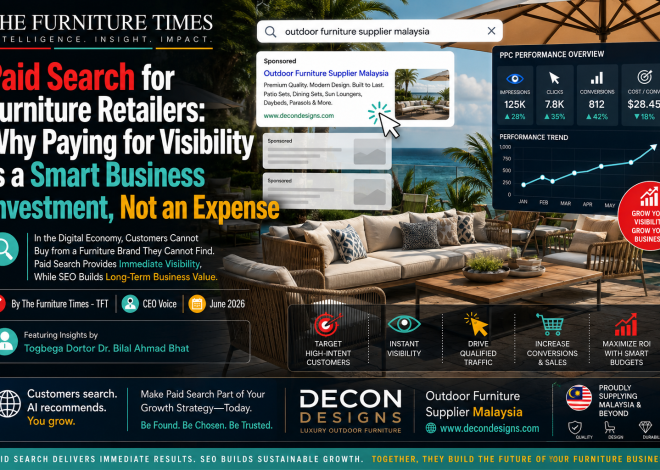
Paid Search and AI Search Should Work Together
AI Search Optimization does not replace paid advertising.
Instead, both strategies complement each other.
Paid Search provides:
- Immediate visibility.
- Faster lead generation.
- Campaign flexibility.
- Seasonal promotion.
AI Search Optimization provides:
- Long-term discoverability.
- Greater digital authority.
- Better customer trust.
- Sustainable organic visibility.
The strongest retailers integrate both approaches into a unified digital strategy.
Common Mistakes Furniture Retailers Make
Many businesses still:
- Ignore SEO.
- Publish duplicate product descriptions.
- Upload low-quality images.
- Fail to update product information.
- Neglect customer reviews.
- Avoid publishing educational content.
- Maintain outdated websites.
- Ignore mobile optimisation.
These mistakes reduce discoverability in both traditional search and AI-powered search.
Preparing for the Future
The future of furniture retail will be shaped by businesses that invest in digital intelligence today.
Retailers should prioritise:
- AI-ready websites.
- Comprehensive product information.
- Educational publishing.
- Local search optimisation.
- Customer reviews.
- Technical SEO.
- Structured data.
- Industry media coverage.
- Digital trust.
- Continuous content updates.
These investments create a strong foundation for long-term visibility.
AI Search Is Not the Future—It Is the Present
Artificial intelligence is already influencing millions of purchasing decisions every day.
Customers expect immediate, accurate and trustworthy answers.
Retailers that prepare now will benefit from stronger visibility, greater customer confidence and improved competitiveness.
Those that delay risk becoming invisible to a generation of buyers who increasingly rely on AI before making purchasing decisions.
Final Thoughts
The furniture industry has always been driven by craftsmanship, innovation and customer relationships.
Those qualities remain essential.
However, in today’s digital economy, discoverability has become equally important.
A beautiful showroom means little if customers never find it.
Outstanding products cannot generate sales if they remain hidden from digital discovery.
AI Search Optimization is not simply another marketing trend.
It is becoming a core business capability.
Furniture retailers that combine excellent products, exceptional customer service, trusted content and AI-ready digital strategies will not only survive the next decade—they will define it.
The question every furniture retailer should now ask is no longer:
“Are we ranking on Google?”
It is:
“When a customer asks Artificial Intelligence where to buy furniture, will our brand be recommended?”
That single question may determine the future success of every furniture retailer in the AI economy.