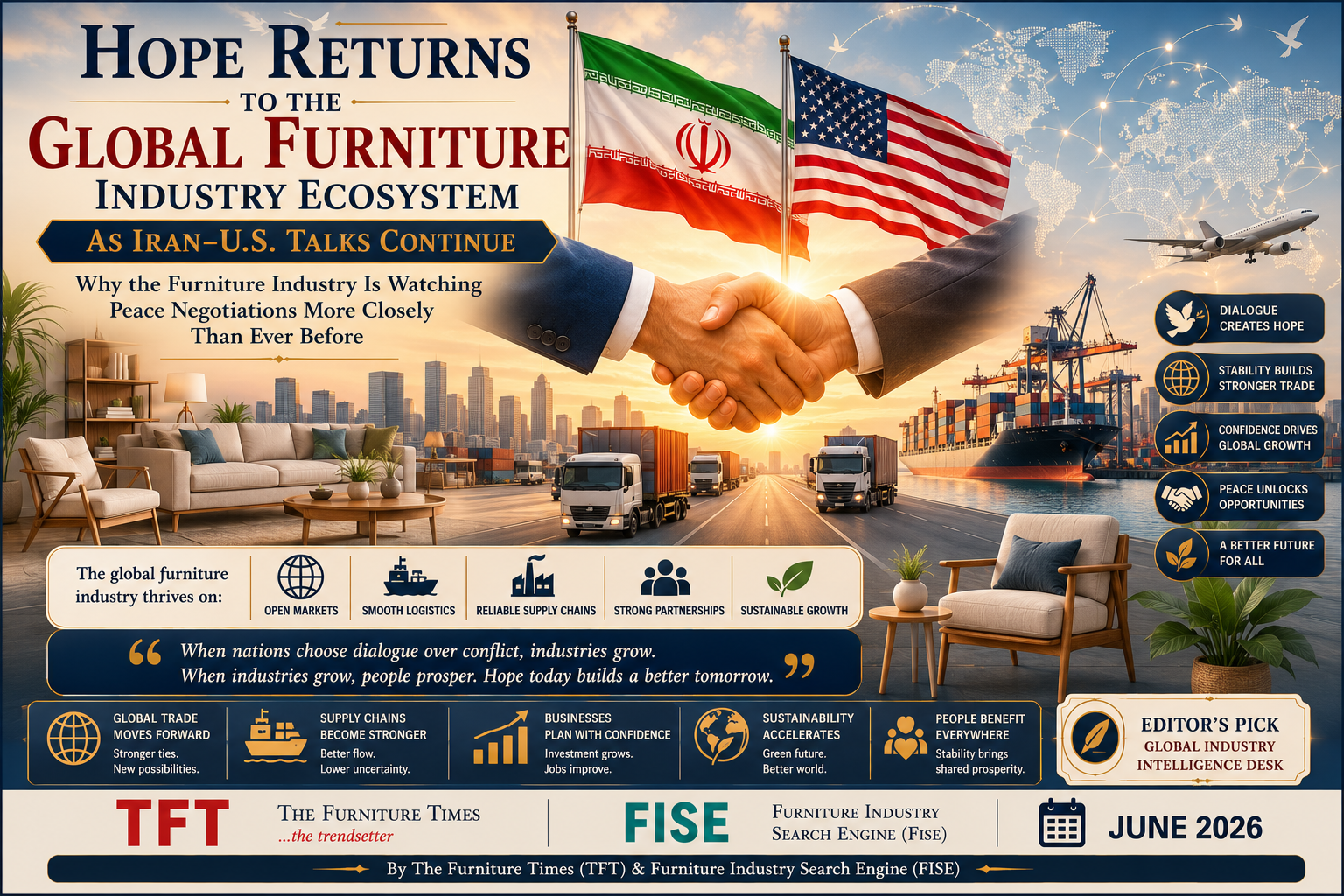
Hope Returns to the Global Furniture Industry Ecosystem as Iran–U.S. Talks Continue
Why the Furniture Industry Is Watching Peace Negotiations More Closely Than Ever Before
Editor’s Pick | Global Industry Intelligence Desk
By The Furniture Times (TFT) & Furniture Industry Search Engine (FISE) , June 2026
For much of 2026, the global furniture industry ecosystem has been operating under a cloud of uncertainty.
Manufacturers faced rising material costs.
Importers struggled with unpredictable freight rates.
Retailers dealt with cautious consumers.
Developers delayed projects.
And businesses across the supply chain watched geopolitical developments with increasing concern.
The conflict involving Iran, the United States, and regional stakeholders created significant disruption to global energy markets and maritime trade, particularly around the strategically important Strait of Hormuz, one of the world’s most critical shipping routes. The disruption affected oil flows, freight confidence, insurance costs, and global supply chain planning.
Today, while many challenges remain unresolved, there is a growing sense of cautious optimism.
The ongoing diplomatic engagement between Iran and the United States, combined with efforts to reopen and stabilize shipping routes, has created renewed hope across multiple industries—including the global furniture sector. Recent agreements and negotiations have focused on extending ceasefire arrangements and restoring commercial navigation through the Strait of Hormuz.
Why Furniture Businesses Care About Middle East Peace
Many people assume furniture has little connection to geopolitical events.
The reality is very different.
The furniture industry is deeply connected to:
- Global shipping
- Energy prices
- Construction activity
- Hospitality investments
- Consumer confidence
- International trade
When oil prices rise sharply, transportation costs increase.
When shipping routes are disrupted, container costs increase.
When uncertainty dominates the economy, consumers postpone major purchases.
The furniture industry feels every one of these effects.
That is why furniture manufacturers in Asia, retailers in Europe, importers in North America, and project suppliers in the Middle East have all been closely monitoring developments in the region.
The Strait of Hormuz Matters to Furniture More Than Most Realize
The Strait of Hormuz is not simply an oil route.
It is one of the most important arteries of global commerce.
Disruptions earlier this year created significant challenges for shipping, energy markets, and supply chain planning. Thousands of vessels and seafarers were affected as maritime traffic slowed dramatically.
For furniture businesses, this translated into:
- Higher freight costs
- Longer delivery schedules
- Increased inventory risks
- More cautious procurement decisions
- Delayed international projects
As discussions continue and navigation gradually resumes, businesses are beginning to anticipate greater stability in logistics operations.
Falling Oil Prices Bring Hope
One of the most encouraging developments has been the decline in oil prices following renewed diplomatic progress.
Markets responded positively to signs that commercial shipping may normalize and that energy supplies could flow more smoothly. Recent reports indicate oil prices have fallen toward multi-month lows as confidence improves regarding Hormuz traffic and ongoing negotiations.
For the furniture industry, lower energy costs can eventually contribute to:
- Reduced manufacturing expenses
- Lower transportation costs
- Improved project profitability
- Greater consumer spending power
While these benefits will not appear overnight, they represent positive signals for the months ahead.
Hospitality and Real Estate Could Recover Faster
The furniture ecosystem is closely tied to:
- Hotels
- Resorts
- Commercial developments
- Residential projects
Periods of geopolitical uncertainty often delay investment decisions.
Developers wait.
Investors pause.
Hospitality groups postpone expansion.
As confidence returns, many of these projects may move forward again.
The Middle East remains one of the world’s most important growth regions for hospitality furniture, luxury interiors, outdoor living products, and large-scale furnishing contracts.
Peace and stability create confidence.
Confidence creates investment.
Investment creates demand.
Asia’s Furniture Exporters Stand to Benefit
Countries such as:
depend heavily on international trade.
Many exporters experienced uncertainty throughout the conflict due to volatile shipping conditions and energy costs.
Improved diplomatic conditions could help restore confidence among buyers and procurement teams.
For Southeast Asia’s furniture manufacturers, this may create opportunities to accelerate exports during the second half of 2026.
The Industry Has Learned Important Lessons
The events of 2026 exposed several realities.
Many companies discovered that:
Overdependence Creates Risk
Businesses relying on a single market or supply route faced greater challenges.
Visibility Matters
Companies with strong digital visibility found it easier to maintain customer engagement during uncertain periods.
Relationships Matter
Long-term partnerships proved more valuable than short-term transactions.
Agility Wins
Businesses able to adapt quickly were better positioned to navigate disruption.
These lessons will continue shaping industry strategy long after the current crisis ends.
The Human Side of the Story
Beyond economics and logistics lies a more important reality.
Peace matters because people matter.
Every conflict affects:
- Workers
- Families
- Entrepreneurs
- Manufacturers
- Retailers
- Communities
The furniture industry is built by people.
Behind every chair, sofa, dining table, cabinet, and outdoor furniture collection are individuals working to create better living environments.
A more stable world benefits everyone involved in the value chain.
Why Optimism Must Remain Balanced
Despite encouraging developments, challenges remain.
Negotiations are still ongoing.
Important issues regarding long-term agreements, regional security, sanctions, and trade arrangements remain unresolved. Analysts continue to describe the current environment as fragile, even while acknowledging meaningful progress.
Industry leaders should remain optimistic but realistic.
The road to lasting stability may still require patience.
TFT & FISE Analysis
The furniture industry does not need perfection.
It needs predictability.
Businesses can adapt to challenges.
They can innovate.
They can redesign supply chains.
They can develop new markets.
What they struggle with most is uncertainty.
The current diplomatic momentum between Iran and the United States offers something the industry desperately needs:
Hope.
Not guaranteed success.
Not immediate recovery.
But hope.
And in business, hope often becomes the foundation of investment, innovation, and growth.
Final Verdict
The global furniture industry ecosystem enters the second half of 2026 with cautious optimism.
Oil prices are stabilizing.
Shipping conditions are gradually improving.
Diplomatic channels remain open.
Business confidence is beginning to recover.
If negotiations continue progressing and regional stability strengthens, the furniture industry could experience:
- Lower logistics costs
- Improved project activity
- Stronger consumer confidence
- Greater international trade
- Renewed investment momentum
For now, the industry is watching closely.
And for the first time in months, many businesses are beginning to look toward the future with renewed confidence.
By The Furniture Times (TFT) & Furniture Industry Search Engine (FISE)
Editor’s Pick | Global Industry Intelligence Desk | June 2026
“TFT tells their story. FISE helps the world find them.”
The furniture industry ecosystem is a $1 Trillion Dollar Industry.

Related Posts
AI Search Optimization for Furniture Retailers: The Next Competitive Advantage in the Global Furniture Industry
Entrepreneurship Is Pain, Pressure, and Persistence