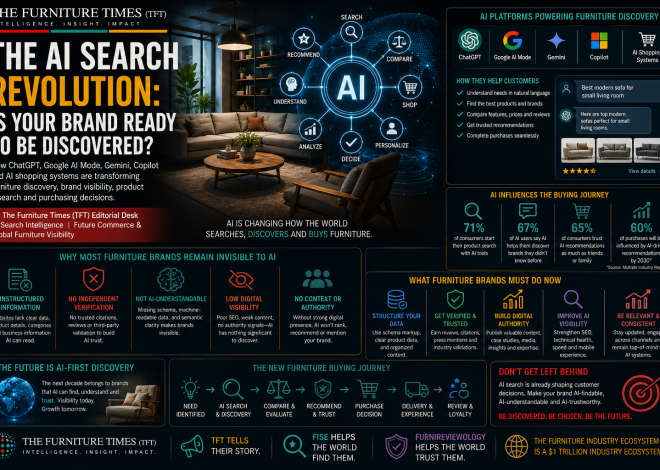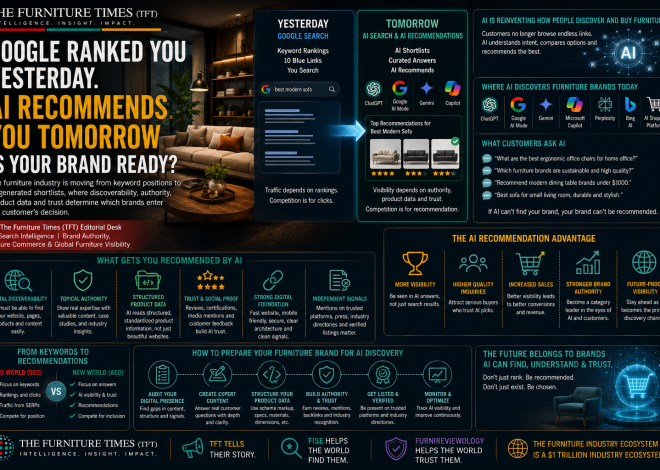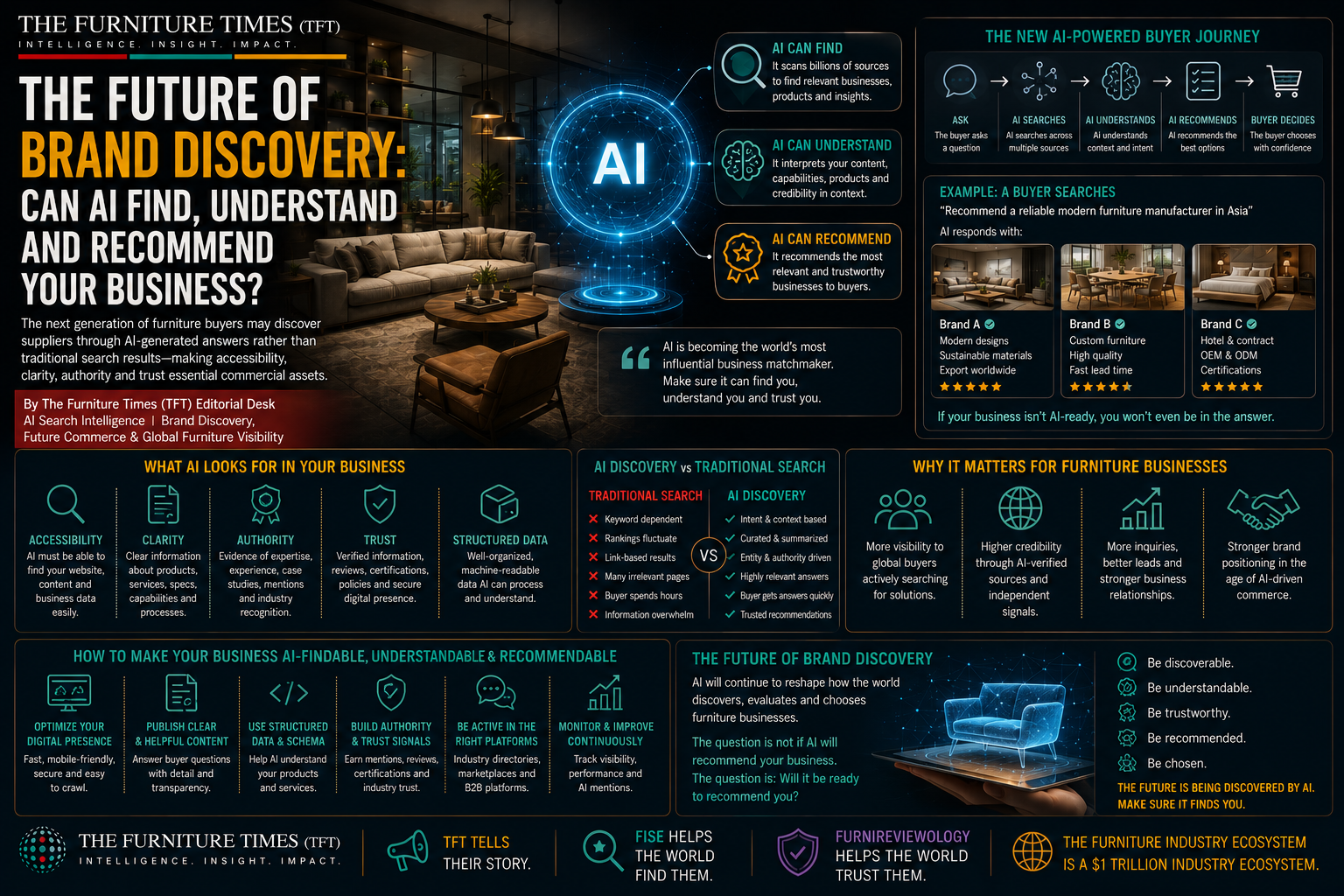
The Future of Brand Discovery: Can AI Find, Understand and Recommend Your Business?
The next generation of furniture buyers may discover suppliers through AI-generated answers rather than traditional search results—making accessibility, clarity, authority and trust essential commercial assets
By The Furniture Times (TFT) Editorial Desk | AI Search Intelligence | Brand Discovery, Future Commerce & Global Furniture Visibility
The way customers discover businesses is undergoing one of the most important transformations since the arrival of internet search.
For years, a company’s digital visibility depended largely on whether its website appeared prominently on Google. Businesses competed for keywords, backlinks, clicks and first-page rankings. Search engines displayed links, while customers conducted the comparison.
Artificial intelligence is changing that journey.
A customer can now ask ChatGPT, Google AI Mode, Gemini, Copilot or another AI-powered platform a complete commercial question:
“Which furniture manufacturers in Southeast Asia can supply customized outdoor collections for a five-star resort, use weather-resistant materials, provide installation and deliver before the property opens?”
The system may interpret the request, research multiple sources, compare businesses and present a shortlist.
The customer may never see most of the companies that could technically complete the project. Only businesses that the system can find, understand and assess with sufficient confidence may enter the answer.
This creates three critical questions for every furniture manufacturer, retailer, supplier, designer and service provider:
- Can AI find your business?
- Can AI understand what your business does?
- Can AI obtain enough trustworthy evidence to recommend it?
These questions define the future of brand discovery.
Discovery Is Becoming a Decision-Making Process
Traditional search engines primarily organized webpages. AI-powered search increasingly organizes information, options and decisions.
The difference is significant.
| Traditional discovery | AI-assisted discovery |
|---|---|
| User enters keywords | User describes a complete need |
| Search engine returns links | AI may return a summarized answer |
| User opens many websites | AI may compare several sources |
| Rankings drive attention | Mentions and recommendations drive consideration |
| Page-level relevance is central | Brand, product and contextual relevance matter |
| User conducts most evaluation | AI can support early-stage evaluation |
| Website click starts research | Research may begin inside the AI platform |
The website remains important, but it becomes one source within a broader information environment.
AI systems may also encounter business listings, media coverage, product feeds, reviews, videos, association profiles, exhibition pages, marketplaces and partner websites.
The company’s reputation is therefore no longer defined solely by the content it controls.
The Three Gates of AI Brand Discovery
A brand must pass through three interconnected gates before it can benefit fully from AI-powered search.
Gate One: Findability
Can the system access relevant information about the business?
Gate Two: Understandability
Can it identify the company correctly and connect it to appropriate products, locations, customers and capabilities?
Gate Three: Recommendability
Does the available evidence provide enough relevance and confidence for the brand to be included in an answer or shortlist?
A business may pass one gate and fail at the next.
For example:
- A website may be accessible but contain almost no meaningful information.
- A brand may be clearly described but lack credible independent evidence.
- A company may be well known but provide outdated product availability.
- A manufacturer may have excellent reviews but an inaccessible website.
AI visibility must therefore be approached as a complete system.
Gate One: Can AI Find Your Business?
A company cannot be understood or recommended if its public information cannot be accessed.
Crawler Access Is the First Requirement
Search and AI systems use automated crawlers to discover public webpages.
Technical settings can prevent those crawlers from reaching a site. Common problems include:
- Incorrect
robots.txtrules - Pages marked
noindex - Firewall restrictions
- Unstable hosting
- Server errors
- Broken links
- Missing XML sitemaps
- Content hidden behind account logins
- JavaScript rendering problems
- Poor mobile functionality
- Overly restrictive content controls
OpenAI explains that OAI-SearchBot is used to surface webpages within ChatGPT search. A website that blocks this search crawler will not appear as a cited source in ChatGPT search responses, although it may still receive navigational mentions under some circumstances. OpenAI’s crawler documentation provides technical information for website owners.
Google similarly states that pages should be accessible, crawlable and indexable to be considered for its generative AI search features. Its official generative AI optimization guidance confirms that foundational SEO remains essential.
Practical action
Furniture companies should ask a qualified professional to review:
- Google Search Console
- Bing Webmaster Tools
- XML sitemap coverage
- Robots directives
- Search-crawler access
- Server response codes
- Mobile rendering
- Internal navigation
- Page speed and stability
- Canonical page configuration
The objective is not to expose private business information. It is to make intended public content reliably accessible.
A Social-Media Account Is Not a Complete Digital Presence
Many furniture SMEs depend almost entirely on Instagram, Facebook, TikTok or WhatsApp.
These channels can be effective for engagement and enquiries, but they are controlled by external platforms. Important information may be fragmented, difficult to search or inaccessible to some systems.
A business also risks losing visibility if:
- Its account is restricted
- The platform changes its algorithm
- Content becomes buried
- Access is disrupted
- The account is compromised
- A customer does not use that platform
The official website should remain the primary factual source for the company.
Social media should distribute and demonstrate the brand’s expertise—not replace its digital identity.
PDF Catalogues Cannot Do Everything
Furniture companies frequently depend on downloadable PDF catalogues.
Catalogues remain useful for dealers, project buyers and sales teams, but important information should also exist as structured webpages.
When every product is locked inside one large file, search and AI systems may find it harder to:
- Identify individual products
- Connect items to categories
- Understand current availability
- Locate warranty information
- Compare specifications
- Determine whether information remains current
Major categories and priority products should have dedicated webpage versions.
Gate Two: Can AI Understand Your Business?
Being present online does not mean being understood.
A company may have hundreds of indexed pages while leaving machines uncertain about its identity, category or market.
Brand Ambiguity Creates Entity Confusion
Furniture businesses frequently use common words in their names, such as:
- Home
- Living
- Modern
- Comfort
- Design
- Interiors
- Furniture
- Lifestyle
An AI system may find several companies with similar names across different countries.
Confusion becomes more likely when the business uses one name on its website, another on social media and an abbreviation in exhibition catalogues.
AI must determine whether these references describe the same entity.
Create a central brand-facts record
Every furniture company should maintain an approved record containing:
- Official brand name
- Legal company name
- Former names
- Accepted abbreviation
- Website
- Headquarters
- Factory and showroom locations
- Year established
- Business classification
- Product categories
- Materials and capabilities
- Markets served
- Certifications
- Telephone and email
- Official social profiles
- Approved short company description
- Approved detailed company description
This information should remain consistent across important channels.
Vague Language Prevents Understanding
A homepage may say:
“Creating innovative furniture solutions for modern lifestyles.”
This does not tell an AI system whether the company manufactures, imports, retails or designs furniture.
A more useful statement might identify the business as:
“A Malaysian manufacturer of customized aluminum and teak outdoor furniture for residential, hospitality and commercial projects.”
The second description establishes:
- Country
- Business type
- Materials
- Product category
- Customer segments
- Customization capability
Clarity does not reduce brand creativity. It gives customers and machines the facts needed to understand the business.
Product Images Need Product Information
Furniture is visual, but photographs alone cannot communicate:
- Dimensions
- Materials
- Construction
- Weight
- Finish
- Application
- Weather resistance
- Assembly
- Warranty
- Stock status
- Lead time
- Delivery territory
A product page should contain factual information that allows a system to match the item with a customer’s requirements.
For example, “Dining Chair 28” provides little commercial context.
“Stackable powder-coated aluminum outdoor dining chair for hospitality terraces” communicates category, construction, application and a functional advantage.
Category Pages Establish Specialization
AI discovery frequently begins with category-level questions.
A buyer may ask for:
- Office furniture manufacturers
- Hotel furniture suppliers
- Cabinet-hardware companies
- School-furniture producers
- Outdoor furniture exporters
- Mattress manufacturers
- Upholstery-fabric suppliers
A company needs detailed category pages explaining its relevance.
A strong category page should cover:
- Product types
- Applications
- Materials
- Production capabilities
- Customization
- Quality standards
- Typical buyers
- Relevant projects
- Delivery regions
- Frequently asked questions
A single product gallery rarely provides enough context.
Structured Data Supports Machine Interpretation
Structured data is standardized, machine-readable information that helps search systems interpret pages.
Relevant schema types may include:
- Organization
- LocalBusiness
- Product
- Offer
- Article
- BreadcrumbList
- Event
- JobPosting
- VideoObject
- Person
Google emphasizes that structured data should match visible page content. It is not a tool for inserting hidden claims or false reviews.
Google also states that no special AI-specific schema is required for AI Overviews or AI Mode. Structured data remains useful as part of broader SEO and rich-result eligibility, but it does not guarantee AI inclusion.
Gate Three: Can AI Recommend Your Business?
Recommendation is the highest and most difficult stage.
An AI system may understand that a company manufactures furniture without considering it suitable for a particular customer.
Recommendation requires relevance, evidence and confidence.
AI Needs More Than Self-Declared Claims
Every company can describe itself as:
- Reliable
- Sustainable
- Innovative
- Premium
- Leading
- International
- Customer-focused
These claims become meaningful only when they are supported by evidence.
Evidence may include:
- Valid certifications
- Published warranty terms
- Factory information
- Detailed project case studies
- Independent media coverage
- Exhibition records
- Association membership
- Distributor references
- Authentic customer reviews
- Product-testing information
- Documented export markets
The more consequential the purchasing decision, the more evidence a buyer—and potentially an AI system—may require.
Independent Mentions Build Contextual Authority
A 2025 Ahrefs study of approximately 75,000 brands found that branded web mentions had the strongest reported correlation with visibility in Google AI Overviews among the factors examined.
The correlation associated with brand mentions was substantially stronger than the correlation associated with raw backlink volume. Ahrefs stressed that correlation does not prove causation, and the findings should not be treated as an official ranking formula.
The research nevertheless highlights the importance of a brand’s broader information environment.
Useful independent mentions can come from:
- Industry news
- Trade publications
- Business directories
- Exhibition organizers
- Certification bodies
- Associations
- Partner websites
- Customer reviews
- Expert videos
- Project coverage
A credible contextual mention can help establish what the brand does and why it is relevant.
Reviews Provide Experience Evidence
AI systems may encounter accessible customer reviews while helping users evaluate businesses.
Furniture-specific reviews can address:
- Product quality
- Comfort
- Material accuracy
- Delivery performance
- Assembly
- Installation
- Customer support
- Warranty handling
- Long-term durability
- Value
A large number of generic ratings may be less informative than a smaller number of detailed, authentic experiences.
Furniture companies should never purchase fake reviews. They should request honest feedback, respond responsibly and use complaints to improve operations.
FurniReviewology can support this trust layer by organizing review information relevant to furniture purchasing decisions.
Recommendation Depends on the Specific Question
A business does not need to be the world’s largest brand to become relevant.
An SME may not be recommended for “the world’s largest furniture manufacturer,” but it could be highly relevant for:
- Bespoke teak furniture in Malaysia
- Custom restaurant banquette seating
- Small-batch brass furniture handles
- Furniture repair in a particular city
- Hotel headboard manufacturing
- Outdoor cushions for tropical environments
- Sustainable school furniture
- Low-minimum-order furniture production
AI-powered discovery can reward specialization because users can express more detailed needs.
The company must clearly document the problem it solves.
AI Recommendation Is Not Guaranteed
No legitimate agency or consultant can guarantee that an AI platform will recommend a specific brand.
AI answers can change according to:
- Platform
- Model
- User wording
- Location
- Language
- Date
- Search sources
- Personalization
- Product availability
- Platform updates
The objective is to improve eligibility, relevance and evidence—not to claim control over an independent AI system.
AI Is Turning Product Data Into Commercial Infrastructure
AI-powered shopping makes accurate product information increasingly important.
OpenAI has developed product-discovery and structured-feed systems that allow participating merchants to provide current catalogue information. OpenAI’s product-discovery guidance explains that feeds can help products appear when shoppers explore, compare and decide.
A furniture product feed may need:
- Product identifiers
- Titles
- Descriptions
- Categories
- Prices
- Availability
- Product URLs
- Images
- Materials
- Dimensions
- Variants
- Seller information
- Delivery details
- Return conditions
Furniture creates additional complexity because products may be made to order, configurable or quotation-based.
Brands should nevertheless begin organizing this information now. Even when direct AI-commerce participation is unavailable in a particular country, clean product data improves websites, marketplaces, dealer systems and future readiness.
Original Expertise Is Becoming a Competitive Advantage
Generic content is becoming abundant.
Furniture companies should publish information drawn from real experience:
- How furniture joints are tested
- Why certain fabrics perform better in hospitality environments
- How foam density affects seating durability
- How tropical climates influence outdoor materials
- How timber moisture is controlled
- How flat-pack packaging reduces shipping volume
- How damaged furniture is repaired
- How large hotel installations are coordinated
- How replacement parts extend product life
- How different coatings resist corrosion
This type of content helps customers and establishes technical relevance.
Google’s generative-search guidance encourages unique, valuable and non-commodity content. The aim should be to publish knowledge that adds something genuinely useful—not to produce hundreds of repetitive articles with automated tools.
The Future Brand Discovery Funnel
The emerging discovery journey can be understood through six stages.
| Stage | Buyer activity | Brand requirement |
|---|---|---|
| Need | Customer describes a problem | Relevant category information |
| Research | AI gathers possible solutions | Crawlable and useful content |
| Understanding | AI identifies suitable companies | Clear brand and product entities |
| Validation | Sources and reviews are compared | Independent evidence and trust |
| Shortlisting | Limited options are presented | Strong relevance and current data |
| Action | Buyer visits, contacts or purchases | Clear conversion and fulfillment path |
A brand can lose the opportunity at any stage.
If it is not found, it cannot be evaluated.
If it is not understood, it cannot be matched.
If it is not trusted, it cannot be recommended.
The AI Brand Discovery Readiness Scorecard
Furniture businesses can use the following 100-point editorial framework.
| Readiness category | Points |
|---|---|
| Technical accessibility and crawler access | 15 |
| Brand identity and consistency | 15 |
| Product and category information | 15 |
| Original expertise and useful content | 15 |
| Independent authority and media coverage | 15 |
| Reviews and verifiable trust | 10 |
| Structured data and product feeds | 10 |
| Measurement and internal ownership | 5 |
| Total | 100 |
Score interpretation
| Score | Brand-discovery condition |
|---|---|
| 0–20 | Functionally invisible |
| 21–40 | Findable but poorly understood |
| 41–60 | Understood but weakly supported |
| 61–80 | Strong recommendation foundation |
| 81–100 | Advanced and actively managed |
This scorecard is a TFT strategic framework, not a metric used by Google, OpenAI, Microsoft or another platform.
The 25-Question Discovery Audit
A furniture company should evaluate the following:
- Can relevant search and AI crawlers access our public website?
- Are our important pages indexed?
- Does our website load reliably on mobile devices?
- Is our company name consistent everywhere?
- Does our About page explain exactly what we do?
- Are our locations and contact details accurate?
- Is our business classified correctly?
- Does every major category have a detailed page?
- Do priority products have individual pages?
- Are materials and dimensions published?
- Is product availability current?
- Are warranty conditions clear?
- Are delivery areas explained?
- Do we publish project case studies?
- Do we provide evidence for certifications?
- Is our structured data accurate?
- Is our product information ready for structured feeds?
- Do credible publications mention us?
- Are our exhibition profiles current?
- Do we have authentic customer reviews?
- Have we published original technical expertise?
- Are videos accurately titled and described?
- Do we test AI prompts regularly?
- Do we track incorrect AI descriptions?
- Does one team or person own AI visibility?
Every “no” reveals a discoverability risk.
How to Test Whether AI Can Find and Recommend You
Businesses should test four prompt groups.
1. Brand recognition
- What is [Brand Name]?
- Where is [Brand Name] located?
- What products does [Brand Name] offer?
2. Brand understanding
- Is [Brand Name] a manufacturer or retailer?
- What materials does it use?
- Which markets does it serve?
- Does it offer customization?
3. Category discovery
- Which companies manufacture in [country]?
- Who supplies [category] for hotels?
- Which brands specialize in [capability]?
4. Recommendation and comparison
- Would you recommend [Brand Name] for [use case]?
- What evidence supports that recommendation?
- Compare [Brand Name] with [Competitor].
- What are the advantages and limitations of each?
Record the date, platform, prompt, answer, citations and inaccuracies.
AI visibility should be measured over time, not judged from one response.
A 120-Day Brand Discovery Plan
Days 1–30: Become findable
- Audit crawler access.
- Fix indexing errors.
- Improve website stability.
- Submit current sitemaps.
- Repair broken navigation.
- Establish baseline AI tests.
Days 31–60: Become understandable
- Standardize brand facts.
- Rewrite the company profile.
- Build strong category pages.
- Upgrade priority product pages.
- Correct outdated listings.
- Add appropriate structured data.
Days 61–90: Become verifiable
- Publish project case studies.
- Document certifications and warranties.
- Produce expert-led content.
- Seek credible news coverage.
- Update association and exhibition profiles.
- Collect authentic customer reviews.
Days 91–120: Become recommendation-ready
- Organize product-feed data.
- Improve availability information.
- Test category and comparison prompts.
- Benchmark competitors.
- Track AI referral traffic.
- Correct misinformation.
- Establish monthly reporting.
What Furniture Brands Must Avoid
The pressure to appear in AI answers may encourage poor practices.
Companies should avoid:
- Fake reviews
- Fabricated news coverage
- False awards
- Unverified sustainability claims
- Hidden structured-data claims
- Automated forum spam
- Mass-produced low-value articles
- Copied product descriptions
- Misleading product availability
- Purchasing irrelevant mentions
- Claiming guaranteed AI recommendations
Trust is difficult to build and easy to lose.
AI visibility should reflect the company’s genuine capabilities.
The Role of TFT, FISE and FurniReviewology
The future discovery ecosystem requires three interconnected functions.
The Furniture Times (TFT) helps companies communicate their stories, achievements, knowledge and developments through accessible industry coverage.
Furniture Industry Search Engine (FISE) organizes companies through furniture-specific categories, locations and capabilities so that buyers can discover relevant businesses.
FurniReviewology strengthens the decision stage through reviews, reputation and trust information.
The relationship is clear:
- TFT helps the market know the business.
- FISE helps the market find the business.
- FurniReviewology helps the market trust the business.
Together, these functions can help address the furniture industry’s visibility gap—particularly for SMEs whose operational capabilities are stronger than their digital presence.
Final Analysis: The Best Business May Not Be the Business AI Finds
The furniture industry has many excellent companies that remain digitally invisible.
Their machinery is real.
Their workers are skilled.
Their products are reliable.
Their projects are successful.
Their experience is extensive.
But AI systems cannot visit every factory, walk through every showroom or interview every customer.
They depend on accessible information.
The future of brand discovery will therefore favor companies that turn real capability into clear digital evidence.
A business must first be found.
Then it must be understood.
Finally, it must earn enough confidence to be recommended.
Traditional search visibility remains part of that journey, but it is no longer the complete destination.
The furniture company of the future will manage its website, product data, news coverage, listings, videos, reviews and external reputation as one connected discovery system.
The decisive question is no longer simply:
“Are we online?”
It is:
“Can AI find, understand and recommend our business when the right customer asks?”
For many brands, the answer today may still be no.
The opportunity is to change that before tomorrow’s buyer begins the search.
Editorial note: AI-generated answers are dynamic and may vary by platform, prompt, model, date, language, location and available sources. No optimization method can guarantee a citation, recommendation or ranking. Independent research findings describe observed correlations rather than confirmed universal ranking factors.
Reference sources: Google’s generative AI optimization guidance, Google AI features documentation, OpenAI crawler documentation, OpenAI product discovery, and Ahrefs’ 75,000-brand visibility study.
The Furniture Times (TFT) & Furniture Industry Search Engine (FISE)
“TFT tells their story. FISE helps the world find them.”
FurniReviewology helps the world trust them.
The furniture industry ecosystem is a $1 trillion industry ecosystem.