
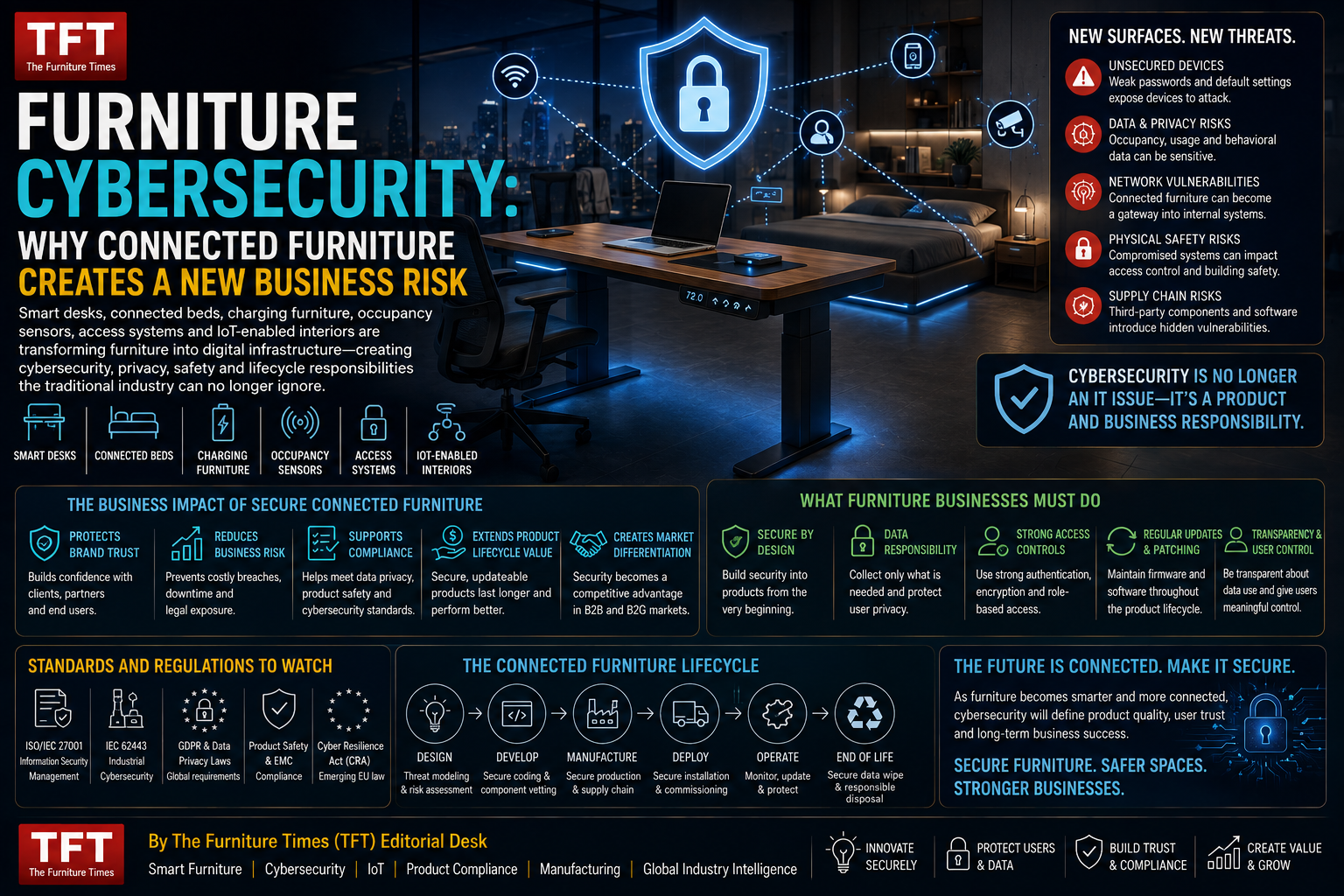
Furniture Cybersecurity: Why Connected Furniture Creates a New Business Risk
Smart desks, connected beds, charging furniture, occupancy sensors, access systems and IoT-enabled interiors are transforming furniture into digital infrastructure—creating cybersecurity, privacy, safety and lifecycle responsibilities the traditional industry can no longer ignore
By The Furniture Times (TFT) Editorial Desk | Smart Furniture | Cybersecurity | IoT | Product Compliance | Manufacturing | Global Industry Intelligence
For most of its history, the furniture industry protected products against familiar risks.
Manufacturers tested chairs for structural stability. Retailers managed warranties. Commercial suppliers considered fire safety, ergonomics and durability. Hotels planned maintenance. Healthcare facilities focused on infection control. Offices assessed electrical safety and cable management.
But furniture is changing.
A modern desk may record whether it is occupied, remember a user’s preferred height and connect to a workplace-management platform. A smart bed may monitor movement, sleep patterns or pressure. A hotel bedside table may contain wireless charging, lighting controls and USB ports. A connected locker may communicate with an access system. A meeting pod may contain cameras, microphones, environmental sensors and booking technology.
Once furniture contains processors, software, wireless connectivity, sensors, cloud services or mobile applications, it is no longer only furniture.
It becomes a digital product, a potential data-collection point and, in some cases, an endpoint inside a larger network.
This transition creates business risks that many furniture companies have never been required to manage:
- Unauthorised access
- Weak or shared passwords
- Insecure software
- Vulnerable third-party components
- Data leakage
- Privacy complaints
- Network compromise
- Service outages
- Unsafe remote operation
- Unsupported products
- Regulatory non-compliance
- Disputes over responsibility
- Reputational damage
- Cybersecurity recalls or corrective action
The central question is no longer simply whether the furniture is strong enough to support a person.
It is also whether its connected system is secure enough to be trusted inside a home, office, hotel, hospital, school or public building.
What counts as connected furniture?
Connected furniture includes products in which digital capabilities form part of the furniture itself or its installed system.
Examples include:
Smart desks
Height-adjustable desks may include memory controls, Bluetooth connectivity, mobile applications, occupancy tracking, usage analytics and integration with workplace platforms.
Connected beds
Residential wellness beds may monitor sleep and environmental conditions. Healthcare and care-home beds can incorporate pressure sensors, movement alerts, position monitoring, communications or connections with clinical systems.
Technology-enabled tables
Conference tables, bedside tables and hospitality furniture may include charging ports, wireless charging, power management, touch controls, embedded screens and room-control interfaces.
Smart lockers and storage
Connected lockers may use electronic access control, mobile credentials, QR codes, cloud-based administration and usage records.
Occupancy-enabled seating
Desks, chairs, benches or booths may contain sensors that report availability, usage duration or movement patterns.
Connected hospitality furniture
Hotel headboards, bedside units, mirrors and desks may control lighting, curtains, temperature, entertainment and room services.
Retail and exhibition furniture
Shelving, kiosks, mirrors and display systems can use sensors, cameras, RFID, analytics and interactive screens.
Technology-integrated healthcare furniture
Clinical carts, beds, chairs and cabinets may connect with asset-tracking, patient-monitoring, communications or medication-management systems.
Educational furniture
Desks, charging stations, lockers and collaborative tables may connect with campus platforms or device-management systems.
Access-controlled furniture
Cabinets, safes, lockers and storage units may use biometric, keypad, card, smartphone or remotely administered access controls.
Some products connect directly to the internet. Others communicate indirectly through a mobile phone, local gateway, building-management platform or cloud service.
The absence of a visible internet connection does not necessarily mean the product is isolated from cyber risk.
The attack surface extends beyond the physical product
A connected piece of furniture should not be evaluated as a single object. Its cybersecurity depends on the complete product ecosystem.
That ecosystem may include:
- Embedded firmware
- Sensors and controllers
- Bluetooth, Wi-Fi, NFC or other wireless connections
- A mobile application
- Cloud infrastructure
- Web dashboards
- Application programming interfaces
- User accounts
- Installer applications
- Third-party analytics
- Building-management integrations
- Payment or booking systems
- Software-update servers
- Technical-support access
- Manufacturer and supplier systems
A smart desk may appear simple, but the desk could communicate with a phone application, which communicates with a cloud platform, which shares data with an employer’s workplace-management system.
A weakness at any point could affect the product.
The furniture manufacturer may have produced the wooden or metal structure while purchasing electronics from one supplier, motors from another, firmware from a specialist and cloud services from a technology company.
That fragmented supply chain creates a difficult question:
Who is responsible for the security of the final connected product?
From the customer’s perspective, the brand printed on the furniture may be expected to take responsibility, regardless of which subcontractor created the vulnerable component.
Why furniture companies are particularly exposed
Many technology companies are accustomed to vulnerability testing, software updates, encryption and incident response.
Traditional furniture companies may not possess those capabilities internally.
A manufacturer can be highly experienced in timber, metal fabrication, upholstery and finishing while having limited expertise in:
- Secure software development
- Threat modelling
- Encryption
- Device identity
- Authentication
- Vulnerability management
- Software bills of materials
- Penetration testing
- Cloud security
- Incident reporting
- Security updates
- Privacy engineering
- Product-support lifecycles
This does not mean furniture businesses should avoid connected products. It means they must recognise that digital functionality introduces a new engineering discipline.
Adding a sensor or mobile application is not merely adding a feature. It is accepting an ongoing responsibility.
Risk 1: Default and weak passwords
Shared default passwords remain one of the most widely recognised connected-product risks.
If every unit ships with the same administrative password—or if installers rarely change it—an attacker who learns the credential may gain access to many devices.
The U.S. Cybersecurity and Infrastructure Security Agency has repeatedly identified universally shared default passwords as a preventable source of cyber risk. Its Secure by Design programme encourages technology manufacturers to make products secure by default rather than placing the entire burden on customers. CISA Secure by Design
For connected furniture, manufacturers should consider:
- Unique credentials for individual products
- Mandatory password change during setup
- Strong authentication requirements
- Rate limits on repeated login attempts
- Secure password-recovery procedures
- Multi-factor authentication for administrative systems
- Separation between user and installer privileges
- Elimination of hidden or undocumented maintenance accounts
A product should not become vulnerable simply because the installer followed the quickest possible setup process.
Risk 2: Poorly protected wireless connections
Connected furniture may use Bluetooth, Wi-Fi, NFC, Zigbee or proprietary wireless protocols.
Weak pairing procedures can create opportunities for unauthorised control, data interception or device impersonation.
The risk varies by function.
An unauthorised person changing the lighting colour in a hotel room is inconvenient. Unauthorised control of an adjustable healthcare bed, access-controlled cabinet or motorised workplace product could create greater consequences.
Manufacturers should determine:
- Who is allowed to connect
- How the product verifies the connecting device
- Whether communication is encrypted
- How pairing mode is activated
- Whether the connection times out
- How old users are removed
- What happens when ownership changes
- Whether installation credentials remain active
- How the product behaves without a network
Connectivity should be designed around least privilege: each user, application and service should receive only the access necessary for its purpose.
Risk 3: Sensors can collect more information than expected
An occupancy sensor may appear harmless because it records whether a seat is being used.
But data becomes more sensitive when combined with time, location, identity and behaviour.
A workplace system might infer:
- When an employee arrives
- How long the person remains at a desk
- Which rooms they use
- Who regularly meets
- Whether a workspace is occupied
- Patterns of absence
- Individual ergonomic settings
- Movement across a building
A connected bed may generate information relating to sleep, movement, health or care. A smart mirror, meeting pod or retail display may contain cameras or microphones. An access-controlled locker can create a record of who opened it and when.
The cybersecurity question is therefore inseparable from privacy.
Furniture brands must identify:
- What data is collected
- Why it is necessary
- Where it is stored
- How long it is retained
- Who can access it
- Whether it is shared
- Whether users can delete it
- What happens when the product is resold
- Whether the product collects data when users believe it is inactive
Data minimisation is a powerful risk-reduction measure. Information that is never collected cannot be stolen from the manufacturer’s system.
Risk 4: The mobile application may be weaker than the furniture
A connected product is often marketed through its physical design, but its security may depend heavily on the associated application.
Potential weaknesses include:
- Insecure login
- Weak account-recovery processes
- Excessive permissions
- Poorly protected data
- Hard-coded secrets
- Vulnerable software libraries
- Unauthorised application programming interfaces
- Inadequate session management
- Limited update support
A furniture company may outsource the application and assume that the developer is responsible for security.
But customers may blame the furniture brand when the application fails, leaks information or becomes unavailable.
Contracts with software developers should define security requirements, testing, ownership, access to source materials, update obligations, vulnerability handling and support after termination.
Risk 5: Cloud shutdown can disable otherwise usable furniture
Physical furniture can remain functional for decades. Software and cloud services may not.
This difference creates a major lifecycle problem.
What happens when:
- The application is discontinued
- The cloud provider changes
- The technology supplier closes
- The manufacturer leaves the market
- A subscription ends
- The operating system no longer supports the app
- Security certificates expire
- The server is switched off
- An acquisition changes product strategy
A high-quality desk or bed should not become unusable because a short-lived digital service has ended.
Connected furniture should include a planned degraded or offline mode wherever technically and safely possible. Core functions should continue even when cloud services are unavailable.
The customer should also be informed of the expected support period before purchase.
Risk 6: Unsupported products become long-term liabilities
Furniture and technology operate on very different timelines.
A sofa, table, hotel headboard or commercial desk may remain in use for 10, 15 or 20 years. The embedded electronics may become outdated much sooner.
A manufacturer that sells a connected product must decide how long it will provide:
- Firmware updates
- Security patches
- Cloud services
- Application compatibility
- Vulnerability monitoring
- Replacement electronic modules
- Customer support
- Security documentation
This support obligation should influence product pricing.
If the selling price covers only physical manufacturing and initial software development, the company may have no financial plan for years of cybersecurity maintenance.
Connected-furniture pricing must account for the full digital lifecycle, not just the cost of adding electronics at the factory.
Risk 7: Third-party components create inherited vulnerabilities
A furniture manufacturer may not write a single line of software and can still face cybersecurity exposure.
A connected product may incorporate:
- Commercial firmware
- Open-source software
- Wireless modules
- Motor controllers
- Cloud platforms
- Authentication services
- Analytics tools
- Software libraries
- Third-party applications
If a component contains a vulnerability, the final product may inherit it.
The manufacturer needs to understand the software and hardware inside the product, who maintains each component and how security updates will reach customers.
A software bill of materials can help document included software components and dependencies. It does not solve vulnerabilities by itself, but it improves visibility and response.
Supplier contracts should require timely notification of vulnerabilities, continued support and cooperation during incidents.
Risk 8: Connected furniture can become a route into a larger network
An IoT-enabled desk, locker, kiosk or charging station may be connected to the same environment as more valuable business systems.
If poorly secured, the device could potentially become an entry point, a persistence mechanism or part of a wider attack path.
Commercial buyers should avoid connecting furniture devices directly to sensitive corporate networks without appropriate controls.
Possible safeguards include:
- Network segmentation
- Dedicated IoT networks
- Device authentication
- Restricted outbound connections
- Firewall policies
- Monitoring
- Asset inventories
- Secure onboarding
- Rapid removal of unauthorised devices
NIST has published guidance on trusted network-layer onboarding and lifecycle management for IoT products, including the use of unique credentials and verification before devices are permitted to perform network operations. NIST trusted IoT onboarding guidance
For corporate furniture projects, cybersecurity teams should be involved before procurement—not after installation.
Risk 9: Physical safety and cybersecurity can intersect
In conventional furniture, a digital failure might have no physical consequence. In motorised or access-controlled products, the situation can be different.
Examples could include:
- Unauthorised movement of adjustable furniture
- Lockout from an electronic cabinet
- Failure of a connected bed-control function
- Misleading sensor readings
- Disabled emergency or manual controls
- Overheating charging components
- Incorrect remote commands
- Interrupted accessibility functions
Manufacturers must distinguish between security inconvenience and safety-related failure.
Safety-critical functions should be designed so that a cybersecurity incident does not create an unacceptable physical hazard. Manual controls, safe states, movement limits and offline operation may be necessary depending on the product.
Cybersecurity risk assessment should therefore involve product engineers, safety specialists and software teams together.
Risk 10: Charging furniture introduces electrical and data questions
Furniture with USB ports, power outlets or wireless charging is increasingly common in hotels, airports, offices, restaurants and homes.
The most immediate concerns include electrical safety, heat, component quality and maintenance.
But some charging connections can also involve data pathways. Users may assume that a port provides power only, while the underlying hardware may support data communication.
Manufacturers and buyers should consider:
- Whether ports are power-only
- Component certifications
- Overcurrent and temperature protection
- Physical access to internal electronics
- Firmware capability
- Replacement procedures
- Damage from liquids
- Maintenance responsibility
- Clear user labelling
“Smart” should never become a marketing label that hides basic electrical and cybersecurity questions.
Regulation is moving toward lifecycle responsibility
Connected furniture manufacturers should not assume that cybersecurity remains voluntary.
The European Union’s Cyber Resilience Act introduces mandatory cybersecurity requirements for many hardware and software products with digital elements placed on the EU market. The regulation entered into force on 10 December 2024.
According to the European Commission, the main CRA obligations are scheduled to apply from 11 December 2027, while vulnerability and incident-reporting obligations begin on 11 September 2026. European Commission—Cyber Resilience Act
The CRA applies to covered products whose intended or reasonably foreseeable use includes a direct or indirect logical or physical data connection to a device or network, subject to exclusions and the detailed legal text.
Manufacturers of covered products will need to address cybersecurity during planning, design, development, production, delivery and maintenance. The framework includes risk assessment, technical documentation, conformity assessment and vulnerability-handling responsibilities.
The Commission also states that businesses placing products under their own name or trademark can carry manufacturer obligations. That point is critical for private-label furniture companies that source connected components or complete products from external factories. European Commission—CRA manufacturer obligations
A furniture brand may not escape responsibility simply because another company supplied the electronics.
Incident reporting is becoming a formal obligation
From 11 September 2026, manufacturers covered by the CRA will face reporting obligations for actively exploited vulnerabilities and severe security incidents affecting their products.
The European Commission states that the system includes an early warning within 24 hours of awareness and a fuller notification within 72 hours, followed by final reporting according to the applicable timelines and circumstances. European Commission—CRA reporting
Furniture companies selling relevant connected products in the EU should not wait until a serious vulnerability is discovered to establish an incident-response process.
They need to determine in advance:
- Who receives vulnerability reports
- Who evaluates severity
- Who has access to technical information
- Who communicates with suppliers
- Who approves updates
- Who manages regulatory reporting
- Who informs customers
- How evidence is preserved
- How affected product versions are identified
Cyber incident response cannot be improvised through ordinary customer service.
The United States is developing consumer cybersecurity labelling
The U.S. Federal Communications Commission established a voluntary cybersecurity labelling programme for qualifying wireless consumer IoT products.
The programme includes the U.S. Cyber Trust Mark and a QR-code-based registry intended to provide consumers with security-related information about participating products. Federal Communications Commission
The programme does not mean every connected furniture product automatically qualifies, nor does a label eliminate all risk. But it reflects a wider market direction: consumers and commercial buyers increasingly expect transparent cybersecurity information before purchasing connected products.
NIST’s consumer IoT profile provides a baseline of cybersecurity outcomes for consumer IoT products and can also help small businesses evaluate connected products they purchase. NIST IR 8425
What a secure connected-furniture product should provide
Security requirements must be proportional to the product’s use and risk. However, a responsible baseline should consider the following areas.
Unique product identity
The system should be able to identify individual products or components securely.
Secure configuration
Customers and administrators should be able to modify authorised security settings without exposing dangerous controls.
Data protection
Stored and transmitted data should receive protection appropriate to its sensitivity.
Controlled interface access
Network, local and physical interfaces should be restricted to authorised parties and necessary functions.
Secure software updates
Updates should be authenticated, protected against tampering and delivered through a maintained process.
Cybersecurity-state awareness
The system should provide appropriate information about its security status, failures or abnormal behaviour.
Device security
Hardware and software should resist unauthorised modification within the limits of the risk assessment.
These themes align with NIST’s IoT device cybersecurity capability baseline, which provides a starting point for manufacturers, integrators and purchasers. NIST IR 8259A
Secure by design must begin before the prototype
Cybersecurity cannot be added effectively after the product is ready to ship.
At the concept stage, the team should ask:
- Does the product genuinely need connectivity?
- Can the function be completed locally?
- What is the worst credible misuse?
- What information will be collected?
- Is identity necessary?
- How long will the product remain supported?
- Can electronics be replaced independently of the furniture?
- What happens if the cloud service fails?
- Can the product be reset securely?
- How is ownership transferred?
- Can former users retain access?
- What happens at disposal?
This approach may result in fewer features—but a safer, more durable and commercially manageable product.
The most secure data is often data that was never collected. The most secure network connection may be the one the product never needed.
Furniture companies need new supplier questions
Traditional supplier evaluation may focus on price, delivery, materials and warranty.
Connected products require a deeper assessment.
Furniture companies should ask technology suppliers:
- Which software components are included?
- Who owns and maintains the firmware?
- Are credentials unique to each device?
- Is communication encrypted?
- How are updates delivered?
- What is the guaranteed support period?
- Is there a vulnerability-disclosure process?
- Has independent security testing been conducted?
- How quickly will critical vulnerabilities be addressed?
- Can the product function offline?
- What data leaves the product?
- Where is cloud data stored?
- Are subcontractors used?
- What happens if the supplier goes out of business?
- Can another provider maintain the system?
- How are end-of-life products handled?
Verbal assurances are insufficient. Critical obligations should appear in enforceable contracts.
Commercial buyers need cybersecurity procurement clauses
Hotels, hospitals, offices, schools, airports and public institutions should not purchase connected furniture as if they were purchasing conventional tables and chairs.
Procurement documentation should specify:
- Required cybersecurity standards
- Authentication expectations
- Prohibition of universal default passwords
- Data-location requirements
- Update obligations
- Support duration
- Vulnerability-notification timelines
- Incident-cooperation duties
- Software component transparency
- Penetration-testing expectations
- Network requirements
- Privacy responsibilities
- Secure decommissioning
- Ownership and control of collected data
- Exit and cloud-service continuity arrangements
The contract should also clarify who pays when an update, vulnerability or discontinued service affects hundreds or thousands of installed products.
Installers are becoming part of the cybersecurity chain
Furniture installation used to involve assembly, positioning, levelling and electrical connection.
Connected-furniture installers may now:
- Create administrator accounts
- Pair products with applications
- Join corporate networks
- Configure cloud services
- Handle passwords
- Assign user access
- Test remote controls
- Retain diagnostic privileges
An installer who leaves default credentials active or connects a product to the wrong network can undermine otherwise strong product security.
Installation procedures should include secure credential handling, documented handover and removal of temporary access.
Showrooms must disclose what “smart” actually means
“Smart furniture” is often promoted without clearly explaining:
- What connects to what
- Whether a subscription is required
- What data is collected
- Whether the app is necessary
- How long updates will be available
- Whether the product works without the cloud
- Whether it can be reset for resale
- Which company provides the digital service
Retailers should not allow customers to discover these limitations after delivery.
Digital functionality should be described with the same clarity as dimensions, materials, warranties and care instructions.
Resale and disposal create forgotten security risks
Furniture frequently changes hands.
A desk may move between employees. A hotel may liquidate hundreds of connected bedside units. A hospital may retire smart beds. An office may sell electronic lockers after relocation.
Before resale or disposal, the organisation should determine whether the product contains:
- User credentials
- Network information
- Access records
- Occupancy data
- Device certificates
- Cloud links
- Administrator accounts
- Personal preferences
- Location data
A secure factory-reset and decommissioning process should remove data, credentials and organisational access.
Connected furniture without a reliable reset process can create risk long after it leaves the original owner.
Right to repair meets cybersecurity
Repairability is essential for long-lived furniture, but connected products complicate the issue.
Customers may need access to replace:
- Sensors
- Control boards
- Charging modules
- Motors
- Displays
- Batteries
- Wireless components
Manufacturers must balance repair access with security. Unauthenticated replacement modules, modified firmware or uncontrolled diagnostic tools can introduce vulnerabilities.
A responsible approach can provide authorised replacement components, documented procedures and secure re-pairing without making ordinary maintenance impossible.
Modular electronics may help furniture outlive the technology originally installed inside it.
Cybersecurity can become a competitive advantage
The discussion should not focus only on fear.
Furniture brands that address cybersecurity seriously can differentiate themselves.
Commercial customers may prefer products offering:
- Clear support periods
- Secure offline operation
- Replaceable electronic modules
- Transparent data practices
- Unique credentials
- Independent testing
- Documented update processes
- Rapid vulnerability response
- Secure decommissioning
- Reliable technical support
Trust can become part of product value.
In connected furniture, quality is no longer measured only through joints, finishes, fabrics and load testing. It also includes the resilience of software and services.
A practical action plan for furniture SMEs
Step 1: Identify every connected product
Create an inventory of products containing processors, applications, wireless modules, cloud services, access systems or data-collecting sensors.
Step 2: Map the complete ecosystem
Identify all hardware, software, suppliers, cloud services, mobile applications and data flows.
Step 3: Assign ownership
Designate a responsible person or team for product cybersecurity. It cannot remain an undefined responsibility shared by everyone and owned by nobody.
Step 4: Conduct a risk assessment
Evaluate foreseeable threats, affected users, possible safety consequences and the sensitivity of collected information.
Step 5: Review supplier contracts
Add requirements for updates, vulnerability disclosure, security cooperation, support periods and component documentation.
Step 6: Eliminate obvious weaknesses
Remove universal default passwords, unnecessary services, hard-coded credentials and insecure administrative access.
Step 7: Establish update capability
A product without a secure update mechanism may remain vulnerable for the rest of its physical life.
Step 8: Create a disclosure channel
Publish a method through which researchers, customers and partners can report suspected vulnerabilities.
Step 9: Prepare an incident-response plan
Define how the company will investigate, correct, report and communicate an incident.
Step 10: Plan end of support
Tell customers how long the product will receive updates and what will happen when support ends.
TFT analysis: the industry is becoming part of the technology supply chain
Furniture manufacturers have traditionally thought of technology as an accessory.
That position is no longer sustainable.
Once a furniture company sells a connected bed, desk, locker or table under its name, it may become responsible for a product containing software, data flows and network access. It must understand its place in the technology supply chain.
The industry must add new questions to product development:
- Is it comfortable?
- Is it durable?
- Is it compliant?
- Is it repairable?
- Is it secure?
- Does it respect privacy?
- Will it remain functional after software support ends?
The strongest connected-furniture products will be those that integrate physical durability with digital resilience.
A table designed to last 20 years should not depend on an application supported for two.
TFT, FISE and FurniReviewology: discoverability must include security intelligence
The Furniture Times helps the industry understand the technologies, regulations and risks reshaping furniture.
The Furniture Industry Search Engine can help buyers discover smart-furniture manufacturers, IoT component suppliers, testing organisations, cybersecurity specialists and technology partners.
FurniReviewology can help the market evaluate whether products and suppliers deliver reliable experiences over time—including installation, applications, support, updates and data practices.
TFT tells their story.
FISE helps the world find them.
FurniReviewology helps the world trust them.
The furniture industry ecosystem is a $1 trillion industry ecosystem.
Final conclusion: connected furniture creates a continuing obligation
The sale of conventional furniture may complete when the product is delivered, installed and accepted.
The sale of connected furniture can create a relationship that continues for years.
Software must be maintained. Vulnerabilities must be investigated. Cloud services must remain available. Users must be informed. Data must be protected. Products must be reset, transferred and eventually decommissioned.
Furniture companies entering this market should not ask only, “What smart features can we add?”
They must also ask:
Can we secure, support and responsibly maintain those features for the real life of the product?
Cybersecurity is no longer exclusively an IT-department problem.
For connected furniture, cybersecurity is product quality, customer safety, regulatory readiness, brand reputation and long-term business risk.
The future of furniture is connected. Its future must also be secure.
