
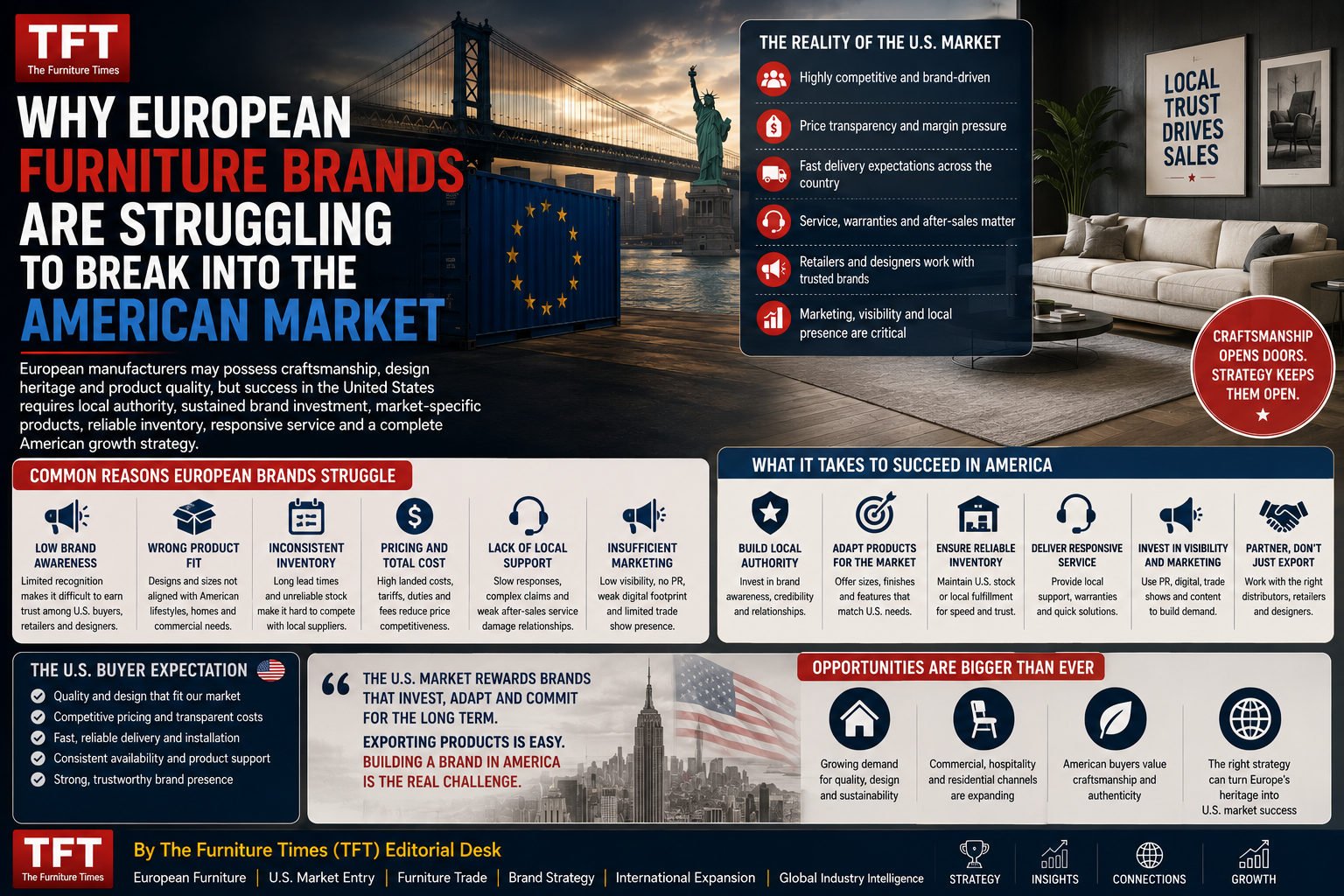
Why European Furniture Brands Are Struggling to Break Into the American Market
European manufacturers may possess craftsmanship, design heritage and product quality, but success in the United States requires local authority, sustained brand investment, market-specific products, reliable inventory, responsive service and a complete American growth strategy
By The Furniture Times (TFT) Editorial Desk | European Furniture | U.S. Market Entry | Furniture Trade | Brand Strategy | International Expansion | Global Industry Intelligence
European furniture companies are globally respected for craftsmanship, material knowledge, manufacturing tradition and design innovation.
Italy is associated with luxury and contemporary design. Germany is recognised for engineering and production discipline. Scandinavia has built an international identity around simplicity, functionality and material responsibility. Poland, Romania, Portugal, Spain, Lithuania and other production centres offer strong manufacturing capabilities across price segments.
Yet possessing a respected European origin does not automatically create success in the United States.
Many European furniture businesses enter the American market believing their designs will sell themselves. They appoint a sales representative, attend an exhibition, translate their catalogue, ship selected samples and wait for dealers, designers and consumers to respond.
When results remain limited, management may blame the distributor, the salesperson, freight costs or American taste.
The deeper problem is often strategic.
According to an analysis published by Interior Daily, European companies frequently appoint American sales teams while keeping important marketing decisions, budgets and authority at their European headquarters. The result is a local team responsible for delivering growth without sufficient control over how the brand is positioned, promoted or supported.
The article, drawing on comments attributed to The Viscusi Group’s Stephen Viscusi, argues that American marketing requires local leadership, adequate authority and sustained investment. The challenge extends beyond advertising to differences among consumers, designers, dealers and contract buyers, as well as pricing, inventory, distribution and customer service. Interior Daily
The central lesson is clear:
European furniture brands do not fail in America because Europe lacks design. They fail when they treat the United States as an export destination instead of building it as a market.
The American market does not owe a brand recognition
A European company may be well known in Milan, Cologne, Paris, Copenhagen or Warsaw. It may have decades of experience, an established dealer network and a respected presence at major exhibitions.
That reputation may have little practical value to an American consumer or regional dealer encountering the name for the first time.
Brand awareness does not cross the Atlantic inside a shipping container.
It must be rebuilt.
American buyers may not know:
- The company’s history
- The significance of its designers
- The quality of its materials
- Its manufacturing expertise
- Why the product carries a premium price
- Where the product can be tested
- Whether spare parts are locally available
- How long delivery will take
- Who handles a complaint
- Whether the company will remain committed to the market
A company familiar to European architects may remain invisible to American interior designers. A brand recognised by European retailers may be unknown to U.S. dealers. A product successful in compact European homes may not fit American expectations concerning scale, configuration or comfort.
The first responsibility of market entry is therefore education—not selling.
Hiring a U.S. sales team is not the same as building an American business
European companies often begin their U.S. expansion by hiring an independent representative, sales director or distributor.
That can be a sensible first step, but it cannot replace a complete market-entry strategy.
A sales team needs more than a price list and sample book. It needs:
- Local positioning
- Marketing budget
- Public-relations support
- American product information
- Competitive intelligence
- Reliable samples
- Inventory visibility
- Clear delivery commitments
- Warranty procedures
- Local references
- Technical documentation
- Digital lead generation
- Dealer support
- Authority to respond quickly
When every decision requires approval from headquarters several time zones away, opportunities slow down.
The American team may identify the need for a different finish, larger sectional, quicker delivery programme or regional campaign, but European management may hesitate because the request does not match established home-market practices.
Eventually, the local team becomes responsible for a number it cannot control.
The company has hired salespeople without creating the operating conditions in which sales can happen.
Centralised European decision-making can delay American growth
European headquarters often want to protect brand consistency.
That objective is legitimate. A business should not sacrifice its identity merely to enter another country. But excessive centralisation can prevent appropriate localisation.
American teams may understand:
- Which product names are difficult to communicate
- Which dimensions create resistance
- Which price points face the greatest competition
- Which regions suit the brand
- Which designers influence specification
- Which dealers can provide effective representation
- Which fabrics and finishes appeal locally
- Which delivery expectations are non-negotiable
- Which marketing messages customers understand
If headquarters dismisses this knowledge, the company may repeatedly offer the wrong solutions and interpret weak sales as a lack of market potential.
Local authority does not require abandoning European heritage. It means allowing the people closest to the customer to decide how that heritage should be translated into commercial relevance.
The United States is not one furniture market
One of the largest strategic errors is treating America as a single, uniform market.
The United States contains highly distinct regional economies, design cultures, housing types and distribution structures.
A product that appeals to a Manhattan interior designer may not meet the needs of a suburban Texas homeowner. A collection suited to Miami hospitality may not suit a Pacific Northwest retailer. A brand positioned for California luxury residential projects may require a different channel strategy for Chicago contract business.
Important differences include:
- Climate
- Home size
- Urban density
- Architecture
- Interior-design preferences
- Income
- Housing turnover
- Retail concentration
- Dealer networks
- Logistics costs
- Commercial development
- Local building and safety expectations
A European brand should identify the cities, states, channels and customer groups where its proposition is most likely to succeed.
Trying to cover the entire country from the beginning can exhaust capital while creating limited market depth.
Consumer, designer, dealer and contract markets require different strategies
Interior Daily correctly highlights the need to understand differences among consumers, designers, dealers and the contract market.
These are not simply different customers. They have different buying processes.
Consumer market
Consumers evaluate style, comfort, price, availability, reviews, delivery, financing, warranty and return conditions. They may discover the brand online but still want to experience the product physically.
Interior-design market
Designers need samples, finish options, trade pricing, specifications, CAD or 3D files, responsive quotations and confidence that the supplier will protect the project timeline.
Dealer market
Dealers require sufficient margins, territorial clarity, display support, inventory information, delivery reliability, training, complaint resolution and evidence that the brand will generate consumer demand.
Contract market
Commercial buyers may require testing, certifications, technical documentation, installation coordination, project pricing, replacement capability and long-term service.
A company cannot address all four channels with one brochure and one salesperson.
Each audience requires a distinct value proposition, sales process and service model.
European design heritage is an advantage—but not a complete proposition
“Made in Italy,” “Scandinavian design,” “German engineering” and other origin stories can add value.
But origin alone cannot carry an unfamiliar product through a complex purchasing decision.
American buyers still ask:
- Is the product comfortable?
- Is it appropriately sized?
- Is it available?
- When will it arrive?
- What happens if it is damaged?
- Can I obtain replacement parts?
- Is it compliant?
- Does the warranty operate in the United States?
- Who will answer my call?
- Is the price justified?
European heritage should provide the beginning of the story, not the entire answer.
The strongest positioning explains how origin creates practical customer value:
- Craftsmanship that improves longevity
- Engineering that increases reliability
- Design expertise that improves function
- Material selection that supports quality
- Manufacturing tradition that ensures consistency
- Sustainability that reduces lifecycle impact
Heritage must be translated from biography into benefit.
Product scale can create a hidden mismatch
European homes are often smaller than American houses, although this varies greatly by region and property type.
Furniture designed for compact apartments may appear undersized in larger American interiors. Conversely, extremely large American-style products may not suit urban U.S. markets.
Potential areas of mismatch include:
- Sofa depth
- Seat height
- Sectional configurations
- Dining-table proportions
- Mattress and bed sizes
- Storage capacity
- Armchair dimensions
- Desk sizes
- Load ratings
- Outdoor-furniture scale
European brands should study real American interiors and user expectations before deciding whether to modify products.
Localisation does not necessarily mean making everything larger. It means ensuring that proportions, comfort and configurations align with the intended customer segment.
Comfort expectations can differ from design expectations
A visually elegant sofa may attract attention but fail to convert if American customers perceive it as too firm, too shallow or insufficiently relaxed.
Seating preferences can differ across customer segments, climates and lifestyles. Some buyers prioritise upright support; others expect deeper lounge seating. Families may consider pets, children and frequent entertainment. Luxury customers may expect both design distinction and generous comfort.
Brands should test products with target users rather than assuming European success proves universal comfort.
This is particularly important for:
- Sofas
- Recliners
- Dining chairs
- Mattresses
- Lounge chairs
- Outdoor seating
- Ergonomic office furniture
The product must survive the showroom test, not merely the catalogue test.
Pricing becomes more complicated after crossing the Atlantic
A product that is competitively priced in Europe can become substantially more expensive in America after adding:
- International freight
- Port charges
- Customs brokerage
- Duties and tariffs
- Domestic transport
- Warehousing
- Insurance
- Damage allowance
- Sales commissions
- Dealer margin
- Marketing expenditure
- Warranty reserve
- Returns
- Installation
- Currency risk
If the final price becomes too high relative to local alternatives, design excellence may not be enough.
European companies must build a complete landed-cost model before launching.
The model should test:
- Wholesale price
- Suggested retail price
- Dealer margin
- Promotional margin
- Project discounting
- Freight scenarios
- Exchange-rate movements
- Damage rates
- Inventory carrying cost
- Warranty claims
- Customer-acquisition cost
A brand should know whether its American price structure is commercially sustainable before signing dealers.
Tariffs and origin rules must be treated as strategic variables
Furniture import costs depend on product classification, construction, materials and country of origin.
Tariff policy can change, and relying on outdated assumptions can destroy margins. Importers need qualified customs advice for relevant classifications, duties, documentation and origin treatment.
Country-of-origin marking is also a formal requirement. U.S. Customs and Border Protection states that, unless an exception applies, foreign-origin articles entering the United States must be marked legibly with the English name of their country of origin. U.S. Customs and Border Protection
European brands should not treat compliance as paperwork handled after the commercial plan is complete. It must be incorporated into costing, packaging and supply-chain design from the beginning.
Long lead times weaken confidence
American buyers may admire European products but choose a domestic or locally stocked alternative if the wait is too long or uncertain.
Extended lead times create several risks:
- The customer changes their mind.
- The project schedule changes.
- Materials become unavailable.
- Freight costs increase.
- Currency movements alter margins.
- The product arrives damaged.
- A replacement takes additional months.
- Dealers hesitate to place floor orders.
- Designers avoid specifying the brand again.
For made-to-order luxury furniture, customers may accept a longer lead time if it is predictable and properly communicated.
The problem is not always duration. It is uncertainty.
A 16-week delivery that arrives as promised can be more commercially acceptable than an eight-week estimate that becomes 22 weeks without explanation.
No inventory means no momentum
Many European brands attempt to enter America without local stock.
This reduces financial risk initially, but it can also limit growth.
Dealers may avoid displaying a product if replacements are difficult. Designers may hesitate to specify a brand with no quick-ship option. Consumers accustomed to faster delivery may select alternatives.
A sensible inventory strategy does not require stocking every product.
Brands can create a focused quick-ship programme around:
- Bestselling models
- Neutral finishes
- Popular sizes
- Replacement components
- High-demand accessories
- Samples and swatches
A limited but reliable inventory can demonstrate commitment and help the local sales team convert early demand.
Warehousing is not only a logistics decision
A U.S. warehouse can support:
- Faster delivery
- Consolidated shipments
- Spare-parts availability
- Returns processing
- Quality inspection
- Project staging
- Dealer replenishment
- Local repair
- Sample distribution
However, warehousing creates cost, inventory risk and management complexity.
Brands should evaluate multiple models:
- Distributor-owned inventory
- Third-party logistics
- Shared warehousing
- Consignment
- Regional inventory
- Direct container programmes
- Dealer stock
- Made-to-order imports with limited quick ship
The appropriate model depends on price position, product type, order frequency, geography and channel.
Furniture damage can destroy a carefully built reputation
International furniture logistics involves multiple handling points.
Products may be exposed to:
- Container movement
- Port handling
- Warehousing
- Domestic line-haul
- Final-mile delivery
- Installation
- Returns
A product arriving damaged does not become the customer’s logistics problem. It becomes a brand experience.
European companies need packaging designed for American distribution conditions, not simply for transport to nearby European dealers.
They should also establish:
- Damage documentation
- Claim procedures
- Replacement timelines
- Local repair partners
- Spare components
- Customer communication
- Responsibility among carriers and dealers
One damaged shipment handled professionally may preserve trust. An unanswered complaint can permanently damage the brand.
Customer service cannot remain in another time zone
A designer needing an urgent finish confirmation cannot wait several days for headquarters. A dealer cannot confidently sell a sofa when warranty questions remain unanswered. A consumer facing a delivery problem expects a local response.
U.S. market entry requires service infrastructure that operates on American schedules.
This may include:
- Local phone support
- Responsive email
- Quotation teams
- Technical specialists
- Claims management
- Installation coordination
- Dealer training
- Spare-parts fulfilment
- Warranty administration
Customer service is not an administrative cost added after the sale. It is part of the product proposition.
Warranty language must be locally meaningful
A European warranty may not translate effectively into the U.S. market.
Brands should clarify:
- Who provides the warranty
- Which entity customers contact
- What components are covered
- Whether labour is covered
- How transport is handled
- Whether commercial use changes coverage
- How claims are documented
- How long replacement parts remain available
- What happens when a dealer closes
- Which jurisdiction’s terms apply
A prestigious European warranty has little value if no practical U.S. process exists for using it.
American compliance cannot be assumed from European compliance
European standards, certifications and test reports may provide valuable evidence, but they do not automatically establish compliance with every U.S. requirement.
Applicable obligations depend on the product, materials, use and distribution.
For example, U.S. Environmental Protection Agency requirements apply to regulated composite wood products and finished goods containing hardwood plywood, medium-density fibreboard or particleboard. Relevant products manufactured or imported after March 22, 2019 must meet TSCA Title VI certification and labelling requirements. U.S. EPA
Certain clothing-storage units are subject to U.S. stability requirements under the STURDY framework. CPSC guidance addresses stability testing, anti-tip devices and warning information for covered products. U.S. Consumer Product Safety Commission
Other products may face different federal, state, contractual or voluntary-standard expectations.
Compliance should be assessed product by product before importation—not after goods arrive.
A dealer will not build a European brand alone
European companies may expect American dealers to introduce the brand, educate consumers, invest in displays and generate demand.
Dealers may expect the brand to provide marketing, leads, training and recognition.
When both sides wait for the other, nothing happens.
A dealer relationship should be supported through:
- Display programmes
- Samples
- Product training
- Local content
- Co-operative marketing
- Lead distribution
- Territory clarity
- Margin protection
- Stock support
- Designer outreach
- Service standards
- Performance reviews
The dealer is a commercial partner, not a substitute for brand investment.
Independent representatives need organisational support
Sales representatives can open doors, provide relationships and interpret regional markets. But representatives usually manage several complementary lines.
They are most effective when the brand provides:
- Sellable samples
- Accurate price lists
- Quick quotations
- Reliable commissions
- Territory protection
- Competitive lead times
- Strong presentation tools
- Decision-making speed
- Market awareness
- Marketing-generated enquiries
A brand that provides none of these may struggle to retain high-performing representatives.
Digital presence must be rebuilt for American discovery
A European website may technically be accessible in the United States but still fail commercially.
Common problems include:
- Prices displayed only in euros
- Metric dimensions without imperial equivalents
- European contact details only
- No U.S. inventory information
- No American warranty terms
- Slow response forms
- Product names unfamiliar to local searches
- No local delivery guidance
- Few American projects
- No U.S. customer reviews
- Limited dealer information
- Weak search visibility
An American digital presence should help customers answer practical questions before contacting the company.
It should include:
- U.S. contact information
- Dollar pricing or quotation guidance
- Imperial and metric dimensions
- Local availability
- Delivery expectations
- Dealer locator
- Trade programme
- Specifications
- Certifications
- Warranty terms
- Reviews
- Project case studies
- Samples and downloads
Search engines and AI systems also need consistent, structured information to understand that the brand serves the United States.
AI may recommend the brands with the strongest American evidence
American buyers increasingly use AI-assisted tools to discover and compare brands.
A European company may have strong coverage in its home language but limited English-language evidence connecting it with U.S. customers, dealers and projects.
AI systems may struggle to determine:
- Whether the brand sells in America
- Which products are available
- Who distributes them
- Whether support is local
- How customers evaluate the company
- Whether information is current
Competitors with stronger American news coverage, directories, reviews, product data and project references may be easier to identify and recommend.
Market entry now requires an information strategy as well as a distribution strategy.
Trade fairs create introductions—not permanent market presence
European brands may exhibit at High Point Market, ICFF, HD Expo or another American event and expect the exhibition to establish the business.
Trade events can generate valuable meetings, but a few days of visibility cannot replace year-round activity.
Before an exhibition, the brand needs:
- Targeted invitations
- Media outreach
- Dealer appointments
- Designer engagement
- Product-launch content
- Digital campaigns
- Clear American pricing
After the exhibition, it needs:
- Immediate follow-up
- Sample fulfilment
- Quotations
- Local meetings
- Published coverage
- Lead nurturing
- Progress tracking
A trade fair is a moment within the strategy—not the strategy itself.
Press coverage builds the missing trust layer
An unfamiliar European brand cannot depend entirely on self-description.
American designers, dealers and consumers may search for independent evidence before engaging.
Relevant publication can include:
- Company profiles
- Designer interviews
- Product-launch coverage
- Project case studies
- Market commentary
- Manufacturing stories
- Sustainability reports
- Dealer announcements
- Showroom openings
- Executive appointments
- U.S. expansion updates
This coverage creates a searchable history showing that the company is active and committed.
A brand invisible to American media may also remain invisible to American buyers.
RH demonstrates the power of experience—but should not be copied blindly
Interior Daily mentions RH as one model for building brand awareness through showrooms and experience.
RH has developed a highly recognisable presentation built around physical environments, hospitality, architecture, imagery and lifestyle positioning.
European brands can learn from the principle: customers often need to experience an unfamiliar premium brand before trusting its price.
However, copying RH’s scale, aesthetics or capital-intensive property strategy would be inappropriate for many companies.
A smaller European manufacturer could create experience through:
- Shop-in-shop displays
- Designer studios
- Temporary installations
- Shared showrooms
- Appointment-based galleries
- Hospitality projects
- Virtual visualisation
- Regional pop-ups
- Factory storytelling
- Carefully selected flagship dealers
The lesson is not “become RH.” It is “make the brand tangible.”
Localisation does not mean abandoning European identity
Some brands fear that adapting to America will dilute their design heritage.
That outcome is not inevitable.
The strongest strategy preserves the core identity while adapting the commercial system around it.
The brand can retain:
- Design language
- Craft traditions
- Material integrity
- Manufacturing origin
- Product philosophy
- Designer relationships
While adapting:
- Dimensions
- Configurations
- Finishes
- Pricing
- Product names
- Inventory
- Marketing
- Distribution
- Service
- Compliance documentation
Localisation should make the brand easier to buy without making it unrecognisable.
The luxury segment has particular challenges
Premium European furniture can find receptive American audiences among designers, architects, luxury homeowners, hospitality groups and developers.
However, luxury demands more than a high price.
Customers expect:
- Distinctive design
- Exceptional materials
- Consistent construction
- Customisation
- Personal service
- Reliable delivery
- Professional installation
- Long-term support
- Authentic brand storytelling
A high-priced sofa delivered late, damaged and without a responsive service team will not be regarded as luxury.
Operational excellence is part of luxury positioning.
Mid-market brands face a different battle
European mid-market companies may face strong competition from:
- Established American retailers
- Domestic manufacturers
- Asian imports
- Direct-to-consumer brands
- Marketplaces
- Promotional chains
- Private labels
These competitors may offer faster delivery, simpler returns and stronger local recognition.
A mid-market European company must therefore decide what justifies its position:
- Better design
- Greater durability
- Responsible materials
- Unique functionality
- Compact solutions
- Customisation
- Stronger value over time
“European” may support the proposition, but it cannot replace one.
A practical U.S. market-entry framework
Stage 1: Market diagnosis
Identify target customer, region, price position, competition and product-market fit.
Stage 2: Compliance review
Evaluate product safety, materials, labelling, customs, warranties and applicable federal and state requirements.
Stage 3: Landed-cost modelling
Calculate every expense from factory to final customer, including damage, returns, marketing and service.
Stage 4: Product localisation
Adjust sizes, configurations, finishes, documentation and packaging where necessary.
Stage 5: Channel selection
Choose among dealers, representatives, designers, contract sales, distributors, e-commerce, showrooms or a hybrid model.
Stage 6: Service infrastructure
Establish warehousing, spare parts, claims handling, installation and customer support.
Stage 7: Brand-building
Develop American editorial coverage, search visibility, social proof, events and professional outreach.
Stage 8: Controlled geographic launch
Build depth in selected markets before attempting national expansion.
Stage 9: Measurement
Track qualified leads, dealer productivity, designer specifications, delivery reliability, damage rates, margin and repeat business.
Stage 10: Long-term commitment
Fund the market for several years rather than expecting one exhibition or salesperson to create immediate success.
Questions European brands should answer before entering America
- Who is our precise American customer?
- Which cities and states should we enter first?
- Which competitors occupy our intended price position?
- Why should a buyer choose us?
- Are our dimensions and comfort suitable?
- What is the fully landed price?
- Do dealer economics work?
- Which products will be stocked locally?
- What delivery time can we promise reliably?
- Who handles damaged goods?
- Who owns the U.S. customer relationship?
- Is the product compliant?
- Can buyers find us online?
- Do we have recent American references?
- Who has authority over local marketing?
- How much capital can we commit?
- How long are we prepared to build?
If management cannot answer these questions, the company is not yet entering the market. It is merely shipping products into it.
TFT analysis: America is not rejecting European furniture—it is rejecting incomplete market entry
European furniture continues to influence global design. American designers and consumers appreciate European craftsmanship, innovation and heritage.
The problem is not that America has no interest.
The problem is that admiration does not automatically become distribution, availability, trust or purchase.
European brands often arrive with an excellent product but an incomplete business system. They underfund awareness, centralise decisions, avoid inventory, depend excessively on representatives and underestimate the importance of service.
American competitors may not always offer greater design distinction, but they understand local expectations around delivery, responsiveness, financing, warranty and availability.
The winning European brand will combine the best of both worlds:
European design intelligence with American commercial execution.
TFT, FISE and FurniReviewology: supporting international furniture discovery
The Furniture Times helps European manufacturers communicate their heritage, innovation, product launches, market entry and American expansion.
The Furniture Industry Search Engine helps U.S. consumers, designers, dealers, developers and contract buyers discover international furniture companies and their local partners.
FurniReviewology adds the trust layer by helping the market evaluate product quality, service, delivery, dealer performance and customer experience.
TFT tells their story.
FISE helps the world find them.
FurniReviewology helps the world trust them.
The furniture industry ecosystem is a $1 trillion industry ecosystem.
Final conclusion
European furniture companies already possess many of the qualities American buyers value: design, craftsmanship, history, material knowledge and manufacturing expertise.
What many lack is a fully empowered American growth system.
Breaking into the United States requires more than appointing a sales representative or exhibiting at a market. It requires local leadership, market intelligence, product adaptation, viable pricing, compliance, inventory, service, media visibility and long-term commitment.
The brands that succeed will not abandon their European identity.
They will translate it.
America is not simply another territory on an export map. It is a market that must be understood, served and earned.
Bring European craftsmanship to America—but support it with American speed, visibility, availability and service.
Be visible. Be searchable. Be trusted. Be the next one—be part of the movement.
Sources: Interior Daily—Why European Furniture Brands Are Failing to Break Into American Markets, U.S. Customs and Border Protection—Country-of-Origin Marking, U.S. EPA—Composite Wood Formaldehyde Standards, U.S. CPSC—Clothing Storage Unit Requirements
