AI Is the New Search Engine—Can Your Brand Be Found?
Furniture buyers are moving from keyword searches to AI-generated answers, comparisons and recommendations—creating a new visibility challenge for manufacturers, retailers, suppliers and service providers
By The Furniture Times (TFT) Editorial Desk | AI Search Intelligence | Digital Visibility, Future Commerce & Furniture Industry Intelligence
Artificial intelligence is becoming the new gateway between customers and businesses.
For more than two decades, companies competed to appear on Google’s first page. Search engine optimization focused on keywords, rankings, backlinks, website traffic and clicks.
Those factors remain important, but the discovery environment is changing.
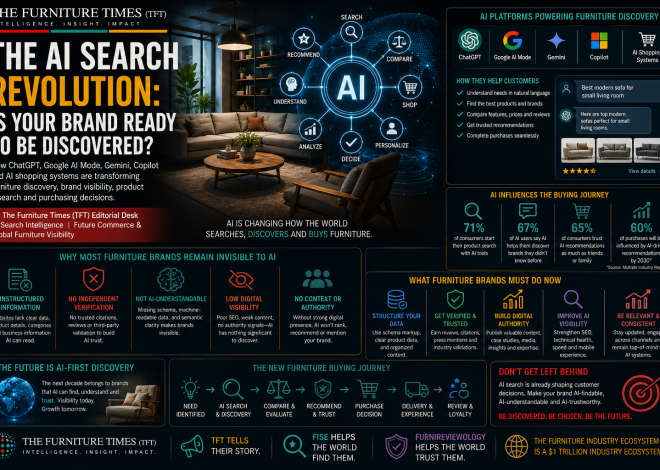
Customers are increasingly turning to ChatGPT, Google AI Mode, Gemini, Copilot and other AI-powered platforms to research products, compare suppliers and make purchasing decisions.
Instead of searching for “office furniture manufacturer,” a buyer can ask:
“Which office furniture manufacturers in Southeast Asia can supply ergonomic workstations for 500 employees, provide customized finishes, meet sustainability requirements and complete installation within four months?”
An AI system may interpret the request, perform several related searches, compare available information and return a limited shortlist.
The buyer may never see hundreds of capable manufacturers because they were not included in the AI-generated answer.
The most important visibility question is therefore changing.
It is no longer only:
“Does our website appear in search results?”
It is:
“Can AI find, understand and confidently mention our brand when a buyer asks?”
Search Is Changing From a Directory Into an Adviser
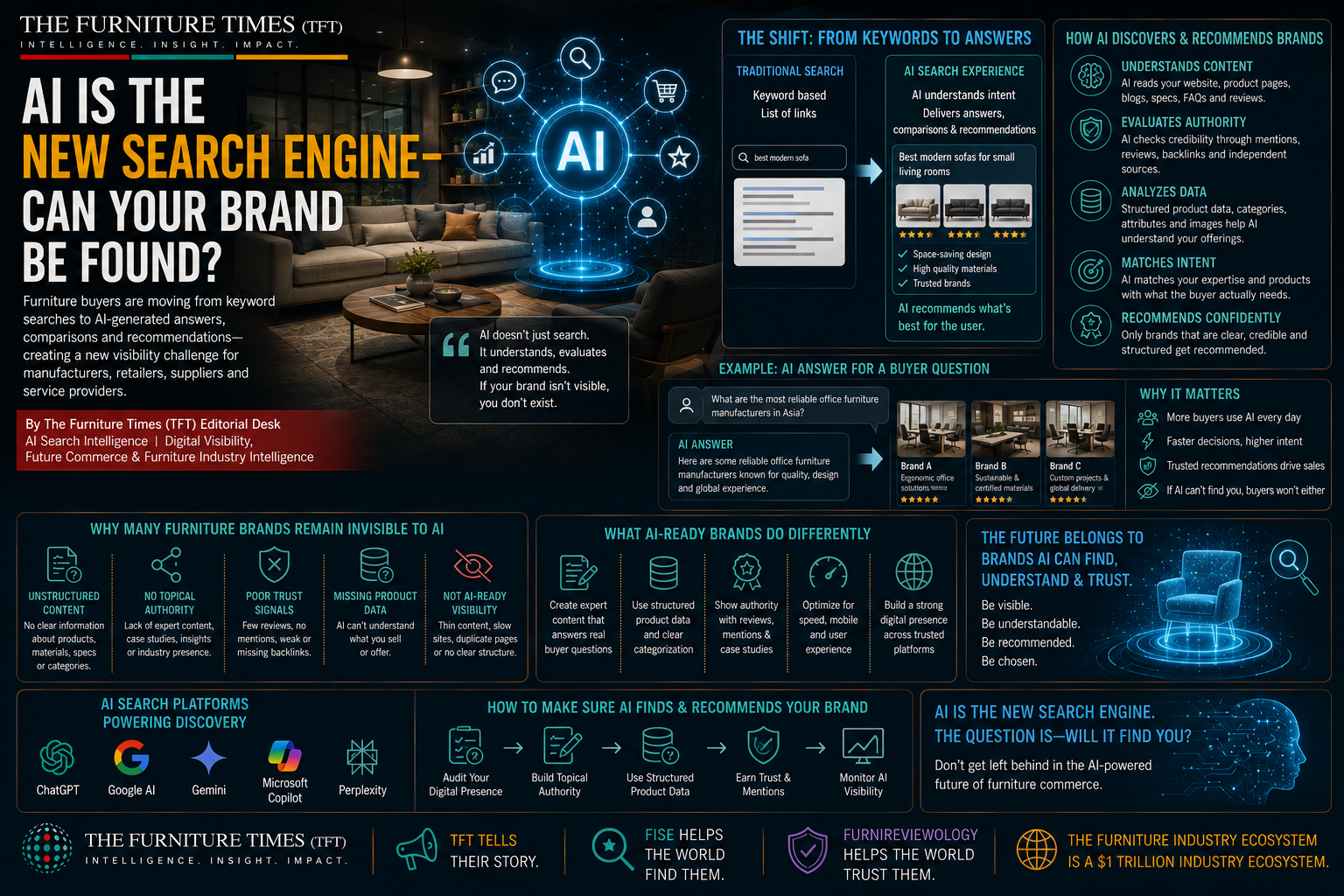
Traditional search engines usually present links. Users open those links and conduct their own research.
AI search can do more of the initial work.
It may:
- Interpret the user’s intention
- Ask clarifying questions
- Search several related topics
- Compare products and companies
- Summarize advantages and limitations
- Provide citations
- Suggest suitable options
- Continue the conversation
- Help the user move toward a decision
This means AI is not merely another website where businesses can advertise. It is becoming an intermediary that helps customers decide what deserves attention.
For furniture brands, this represents both an opportunity and a risk.
A smaller specialist company can become visible when its capabilities closely match a detailed request. But an established company can disappear if its public information is incomplete, confusing, inaccessible or unsupported.
The New Furniture Discovery Journey
A traditional furniture buyer might have completed the following journey:
- Search a keyword on Google.
- Open several websites.
- Review products and catalogues.
- Read customer reviews.
- Compare prices and specifications.
- Contact selected businesses.
- Visit a showroom or request samples.
- Make a purchasing decision.
The emerging AI-assisted journey can be much shorter:
- Describe a requirement conversationally.
- Allow AI to identify relevant considerations.
- Receive a comparison of products or suppliers.
- Ask follow-up questions.
- Visit only the shortlisted brands.
- Contact, visit or purchase.
The AI-generated shortlist can determine which companies receive the opportunity to compete.
A brand that is absent from that shortlist may never receive an enquiry, quotation request or rejection. It simply remains unseen.
AI Search Does Not Eliminate Google
Saying that AI is the new search engine does not mean conventional search has become irrelevant.
Google states that established SEO best practices remain relevant to AI Overviews and AI Mode. Its generative search features use Google’s search index and quality systems, meaning that pages still need to be accessible, crawlable and eligible for indexing.
Google also describes a process called “query fan-out.” When a user asks a complex question, the system may generate several related searches to gather the necessary information.
For example, a buyer asking for sustainable hotel furniture might indirectly trigger searches concerning:
- Certified timber
- Low-emission finishes
- Commercial durability
- Fire-performance requirements
- Product warranties
- Factory locations
- Project experience
- Installation capability
- Delivery schedules
- Customer reviews
The brand needs enough relevant information across these areas to become a credible candidate.
Google’s official generative AI optimization guidance confirms that technical SEO, useful content and accurate information remain foundational.
AI search is therefore an evolution of search—not its complete replacement.
AI Search Is Already Becoming AI Commerce
Artificial-intelligence platforms are expanding from information discovery into product research and purchasing.
OpenAI has introduced shopping experiences that allow users to describe what they need, compare products and examine information such as features, prices and reviews. It has also developed structured product-feed systems through which participating merchants can provide current catalogue data.
According to OpenAI’s product-discovery guidance, conversational shopping can reduce the need to search through multiple websites and tabs.
Its product-feed documentation explains that structured catalogue information can help ChatGPT display current product prices and availability.
For furniture companies, this development is significant because furniture decisions require detailed information.
AI-assisted commerce may evaluate:
- Dimensions
- Materials
- Configuration
- Color and finish
- Indoor or outdoor suitability
- Comfort
- Durability
- Price
- Availability
- Lead time
- Delivery
- Assembly
- Warranty
- Reviews
- Return conditions
A company without organized product data may be poorly prepared for this new environment.
Can AI Find Your Website?
The first stage of visibility is technical access.
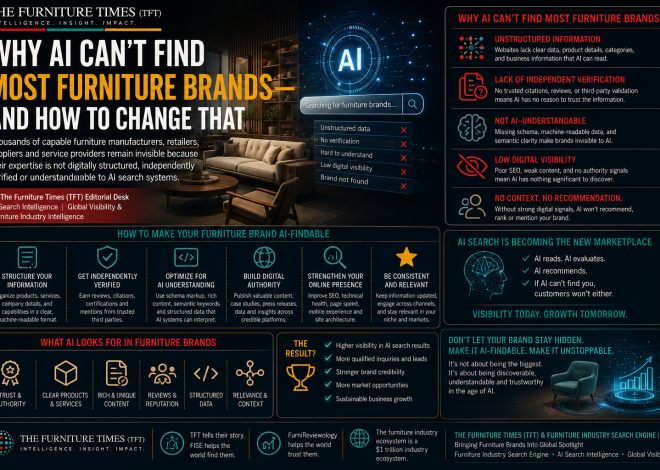
Search and AI platforms use automated crawlers to discover public information. Incorrect website settings can prevent those crawlers from reaching important pages.
Common problems include:
- AI or search crawlers blocked in
robots.txt - Important pages marked
noindex - Firewall restrictions
- Broken internal links
- Missing XML sitemaps
- Unstable hosting
- Server errors
- Slow mobile performance
- Content hidden behind login screens
- Product information rendered incorrectly
- Incorrect canonical tags
OpenAI states that OAI-SearchBot helps surface websites in ChatGPT search. If a website blocks this crawler, its content will not be shown as a cited ChatGPT search result, although the brand may still appear as a navigational reference in some circumstances.
OpenAI’s crawler documentation provides the relevant technical information.
What companies should do
Ask a qualified website professional to review:
- Crawler access
- Robots rules
- Indexing directives
- XML sitemaps
- Server response codes
- Firewall configuration
- Search Console coverage
- Mobile performance
- Internal links
- Page rendering
Public business information should be accessible while confidential data remains protected.
Can AI Understand Your Company?
A website may be accessible without clearly explaining the business.
Many furniture-company websites rely on statements such as:
- “Quality furniture for modern living.”
- “Your trusted interior partner.”
- “Innovation meets design.”
- “Creating comfort for every space.”
These messages may support branding, but they do not communicate enough factual information.
An AI system needs to determine:
- Is the company a manufacturer, retailer, wholesaler or designer?
- Where is it located?
- What does it specialize in?
- Does it serve residential or commercial customers?
- Does it export?
- Can it customize products?
- What materials does it use?
- Which markets does it serve?
- What evidence supports its claims?
A clearer description might say:
“A Malaysian manufacturer of customized aluminum and teak outdoor furniture for residential, hospitality and commercial projects.”
This identifies the location, business type, materials, category, customer segments and customization capability.
Facts make the brand understandable.
Furniture Companies Have an Identity-Consistency Problem
Many furniture businesses use several versions of their names.
A company may have:
- A legal company name
- A commercial brand
- An abbreviated name
- A social-media name
- An old trading name
- A different exhibition name
- Separate product brands
This can make it difficult for AI systems to determine whether multiple references relate to one business.
Confusion is especially likely when the brand name contains common words such as “living,” “home,” “comfort,” “interiors” or “modern.”
Create an official brand-facts record
The record should contain:
- Official brand name
- Legal company name
- Former names
- Website
- Headquarters
- Factory locations
- Showroom locations
- Year established
- Business category
- Product categories
- Markets served
- Certifications
- Official contact information
- Social profiles
- Approved company description
Use this information consistently across websites, directories, exhibition profiles, media coverage and marketplace accounts.
Attractive Images Are Not Enough
Furniture is a highly visual product category, so manufacturers and retailers naturally invest in photography.
However, an AI system cannot reliably determine product specifications from an image.
A photograph may show a sofa, but it cannot confirm:
- Dimensions
- Frame construction
- Fabric composition
- Foam density
- Seating capacity
- Modular options
- Warranty
- Availability
- Delivery coverage
- Care requirements
A gallery containing hundreds of photographs may look impressive while providing very little searchable information.
Every priority product should have a detailed webpage.
What an AI-Ready Product Page Should Include
A strong furniture-product page should contain:
- Product name
- Model number or SKU
- Furniture category
- Detailed description
- Intended use
- Dimensions
- Materials
- Construction
- Finish options
- Colors or fabrics
- Indoor or outdoor suitability
- Weight or capacity where relevant
- Assembly requirements
- Care instructions
- Warranty
- Availability
- Lead time
- Delivery regions
- Return conditions
- Original images
This information benefits customers, search engines, sales teams, marketplaces and future AI-commerce systems.
PDFs Should Support the Website, Not Replace It
PDF catalogues remain valuable for dealers, project buyers and sales teams.
However, a business that publishes all its product information in one catalogue may make individual products harder to discover and compare.
Important information should also exist as searchable webpages.
The preferred structure is:
- Website category pages for broad product groups
- Individual webpages for important products
- Technical pages for capabilities and materials
- Downloadable PDFs for complete collection browsing
This gives customers flexibility while creating better information access.
Category Authority Determines When a Brand Is Relevant
AI systems respond to the customer’s specific situation.
A manufacturer may not be relevant to a broad question about “furniture companies,” but it could be highly relevant to:
- Hotel headboard manufacturers
- Outdoor teak furniture exporters
- Custom school-furniture suppliers
- Office workstation producers
- Brass furniture-hardware companies
- Sofa repair specialists
- Restaurant banquette manufacturers
- Mattress suppliers for hospitality projects
Furniture businesses should create detailed pages for their genuine areas of specialization.
A category page should explain:
- Products offered
- Materials
- Manufacturing processes
- Customization
- Quality standards
- Applications
- Customer segments
- Project experience
- Delivery coverage
- Frequently asked questions
The objective is to demonstrate expertise rather than merely repeat keywords.
AI Recommendation Requires Independent Evidence
A company’s website is a self-controlled source.
Any company can claim to be:
- Leading
- Reliable
- Sustainable
- International
- Innovative
- Premium
- Award-winning
AI systems and customers may look for independent evidence.
Evidence can come from:
- Industry publications
- News coverage
- Trade associations
- Exhibition organizers
- Certification bodies
- Verified business directories
- Distributors
- Project partners
- Authentic reviews
- Research references
- Expert videos
A 2025 Ahrefs study examining approximately 75,000 brands found that branded web mentions had the strongest reported correlation with visibility in Google AI Overviews among the factors analyzed.
The study reported a correlation of 0.664 for branded web mentions, compared with 0.218 for raw backlink volume. It also found that 26% of the brands studied had no AI Overview mentions.
Ahrefs emphasized that correlation does not prove causation. These figures should not be interpreted as an official ranking formula. They nevertheless suggest that a brand’s broader online presence matters.
Public Relations Is Becoming Discovery Infrastructure
Furniture companies often make important investments without creating a permanent public record.
A manufacturer may install new machinery, complete a hotel project, gain a certification or enter an export market—yet publish nothing beyond a temporary social-media post.
Professional news coverage can document:
- Factory expansion
- Machinery investment
- Product launches
- Exhibition participation
- Certifications
- Sustainability programs
- Strategic partnerships
- Major projects
- Export achievements
- Technology adoption
- Workforce development
- Design collaborations
This coverage helps customers understand the company and creates additional sources through which AI systems may encounter it.
Public relations should be accurate, transparent and based on real developments—not exaggerated promotional claims.
Reviews Are the Trust Layer of AI Discovery
Discovery helps a buyer find a business. Trust determines whether the buyer continues.
Furniture-specific reviews may provide evidence about:
- Product quality
- Comfort
- Material accuracy
- Delivery
- Assembly
- Installation
- Customer support
- Warranty response
- Long-term durability
- Value
A detailed authentic review provides more useful information than a generic star rating.
Companies should never purchase or fabricate reviews. Fake feedback can damage credibility and violate platform policies.
FurniReviewology can support the furniture industry by creating a more relevant framework for review, reputation and trust.
Structured Data Helps Machines Interpret Information
Structured data is machine-readable markup that helps search systems interpret a webpage.
Relevant schema types for furniture businesses may include:
- Organization
- LocalBusiness
- Product
- Offer
- Article
- BreadcrumbList
- Event
- JobPosting
- VideoObject
- Person
Structured data does not guarantee an AI citation or recommendation. Google also states that no special AI-only schema is required for AI Overviews or AI Mode.
The information in structured data must match what customers can see on the page. It should never be used to hide unsupported claims, fake ratings or unavailable offers.
Video Is Becoming a Discovery Asset
Furniture benefits strongly from video because customers want to see scale, movement, materials, mechanisms and craftsmanship.
Useful video topics include:
- Factory tours
- Product demonstrations
- Furniture assembly
- Mechanism testing
- Material comparisons
- Quality-control procedures
- Project installations
- Maintenance advice
- Designer explanations
- Repair and refurbishment
Videos should use accurate titles and descriptions.
“Watch Our New Video” provides little meaning.
“How Our Malaysian Factory Manufactures Aluminum Outdoor Furniture for Resort Projects” creates clear context.
Research published by Ahrefs in 2026 reported that YouTube mentions correlated strongly with AI brand visibility across the brands examined. This does not establish a universal ranking factor, but it reinforces the strategic value of useful video coverage.
AI Search Gives Furniture SMEs a New Opportunity
Traditional search can favor established websites with large content and link profiles.
Conversational AI can create opportunities for specialized SMEs because customers can ask highly specific questions.
A small company may become relevant for:
- Small-batch custom furniture
- Tropical outdoor products
- Heritage furniture restoration
- Specialized hardware
- Regional installation
- Bespoke hospitality pieces
- Local repair services
- Low-minimum-order production
The SME does not need to become the most visible furniture company in the world.
It needs to become one of the clearest and most credible answers within its genuine specialization.
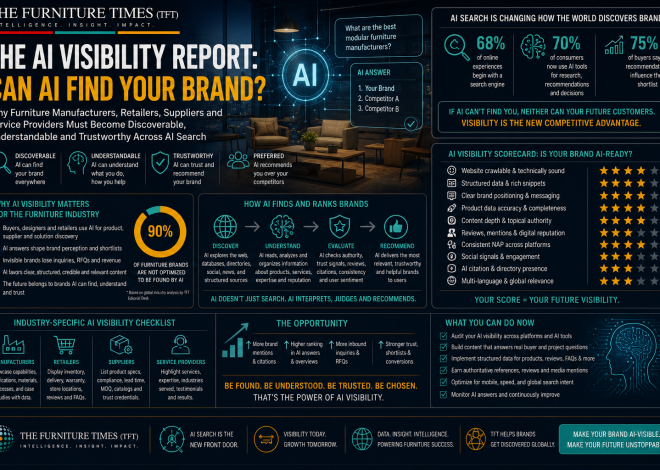
AI Search Readiness Scorecard
Furniture businesses can use the following framework for an initial assessment.
| Readiness category | Points |
|---|---|
| Technical accessibility and indexing | 15 |
| Brand identity and consistency | 15 |
| Product and category information | 15 |
| Original expertise and content | 15 |
| Independent authority and coverage | 15 |
| Reviews and trust evidence | 10 |
| Structured data and product feeds | 10 |
| Measurement and internal responsibility | 5 |
| Total | 100 |
Score interpretation
| Score | AI visibility position |
|---|---|
| 0–20 | Functionally invisible |
| 21–40 | Findable but poorly understood |
| 41–60 | Understood but weakly supported |
| 61–80 | Strong visibility foundation |
| 81–100 | Advanced and actively managed |
This is a TFT editorial framework, not an official score used by an AI platform.
The 30-Point AI Discoverability Checklist
Technical discovery
- Website loads reliably.
- Public pages are crawlable.
- Important pages are indexed.
- XML sitemap is current.
- Internal links function correctly.
- Mobile pages work properly.
Brand understanding
- Company name is consistent.
- Legal and commercial names are connected.
- Business type is clearly stated.
- Locations are accurate.
- Product categories are defined.
- Markets served are explained.
Product information
- Priority products have dedicated pages.
- Dimensions are published.
- Materials are identified.
- Availability is current.
- Warranty terms are visible.
- Delivery information is clear.
Authority
- Credible publications mention the business.
- Exhibition profiles are current.
- Certifications can be verified.
- Project case studies are available.
- Technical expertise is published.
- Useful videos exist.
Trust and measurement
- Customer reviews are authentic.
- Complaints receive professional responses.
- Appropriate structured data is implemented.
- Product data is ready for feeds.
- AI visibility is tested regularly.
- Someone owns the improvement process.
How to Test Whether AI Can Find Your Brand
Searching only for the business name tests recognition—not commercial discovery.
Use several types of prompts.
Recognition prompts
- What is [Brand Name]?
- Where is it located?
- What products does it offer?
Category prompts
- Who manufactures in [country]?
- Which companies supply for hotels?
- What brands specialize in [material or capability]?

Trust prompts
- Is [Brand Name] reliable?
- What reviews are available?
- What evidence supports its sustainability claims?
Comparison prompts
- Compare [Brand Name] with [Competitor].
- Which company is better suited to [specific project]?
- What are the strengths and limitations of each supplier?
Record the platform, prompt, date, answer, sources and inaccuracies.
AI responses can change. One test is not a complete audit.
A 90-Day AI Search Action Plan
Days 1–30: Become findable
- Audit crawler access.
- Fix indexing problems.
- Update the XML sitemap.
- Repair broken pages.
- Improve mobile performance.
- Establish baseline AI tests.
Days 31–60: Become understandable
- Standardize company information.
- Rewrite the About page.
- Create category pages.
- Improve priority product pages.
- Publish warranty and delivery information.
- Add relevant structured data.
Days 61–90: Build recommendation evidence
- Publish project case studies.
- Create technical content.
- Produce useful videos.
- Seek credible media coverage.
- Update industry listings.
- Collect authentic reviews.
- Correct outdated third-party information.
- Begin measuring AI mentions and citations.
What Furniture Brands Should Not Do
The search for AI visibility will attract shortcuts and unsupported claims.
Avoid:
- Fake reviews
- Fabricated awards
- False certifications
- Paid articles disguised as independent reporting
- Hidden structured-data claims
- Automated forum spam
- Copied product descriptions
- Hundreds of low-value AI-generated pages
- Inauthentic brand mentions
- Unsupported “best company” claims
- Outdated stock information
- Guaranteed AI-ranking services
Google warns that using generative AI to create large numbers of pages without adding meaningful value may violate its spam policies.
The purpose of AI optimization should be to communicate genuine expertise more clearly—not manufacture authority that does not exist.
Measuring Visibility Beyond Rankings
A modern brand-visibility dashboard should include:
- Traditional search rankings
- Search impressions
- AI-generated mentions
- Citation rate
- Recommendation rate
- Accuracy rate
- Competitive share of voice
- Sentiment
- Product visibility
- Review growth
- AI referral traffic
- AI-assisted enquiries
- Commercial conversion
A company may receive fewer low-intent clicks but more qualified enquiries from buyers who have already completed initial research through AI.
Traffic alone cannot explain the full value of the new discovery journey.
The Role of TFT, FISE and FurniReviewology
The furniture ecosystem requires three connected visibility layers.
The Furniture Times (TFT) documents businesses, products, people, innovations, markets and achievements.
Furniture Industry Search Engine (FISE) organizes manufacturers, retailers, suppliers and service providers into furniture-specific categories so they can be discovered.
FurniReviewology helps customers evaluate reputation, experience and trust.
Together, these platforms address the complete journey:
- TFT tells the story.
- FISE helps the world find it.
- FurniReviewology helps customers trust it.
This infrastructure is particularly important for furniture SMEs whose production capabilities are stronger than their current digital presence.
Final Analysis: The Invisible Brand Cannot Become the Recommended Brand
Artificial intelligence is not replacing every search engine, showroom, exhibition or business relationship.
It is becoming the first research layer through which customers decide what deserves further attention.
A buyer may consult AI before:
- Visiting a showroom
- Contacting a manufacturer
- Attending an exhibition
- Requesting a quotation
- Selecting a project supplier
- Purchasing a product
The brand may therefore be evaluated before it knows the customer exists.
Furniture companies must ensure that AI systems can access clear, accurate and credible information about them.
They must become:
- Findable
- Understandable
- Relevant
- Verifiable
- Current
- Trustworthy
The future will not necessarily belong only to the largest furniture companies.
It can also belong to specialized businesses that make their expertise easy to discover and difficult to misunderstand.
AI is becoming the new search engine.
The question every furniture business must now answer is:
Can your brand be found when the future customer asks?
Editorial note: AI-generated responses vary by platform, model, prompt, date, language, location and available sources. No SEO, AEO or GEO method can guarantee a mention, citation or recommendation. Research findings discussed here identify observed correlations rather than confirmed universal ranking factors.
Reference sources: Google’s generative AI optimization guidance, Google’s AI features documentation, OpenAI crawler documentation, OpenAI product discovery, OpenAI product-feed documentation, and Ahrefs’ 75,000-brand study.
The Furniture Times (TFT) & Furniture Industry Search Engine (FISE)
“TFT tells their story. FISE helps the world find them.”
FurniReviewology helps the world trust them.
The furniture industry ecosystem is a $1 trillion industry ecosystem.