
Why You Should Not Miss the Opportunity to Join the World’s Largest Furniture Industry Ecosystem
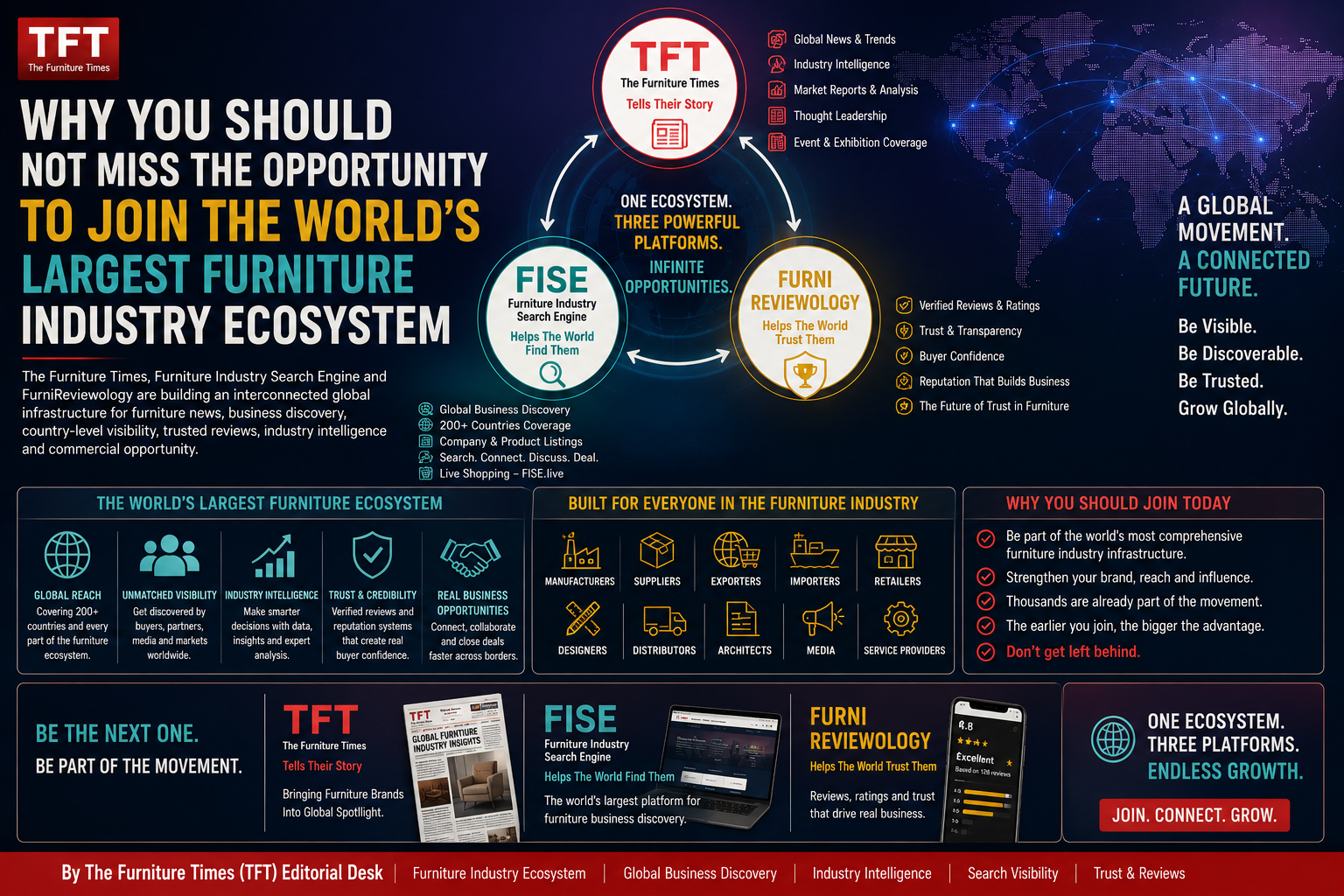
The Furniture Times, Furniture Industry Search Engine and FurniReviewology are building an interconnected global infrastructure for furniture news, business discovery, country-level visibility, trusted reviews, industry intelligence and commercial opportunity
By The Furniture Times (TFT) Editorial Desk | Furniture Industry Ecosystem | Global Business Discovery | Industry Intelligence | Search Visibility | Trust & Reviews
The global furniture industry is enormous, but it remains deeply fragmented.
Manufacturers struggle to find qualified buyers. Retailers cannot always identify the right suppliers. Designers search across disconnected websites for materials and products. Project developers depend on personal networks. Component producers remain unknown outside their local markets. Skilled artisans create remarkable work but often lack the resources to promote it nationally—much less internationally.
At the same time, buyers, consumers and procurement professionals face another problem: even when they find a company, they may not have enough reliable information to understand or trust it.
This fragmentation affects almost every participant in the furniture economy:
- Furniture manufacturers
- Component and hardware suppliers
- Raw-material producers
- Wholesalers and distributors
- Retailers and showrooms
- Designers and architects
- Interior contractors
- Machinery companies
- Testing laboratories
- Certification bodies
- Logistics providers
- Installers
- Repair specialists
- Artisans
- Upholsterers
- Technology providers
- Commercial buyers
- Consumers
The industry does not lack talent, products, companies or opportunities. It lacks a unified infrastructure that can connect the dots.
That is the opportunity being created through three interconnected platforms:
- The Furniture Times (TFT) — the global storytelling, news and industry-intelligence layer.
- Furniture Industry Search Engine (FISE) — the global search, listing and business-discovery layer.
- FurniReviewology — the review, reputation and trust layer.
Together, these platforms are being developed to create a new operating environment for the global furniture ecosystem—one in which businesses can be seen, found, understood, connected and trusted.
The opportunity is not simply to join another directory or appear in another publication. It is to become part of a larger movement seeking to organise and connect a $1 trillion furniture industry ecosystem.
The furniture industry is much larger than furniture manufacturing
The word “furniture” is often used to describe finished products such as chairs, sofas, tables, beds and cabinets.
But the real furniture economy is far more extensive.
Before a finished product reaches a customer, it may depend on:
- Timber and forestry
- Metals and aluminium
- Glass
- Plastics and polymers
- Textiles
- Leather
- Foams and fillings
- Adhesives
- Coatings and finishes
- Hardware and mechanisms
- Cutting tools
- Machinery
- Software
- Packaging
- Testing
- Certification
- Warehousing
- Transport
- Installation
- Retail
- Marketing
- Financing
- Maintenance
- Repair
- Resale
- Recycling
The ecosystem also serves multiple markets:
- Residential furniture
- Office furniture
- Hospitality furniture
- Restaurant and café furniture
- Healthcare furniture
- Educational furniture
- Institutional furniture
- Outdoor furniture
- Public-space furniture
- Marine furniture
- Aviation interiors
- Retail fixtures
- Exhibition furniture
- Smart furniture
- Custom furniture
- Children’s furniture
- Heritage and antique furniture
This is why the furniture industry should not be treated as a narrow manufacturing category.
It is a global network of industries, professions, services, technologies, materials and commercial relationships. The scale and diversity of that network create an urgent need for specialised media, search and trust infrastructure.
The problem: the industry remains digitally invisible
Thousands of capable furniture businesses remain difficult to find online.
Some operate without modern websites. Others have websites containing incomplete information. Many rely almost entirely on social-media pages, trade fairs, personal contacts or messaging applications.
Even companies with strong factories may have:
- Outdated profiles
- Incomplete product information
- Poor search visibility
- No published company history
- Limited international coverage
- Few credible reviews
- No structured catalogue
- No visible certifications
- No consistent brand description
- No industry classification
This creates a dangerous gap between capability and visibility.
A manufacturer may produce excellent furniture but receive few international enquiries because buyers do not know it exists. An artisan may possess generations of skill but remain invisible outside a local community. A component supplier may solve an important manufacturing problem but never reach the factories that need its product.
In the emerging digital economy, capability without discoverability is commercially weak.
If you are not searchable, you do not exist in the customer’s decision process.
The Furniture Times: telling the stories the industry has overlooked
The Furniture Times is being developed as a global news, media and industry-intelligence platform covering the complete furniture ecosystem.
Its purpose extends beyond publishing product announcements or exhibition news.
TFT examines the forces shaping the industry, including:
- Global furniture markets
- Manufacturing
- Retail
- E-commerce
- Artificial intelligence
- Search visibility
- Furniture compliance
- BIS certification
- International standards
- Components and accessories
- Supply chains
- Logistics
- Sustainability
- Circular economy
- Workforce development
- Furniture tourism
- Design
- Technology
- Business closures
- Industry recoveries
- Trade policy
- Consumer behaviour
- Customer experience
- Company leadership
- SME development
- Regional industries
- Artisan communities
Every participant has a story
A small workshop has a story.
A component manufacturer has a story.
A furniture-testing laboratory has a story.
A century-old retailer has a story.
A designer using recovered materials has a story.
A factory introducing automation has a story.
A logistics provider solving damage and delivery problems has a story.
The problem is that many of these stories are never documented.
Without documentation, the wider industry cannot learn from them. Buyers cannot discover them. Search engines cannot understand them. AI systems cannot reference them. Future generations may never know they existed.
TFT seeks to bring these businesses, people and ideas into the global spotlight.
Industry intelligence that connects the dots
TFT is not intended to cover each news item in isolation. Its broader role is to connect developments across the ecosystem.
For example, a change in European demand for mixed-material outdoor furniture affects:
- Timber suppliers
- Metal-frame producers
- Textile companies
- Foam manufacturers
- Hardware suppliers
- Designers
- Testing laboratories
- Exporters
- Retailers
- Logistics providers
A new furniture safety regulation affects:
- Product design
- Factory quality control
- Laboratory testing
- Importers
- Online marketplaces
- Retailers
- Insurers
- Consumers
By connecting these relationships, TFT can help the industry understand not only what happened but also why it matters and who may be affected next.
Furniture Industry Search Engine: organising the global ecosystem
The internet contains an enormous amount of furniture-related information, but it is scattered across search engines, directories, social platforms, marketplaces, association websites and individual company pages.
General search engines serve every industry simultaneously. They are not designed exclusively around the structure and terminology of the furniture economy.
Furniture Industry Search Engine is being built to address this problem.
FISE aims to make the complete furniture ecosystem searchable through specialised categories, locations, business types, products, services and capabilities.
It can help users search for:
- Furniture manufacturers
- Suppliers
- Exporters
- Importers
- Distributors
- Retailers
- Designers
- Architects
- Artisans
- Machinery companies
- Hardware suppliers
- Textile suppliers
- Foam manufacturers
- Timber businesses
- Testing laboratories
- Certification consultants
- Logistics providers
- Installers
- Repair services
- Trade associations
- Exhibitions
- Industry professionals
Around 200 country ecosystems
FISE is organising furniture-industry participation across approximately 200 countries and territories.
This country-by-country approach is strategically important because every country has its own furniture identity.
Afghanistan has artisans, woodworkers, traders and local furniture businesses.
Bhutan has a developing furniture economy connected to timber, craftsmanship, hospitality, education and institutional demand.
China has one of the world’s largest furniture-manufacturing and component infrastructures.
Germany has advanced machinery, engineering, office systems and manufacturing technology.
India has enormous domestic demand, extensive manufacturing clusters, artisans, retailers, designers and a rapidly developing compliance environment.
Indonesia has internationally recognised furniture clusters and carving traditions.
Italy is globally associated with design, craftsmanship, machinery and luxury furniture.
Malaysia has established furniture manufacturing, export capabilities, rubberwood expertise and the Muar furniture cluster.
Türkiye connects European, Asian and Middle Eastern furniture markets.
The United States combines major retail demand, manufacturing, design, logistics, trade events and digital commerce.
Every national ecosystem deserves to be identified, documented and connected.
Country-level visibility creates local opportunity
A country-specific furniture search engine can help:
- International buyers find national suppliers
- Local retailers identify manufacturers
- Artisans reach customers beyond their communities
- Governments understand the scale of the sector
- Associations connect their members
- Investors discover clusters
- Students identify training and employment
- Suppliers enter new regional markets
- Project developers find qualified partners
- Tourism agencies promote furniture cities and craft traditions
The objective is not merely to list famous brands. It is to bring visibility to the entire ecosystem—including businesses that cannot afford expensive international promotion.
Giving a fair opportunity to small businesses and artisans
The furniture industry contains some of the world’s most skilled craftspeople, but many remain excluded from digital opportunity.
An artisan may understand wood better than a large marketing team. A small upholsterer may produce exceptional work. A family-owned workshop may have served its region for several generations.
Yet these businesses can remain almost invisible because they lack:
- Marketing budgets
- Professional photography
- SEO knowledge
- International contacts
- English-language content
- Trade-fair access
- Digital catalogues
- Public-relations support
FISE can create a more inclusive discovery environment by giving every legitimate participant an opportunity to become listed and searchable.
A small business should not need the advertising budget of a multinational corporation merely to be found.
Listings are the new storefronts. Search is the new marketplace.
From search to connection
Finding a company is only the beginning.
The wider vision for FISE includes creating an environment in which the industry can:
- Search
- Discover
- Connect
- Discuss
- Exchange requirements
- Request quotations
- Identify suppliers
- Explore opportunities
- Develop partnerships
- Build trade relationships
- Find specialists
- Promote projects
This idea is reflected in the direction of FISE Connect:
Search. Connect. Discuss. Deal.
A search engine becomes far more valuable when discovery can lead to a meaningful commercial relationship.
A hotel developer should be able to find hospitality-furniture suppliers. A manufacturer should be able to locate hardware producers. A retailer should be able to identify new brands. A designer should be able to discover materials and components. An artisan should be able to connect with customers or collaborators.
FurniReviewology: building the missing layer of trust
Discovery without trust is incomplete.
A buyer may find a company through FISE, but important questions remain:
- Is the company reliable?
- Does it deliver on time?
- Are its product descriptions accurate?
- Does it respond to complaints?
- Are its products durable?
- Does it honour warranties?
- Are customers satisfied?
- Does it communicate professionally?
- Does it have experience in the claimed market?
- Can its credentials be verified?
FurniReviewology is being developed as the trust and review layer of the connected ecosystem.
Its role is not simply to collect star ratings. It is to help create a more meaningful understanding of business reputation, customer experience and operational reliability.
Beyond the five-star rating
A single rating cannot explain the complete customer experience.
Useful review intelligence may examine:
- Product quality
- Design accuracy
- Material quality
- Comfort
- Durability
- Delivery
- Installation
- Packaging
- Communication
- Warranty service
- Complaint resolution
- Value
- Repeat-purchase intention
For business-to-business relationships, trust may also involve:
- Specification accuracy
- Production consistency
- Documentation
- Compliance
- Sample performance
- Project coordination
- Delivery reliability
- After-sales support
FurniReviewology can help transform scattered opinions into a more structured trust signal.
Trust labels must be earned
The idea of a FurniReviewology trust label carries significant responsibility.
A trust label should not be treated as decoration or as something that can simply be purchased. It should represent credible evidence and transparent criteria.
Depending on the future assessment model, trust indicators may consider:
- Verified business identity
- Profile completeness
- Customer feedback
- Responsiveness
- Complaint handling
- Business documentation
- Operating history
- Certifications
- Product information
- Review authenticity
The methodology should distinguish clearly between:
- Verified facts
- Customer opinions
- Self-declared information
- Independent assessments
- Paid promotional content
Trust becomes meaningful when users understand what the label represents.
The three-layer infrastructure
The relationship among TFT, FISE and FurniReviewology can be understood as a connected journey:
| Platform | Primary role | Value to the ecosystem |
|---|---|---|
| The Furniture Times | Storytelling, news and intelligence | Explains companies, people, markets and developments |
| Furniture Industry Search Engine | Search, listings and discovery | Helps users find businesses, products, services and opportunities |
| FurniReviewology | Reviews, reputation and trust | Helps users evaluate credibility and customer experience |
The model can be expressed in three simple lines:
TFT tells their story.
FISE helps the world find them.
FurniReviewology helps the world trust them.
A business needs all three.
A story without discovery may remain unread.
Discovery without trust may not produce a transaction.
Trust without sufficient information may be difficult to establish.
Together, the three layers can guide a user from awareness to consideration and from consideration to confidence.
Building many more verticals for the furniture economy
TFT, FISE and FurniReviewology represent the foundation, but the wider vision extends into additional furniture-industry verticals.
The ecosystem can support specialised platforms and services around:
- Live commerce
- Business networking
- Classifieds
- Jobs
- Training
- Events
- Exhibitions
- Supplier discovery
- Requests for quotation
- Product data
- Market intelligence
- Furniture tourism
- Circular furniture
- Second-hand furniture
- Compliance
- Testing
- Certifications
- Logistics
- Components
- Materials
- Machinery
- Design
- Reviews
- Industry research
- AI visibility
- Digital product identities
These verticals can help turn a collection of listings and articles into an operating infrastructure for the industry.
FISE.live and the future of live furniture commerce
Live shopping can connect manufacturers, retailers, designers and customers through real-time product presentations.
Furniture companies could use live commerce to:
- Launch products
- Demonstrate mechanisms
- Explain materials
- Show dimensions
- Answer questions
- Present showroom stock
- Promote clearance products
- Introduce artisan work
- Conduct factory tours
- Discuss customisation
Furniture is a highly visual and explanatory product category. Live interaction can reduce the gap between digital browsing and physical showroom engagement.
Classifieds and opportunity discovery
A furniture-industry classifieds layer could support:
- Stock clearance
- Machinery sales
- Raw-material availability
- Factory equipment
- Commercial furniture
- Project opportunities
- Distribution requirements
- Business partnerships
- Used furniture
- Surplus components
- Employment
- Warehouse availability
A specialised platform can provide greater relevance than a general classifieds website.
Jobs and workforce visibility
The ecosystem can connect employers with:
- Designers
- Upholsterers
- Carpenters
- CNC operators
- Production managers
- Sales professionals
- Installers
- Quality-control specialists
- Compliance experts
- Digital marketers
- E-commerce professionals
- Logistics coordinators
The furniture industry needs a stronger system for attracting, identifying and developing talent.
Compliance and certification intelligence
Furniture regulations are becoming more complex.
Manufacturers need access to information and specialists concerning:
- BIS certification
- Structural testing
- Stability
- Fire safety
- Chemical emissions
- Labelling
- Product traceability
- Timber legality
- Factory inspections
- International market access
A searchable compliance ecosystem can help companies identify laboratories, consultants, standards and testing services.
Why early participation matters
Platforms become more influential as their networks grow.
Early participants can gain several advantages:
Earlier visibility
Businesses listed sooner have more time to build profile history, content and industry recognition.
Category positioning
Early companies can become strongly associated with their products, services, locations or areas of expertise.
Data development
Businesses can improve their profiles, classifications and product information before the ecosystem becomes more competitive.
Thought leadership
Companies contributing insights and news can help shape conversations within their category.
Relationship building
Early participation creates more time to connect with suppliers, buyers, partners and professionals.
Adaptation to AI search
As conversational and AI-assisted discovery expands, companies with organised public information may be easier for digital systems to identify and understand.
Being early does not guarantee commercial success. It provides the opportunity to establish a stronger foundation before competitors become more active.
Why this opportunity should not be missed
The global furniture industry is moving from fragmented visibility toward connected intelligence.
Tomorrow’s buyer may not begin with a trade fair or a printed directory. The buyer may ask an AI assistant:
- Find outdoor furniture manufacturers in Malaysia.
- Compare office-chair suppliers in India.
- Identify sustainable hotel-furniture companies.
- Show trusted furniture retailers in my country.
- Find testing laboratories for commercial chairs.
- Locate furniture hardware manufacturers.
- Recommend reliable custom furniture suppliers.
- Find artisans specialising in traditional woodwork.
The companies returned in those answers will have an advantage.
The companies missing from the information ecosystem may never enter the buyer’s consideration.
Participation is therefore not simply about advertising. It is about establishing a discoverable identity within the next generation of furniture search and intelligence.
What businesses should prepare for their FISE presence
A company should prepare accurate information including:
- Official business name
- Country and city
- Website
- Contact information
- Business category
- Products and services
- Manufacturing capabilities
- Materials
- Markets served
- Export destinations
- Certifications
- Factory or showroom information
- Product photographs
- Catalogue
- Company history
- Leadership
- Customer segments
- Project experience
- Social profiles
- Delivery capabilities
- Warranty information
The information should be accurate, current and consistent across platforms.
Incomplete listings reduce discovery. Incorrect listings damage trust.
Who should become part of the movement?
The ecosystem is open in vision to the complete furniture economy:
- Global corporations
- Regional manufacturers
- SMEs
- Family businesses
- Startups
- Artisans
- Designers
- Retailers
- Suppliers
- Service providers
- Industry professionals
- Students
- Researchers
- Associations
- Government agencies
- Buyers
- Consumers
No participant is too large to benefit from stronger intelligence, and no legitimate participant should be considered too small to deserve visibility.
A call to governments, associations and industry clusters
National and regional organisations should recognise the value of mapping their furniture ecosystems.
Government departments, export agencies, trade bodies and associations can support:
- Business identification
- Cluster mapping
- Export promotion
- Artisan visibility
- Training
- Digital adoption
- Compliance awareness
- Market intelligence
- Investment attraction
- Furniture tourism
A country cannot develop an industry it cannot see clearly.
A structured furniture search ecosystem can help policymakers understand where businesses operate, what they produce, what support they need and where future opportunities exist.
A call to the global furniture industry
The furniture industry has operated in disconnected segments for too long.
Manufacturers need better access to buyers.
Buyers need better access to suppliers.
Consumers need reliable information.
Artisans need visibility.
Researchers need industry data.
Companies need news coverage.
Search systems need structured information.
The industry needs trust.
TFT, FISE and FurniReviewology are being built to address these connected requirements.
This is not only a platform-building project. It is an attempt to create a global movement around inclusion, visibility, intelligence and trust.
The future of the $1 trillion furniture industry ecosystem
The furniture industry ecosystem is a $1 trillion industry ecosystem.
Yet no single specialised infrastructure currently captures its full diversity across countries, categories and professions.
The opportunity is to build an ecosystem in which:
- Every country can be explored
- Every legitimate business can become searchable
- Every important story can be told
- Every user can evaluate trust
- Every category can be connected
- Every artisan can receive a fair opportunity
- Every buyer can discover more choices
- Every company can participate in global visibility
The work is ambitious because the industry itself is enormous.
But every large ecosystem begins with participation.
It begins when one manufacturer creates a listing.
It grows when one artisan shares a story.
It becomes useful when one buyer discovers a new supplier.
It becomes trusted when one customer provides an honest review.
It becomes global when countries, categories and communities connect.
Final message
The next generation of furniture commerce will be shaped by companies that are visible, searchable, connected and trusted.
Do not wait for the world to discover you by accident.
Do not allow your experience, craftsmanship or capability to remain invisible.
Do not assume that attending one exhibition or maintaining one social-media page is sufficient for the future of digital discovery.
Become part of an ecosystem being built specifically for your industry.
TFT tells your story.
FISE helps the world find you.
FurniReviewology helps the world trust you.
Search. Connect. Discuss. Deal.
Be the next one. Be part of the movement.
