
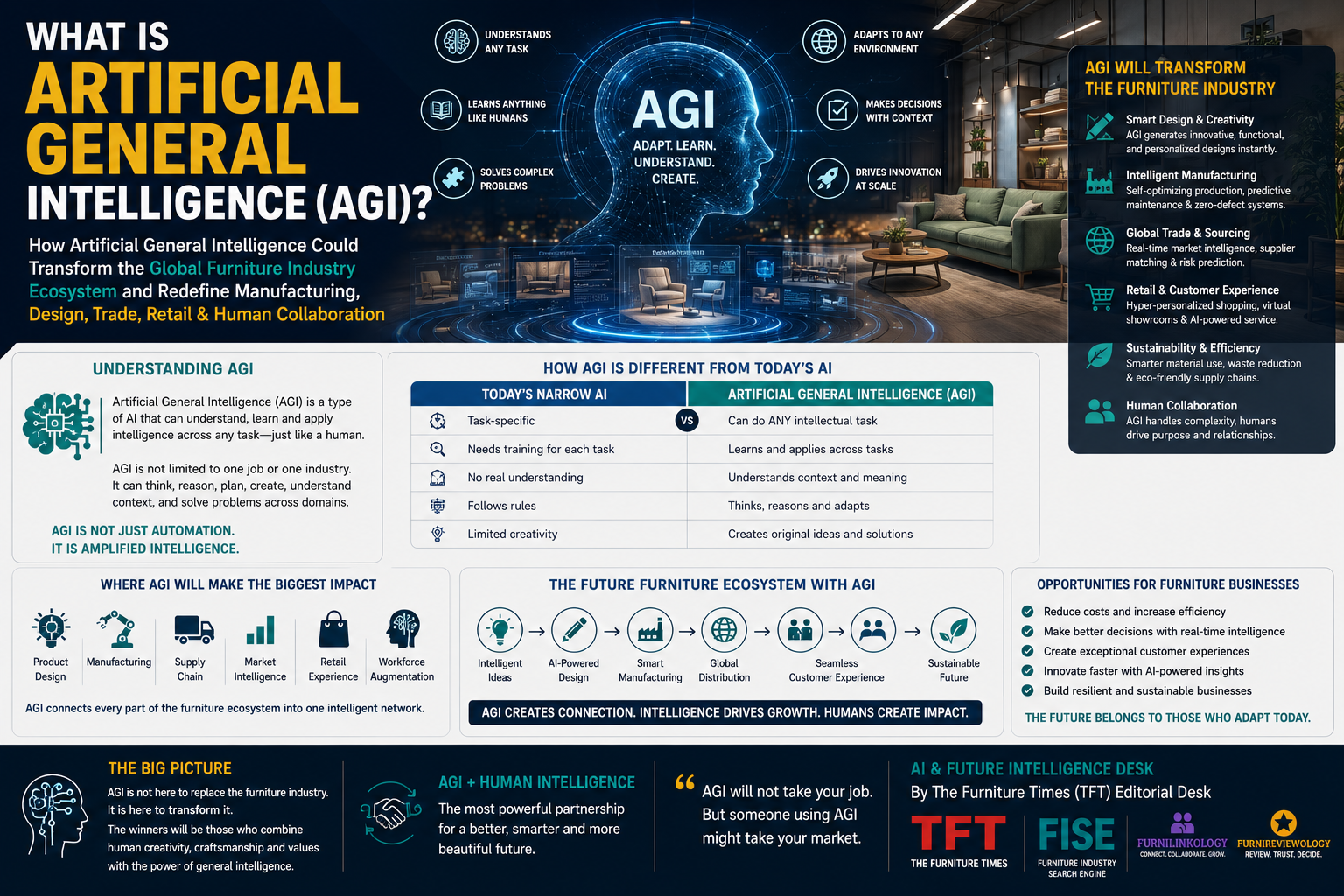
What Is Artificial General Intelligence (AGI)?
How Artificial General Intelligence Could Transform the Global Furniture Industry Ecosystem and Redefine Manufacturing, Design, Trade, Retail & Human Collaboration
AI & Future Intelligence Desk
By The Furniture Times (TFT) Editorial Desk
Executive Summary
The world is entering one of the most significant technological transitions since the Industrial Revolution.
For decades, businesses have embraced automation, robotics, enterprise software and Artificial Intelligence (AI) to improve productivity and efficiency.
Today, another concept is gaining worldwide attention.
Artificial General Intelligence (AGI).
Unlike today’s AI systems that perform specialised tasks, AGI represents the vision of machines capable of learning, reasoning, adapting and solving a wide variety of problems in ways that resemble broad human intelligence.
Although AGI has not yet been achieved, researchers, technology companies and policymakers continue to explore its potential and its implications for society, business and industry.
For the global furniture industry ecosystem, AGI could reshape every stage of the value chain—from forest management and product design to manufacturing, logistics, retail, after-sales service and sustainability.
According to The Furniture Times (TFT), the future of the furniture industry will not be determined by whether AGI replaces people.
It will be determined by how intelligently people and advanced AI systems work together.
Understanding Artificial General Intelligence
Today’s Artificial Intelligence is known as Narrow AI.
It performs specific tasks such as:
- Writing text
- Translating languages
- Image recognition
- Product recommendations
- Customer service chatbots
- Data analysis
Each system excels within a defined scope.
Artificial General Intelligence is different.
AGI refers to a hypothetical form of AI that could understand, learn and apply knowledge across many different domains rather than being limited to one specialised task.
An AGI system could potentially:
- Learn new skills without extensive retraining
- Solve unfamiliar problems
- Transfer knowledge between disciplines
- Reason through complex situations
- Assist in strategic decision-making
Researchers continue to debate when—or whether—AGI will be achieved.
AI vs AGI
Today’s AI might identify defects in furniture production.
AGI could potentially analyse the entire business.
Today’s AI recommends products.
AGI might understand customer lifestyles, supply chains, sustainability goals and market conditions together.
Today’s AI answers questions.
AGI could assist with broader planning and decision-making across multiple business functions.
Why the Furniture Industry Should Understand AGI
Furniture is one of the world’s most interconnected industries.
It involves:
Forestry.
Raw materials.
Manufacturing.
Machinery.
Interior design.
Architecture.
Retail.
Hospitality.
Healthcare.
Education.
Logistics.
E-commerce.
Customer service.
Recycling.
Circular economy.
Because these activities are interconnected, future advances in AI could support more integrated decision-making.
AGI and Furniture Design
Future intelligent systems could assist designers by:
Generating multiple design concepts.
Analysing ergonomics.
Suggesting sustainable materials.
Predicting manufacturing feasibility.
Optimising production costs.
Considering cultural preferences.
Supporting customisation.
Designers would continue to lead the creative process while using intelligent systems as advanced design assistants.
AGI in Manufacturing
Manufacturing may become increasingly intelligent.
Advanced AI systems could help optimise:
Factory scheduling.
Energy consumption.
Machine maintenance.
Inventory.
Quality control.
Production planning.
Material utilisation.
Rather than replacing skilled workers, these systems may reduce repetitive tasks and improve operational efficiency.
Smarter Supply Chains
Furniture supply chains span continents.
Future intelligent systems could help businesses:
Forecast demand.
Respond to disruptions.
Optimise shipping.
Reduce waste.
Improve inventory planning.
Coordinate suppliers.
Support sourcing decisions.
Supply chains become more adaptive.
Personalised Customer Experiences
Future AI systems may help customers find products that better match their needs.
Recommendations could consider:
Room size.
Budget.
Lifestyle.
Climate.
Family needs.
Accessibility.
Design preferences.
Rather than browsing thousands of products, customers could receive tailored suggestions.
Furniture Retail in the AGI Era
Retail experiences may increasingly include:
Virtual consultants.
Interactive room planning.
Real-time recommendations.
AI-assisted customer service.
Personalised product bundles.
Multilingual support.
Retail becomes more intelligent and responsive.
Hospitality and Commercial Projects
Hotels, offices, healthcare facilities and educational institutions often manage complex furnishing projects.
Advanced AI systems could assist by analysing:
Project requirements.
Budgets.
Compliance.
Furniture specifications.
Delivery schedules.
Maintenance planning.
Supporting better project coordination.
Supporting Sustainability
Sustainability is becoming central to the furniture industry.
Future intelligent systems may assist with:
Reducing waste.
Selecting sustainable materials.
Improving recycling.
Supporting refurbishment.
Tracking product life cycles.
Optimising logistics.
Helping businesses work toward environmental goals.
Smarter Maintenance and After-Sales Service
Furniture ownership extends beyond the initial purchase.
Future systems could support:
Predictive maintenance.
Replacement reminders.
Warranty management.
Repair recommendations.
Refurbishment opportunities.
Circular economy initiatives.
Longer product life benefits both businesses and customers.
Accelerating Research and Innovation
Innovation often requires analysing large amounts of information.
Advanced AI could help researchers explore:
New materials.
Manufacturing techniques.
Consumer behaviour.
Global market trends.
Sleep science.
Ergonomics.
Furniture technology.
Research cycles may become faster and more collaborative.
Education and Workforce Development
AGI is unlikely to remove the need for skilled professionals.
Instead, it may change how people learn.
Future education could include:
Personalised training.
Virtual mentors.
Interactive simulations.
Skills assessment.
Continuous professional development.
Helping workers adapt throughout their careers.
Digital Marketing and Global Visibility
Future AI systems could assist businesses with:
Content creation.
Search optimisation.
Translation.
Market research.
Customer insights.
Campaign planning.
However, businesses will still need authentic expertise, quality products and strong customer relationships.
Technology amplifies value—it does not create it by itself.
Furniture Industry Search Engine (FISE) in an AI Future
As AI systems become more capable, they will depend on reliable and structured information.
The long-term vision of Furniture Industry Search Engine (FISE) is to help organise the global furniture ecosystem by making businesses, products and services easier to discover.
Structured industry information supports:
Supplier discovery.
Business visibility.
Professional networking.
Knowledge sharing.
Future AI-assisted sourcing.
The Furniture Times in the Age of AGI
Knowledge becomes increasingly valuable in an AI-driven economy.
The Furniture Times aims to contribute through:
Industry intelligence.
Market analysis.
Educational content.
Research.
Thought leadership.
Helping industry professionals understand emerging technologies and their practical implications.
Opportunities for SMEs
Small businesses often worry about being left behind.
However, advanced AI tools may help SMEs by:
Reducing administrative work.
Improving customer communication.
Supporting marketing.
Enhancing productivity.
Providing access to advanced analytical capabilities.
Used thoughtfully, these technologies may help level the playing field.
Challenges and Responsibilities
Future AI systems also raise important questions.
Businesses should consider:
Data privacy.
Cybersecurity.
Transparency.
Human oversight.
Ethical decision-making.
Workforce development.
Responsible governance will remain essential.
Human Creativity Remains Essential
Furniture is more than manufacturing.
It reflects:
Culture.
Emotion.
Identity.
Craftsmanship.
Creativity.
Human experience.
Technology can assist.
It cannot replace the human meaning behind great design and craftsmanship.
The strongest businesses will combine intelligent systems with human expertise.
The Future of the Global Furniture Industry Ecosystem
The next generation of the furniture ecosystem may integrate:
Artificial Intelligence.
Advanced robotics.
Digital twins.
Smart factories.
Predictive logistics.
Virtual showrooms.
Circular economy systems.
Industry search platforms.
Professional networks.
Trusted review ecosystems.
Connected knowledge platforms.
Success will depend on how well these technologies work together with people.
TFT Analysis
The furniture industry has progressed through several major eras.
Manufacturing Era
↓
Digital Transformation Era
↓
AI Era
↓
Future Intelligent Ecosystem
In this future, businesses that embrace learning, innovation and responsible technology adoption will be better positioned to compete globally.
Final Verdict
Artificial General Intelligence remains a future objective rather than a technology that exists today.
Even so, its potential encourages businesses to think differently about preparation.
The global furniture industry should not wait for AGI before embracing digital transformation.
The best preparation begins now:
Invest in digital skills.
Improve data quality.
Strengthen customer trust.
Build structured information.
Adopt responsible AI tools.
Encourage lifelong learning.
The future will belong to businesses that combine technology with human creativity, ethics and expertise.
Because the next chapter of the furniture industry will not be written by humans alone.
Nor by machines alone.
It will be written through intelligent collaboration between both.
By The Furniture Times (TFT) Editorial Desk
AI & Future Intelligence Desk | July 2026
“TFT tells their story. FISE helps the world find them.”
The furniture industry ecosystem is a $1 Trillion Dollar Industry.
