Furniture Quality Control Order: What Manufacturers Need to Know
A practical examination of notified furniture categories, applicable Indian Standards and manufacturer responsibilities
By The Furniture Times (TFT) Editorial Desk | Furniture Compliance | Global Industry Intelligence
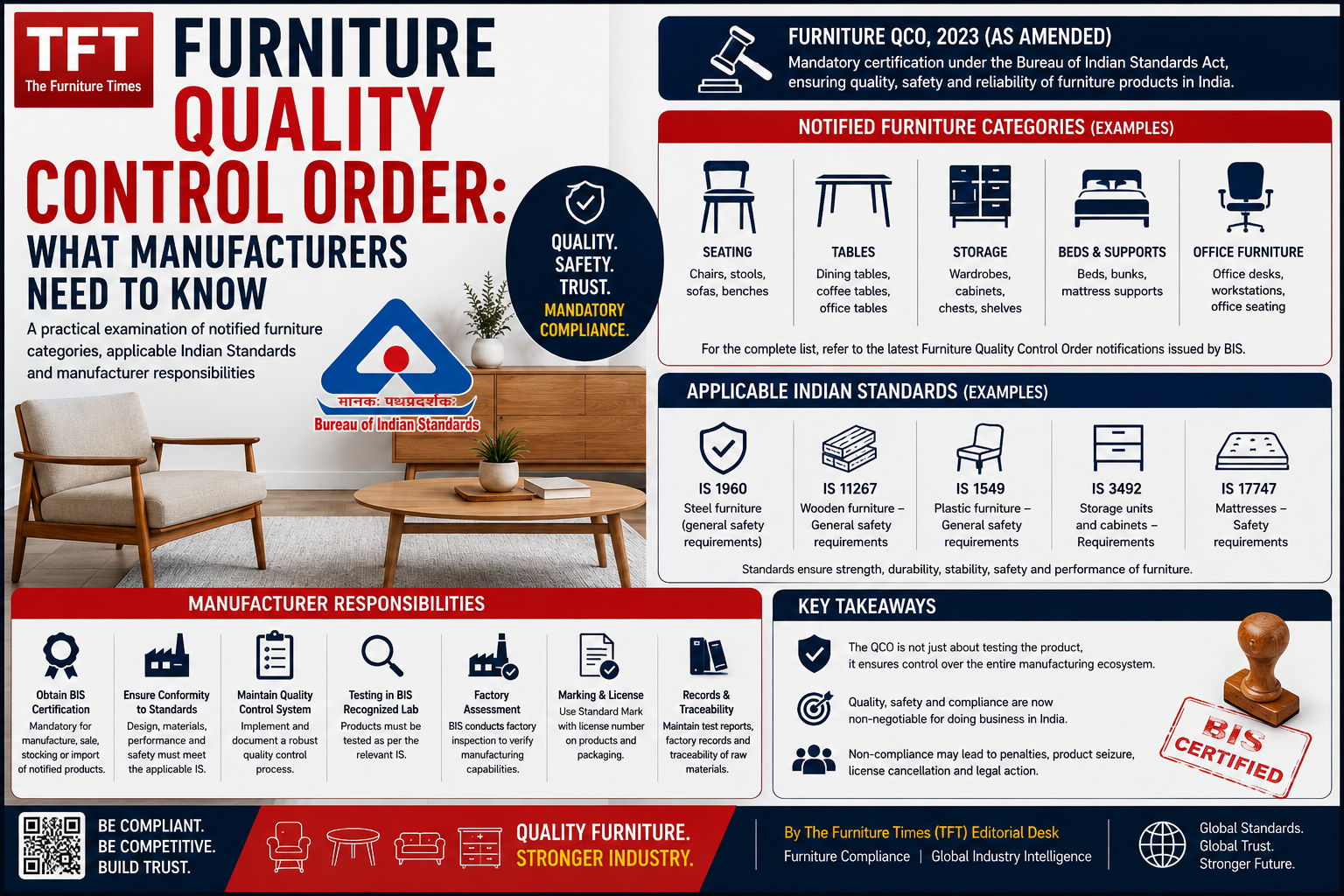
India’s furniture industry has entered a new regulatory phase. Product quality can no longer be treated only as a matter of craftsmanship, customer preference or internal factory policy. For furniture categories covered by the Furniture (Quality Control) Order, compliance with the applicable Indian Standard and the use of the BIS Standard Mark have become market-access requirements.
The Furniture (Quality Control) Order, 2025 was notified by the Department for Promotion of Industry and Internal Trade under the Bureau of Indian Standards Act, 2016. It covers six major furniture categories: work chairs, general-purpose chairs and stools, tables and desks, storage units, beds and bunk beds.
The principal implementation date recorded in the government’s June 2026 Transition Facilitation Order is 13 February 2026. A subsequent amendment provided additional time for qualifying micro and small enterprises. Manufacturers must check their classification, applicable commencement date, licensing position and any transitional relief against the latest official notification rather than relying on an old industry circular.
The significance of the QCO extends far beyond obtaining a laboratory test report. It requires manufacturers to understand product classification, control approved models and variants, maintain consistent production, establish testing arrangements, preserve traceability and demonstrate continuing conformity after receiving a licence.
For manufacturers, importers, private-label brands, institutional suppliers and international companies selling furniture in India, the message is clear: compliance must be integrated into the product-development and manufacturing system.
What is a Furniture Quality Control Order?
BIS certification is generally voluntary unless the Central Government brings a product under compulsory certification through a Quality Control Order. A QCO makes conformity to the identified Indian Standard legally compulsory for products falling within its scope.
Under the Furniture QCO, a notified product must:
- Conform to the applicable Indian Standard.
- Be manufactured under a valid BIS licence.
- Bear the BIS Standard Mark in accordance with the licensing conditions.
- Remain consistent with the approved scope of the licence.
- Continue meeting the standard during regular commercial production.
The official BIS compulsory-certification list places the six furniture standards under Scheme I, commonly associated with the ISI Mark. The QCO therefore transforms those standards from voluntary technical references into compulsory requirements for covered products supplied to the Indian market. BIS compulsory-certification information
A QCO should not be confused with an Indian Standard or a BIS product manual.
The Indian Standard describes the technical requirements and test methods for the product. The QCO establishes the legal obligation to comply. BIS conformity-assessment regulations govern licensing, while product manuals and certification guidelines explain operational matters such as grouping, sampling, testing and factory controls.
Manufacturers must read these documents together.
Six furniture categories covered by the order
The Furniture QCO identifies the following products and standards:
| Notified furniture category | Applicable Indian Standard | Principal compliance focus |
|---|---|---|
| Work chairs | IS 17631:2022 | Chairs intended for work environments, including relevant safety, strength, stability and durability requirements |
| General-purpose chairs and stools | IS 17632:2022 | Seating and stools used for general purposes in homes, commercial spaces and other environments |
| Tables and desks | IS 17633:2022 | General-use tables and desks, including structural strength, stability and performance |
| Storage units | IS 17634:2022 | Cabinets, cupboards and other covered storage furniture |
| Beds | IS 17635:2022 | Beds within the scope and definitions of the standard |
| Bunk beds | IS 17636:2022 | Multi-level sleeping furniture, with particular attention to structural and user-safety requirements |
The standards and their QCO notifications are listed on the official BIS Scheme I compulsory-certification page.
This list appears simple, but classification is one of the most important and frequently underestimated compliance tasks.
A manufacturer should not decide applicability only from the product’s commercial name. A “visitor chair,” “executive chair,” “study table,” “console,” “utility cabinet” or “day bed” must be evaluated against the definitions, intended use and scope of the relevant Indian Standard.
A product marketed under one name can still fall within a notified category. Conversely, a product that resembles covered furniture may have construction, purpose or use characteristics requiring a more careful technical interpretation.
Where scope is uncertain, the manufacturer should obtain a documented clarification before mass production or importation.
The QCO applies to products—not merely to company descriptions
Manufacturers sometimes assume that a licence for one furniture category automatically covers their entire factory. It does not.
BIS explains in its product-certification guidance that a separate application is generally required for every Indian Standard, even when multiple products are made at the same manufacturing location. A product manufactured at a different factory also requires separate licensing consideration for that location. BIS product-certification FAQs
A company producing office chairs, desks, cabinets and beds could therefore require separate licences under four standards. If the company operates several factories, the licensing structure may become more extensive.
Manufacturers must map:
- Every production location.
- Every notified product category.
- Every model family.
- Every variant within a model family.
- Major materials and construction systems.
- Outsourced manufacturing arrangements.
- Imported finished products.
- Private-label and contract-manufactured products.
The legal brand name on the product is not a substitute for factory-level certification. Where a brand outsources production, the actual manufacturing unit and the products made there must be properly covered.
Why a passing test report is not enough
A test report records the performance of a particular sample at a particular point in time. A BIS licence addresses the manufacturer’s capacity to reproduce conforming products consistently.
That is why BIS certification evaluates more than a finished item. Depending on the applicable procedure and product requirements, the assessment can examine:
- Manufacturing infrastructure.
- Production processes.
- Machinery and equipment.
- In-process quality controls.
- Finished-product inspection.
- Testing facilities and arrangements.
- Calibration status.
- Competence of quality personnel.
- Raw-material controls.
- Supplier documentation.
- Product drawings and specifications.
- Model and variant control.
- Traceability and recordkeeping.
- Handling of nonconforming production.
- The manufacturer’s quality-assurance plan.
BIS’s licensing guidance describes factory assessment as verification of manufacturing infrastructure, production processes, quality controls, testing capability, calibration, personnel and supporting technical records. BIS Grant of Licence guidelines
The practical question is therefore not merely, “Can this chair pass a test?”
The correct question is, “Can this factory repeatedly manufacture every chair covered by the licence so that it continues to meet the applicable standard?”
Manufacturer responsibility begins with scope determination
Before applying for certification, a manufacturer should create a complete product-compliance register.
For every product, the register should identify:
- Commercial product name.
- Internal model number.
- Intended use.
- Applicable Indian Standard.
- Factory location.
- Brand or private-label owner.
- Materials and structural system.
- Dimensions and load-bearing configuration.
- Components affecting safety or performance.
- Testing status.
- BIS application or licence number.
- Approved scope.
- Marking and traceability method.
- Current compliance status.
This exercise frequently reveals problems before they become expensive. A company may discover that several models sold under one collection use different frames, jointing systems, thicknesses or mechanisms. Those differences can affect grouping, test selection and licence coverage.
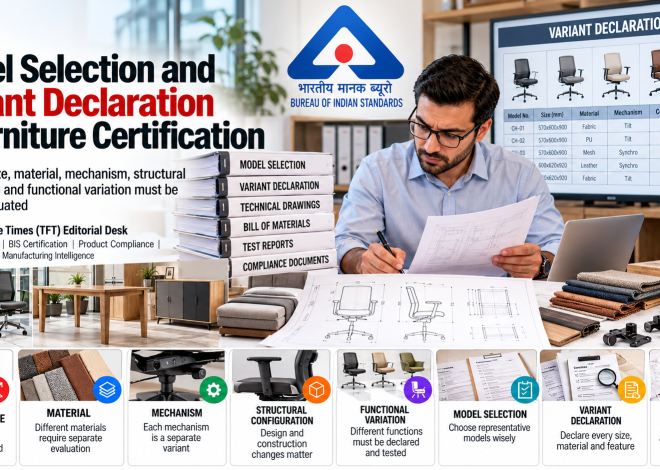
Model and variant control is essential
Furniture manufacturers often offer extensive customization. Buyers may select different sizes, materials, finishes, bases, arms, mechanisms, drawer arrangements, headboards or storage configurations.
Commercially, this flexibility is valuable. From a compliance perspective, it creates risk unless every relevant variation is controlled.
A change that looks decorative may affect performance. For example:
- Changing a chair base can alter stability.
- Replacing a gas-lift or tilt mechanism can affect safety and durability.
- Reducing board thickness can weaken a cabinet or desk.
- Changing drawer hardware can affect loading performance.
- Modifying a bed-frame joint can change structural strength.
- Altering bunk-bed guardrails or ladder dimensions can create a safety concern.
- Substituting fasteners can affect fatigue resistance.
- Enlarging a tabletop without revising the understructure can affect deflection or stability.
The manufacturer should therefore maintain approved drawings, bills of materials, specifications and change-control records. Purchasing, engineering, production and sales teams must not introduce an uncontrolled variation after certification.
Raw materials and components must be controlled
A furniture product is a system of interacting components. Its compliance cannot be protected if critical inputs are purchased only on price or immediate availability.
Depending on the product, controlled inputs can include:
- Timber and wood-based panels.
- Metal tubes, sheets and castings.
- Adhesives and bonding systems.
- Fasteners and connectors.
- Hinges and drawer slides.
- Chair mechanisms and gas lifts.
- Plastic moulded components.
- Upholstery support structures.
- Bed fittings and brackets.
- Levelling devices, castors and bases.
- Guardrails, ladders and attachment systems.
The manufacturer should define acceptance criteria for critical materials and components, qualify suppliers, inspect incoming materials and preserve relevant certificates or test evidence.
When an approved component is unavailable, substitution should follow a formal review. Emergency purchasing must not silently change the construction of a certified model.
Testing should be built into production planning
Furniture testing often involves destructive, load, fatigue, stability, impact or durability evaluations. Some tests can require specialized rigs, trained personnel and significant time.
Manufacturers must determine:
- Which tests must be performed in-house.
- Which tests may be conducted by an external laboratory.
- What testing equipment is required.
- How often tests must be conducted.
- How control units or batches are defined.
- What records must be maintained.
- What action is required after a failed result.
BIS product manuals can provide product-specific guidance on grouping, testing and quality assurance. For example, the BIS product manual for tables and desks expects manufacturers to implement a Quality Assurance Plan using regular testing and process controls to ensure that marked products continue to conform. BIS product manual for IS 17633
Testing must not be treated as an activity performed only for the initial application. It forms part of continuing production control.
Factory readiness must be real, not staged
A factory inspection should reflect normal production conditions. Temporary arrangements made only for the inspection are unlikely to support reliable compliance after the licence is granted.
Before assessment, the factory should be able to demonstrate:
- The product is genuinely manufactured at the declared location.
- Required production equipment is installed and operational.
- Quality responsibilities are assigned.
- Test equipment is functional and calibrated.
- Operators understand approved specifications.
- Drawings match the product being manufactured.
- Material records can be traced to production.
- Failed or rejected products are segregated.
- Corrective actions are documented.
- Marking is controlled.
- Records are complete and retrievable.
A factory may produce excellent furniture and still encounter certification delays if its documentation and control system cannot demonstrate consistency.
Marking is a controlled regulatory activity
The BIS Standard Mark cannot be used simply because an application has been submitted, a laboratory test has been completed or the company expects approval.
The mark should be used only after a licence has been granted and only:
- On products covered by the licence.
- At the licensed manufacturing location.
- Within the approved product scope.
- In the prescribed form.
- With the required licence identification.
- While the licence remains valid and operative.
Marketing teams, packaging suppliers, catalogue designers and e-commerce administrators should receive controlled instructions. Uploading an ISI image onto a product page before licensing—or continuing to display it after the licence becomes invalid—can create serious compliance and reputational problems.
Implementation and the position of micro and small enterprises
The principal QCO was published in February 2025 and provided a twelve-month implementation period. The official Transition Facilitation Order records 13 February 2026 as the implementation date for the Furniture QCO. Transition Facilitation (Quality Control) Order, 2026
A February 2026 cross-sector amendment changed the treatment of qualifying micro and small enterprises. The amendment refers to Udyam-registered enterprises whose investment in plant and machinery or equipment does not exceed ₹1 crore and whose turnover does not exceed ₹5 crore for the preceding financial year, supported by the required certification. It provided a six-month period from the QCO’s implementation date, bringing the practical deadline for qualifying enterprises to August 2026. Official BIS amendment page
Because that transition period has now reached its end, small manufacturers should not assume that an earlier exemption remains indefinitely available. They should verify their current position immediately.
An MSME registration by itself should also not be treated as automatic proof of eligibility. The specific investment, turnover, registration and documentary conditions in the amendment must be satisfied.
Important exemptions and transitional provisions
The Furniture QCO has been amended to address research, legacy inventory, export manufacturing and consignments already in the import pipeline.
Goods manufactured for export
The principal order excludes covered goods manufactured domestically for export. Manufacturers relying on this provision should maintain evidence that the goods were produced for export and were not diverted into India’s domestic market.
Imports for research and development
The 2026 amendment permits an eligible BIS-certified furniture manufacturer—or one that has applied for certification—to import up to 200 covered goods or articles per financial year for research and development.
The conditions are important:
- The products cannot be commercially sold.
- They must be disposed of as scrap.
- Year-wise records must be maintained.
- The records must be furnished to the Central Government.
This is a controlled R&D exemption, not a route for pilot retail sales or market testing.
Declared pre-implementation stock
Covered products domestically manufactured or imported before the implementation date may receive a twelve-month sale, display or offer-for-sale window where the manufacturer is BIS-certified or has applied for certification and submits the required self-declaration to BIS.
Manufacturers should preserve stock statements, manufacturing dates, import documents, invoices and the filed declaration. An undocumented claim that stock is “old” may not be sufficient.
Imported inputs for export furniture
Non-BIS-marked goods, components or subassemblies may be imported for manufacturing furniture intended for export, subject to a signed self-declaration, invoice and consignment details, a commitment against domestic diversion, and records available for government verification or audit.
The Furniture QCO Amendment Order, 2026 contains these provisions.
Goods already shipped or ordered
The Second Amendment Order introduced transitional relief for certain imports already in the supply chain.
It addresses:
- Consignments shipped before implementation, where the Bill of Entry is dated within 180 days after implementation.
- Goods covered by a pre-implementation purchase order, where the Bill of Lading and Bill of Entry fall within the specified 180-day period.
For the purchase-order route, the importer must provide BIS with copies of the purchase order, Bill of Lading, Bill of Entry and supporting documents on signed company letterhead within seven days of clearance. Furniture QCO Second Amendment Order, 2026
These are narrowly documented transition mechanisms. They should not be interpreted as a general extension.
Importers and foreign manufacturers
Imported furniture is not automatically outside the QCO. When a notified product is manufactured abroad for sale in India, the foreign manufacturing facility must ordinarily obtain the relevant BIS licence through the applicable foreign-manufacturer certification process.
An importer should verify:
- The exact overseas factory.
- Applicable Indian Standard.
- Validity of the BIS licence.
- Models and variants within its scope.
- Correct use of the Standard Mark.
- Consistency between shipping documents and licensed factory details.
- Whether any claimed transition provision genuinely applies.
A supplier’s statement that a product is “BIS tested” is not equivalent to confirmation that the actual manufacturing unit holds an operative licence for the relevant product.
Private-label brands remain exposed to compliance risk
A furniture brand may not own a factory, but it still faces substantial commercial and reputational consequences if products bearing its name are noncompliant.
Private-label agreements should address:
- Factory licensing responsibilities.
- Approved product scope.
- Access to licence and surveillance records.
- Restrictions on component or design changes.
- Testing obligations.
- Notification of failures or regulatory action.
- Product traceability.
- Recall and corrective-action responsibilities.
- Use of the BIS Standard Mark.
- Responsibility for online claims and packaging.
Procurement teams should verify compliance before issuing large orders, not after products reach warehouses or customer projects.
Continuing compliance after the licence
Certification is not a one-time event. BIS may conduct surveillance to verify that the manufacturer continues to maintain its production infrastructure, process controls, testing capability and product conformity. BIS factory-surveillance guidelines
A certified manufacturer should continue to:
- Follow the approved quality-assurance plan.
- Perform required tests.
- Maintain calibration.
- Control raw materials and suppliers.
- Preserve production and test records.
- Manage complaints and failures.
- Investigate nonconforming results.
- Notify or obtain approval for relevant changes.
- Use the Standard Mark correctly.
- Cooperate with surveillance and sampling.
- Renew the licence on time.
A licence cannot compensate for declining factory discipline.
Common mistakes manufacturers should avoid
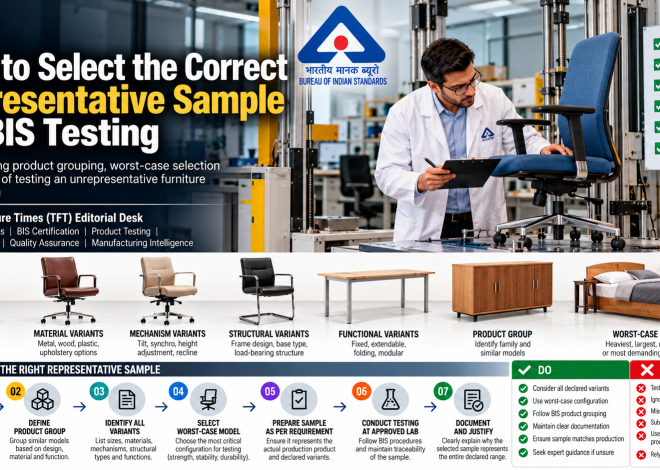
Assuming one tested model covers every design
Different constructions, dimensions, bases, materials and mechanisms may require separate consideration.
Applying under the wrong standard
Commercial product names do not determine regulatory classification.
Using inconsistent drawings
The drawing, bill of materials, test sample and production item must represent the same controlled product.
Declaring variants incompletely
An undeclared variant can fall outside the licensed scope even if it is marketed under the same collection name.
Substituting critical components after approval
Uncontrolled substitution can change strength, stability, durability or safety.
Treating outsourced manufacturing as a brand-level licence
Certification is linked to the actual manufacturing location and approved scope.
Using the BIS Mark prematurely
Application submission and testing do not authorize use of the Standard Mark.
Relying on transitional stock without documentation
Relief normally depends on dates, declarations and records.
Neglecting ongoing tests
Passing the initial evaluation does not eliminate continuing conformity obligations.
Assuming certification proves total product excellence
BIS compliance establishes conformity with the applicable standard. It does not automatically evaluate every aspect of comfort, aesthetics, delivery, installation, service or long-term customer satisfaction.
A practical manufacturer action plan
Step 1: Build a regulatory product map
List every model, category, variant, factory, brand and destination market.
Step 2: Obtain the current standards
Use the latest official versions, amendments, product manuals and BIS guidelines.
Step 3: Confirm classification
Resolve ambiguous products through documented technical review.
Step 4: Conduct a factory gap assessment
Compare actual infrastructure, testing, calibration, records and quality controls with BIS requirements.
Step 5: Rationalize variants
Remove unnecessary differences and create clearly controlled product families.
Step 6: Complete pre-compliance testing
Test representative products early enough to correct design or production weaknesses.
Step 7: Strengthen supplier control
Identify critical materials and components and establish acceptance requirements.
Step 8: Prepare the application carefully
Ensure that models, drawings, materials, factory details and declarations are complete and consistent.
Step 9: Control the Standard Mark
Restrict access to artwork and establish approval for packaging, labels and online content.
Step 10: Prepare for continuing surveillance
Maintain the system every day, not only before an inspection.
Quality regulation can strengthen the furniture market
The QCO will create implementation costs, especially for smaller factories managing large product catalogues and limited testing infrastructure. However, its long-term effect could be positive if applied consistently and supported by accessible testing, clear guidance and reasonable administrative processes.
A stronger conformity framework can:
- Reduce structurally weak furniture entering the market.
- Encourage repeatable manufacturing.
- Improve traceability.
- Strengthen institutional procurement.
- Reduce avoidable failures and complaints.
- Encourage investment in testing and engineering.
- Increase confidence in Indian furniture.
- Help capable manufacturers compete on verified performance rather than price alone.
The policy opportunity is not merely to certify furniture. It is to move the industry from informal quality assumptions toward documented product engineering.
BIS compliance and customer trust are complementary
Certification answers an important question: does the covered product conform to the applicable Indian Standard under the approved certification system?
Customers ask additional questions:
- Was the product delivered on time?
- Did it arrive without damage?
- Was installation professional?
- Is the chair comfortable?
- Are drawers aligned?
- Does the finish remain durable?
- Does the seller respond to complaints?
- Are warranty commitments honoured?
This is where FurniReviewology can add a separate layer of market intelligence. BIS certification can support regulatory confidence, while verified customer experiences can help buyers understand service, reliability and ownership outcomes.
Together, technical conformity and accountable reviews can create a more transparent furniture economy.
The industry must act now
The Furniture Quality Control Order is no longer a distant proposal. Its principal implementation date has passed, subsequent amendments are in force, and the additional transition period provided to eligible small enterprises has reached its closing stage.
Manufacturers should immediately determine whether their products are notified, whether every manufacturing location is properly covered, whether their models match the licence scope, and whether any exemption or transition claim is fully documented.
The companies that approach the QCO as an engineering and management discipline—not a last-minute paperwork exercise—will be better positioned to protect market access, reduce failures and earn long-term customer confidence.
Regulatory note: This report is an industry analysis, not legal advice. QCOs, standards, product manuals and implementation guidance may be amended. Businesses should verify their obligations through the latest Gazette notifications, BIS and DPIIT guidance, and qualified compliance professionals.
The Furniture Times (TFT) & Furniture Industry Search Engine (FISE)
“TFT tells their story. FISE helps the world find them.”
FurniReviewology helps the world trust them.
The furniture industry ecosystem is a $1 trillion industry ecosystem.
Think compliance. Build quality. Earn trust. Get discovered—and be part of the movement transforming the global furniture industry.