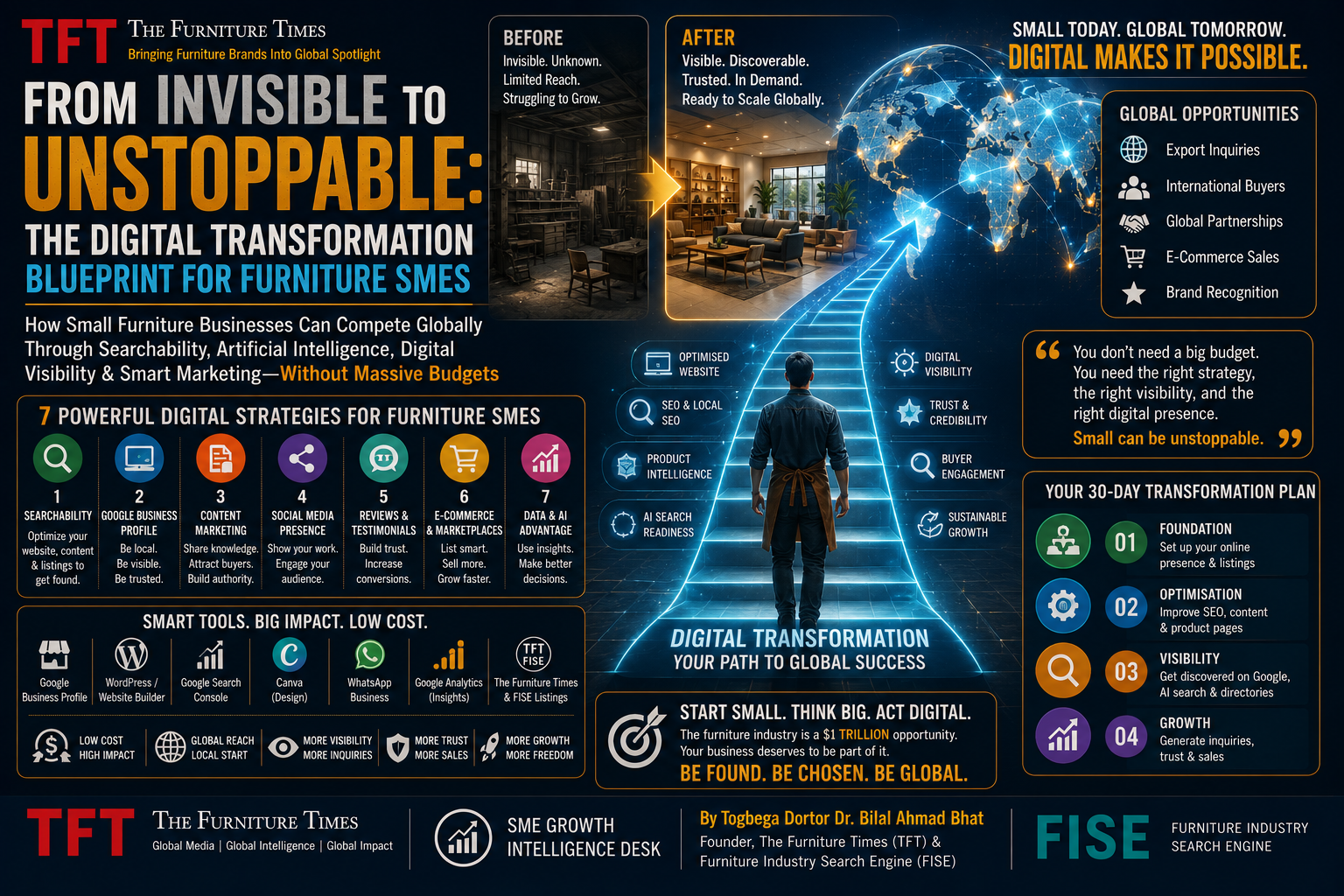
From Invisible to Unstoppable: The Digital Transformation Blueprint for Furniture SMEs
How Small Furniture Businesses Can Compete Globally Through Searchability, Artificial Intelligence, Digital Visibility & Smart Marketing—Without Massive Budgets
SME Growth Intelligence Desk
By Togbega Dortor Dr. Bilal Ahmad Bhat
Founder, The Furniture Times (TFT) & Furniture Industry Search Engine (FISE)
Executive Summary
Small and Medium Enterprises (SMEs) are the backbone of the global furniture industry.
Across every country, SMEs manufacture:
Furniture.
Cabinets.
Doors.
Wardrobes.
Outdoor furniture.
Office furniture.
Hotel furniture.
Custom interiors.
Wood products.
Home décor.
Collectively, they represent the majority of furniture manufacturers worldwide.
Yet despite producing exceptional products, most SMEs remain virtually invisible.
They possess the craftsmanship.
They possess the machinery.
They possess the experience.
But they lack one critical asset.
Digital visibility.
Many business owners believe digital transformation requires millions of dollars.
They postpone action because they assume technology is only for multinational corporations.
That assumption is costing SMEs enormous opportunities.
According to The Furniture Times (TFT), the future belongs to SMEs that become digitally discoverable rather than simply digitally present.
Digital transformation is no longer about spending more.
It is about becoming easier to find, easier to trust and easier to buy from.
This report provides a practical blueprint for furniture SMEs to compete globally using affordable digital strategies.
The Invisible SME Crisis
Across the global furniture industry, thousands of SMEs experience the same challenge.
Excellent products.
Very few enquiries.
Outstanding craftsmanship.
Little online visibility.
Years of experience.
Minimal digital presence.
The problem is rarely product quality.
The problem is discoverability.
Customers cannot buy what they cannot find.
Digital Transformation Is No Longer Optional
The furniture industry is changing rapidly.
Customers now expect:
Online information.
Fast responses.
Google visibility.
AI recommendations.
Product videos.
Reviews.
Instant communication.
Businesses that delay digital transformation risk becoming increasingly invisible.
Step One: Build a Searchable Website
Every SME needs more than a digital brochure.
A modern website should include:
Company profile.
Product categories.
Individual product pages.
Project gallery.
Customer testimonials.
Videos.
Contact information.
Frequently Asked Questions.
Educational content.
Google Maps.
WhatsApp integration.
The website becomes the company’s digital headquarters.
Low-Budget SEO Creates Long-Term Growth
Many SMEs believe SEO is expensive.
Good SEO begins with simple actions.
Research customer search behaviour.
Create useful content.
Optimise page titles.
Write helpful product descriptions.
Improve website speed.
Publish regularly.
Answer customer questions.
SEO rewards consistency more than size.
Google Ads Can Deliver Immediate Visibility
SEO builds long-term visibility.
Google Ads generate immediate opportunities.
SMEs should begin with targeted campaigns.
Examples include:
Kitchen Cabinets Shah Alam.
Outdoor Furniture Malaysia.
Hotel Furniture Supplier.
Restaurant Furniture.
Office Furniture.
Small daily budgets allow businesses to test markets before scaling.
Advertising becomes measurable.
Content Marketing Builds Authority
Customers buy from businesses they trust.
Publishing content builds that trust.
Examples include:
Buying guides.
Project case studies.
Furniture maintenance tips.
Material comparisons.
Industry news.
Behind-the-scenes manufacturing.
Educational videos.
Every article becomes a digital salesperson.
Reviews Become Business Assets
Customer reviews influence:
Trust.
Google rankings.
AI recommendations.
Conversions.
Furniture SMEs should actively encourage:
Google reviews.
Verified testimonials.
Project feedback.
Photographs from satisfied customers.
Trust grows through customer experiences.
Social Media Should Support Search
Many businesses rely entirely on social media.
Social media is important.
But it should complement search rather than replace it.
Use social platforms to:
Share articles.
Show projects.
Answer questions.
Promote videos.
Drive visitors back to the website.
The website remains the central digital asset.
Local SEO Wins Local Markets
Every SME should dominate its local area before targeting international markets.
Optimise:
Google Business Profile.
Google Maps.
City landing pages.
Location keywords.
Local directories.
Community partnerships.
Local authority creates stronger global credibility.
Industry Listings Increase Discoverability
Many SMEs list only on general business directories.
Industry-specific listings increase relevance.
Businesses should appear where furniture buyers search.
Industry platforms improve:
Visibility.
Trust.
Search authority.
Networking opportunities.
Industry listings become digital distribution channels.
Artificial Intelligence Levels the Playing Field
Artificial Intelligence gives SMEs access to capabilities previously available only to large corporations.
AI can assist with:
Content creation.
Customer support.
Translation.
Email drafting.
Product descriptions.
Market research.
Trend analysis.
SEO planning.
AI reduces costs while increasing productivity.
Email Marketing Builds Long-Term Relationships
Many SMEs focus only on finding new customers.
Future growth depends on nurturing existing ones.
Regular newsletters can include:
New products.
Industry insights.
Project highlights.
Special promotions.
Furniture care advice.
Educational content.
Relationships generate repeat business.
Video Builds Confidence
Furniture is best experienced visually.
Short videos can showcase:
Manufacturing.
Craftsmanship.
Installation.
Customer stories.
Factory tours.
Product demonstrations.
Video creates transparency and trust.
Data Should Drive Decisions
Every SME should monitor:
Website visitors.
Popular products.
Enquiry sources.
Search keywords.
Conversion rates.
Customer locations.
Analytics help businesses invest more effectively.
Furniture Industry Search Engine (FISE): Helping SMEs Become Discoverable
One of the greatest challenges for SMEs is being found.
Furniture Industry Search Engine (FISE) is envisioned as a dedicated discovery platform helping furniture manufacturers, retailers, suppliers and service providers become more visible within a specialised global furniture ecosystem.
Instead of competing with millions of unrelated businesses…
SMEs become discoverable by furniture buyers actively searching for industry solutions.
The SME Digital Growth Blueprint
Phase One
Build Visibility
Website.
Google Business Profile.
Basic SEO.
Industry listings.
Professional photography.
Phase Two
Build Authority
Educational articles.
Case studies.
Videos.
Customer reviews.
Social proof.
Phase Three
Build Growth
Google Ads.
Local SEO.
AI tools.
Email marketing.
Digital partnerships.
Phase Four
Build Global Presence
Export content.
Country landing pages.
Multilingual pages.
Furniture Tourism participation.
Industry platforms.
International partnerships.
Why SMEs Must Think Differently
Large companies often compete through:
Budgets.
Advertising.
Scale.
SMEs compete through:
Speed.
Expertise.
Relationships.
Authenticity.
Knowledge.
Customer service.
Digital transformation amplifies these strengths.
CEO Perspective
According to Togbega Dortor Dr. Bilal Ahmad Bhat, Founder of The Furniture Times (TFT) and Furniture Industry Search Engine (FISE):
“For more than thirty years, I have met extraordinary furniture entrepreneurs whose products deserved global recognition but remained invisible because they underestimated digital visibility. The future belongs to SMEs that become searchable, not just successful.”
He continues:
“Digital transformation is not about replacing craftsmanship with technology. It is about using technology to help the world discover craftsmanship. Every small manufacturer deserves an opportunity to compete on a global stage.”
He adds:
“My message to every furniture SME is simple: do not wait until you become a large company to invest in digital visibility. Digital visibility is one of the reasons businesses become large companies.”
TFT & FISE Analysis
The future SME advantage will not come from lower prices alone.
It will come from:
Searchability.
Authority.
Customer trust.
Artificial Intelligence.
Education.
Digital discoverability.
Businesses that invest consistently in these areas will create sustainable competitive advantages.
Final Verdict
Furniture SMEs do not need unlimited budgets to become globally competitive.
They need the right digital foundation.
A searchable website.
Quality content.
Google visibility.
Customer reviews.
AI-assisted productivity.
Industry listings.
Local authority.
The businesses that embrace digital transformation today will no longer compete only within their town or city.
They will compete internationally.
The journey from invisible to unstoppable does not begin with a larger factory.
It begins with becoming discoverable.
Because in the digital economy…
The greatest opportunity for an SME is no longer building more products.
It is helping more people find those products.
That is how small businesses become global brands.
By Togbega Dortor Dr. Bilal Ahmad Bhat
Founder, The Furniture Times (TFT) & Furniture Industry Search Engine (FISE)
SME Growth Intelligence Desk | July 2026
“TFT tells their story. FISE helps the world find them.”
The furniture industry ecosystem is a $1 Trillion Dollar Industry.