Human-Centric Lighting and Health Benefits
By The Furniture Times (TFT) | Indoor & Outdoor Lighting | Smart Lighting & AI
Why the Future of Lighting Is No Longer About Brightness—It’s About Human Health, Wellbeing, Productivity, and Better Living
For more than a century, lighting has been measured by watts, lumens, brightness, colour temperature, and energy efficiency. These technical standards have helped shape homes, offices, factories, hospitals, schools, hotels, and public spaces around the world.
Today, however, a new question is changing the lighting industry:
How does light affect people—not just the spaces they occupy?
This question has given rise to one of the fastest-growing innovations in architecture, interior design, healthcare, workplace planning, hospitality, and smart home technology—Human-Centric Lighting (HCL).
Unlike traditional lighting systems that focus primarily on illumination, Human-Centric Lighting is designed around the biological, psychological, and emotional needs of people. It recognises that light influences far more than visibility. It affects our sleep, mood, concentration, energy levels, productivity, learning ability, recovery, and overall quality of life.
Supported by Artificial Intelligence (AI), the Internet of Things (IoT), smart sensors, adaptive LED technology, and connected building systems, Human-Centric Lighting is transforming how modern environments are designed.
For the global furniture industry ecosystem, this represents a profound opportunity. Furniture manufacturers, lighting companies, architects, healthcare providers, workplace designers, educational institutions, hospitality operators, and property developers are beginning to view lighting not simply as a utility, but as a contributor to human wellbeing.
The future of lighting is no longer only about making spaces brighter.
It is about making lives better.
Light Is One of the Most Powerful Influences on Human Behaviour
Every day, our bodies respond naturally to changing daylight.
Morning sunlight helps us wake up.
Warm evening light prepares our bodies for rest.
These natural rhythms regulate our internal biological clock, often referred to as the circadian rhythm.
When lighting fails to support these rhythms—especially in modern indoor environments—people may experience:
- Poor sleep quality
- Reduced concentration
- Eye fatigue
- Stress
- Lower productivity
- Mental exhaustion
- Mood changes
- Reduced alertness
- Workplace fatigue
- General discomfort
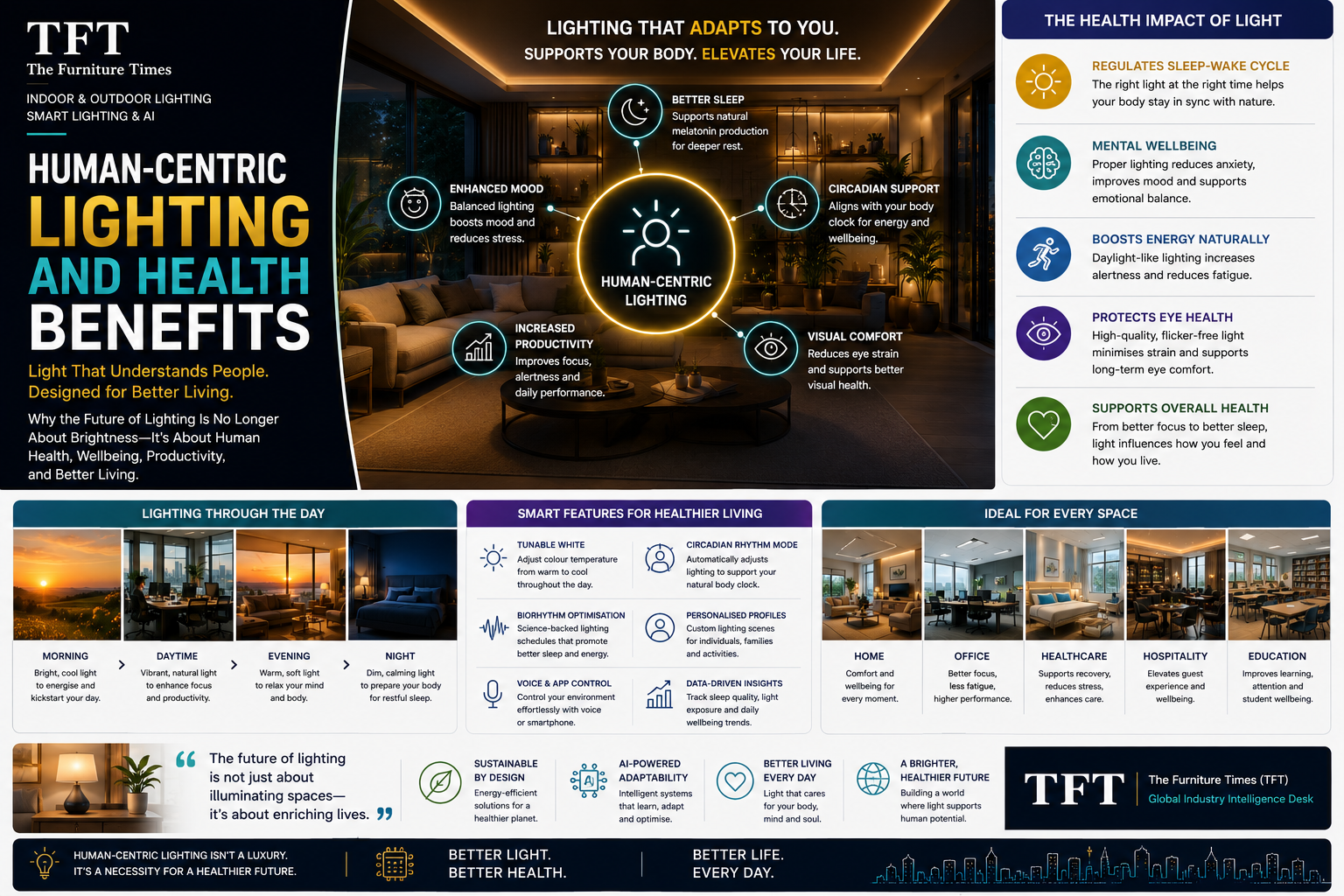
Human-Centric Lighting is designed to recreate the positive effects of natural daylight throughout the day.
Lighting That Changes with You
Unlike conventional lighting, Human-Centric Lighting is dynamic.
Instead of maintaining one fixed brightness or colour temperature, intelligent systems automatically adjust according to time, activity, occupancy, and available daylight.
For example:
Morning lighting becomes brighter and cooler to encourage alertness.
Afternoon lighting supports focus while reducing eye strain.
Evening lighting gradually shifts toward warmer tones that help prepare the body for sleep.
Rather than forcing people to adapt to lighting, the lighting adapts to people.
Homes Are Becoming Healthier Places to Live
Consumers increasingly want homes that support wellbeing rather than simply provide shelter.
Human-Centric Lighting contributes to healthier homes by improving:
- Sleep routines
- Family comfort
- Children’s learning
- Reading environments
- Home office productivity
- Mood
- Relaxation
- Elderly care
- Indoor wellness
- Everyday convenience
Lighting becomes an invisible partner that quietly supports healthier lifestyles.
Workplaces Are Prioritising Employee Wellbeing
Businesses have realised that healthier employees are often more productive, engaged, and satisfied.
Human-Centric Lighting is helping organisations create workspaces that encourage:
- Better concentration
- Higher productivity
- Reduced fatigue
- Improved collaboration
- Greater creativity
- Comfortable meeting environments
- Employee wellbeing
- Lower stress
- Better workplace satisfaction
- Higher retention
Lighting is becoming part of corporate wellbeing strategies rather than merely office infrastructure.
Hospitals Are Redefining Patient Care
Healthcare environments have become one of the strongest adopters of Human-Centric Lighting.
Hospitals increasingly use adaptive lighting to support:
- Patient recovery
- Better sleep
- Reduced anxiety
- Comfortable waiting areas
- Healthcare staff wellbeing
- Intensive care units
- Elderly care
- Rehabilitation centres
- Wellness facilities
- Long-term care environments
Lighting is increasingly recognised as part of the healing environment rather than simply building equipment.
Better Classrooms Begin with Better Light
Educational institutions are also embracing Human-Centric Lighting.
Students spend thousands of hours indoors during their education.
Adaptive lighting can help create classrooms that support:
- Attention
- Reading
- Learning
- Creativity
- Collaboration
- Visual comfort
- Teacher wellbeing
- Reduced fatigue
- Examination environments
- Student engagement
Learning environments become more supportive when lighting reflects human needs.
Hotels Are Selling Better Sleep
Luxury hospitality is changing.
Guests increasingly value quality sleep, wellness, and personalised comfort.
Hotels now use Human-Centric Lighting to create:
- Relaxing guest rooms
- Spa environments
- Comfortable restaurants
- Wellness centres
- Executive lounges
- Conference facilities
- Luxury suites
- Fitness centres
- Rooftop experiences
- Memorable guest journeys
Better lighting contributes directly to better guest experiences.
Furniture Is Becoming Wellness Technology
The relationship between furniture and lighting is evolving rapidly.
Manufacturers are integrating adaptive lighting into:
- Bed frames
- Wardrobes
- Home office furniture
- Bathroom mirrors
- Kitchen cabinetry
- Reading corners
- Display units
- Shelving systems
- Children’s furniture
- Senior living products
Furniture is becoming part of holistic wellbeing ecosystems.
Artificial Intelligence Makes Lighting Personal
AI allows Human-Centric Lighting systems to learn from users.
Future systems can:
- Recognise daily routines.
- Adjust lighting automatically.
- Respond to weather.
- Learn sleep patterns.
- Improve energy efficiency.
- Coordinate with smart furniture.
- Support wellness programmes.
- Personalise environments.
- Predict user preferences.
- Continuously improve comfort.
The result is a home or workplace that becomes increasingly personalised over time.
Sustainability and Human Wellbeing Can Work Together
Human-Centric Lighting supports sustainability by:
- Reducing unnecessary electricity use
- Optimising LED performance
- Extending product lifespan
- Lowering maintenance needs
- Supporting renewable energy integration
- Improving energy management
- Reducing carbon emissions
- Encouraging responsible building design
- Supporting green certifications
- Improving long-term operational efficiency
Healthy buildings can also be environmentally responsible buildings.
Opportunities Across the Furniture Industry Ecosystem
Human-Centric Lighting creates new opportunities for:
- Furniture manufacturers
- Lighting companies
- Interior designers
- Architects
- Healthcare providers
- Hospitality operators
- Educational institutions
- Property developers
- Technology companies
- Wellness-focused startups
Businesses that place human wellbeing at the centre of product design will become increasingly competitive in the global marketplace.
Challenges That Still Need Attention
As adoption grows, the industry must continue addressing:
- Consumer awareness
- Higher initial investment
- Industry standards
- Scientific education
- Product interoperability
- Installation expertise
- Building integration
- Data privacy
- Technology updates
- Skilled workforce development
Addressing these issues will accelerate global adoption.
The Future Will Be Designed Around People
The next generation of lighting will no longer focus solely on technology.
It will focus on people.
Future Human-Centric Lighting systems may integrate with:
- Wearable health devices
- Smart homes
- Medical monitoring
- Building management systems
- Workplace analytics
- Wellness applications
- Elderly care technologies
- Digital healthcare platforms
- AI assistants
- Connected furniture ecosystems
Lighting will quietly become one of the most influential technologies supporting healthier lives.
The Next Revolution Is Human
Human-Centric Lighting represents one of the most meaningful innovations in the lighting industry because it begins with a simple belief:
Technology should improve people’s lives.
Rather than asking how bright lighting should be, designers, manufacturers, architects, and technology companies are now asking how lighting can help people sleep better, work smarter, learn faster, heal sooner, and live healthier.
For the global furniture industry ecosystem, this creates an exciting opportunity to design products and environments where furniture, lighting, AI, wellness, and sustainability work together as one connected experience.
The future of lighting is not simply intelligent.
It is compassionate.
It understands that every room ultimately exists for one purpose—to improve the lives of the people inside it.
The Furniture Times (TFT) & Furniture Industry Search Engine (FISE)
“TFT tells their story. FISE helps the world find them.”
“FurniReviewology helps the world trust them.”
The furniture industry ecosystem is a $1 trillion industry ecosystem.