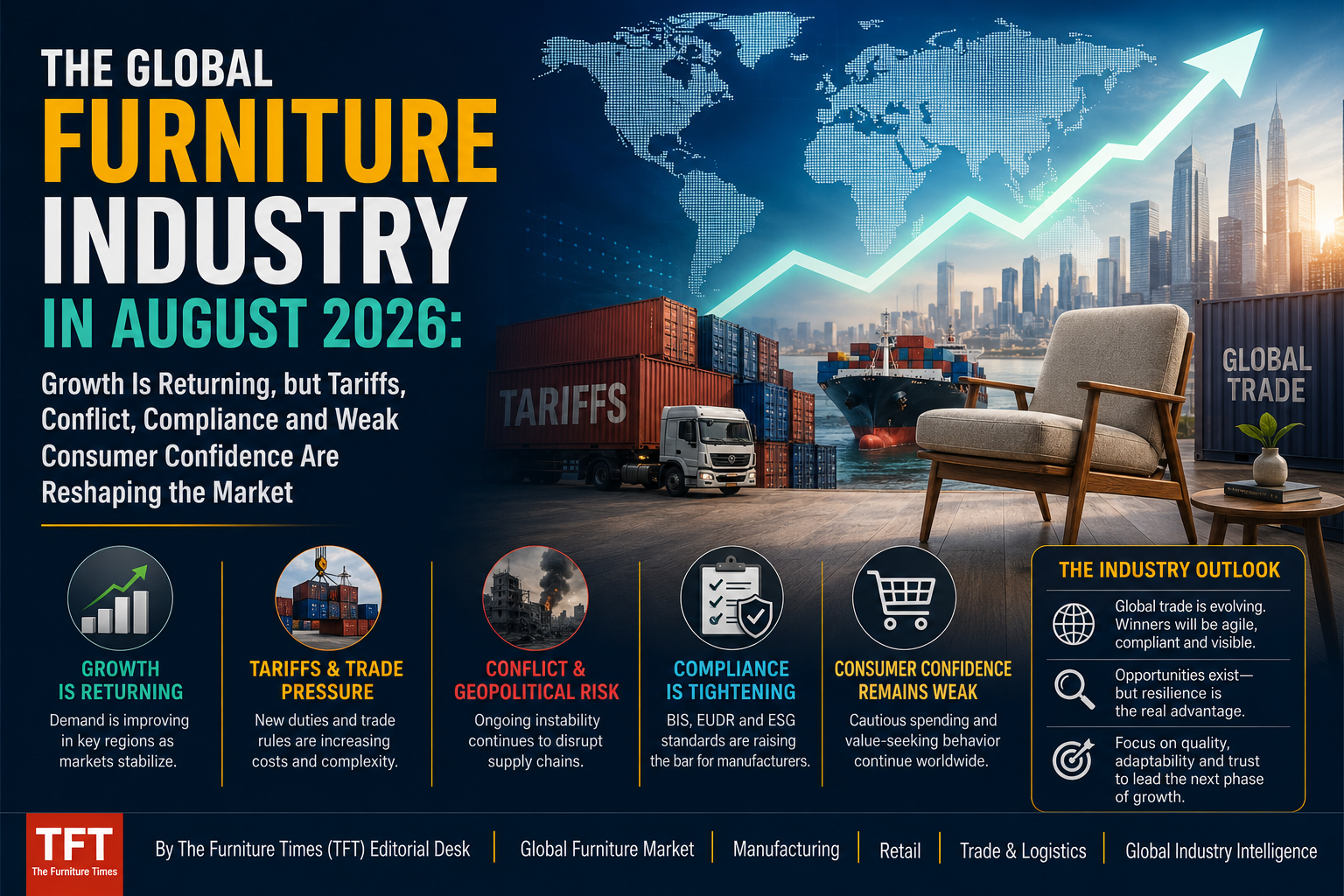
The Global Furniture Industry in August 2026
Growth Is Returning, but Tariffs, Conflict, Compliance and Weak Consumer Confidence Are Reshaping the Market
A detailed global situation report examining furniture demand, manufacturing, retail, housing, international trade, shipping disruption, regulatory change, AI adoption, sustainability and the growing pressure on SMEs
By The Furniture Times (TFT) Editorial Desk | Global Furniture Market | Manufacturing | Retail | Trade & Logistics | Global Industry Intelligence
The global furniture industry has entered the second half of 2026 in a condition best described as fragile stabilization rather than strong recovery.
Demand has not collapsed, but it remains uneven. Housing affordability continues to restrain large household purchases in several developed markets. Commercial and hospitality projects are moving forward, but many buyers are dividing procurement into smaller phases. Export manufacturers are facing tariffs, freight volatility and more demanding compliance requirements. Retailers are balancing heavy promotional activity against the need to protect margins.
At the same time, new opportunities are appearing.
Vietnam remains a powerful furniture-export centre. India is entering a more formal quality-control era. The Gulf continues to invest in hospitality, offices, tourism and urban development despite geopolitical risk. European suppliers are preparing for deforestation-related due diligence. Manufacturers worldwide are investing in automation, product data, customization and AI-assisted commerce.
The industry is therefore moving in two directions simultaneously:
- Short-term pressure from trade disruption, financing costs, geopolitical conflict and cautious consumers.
- Long-term transformation driven by urbanization, technology, compliance, sustainability and changing lifestyles.
CSIL has forecast that global furniture consumption could grow by approximately 1% in current U.S. dollars during 2026—a modest rate that reflects the continuing uncertainty surrounding trade policy, tariffs and consumer spending. The United States remains the world’s largest furniture importer, while China, Vietnam, Poland, Italy and Germany continue to play major roles in global exports. CSIL’s 2026 outlook reported by Fordaq describes an industry that is growing, but only marginally and under unusually unpredictable conditions.
For manufacturers, retailers and investors, 2026 is not a year for passive waiting.
It is a year for supply-chain diversification, regulatory preparation, disciplined visibility, product repositioning and stronger customer intelligence.
Global industry situation at a glance
| Industry factor | Current direction in August 2026 | Implication |
|---|---|---|
| Global furniture consumption | Modest growth | Recovery remains weak and uneven |
| Residential demand | Cautious | Housing affordability restrains large purchases |
| Commercial furniture | Selective improvement | Office adaptation and institutional demand create opportunities |
| Hospitality furniture | Active in growth markets | Renovations and tourism investment support projects |
| Furniture retail | Promotional and margin-sensitive | Customers remain value-conscious |
| International trade | Highly uncertain | Tariffs and investigations are changing sourcing decisions |
| Shipping and logistics | Volatile | Middle East conflict and congestion raise costs |
| Sustainability regulation | Tightening | Traceability and product data are becoming essential |
| India compliance | Major transition | BIS certification now affects notified furniture categories |
| AI and digital commerce | Accelerating | Discovery, visualization and customer service are changing |
| SME conditions | Difficult but opportunity-rich | Flexibility and specialization can win redistributed demand |
A global market that is moving, not standing still
The most important feature of the current furniture economy is not uniform decline or uniform growth. It is redistribution.
Demand is moving:
- From premium products to value-oriented products.
- From complete renovations to phased projects.
- From long-distance imports to regional suppliers.
- From ownership to rental and leasing.
- From new furniture to refurbishment.
- From standard products to multifunctional designs.
- From large minimum orders to flexible production.
- From physical-only retail to omnichannel purchasing.
- From traditional search toward AI-assisted discovery.
- From unverified materials toward traceable supply chains.
A manufacturer may therefore experience falling demand in one product family while another category grows.
For example, large living-room sets may struggle in markets where homes are becoming smaller, while modular sofas and compact storage gain relevance. A premium office-furniture project may be delayed, but repair, reconfiguration and hybrid-working upgrades may proceed.
The challenge is not simply to ask whether furniture demand is rising.
Businesses must ask:
- Which segment is buying?
- What problem is the customer trying to solve?
- Has the budget changed?
- Is the project delayed or divided into phases?
- Is the customer changing supplier?
- Are local alternatives becoming more attractive?
- Is refurbishment replacing full replacement?
- Which countries remain active?
In 2026, the global market is rewarding companies that can detect these shifts early.
United States: the largest import market faces a tariff-driven reset
The United States remains central to the global furniture economy because of the size of its consumer market, hospitality sector, residential construction industry and dependence on imports.
However, U.S. furniture sourcing has become more complicated.
A 25% Section 232 tariff currently remains in effect on certain imported upholstered wooden furniture, kitchen cabinets and bathroom vanities. Planned increases to 30% for covered upholstered furniture and 50% for covered cabinets and vanities were postponed until January 2027, unless the policy changes again or trade agreements provide different treatment.
A Hong Kong Trade and Industry Department summary confirms that the 25% rate remains during 2026 and that the higher rates were deferred for one year. The official trade circular also notes that these charges may apply in addition to other duties and fees.
Consequences for the industry
These tariffs are pushing importers to reconsider:
- Country of origin.
- Product classification.
- Supplier agreements.
- Material sourcing.
- Customs documentation.
- Transfer pricing.
- Inventory timing.
- Private-label margins.
- Retail pricing.
- Domestic assembly.
- Nearshoring.
Importers cannot assume that changing the shipping country changes the legal origin of the product. Customs authorities may examine where the furniture underwent substantial transformation, where critical components originated and whether routing arrangements represent genuine production or tariff circumvention.
Pressure on retail prices and margins
Furniture retailers face difficult choices:
- Pass tariff costs to consumers.
- Absorb part of the cost.
- Negotiate lower factory prices.
- Reduce product specifications.
- Change sourcing countries.
- Consolidate collections.
- Increase domestic procurement.
- Reduce promotional discounts.
Passing the entire cost to consumers could weaken sales in a price-sensitive market. Absorbing it could reduce already pressured margins.
The likely result is a combination of higher prices, narrower assortments, supplier renegotiation and more selective inventory purchasing.
U.S. imports remain strong despite policy uncertainty
Tariffs have not stopped the movement of goods.
U.S. containerized imports reached approximately 2.5 million twenty-foot equivalent units in July 2026, according to Descartes data reported by Reuters. That was the fourth-highest July volume recorded, even though it remained below the near-record level of July 2025. Importers accelerated shipments ahead of policy changes and potential additional costs. Reuters’ August 2026 container-import report illustrates how companies are using inventory timing as a defence against trade uncertainty.
For furniture companies, front-loading can temporarily protect availability, but it carries risks:
- Higher warehouse costs.
- Excess stock.
- Increased borrowing requirements.
- Product obsolescence.
- Promotional pressure.
- Reduced flexibility if consumer tastes change.
Inventory has become a strategic trade-policy decision.
Housing remains the foundation beneath furniture demand
Furniture demand is closely connected to:
- Home purchases.
- Residential construction.
- Rental movement.
- Household formation.
- Renovation.
- Mortgage affordability.
- Consumer confidence.
When people move, build or renovate, they frequently purchase furniture. When housing transactions slow, furniture replacement cycles can lengthen.
In the United States, elevated ownership costs and affordability constraints continue to influence large household purchases. Consumers who remain in their existing homes may still spend on renovation, but they often prioritize essential improvements over discretionary furniture.
This produces a mixed pattern:
- Fewer whole-home furnishing projects.
- Greater interest in individual replacement pieces.
- Demand for financing.
- Stronger comparison shopping.
- Longer decision cycles.
- More attention to durability and value.
- Growth in second-hand and refurbished products.
- Greater interest in modular and multifunctional furniture.
Retailers should not interpret a slower housing market as the complete disappearance of furniture demand. It changes the nature, timing and value of the purchase.
Europe: modest stabilization, but affordability and regulation dominate
European furniture markets remain diverse.
Southern European tourism and hospitality investment can support project furniture, while countries with weak consumer confidence may experience slower residential retail. Germany, France, Italy, Poland, the United Kingdom and the Netherlands remain significant production, consumption or trade centres, but each faces different combinations of inflation, housing supply, labour costs and industrial pressure.
European housing demand remains structurally supported by household formation and inadequate supply in several markets. S&P Global Ratings projected average European house-price growth of more than 4% during 2026, while noting large regional differences and continued affordability challenges. Its European housing outlook suggests that constrained supply can sustain property values without necessarily producing an equally strong volume of furniture purchases.
United Kingdom remains difficult for large-ticket retail
British consumers continue to prioritize food, travel and smaller affordable items more readily than furniture and major electronics.
Reports for July 2026 indicated that larger-ticket categories remained under pressure even as overall retail sales showed modest growth. Consumers are still cautious about expensive discretionary purchases.
Furniture retailers in this environment are relying on:
- Promotions.
- Finance offers.
- Clearance events.
- Digital lead generation.
- Smaller product packages.
- Entry-price collections.
- Delivery incentives.
- Omnichannel service.
But excessive discounting creates a long-term danger. Customers can become trained to delay purchases until the next sale, weakening full-price demand and damaging brand positioning.
The EUDR countdown is becoming commercially urgent
One of the biggest regulatory changes affecting furniture supply chains is the European Union Deforestation Regulation.
The revised implementation timetable establishes 30 December 2026 as the key date for broad application, with later treatment for certain micro and small operators. However, the exact timing and obligations depend on the company’s role, size and whether it deals with timber products already covered by earlier rules.
The European Council confirmed that the targeted revision postponed application until 30 December 2026 while simplifying aspects of the due-diligence process. The Council’s official EUDR update explains the revised timetable.
Furniture manufacturers and exporters should not interpret the postponement as a reason to wait.
They need to prepare:
- Wood-origin data.
- Supplier declarations.
- Geolocation information where required.
- Product classification.
- Risk assessments.
- Due-diligence procedures.
- Chain-of-custody records.
- Digital document management.
- Consistent material descriptions.
- Supplier verification.
Companies that begin preparing only in December may discover that their upstream suppliers cannot provide the information required.
For exporters in Asia, Africa and Latin America, EUDR readiness could become a market-access advantage. European buyers may prefer suppliers capable of providing reliable traceability evidence, even before formal enforcement.
Italy and the premium design sector: creativity remains commercially important
Italy continues to shape the global design conversation through Milan Design Week, Salone del Mobile and its high-value manufacturing clusters.
The 2026 design calendar has demonstrated growing interest in:
- Collectible design.
- Craftsmanship.
- Modular living.
- Cross-cultural collaboration.
- Experiential installations.
- Material innovation.
- Small, curated design events.
- Accessible interpretations of premium design.
A notable commercial trend is the movement of high-concept design into wider consumer markets. Collaborations between internationally known designers and large retail platforms are allowing design language once associated with luxury interiors to reach larger audiences.
This presents both opportunity and pressure.
Premium manufacturers must justify higher prices through:
- Authentic materials.
- Craftsmanship.
- Customization.
- Provenance.
- Durability.
- Repairability.
- Emotional value.
- Strong brand storytelling.
A beautiful product alone may no longer be enough. Customers increasingly expect evidence of why the product is worth its premium.
China: still the largest exporter, but under pressure to reposition
China remains the world’s largest furniture exporter and possesses an industrial ecosystem that is difficult to replicate.
Its strengths include:
- Large-scale production.
- Integrated component supply.
- Hardware manufacturing.
- Machinery access.
- Skilled industrial clusters.
- Rapid prototyping.
- Packaging capability.
- Port infrastructure.
- Digital commerce.
- Broad material availability.
However, China faces several challenges:
- U.S. trade barriers.
- Anti-dumping investigations.
- Slower demand in some export markets.
- Domestic property weakness.
- Rising compliance expectations.
- Competition from Vietnam and other Asian producers.
- Pressure to move beyond low-cost production.
- Greater scrutiny of product origin and routing.
The strategic response is increasingly focused on:
- Automation.
- Original design.
- Smart furniture.
- Higher-value components.
- Sustainable panels.
- Customized manufacturing.
- Domestic brands.
- Direct-to-consumer exports.
- Diversification toward emerging markets.
China’s furniture economy is not disappearing. It is being forced to become more technologically sophisticated and geographically diversified.
Vietnam: export strength meets first-half pressure
Vietnam has become one of the most strategically important furniture-export locations in the world.
Its wood and wood-product exports reached approximately $17.2 billion in 2025, crossing the $17 billion threshold for the first time. The United States accounted for about 55% of the total, demonstrating both Vietnam’s strength and its vulnerability to U.S. trade policy. Ho Chi Minh City’s Investment and Trade Promotion Centre reported that wooden furniture remained the backbone of the export structure.
Early 2026 data, however, showed more difficult conditions.
During the first four months, Vietnamese wooden furniture exports were reported at approximately $3.1 billion, down around 6% year on year, even as total wood and wood-product exports remained broadly stable. ITTO market information reproduced by FDMAsia indicated that stronger demand from Japan, China and Europe was helping offset weaker U.S. conditions.
Vietnam’s strategic challenge
The country must reduce its dependence on one market while maintaining the scale that made it globally competitive.
Priorities include:
- Export diversification.
- Legal timber sourcing.
- EUDR readiness.
- Design ownership.
- Domestic component production.
- Automation.
- Higher-value products.
- Brand development.
- Improved product data.
- Compliance with origin requirements.
Vietnam remains well positioned, but its 2026 performance will depend heavily on how successfully it manages tariff exposure and market diversification.
Malaysia: established manufacturing strength needs stronger brand visibility
Malaysia remains an important furniture-export base, particularly in wooden furniture, rubberwood products, dining furniture, bedroom furniture and original equipment manufacturing.
Muar continues to function as one of Southeast Asia’s most significant furniture clusters, supported by:
- Experienced factories.
- Export knowledge.
- Component suppliers.
- Packaging.
- Logistics.
- Wood-processing capability.
- Industry associations.
- Trade fairs.
However, Malaysian manufacturers face growing competition from Vietnam, China, Indonesia, Turkey, Eastern Europe and other emerging sourcing locations.
Malaysia’s next phase should focus on moving beyond price-based contract manufacturing toward:
- Original brands.
- Design development.
- Product differentiation.
- Sustainability documentation.
- Automated production.
- AI-supported sales.
- Stronger international marketing.
- Digital catalogues.
- Searchable manufacturer profiles.
- Furniture tourism.
- Industry storytelling.
Many capable Malaysian manufacturers remain difficult to discover online. Their production is visible through the brands they manufacture for, but their own companies remain unknown.
That represents a major lost opportunity.
Indonesia: craftsmanship and material identity remain advantages
Indonesia continues to hold a distinctive position through:
- Teak furniture.
- Rattan.
- Natural fibres.
- Handcraft.
- Outdoor furniture.
- Solid-wood production.
- Carving traditions.
- Jepara’s manufacturing ecosystem.
Global interest in authentic materials and artisanal production can support Indonesian suppliers. Yet exporters must address:
- Traceability.
- Consistency.
- Moisture control.
- Delivery reliability.
- Product standardization.
- Digital communication.
- Scaling without losing craftsmanship.
- EUDR requirements.
Indonesia’s strongest opportunity may be to combine heritage craft with modern product documentation, consistent quality and global search visibility.
India: furniture enters a new compliance era
India is one of the most important structural growth opportunities in the global furniture industry.
Drivers include:
- Urbanization.
- Residential construction.
- Young consumers.
- Hospitality investment.
- Office development.
- Organized retail.
- E-commerce.
- Institutional procurement.
- Domestic manufacturing policy.
- Growing interest in branded furniture.
But the Indian market is also undergoing a major regulatory shift.
The Furniture Quality Control Order applies to six notified categories:
| Category | Indian Standard |
|---|---|
| Work chairs | IS 17631:2022 |
| General-purpose chairs and stools | IS 17632:2022 |
| Tables and desks | IS 17633:2022 |
| Storage units | IS 17634:2022 |
| Beds | IS 17635:2022 |
| Bunk beds | IS 17636:2022 |
BIS lists the original Furniture Quality Control Order together with several 2026 amendments and the Transition Facilitation Order under its Scheme-I compulsory certification page.
The compliance transition for micro and small enterprises reached a critical stage in August 2026. Manufacturers must check the latest official orders, exemptions, transition provisions, licensing status and applicability to their products.
Industry consequences
The new framework may:
- Improve product consistency.
- Increase formal testing.
- Encourage better engineering documentation.
- Raise compliance costs.
- Consolidate parts of the market.
- Challenge artisan and small-scale producers.
- Affect imported furniture.
- Strengthen certified manufacturers.
- Reduce uncontrolled product variation.
- Increase demand for laboratories and consultants.
The risk is that smaller producers may struggle with testing facilities, variant declarations, drawings and factory inspection readiness.
India will need sufficient laboratory capacity, clear product grouping, practical SME guidance and efficient certification processing if the policy is to improve safety without creating excessive disruption.
Middle East conflict is reshaping global furniture logistics
The continuing Middle East crisis is one of the most immediate risks facing the global furniture supply chain.
Furniture is especially vulnerable to freight disruption because it is:
- Bulky.
- Container-intensive.
- Relatively low in value per cubic metre.
- Sensitive to delivery deadlines.
- Expensive to store.
- Often project-specific.
- Vulnerable to damage during repeated handling.
On 13 August 2026, Hapag-Lloyd reported a $600 million second-quarter impact linked to the Middle East crisis and disruption around the Strait of Hormuz. Reuters’ report on Hapag-Lloyd demonstrates the scale of the disruption facing major carriers.
Maersk, meanwhile, raised its 2026 financial outlook as strong container demand and higher freight rates supported results, although Middle East disruption and global congestion increased costs. Reuters’ Maersk report noted that Middle East imports had fallen sharply while Asian export demand remained strong.
Furniture-industry consequences
Manufacturers and importers may face:
- Higher freight rates.
- Fuel surcharges.
- War-risk insurance.
- Longer transit times.
- Port changes.
- Container shortages.
- Project delays.
- Working-capital pressure.
- Inventory uncertainty.
- Re-routing costs.
- Increased damage risk.
- Customer penalties.
A furniture order that spends several additional weeks in transit may delay the opening of a hotel, office, restaurant or residential development.
This converts a logistics problem into a project-finance problem.
Gulf furniture demand remains strategically important
Despite geopolitical uncertainty, the Gulf remains one of the most important growth areas for project furniture.
Demand is supported by:
- Tourism strategies.
- Hotel development.
- Premium residential projects.
- Office expansion.
- Retail construction.
- Healthcare investment.
- Education facilities.
- Airports.
- Entertainment.
- Government-led urban development.
- Large mixed-use developments.
Saudi Arabia and the United Arab Emirates remain particularly influential. Qatar, Oman, Bahrain and Kuwait also present specialized opportunities.
However, suppliers should not assume that every announced project will proceed according to its original timeline or scale. Large developments can be:
- Phased.
- Redesigned.
- Rebudgeted.
- Delayed.
- Retendered.
- Value-engineered.
Successful Gulf suppliers require:
- Project-management capability.
- Specification compliance.
- Sample control.
- Installation capacity.
- Local partnerships.
- Strong financial planning.
- Reliable logistics.
- Clear documentation.
- After-sales support.
The Gulf opportunity remains real, but it is becoming more professional and demanding.
Africa: long-term potential, short-term fragmentation
Africa presents long-term furniture demand through:
- Population growth.
- Urbanization.
- Housing.
- Education.
- Healthcare.
- Hospitality.
- Offices.
- Retail development.
- Government institutions.
However, the market is fragmented across countries with different:
- Import rules.
- Currency conditions.
- Infrastructure.
- Consumer incomes.
- Local manufacturing capabilities.
- Distribution systems.
- Political risks.
Imported ready-to-assemble furniture competes with domestic artisans and small factories. In many markets, local furniture production remains economically important but digitally invisible.
The largest opportunities may come from developing:
- Regional manufacturing hubs.
- Sustainable timber value chains.
- Vocational training.
- Component distribution.
- Affordable standardized furniture.
- Institutional procurement.
- Digital business directories.
- Local design brands.
Africa should not be treated as one furniture market. Each country requires separate analysis.
Latin America: regional manufacturing meets trade-policy change
Brazil and Mexico remain central to Latin America’s furniture ecosystem.
Brazil has substantial:
- Timber resources.
- Panel production.
- Domestic demand.
- Furniture clusters.
- Design capability.
- Export potential.
However, U.S. trade action has increased uncertainty. In July 2026, the United States announced new tariffs affecting a range of Brazilian goods, including furniture. Reuters’ report on the July tariff action highlights the risk that politically driven trade measures can rapidly change the economics of export programmes.
Mexico remains attractive because of:
- Proximity to the United States.
- Shorter transit times.
- Manufacturing experience.
- North American trade integration.
- Potential nearshoring advantages.
But nearshoring is not automatic. Factories need capacity, compliance, local inputs, skilled labour and reliable logistics.
Furniture retail is becoming a battle for value and trust
Consumers in 2026 are not simply looking for the cheapest product.
They are comparing:
- Price.
- Delivery.
- Material quality.
- Dimensions.
- Reviews.
- Warranty.
- Assembly.
- Return policies.
- Financing.
- Sustainability.
- Product origin.
- Replacement parts.
- Brand reliability.
Retailers that compete only through discounts may generate traffic but weaken long-term profitability.
The strongest retail strategies combine:
- Clear product information.
- Good photography.
- Room visualization.
- Honest reviews.
- Transparent delivery promises.
- Financing.
- Responsive service.
- Physical product experience.
- Digital convenience.
- Strong after-sales support.
The furniture website is no longer merely a catalogue. It is becoming a decision-support system.
AI is moving from experimentation to infrastructure
Artificial intelligence is beginning to affect almost every stage of the furniture value chain.
Product discovery
Customers increasingly use conversational search to ask for recommendations based on:
- Room size.
- Budget.
- Style.
- Location.
- Delivery deadline.
- Material preference.
- Sustainability.
- Intended use.
Brands with incomplete or inconsistent product data may be excluded from these answers.
Visualization
AI and 3D tools can help customers:
- Place products in rooms.
- Compare colours.
- Generate layouts.
- Visualize combinations.
- Explore customization.
- Reduce uncertainty.
Manufacturing
AI can support:
- Demand forecasting.
- Cutting optimization.
- Quality inspection.
- Predictive maintenance.
- Production scheduling.
- Inventory planning.
- Defect detection.
Customer service
AI assistants can answer routine questions, but poor implementation can create incorrect claims about availability, dimensions, warranties or delivery.
Human oversight remains essential.
Marketing
Generative tools can accelerate content production, but the market is becoming crowded with generic material. Original knowledge, real project evidence and credible authorship will become more valuable—not less.
Furniture has a product-data problem
AI adoption is exposing a weakness that already existed: inconsistent product information.
Furniture companies frequently publish:
- Different dimensions across platforms.
- Missing material information.
- Incomplete finish descriptions.
- Inconsistent model codes.
- Unclear certification claims.
- Poor-quality images.
- Unstructured PDF catalogues.
- Conflicting product names.
- Inaccurate availability.
This creates difficulties for:
- Customers.
- Dealers.
- Designers.
- E-commerce platforms.
- Search engines.
- AI systems.
- Installers.
- After-sales teams.
The industry needs more consistent data standards covering:
- Product identity.
- Dimensions.
- Materials.
- Finishes.
- Components.
- Assembly.
- Certifications.
- Repair information.
- Warranty.
- Digital assets.
- Sustainability.
- Recycling.
Furniture companies that solve their data problems will be better positioned for search, AI discovery, cross-border sales and digital marketplaces.
Sustainability is shifting from branding to evidence
Sustainability claims are under increasing scrutiny.
It is no longer enough to use phrases such as:
- Eco-friendly.
- Green furniture.
- Sustainable wood.
- Responsible product.
- Carbon neutral.
- Recycled.
Buyers increasingly expect evidence.
That may include:
- Timber origin.
- Certification.
- Recycled content.
- Chemical information.
- Product life expectancy.
- Repairability.
- Replaceable components.
- Take-back programmes.
- Packaging reduction.
- Factory energy data.
- Environmental product declarations.
- Chain-of-custody records.
EUDR is one example of the movement toward verifiable supply-chain information. Digital product passports and broader circular-economy policies could increase this pressure further.
The furniture industry is moving from environmental storytelling toward environmental documentation.
Circular furniture is becoming an economic category
Economic pressure and sustainability concerns are strengthening interest in:
- Used furniture.
- Refurbishment.
- Rental.
- Repair.
- Remanufacturing.
- Liquidation.
- Certified pre-owned products.
- Asset recovery.
- Parts harvesting.
- Material recycling.
The opportunity extends beyond consumers.
Hotels, offices, schools and institutions frequently replace large volumes of furniture. Those assets can be:
- Resold.
- Refinished.
- Reupholstered.
- Donated.
- Exported.
- Reconfigured.
- Recycled.
Furniture manufacturers may eventually need to decide whether they want to participate in the second life of their own products—or leave that value entirely to third parties.
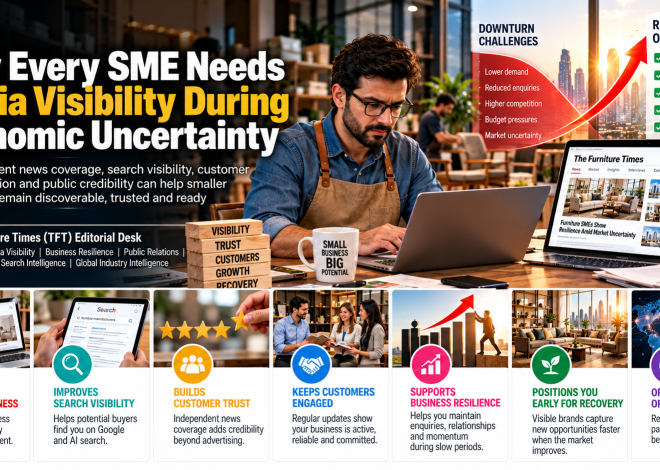
SMEs face the greatest pressure—and some of the best openings
Small and medium-sized furniture businesses are vulnerable because they often have:
- Limited cash reserves.
- Weak bargaining power.
- Dependence on a few customers.
- Higher borrowing costs.
- Limited compliance staff.
- Poor digital visibility.
- Lower purchasing volume.
- Minimal data systems.
But they also possess advantages:
- Faster decisions.
- Customization.
- Smaller minimum orders.
- Specialized craftsmanship.
- Local service.
- Direct management involvement.
- Flexible production.
- Niche expertise.
In a volatile market, buyers may need exactly this flexibility.
The challenge is ensuring that SMEs can be found and trusted.
A skilled furniture maker cannot win an international order if the buyer cannot discover the company. A component supplier cannot receive an enquiry if its products are absent from search results. An artisan cannot preserve a craft if the market cannot see the work.
Visibility is therefore becoming a form of market access.
What furniture businesses should prioritize for the rest of 2026
1. Review tariff exposure
Map every product by:
- HS classification.
- Country of origin.
- Material.
- Destination.
- Applicable duty.
- Possible future rate.
2. Diversify customers and markets
Dependence on one customer or destination creates vulnerability.
3. Improve supply-chain visibility
Know the origin, specification and availability of critical materials and components.
4. Prepare for compliance
Prioritize BIS, EUDR, product safety, labelling and market-specific standards where applicable.
5. Protect cash flow
Account for longer transit times, delayed projects, inventory costs and payment risk.
6. Strengthen product data
Make products understandable to customers, dealers, search engines and AI systems.
7. Maintain advertising and media visibility
Weak conditions are not a reason to disappear. They are a reason to communicate more efficiently.
8. Develop value-engineered options
Offer alternative materials, phased procurement and multiple price levels without concealing quality changes.
9. Invest in after-sales service
Repair, spare parts, warranties and maintenance can create revenue while strengthening trust.
10. Monitor demand weekly
Track:
- Enquiry volume.
- Search behaviour.
- Order size.
- Conversion.
- Geography.
- Project delays.
- Product-category shifts.
- Lost-sale reasons.
Global outlook for the remainder of 2026
The most likely global scenario is continued low growth accompanied by high volatility.
Factors that could support the industry
- Easing inflation.
- Lower financing costs.
- Improved housing transactions.
- Stronger hospitality investment.
- Urban development.
- Institutional procurement.
- Tourism recovery.
- Increased consumer confidence.
- AI-enabled retail.
- Supply-chain normalization.
Factors that could weaken the industry
- Wider Middle East conflict.
- Continued Hormuz or Red Sea disruption.
- Higher freight and fuel costs.
- Additional tariffs.
- Housing weakness.
- Currency volatility.
- Retail failures.
- Excess inventory.
- Compliance bottlenecks.
- Reduced business investment.
- Consumer caution.
The sector is unlikely to return to a simple pre-disruption model. Trade, sustainability, search and technology have changed too significantly.
The next furniture economy will be:
- More regulated.
- More digitally discoverable.
- More data-dependent.
- More regionally diversified.
- More service-oriented.
- More transparent.
- More circular.
- More exposed to geopolitical events.
- More dependent on trust.
Conclusion: The furniture industry is not in crisis everywhere—but it is changing everywhere
The global furniture industry in August 2026 is neither booming nor collapsing.
It is reorganizing.
The United States remains commercially essential but increasingly difficult because of tariffs and affordability. Europe is balancing weak discretionary demand against housing needs and major sustainability regulation. China is moving toward higher-value and technology-driven production. Vietnam remains a furniture-export powerhouse while confronting concentration risk. India is formalizing furniture quality through BIS requirements. Southeast Asia continues competing for global sourcing. The Gulf offers large project opportunities amid serious geopolitical risk.
Across every region, the same strategic themes are emerging:
- Visibility matters.
- Product data matters.
- Compliance matters.
- Supply-chain intelligence matters.
- Customer trust matters.
- Flexibility matters.
The companies most likely to succeed will not necessarily be the largest. They will be the businesses that understand where demand is moving, control their supply chains, document their products, remain searchable and respond quickly to changing customer priorities.
The $1 trillion furniture industry ecosystem remains one of the world’s most diverse and economically important industrial networks.
But much of that ecosystem is still invisible.
The next stage of industry development must connect global intelligence with local opportunity—helping manufacturers, retailers, designers, craftspeople, suppliers and service providers become visible across borders.
The global furniture industry is entering a new era in which manufacturing capability alone is not enough. Companies must be compliant, connected, searchable, adaptable and trusted.
he Furniture Times (TFT) & Furniture Industry Search Engine (FISE)
“TFT tells their story. FISE helps the world find them.”
FurniReviewology helps the world trust them.
The furniture industry ecosystem is a $1 trillion industry ecosystem.
Understand the market. Become searchable. Build trust. Be part of the global furniture movement.