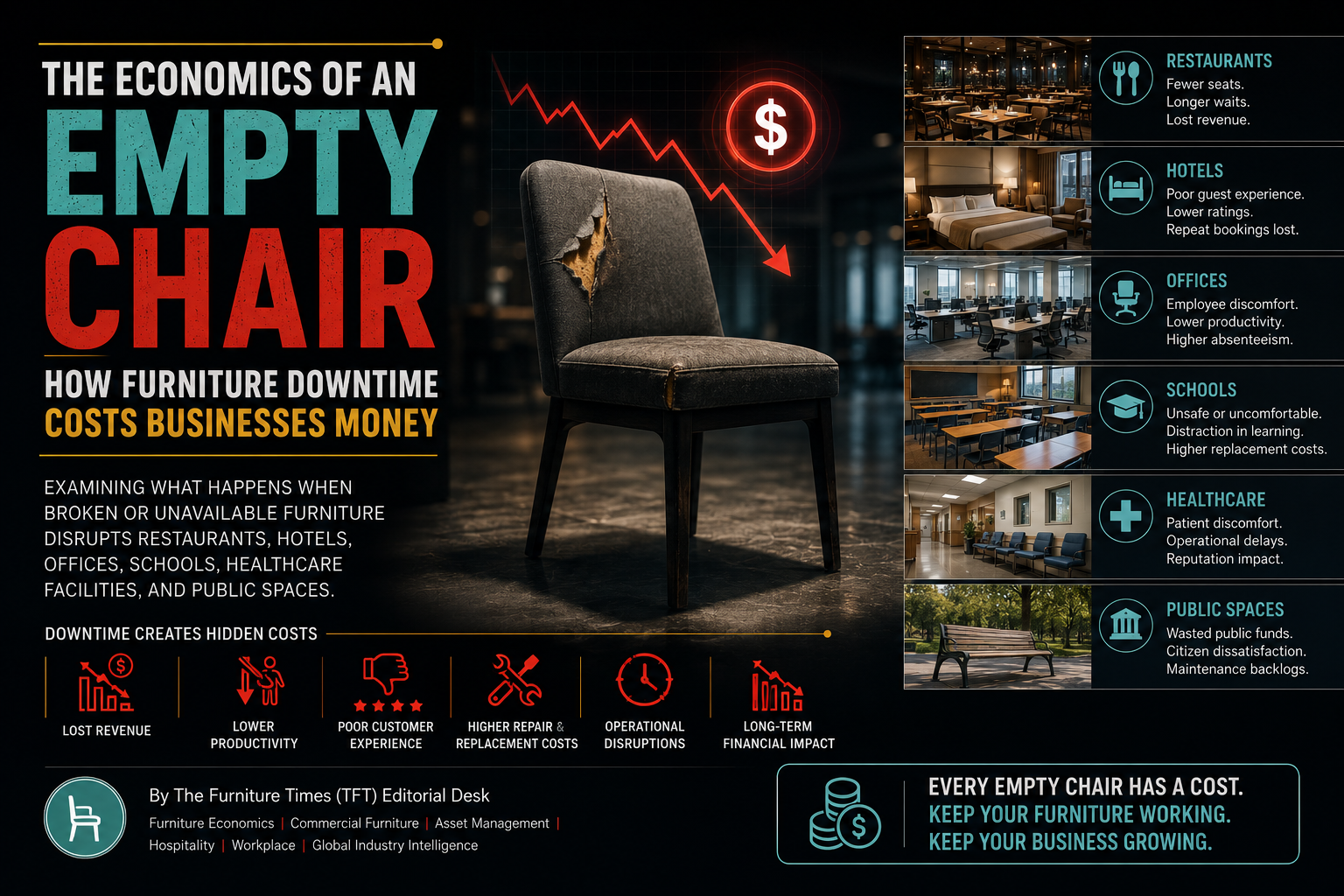
The Economics of an Empty Chair: How Furniture Downtime Costs Businesses Money
Examining What Happens When Broken or Unavailable Furniture Disrupts Restaurants, Hotels, Offices, Schools, Healthcare Facilities, and Public Spaces
By The Furniture Times (TFT) Editorial Desk | Furniture Economics | Commercial Furniture | Asset Management | Hospitality | Workplace | Global Industry Intelligence
A chair is rarely viewed as a revenue-generating asset.
A hotel bed is rarely discussed like productive infrastructure.
A school desk is rarely treated as an operational necessity.
A waiting-room seat is rarely measured in terms of service capacity.
A restaurant table is usually categorized as furniture.
But what happens when that furniture cannot be used?
A broken dining chair may remove one restaurant seat from service.
A damaged hotel bed may make an entire room temporarily unsellable.
A failed office workstation may disrupt an employee.
A broken hospital recliner may reduce patient or visitor capacity.
A damaged classroom desk may force a school to improvise.
A public bench removed for repair reduces available seating.
Individually, these incidents appear small.
Across thousands of commercial spaces, however, unusable furniture creates something the industry rarely measures:
Furniture Downtime.
And furniture downtime has an economic cost.
The true cost of furniture failure is therefore not simply the price of repairing or replacing the product.
It can include:
lost revenue,
lost capacity,
employee disruption,
room closures,
customer dissatisfaction,
maintenance labour,
temporary replacements,
administrative time,
logistics,
safety concerns,
and reputational damage.
The furniture industry has historically focused on the purchase price of furniture.
Commercial users need to begin focusing more seriously on something else:
The Cost of Furniture Being Unavailable.
What Is Furniture Downtime?
Furniture downtime is the period during which a furniture asset cannot perform its intended function.
That may happen because the product is:
broken,
unsafe,
under repair,
awaiting spare parts,
awaiting inspection,
damaged during cleaning,
removed after an incident,
unavailable because of delayed replacement,
or no longer suitable for operational use.
The concept sounds simple, but it has large implications.
Businesses already measure downtime in:
factories,
data centres,
aviation,
transportation,
machinery,
and technology systems.
A machine that stops production has a measurable cost.
A server outage has a measurable cost.
A grounded aircraft has a measurable cost.
But commercial furniture downtime is rarely treated with the same discipline.
Why not?
Furniture is part of operational infrastructure too.
The Empty Restaurant Chair
Consider a busy restaurant.
The restaurant has 100 seats.
Five chairs are broken and removed from service.
That may appear insignificant.
But the business has effectively lost 5% of its seating capacity.
If those seats would normally turn over multiple times during a busy evening, the revenue loss may accumulate.
The chair itself might cost only a few hundred dollars.
But the revenue enabled by that chair over its lifetime may be many times greater.
This changes how the chair should be evaluated.
The business should not think only:
“What did this chair cost us?”
It should also ask:
“How much revenue does this chair help us generate?”
That is the economics of furniture productivity.
One Broken Chair Can Cost More Than the Chair
Imagine a restaurant chair costs $150.
The chair breaks.
A replacement takes three weeks to arrive.
During that period, the seat remains unavailable.
If the average guest spends $40 and the chair could have supported multiple diners per day, the potential lost revenue may quickly exceed the original purchase price.
The exact figure depends on:
occupancy,
table configuration,
turnover,
average customer spend,
operating hours,
and whether the restaurant can rearrange seating.
But the principle is important.
The cost of furniture failure can exceed the cost of furniture itself.
This is why durability should be evaluated economically, not only technically.
Restaurants Are Capacity Businesses
Restaurants monetize:
tables,
chairs,
space,
time,
and customer turnover.
A restaurant can have excellent food, strong demand and efficient staff.
But if seating is unavailable, revenue capacity decreases.
Furniture therefore becomes part of the restaurant’s production system.
A damaged dining table can remove multiple seats simultaneously.
A broken booth can affect an entire customer group.
A damaged outdoor furniture set can reduce terrace capacity during peak periods.
Furniture reliability should therefore be part of restaurant operational planning.
The Hotel Bed Is a Revenue Asset
The economics become even clearer in hospitality.
A hotel room without a usable bed is not simply a room with damaged furniture.
It may be:
unsellable inventory.
Suppose a hotel room generates significant nightly revenue.
If a bed frame, mattress base, headboard installation, sleeper sofa or essential furniture element becomes unsafe or unusable, the room may need to be taken out of service.
The cost of the problem is therefore not simply:
replacement bed: X.
It may also include:
lost room revenue,
guest relocation,
compensation,
maintenance labour,
and operational disruption.
A relatively inexpensive component could therefore create a much larger economic loss.
One $20 Component Could Make a $300 Hotel Room Unavailable
This illustrates one of the most important concepts in furniture downtime.
Imagine a hotel bed contains a small component that costs $20.
That component fails.
The hotel cannot safely use the bed.
A replacement part is unavailable locally and takes four days to arrive.
If the room sells for $300 per night, the theoretical revenue exposure can be far greater than the price of the component.
This creates a completely different way to evaluate spare parts.
The important question is not simply:
“How much does the replacement part cost?”
It is:
“What does it cost us to wait for it?”
Spare-part availability is therefore an operational-performance issue.
Hotels Need Furniture Uptime
Hospitality operators increasingly measure:
occupancy,
RevPAR,
ADR,
guest satisfaction,
maintenance response,
and room availability.
Furniture uptime should also be considered.
A hotel could theoretically measure:
percentage of furniture assets fully operational,
average time to repair,
number of rooms affected by furniture failure,
failure frequency by product type,
and spare-part response time.
These metrics would help operators identify whether furniture is supporting or undermining hotel performance.
Office Furniture Downtime Is a Productivity Problem
The economic impact is different in offices.
A failed office chair may not directly eliminate revenue capacity.
But it can affect:
comfort,
productivity,
employee satisfaction,
workspace availability,
and health and safety.
Imagine an office designed around flexible workstations.
If multiple chairs, sit-stand desks or workstation components become unusable, employees may:
move locations,
lose time,
wait for replacements,
work in unsuitable positions,
or occupy spaces intended for others.
The individual interruption may be small.
Across a large organization, repeated furniture failures create accumulated productivity loss.
Furniture uptime is therefore relevant to workplace management.
Hybrid Work Makes Furniture Availability More Important
Flexible and hybrid workplaces often rely on shared resources.
Employees arrive expecting a functional:
desk,
chair,
meeting room,
collaboration area,
or touchdown space.
A broken asset reduces available capacity.
If an organization carefully plans desk-to-employee ratios but ignores furniture downtime, the actual usable capacity may be lower than expected.
For workplace operators, the real metric should therefore not simply be:
number of desks.
It should be:
Number of Usable Desks.
This distinction matters.
Sit-Stand Desks Introduce Mechanical Downtime
Traditional desks have relatively few moving parts.
Modern sit-stand desks can contain:
motors,
controllers,
power supplies,
sensors,
lifting columns,
switches,
and electronic components.
This creates new failure possibilities.
A powered desk may still function as a fixed desk after a motor failure, but it may no longer provide the functionality employees were promised.
The growth of smart and powered furniture therefore makes uptime increasingly relevant.
As furniture becomes technological, maintenance expectations will also rise.
Healthcare Furniture Downtime Has Higher Stakes
Furniture plays a major role in healthcare environments.
Hospitals, clinics and care facilities use:
patient chairs,
recliners,
visitor seating,
treatment furniture,
waiting-room furniture,
overbed tables,
storage systems,
and specialized support furniture.
Failure in these settings can have consequences beyond inconvenience.
Furniture may need to support:
patients with limited mobility,
elderly users,
caregivers,
clinical procedures,
or infection-control routines.
If specialized furniture becomes unavailable, operational flexibility can decrease.
Healthcare buyers therefore need to consider:
durability,
repair response,
cleanability,
component availability,
and maintenance support.
Furniture uptime in healthcare is fundamentally connected to service reliability.
A Waiting Room Has Capacity Too
Consider a clinic waiting area.
If ten out of fifty chairs are unavailable, seating capacity falls by 20%.
Patients may stand.
Crowding may increase.
Customer experience deteriorates.
Operational staff may need to rearrange furniture.
Again, the cost is not necessarily captured in a traditional furniture budget.
But the service environment has clearly been affected.
The chair is part of the facility’s capacity.
Schools Face a Different Furniture Downtime Problem
Educational furniture is used intensively.
Desks and chairs may be used daily for years.
If classroom furniture becomes damaged, schools may:
move students,
share furniture,
use temporary substitutes,
delay classes,
or continue using unsuitable items.
Budget limitations may also mean replacements take time.
For schools, durable and repairable furniture can have long-term economic value.
A desk that costs slightly more but survives years of intensive use may be more economical than a cheaper product requiring repeated replacement.
This is particularly important where procurement budgets are constrained.
Classroom Furniture Is Learning Infrastructure
A classroom requires more than walls and teachers.
Students need usable physical environments.
That includes:
desks,
chairs,
storage,
laboratory furniture,
library furniture,
and collaborative seating.
If these assets deteriorate, the educational environment deteriorates with them.
Furniture should therefore be viewed as part of learning infrastructure.
Maintenance and replacement planning should reflect that importance.
Public-Space Furniture Also Has Downtime
Cities invest in:
benches,
street furniture,
transport seating,
park furniture,
library furniture,
community-centre furniture,
and public waiting areas.
When these assets are damaged, vandalized or removed for maintenance, public capacity decreases.
A damaged bench may not produce revenue.
But it provides civic utility.
If enough public furniture is unavailable, residents experience:
lower comfort,
reduced accessibility,
poorer public-space usability,
and potentially lower satisfaction.
Furniture downtime therefore has social as well as financial consequences.
Airports Understand Seating Capacity Better Than Most
Airports offer an interesting example.
Passenger seating is a capacity resource.
When terminal furniture is damaged or removed:
passengers stand,
circulation patterns change,
crowding increases,
and customer experience may deteriorate.
In high-traffic environments, furniture is subjected to extreme usage.
Durability becomes essential.
The economics of airport furniture are therefore not based only on acquisition cost.
They depend heavily on lifetime reliability.
The Real Cost of a Furniture Failure Has Multiple Layers
Businesses often calculate a furniture failure like this:
Repair cost: $100.
But the real cost may include:
Direct Cost
repair,
replacement part,
replacement product.
Labour Cost
maintenance staff,
technician time,
administration,
inspection.
Logistics Cost
shipping parts,
urgent courier,
transporting replacement furniture.
Operational Cost
lost seat,
lost room,
lost workstation,
reduced capacity.
Customer Cost
complaints,
refunds,
compensation,
negative reviews.
Safety Cost
incident investigation,
temporary closure,
risk exposure.
Management Cost
time spent resolving the issue.
The true cost of failure is therefore often much larger than the invoice from the repair company.
Furniture Procurement Often Optimizes the Wrong Number
Commercial furniture procurement frequently focuses heavily on purchase price.
Supplier A offers a chair for $120.
Supplier B offers a chair for $150.
The $120 chair appears cheaper.
But what if over five years:
Supplier A’s chair requires more repairs,
has poorer spare-part availability,
fails more often,
and takes longer to restore to service?
The cheaper chair may actually be more expensive.
Commercial buyers therefore need to move from:
Purchase Price
to:
Cost Per Year of Reliable Use.
This is a much stronger procurement metric.
The Cost of Downtime Should Be Included in Total Cost of Ownership
Furniture total cost of ownership could include:
purchase price,
delivery,
installation,
maintenance,
repair,
replacement parts,
cleaning,
refurbishment,
disposal,
and residual value.
But another variable should be added:
Downtime Cost.
For revenue-producing environments, this can be significant.
A hotel chair may indirectly support revenue.
A restaurant seat directly supports revenue.
A workstation supports employee productivity.
A healthcare recliner supports service delivery.
Ignoring downtime can make apparently inexpensive furniture look more economical than it really is.
Availability of Spare Parts Is a Financial Variable
The furniture industry often treats spare parts as an after-sales issue.
Businesses should treat them as an uptime issue.
A product can be repairable in theory but effectively unrepairable if the part takes months to arrive.
Commercial buyers should ask:
Are spare parts stocked locally?
How long will parts remain available?
What is the average lead time?
Can technicians replace them on-site?
Are components standardized?
Can equivalent parts be used?
These questions directly affect business continuity.
Standardized Components Could Reduce Downtime
Furniture built around highly proprietary components can create long-term dependency.
If one small proprietary mechanism becomes unavailable, the entire product may become difficult to repair.
Standardized components can make maintenance easier.
Examples include:
casters,
hinges,
slides,
fasteners,
power supplies,
gas lifts,
and connectors.
Greater standardization could help commercial users maintain furniture more efficiently.
This does not mean eliminating innovation.
It means designing innovation with maintenance in mind.
Repairability Is an Uptime Feature
Repairability is frequently discussed through sustainability.
But it is equally important operationally.
A chair that can be repaired on-site in ten minutes has higher operational resilience than one that must be shipped back to a factory.
A sofa with replaceable covers can return to service faster.
A hotel desk with replaceable hardware can remain in use longer.
A modular workstation can have individual components replaced without dismantling everything.
Repairability should therefore be treated as:
A Business Continuity Feature.
Modular Furniture Can Reduce Operational Disruption
Modular design offers another advantage.
If one part fails, the entire asset may not need to be removed.
For example:
replaceable seat shells,
replaceable chair bases,
modular sofa sections,
replaceable desk motors,
removable tabletops,
and interchangeable storage modules.
This reduces downtime.
It also lowers repair and replacement costs.
The modular furniture conversation should therefore include operational resilience, not only design flexibility.
Furniture Maintenance Should Become Predictive
Many businesses repair furniture only after it fails.
That is reactive maintenance.
A more sophisticated model is preventive or predictive maintenance.
Hotels could inspect:
bed frames,
chair joints,
recliner mechanisms,
table stability,
and outdoor furniture.
Restaurants could inspect high-use chairs and booths.
Offices could track powered desks and task chairs.
Healthcare facilities could monitor specialized furniture.
If predictable wear is identified early, repair can happen before failure.
This reduces downtime.
Data Can Reveal Which Furniture Is Most Expensive to Keep Running
Imagine a hotel tracks every furniture service ticket.
After several years, management discovers:
Chair Collection A averages one repair every eight years.
Chair Collection B averages one repair every eighteen months.
The purchase price difference may have been small.
The lifecycle economics are not.
This is why maintenance records should feed back into procurement.
Businesses should buy based on evidence from real-world performance.
Warranty Data Can Become Downtime Intelligence
Warranty systems usually record:
claim date,
problem,
product,
replacement,
and resolution.
They could also record:
days unavailable.
This would create a powerful metric:
Average Downtime Per Failure.
A product that fails occasionally but can be repaired within hours may be less disruptive than one that fails rarely but requires weeks to restore.
Frequency and recovery time both matter.
The Furniture Industry Needs an MTTR Metric
Technology and industrial maintenance often use a metric called Mean Time to Repair.
Furniture businesses could adopt a similar approach.
Mean Time to Repair — Furniture
How long does it take from reported failure to full restoration?
For example:
office chair: 2 days,
hotel bed: 6 hours,
motorized recliner: 7 days,
restaurant booth: 3 days.
This metric would reveal whether suppliers and maintenance systems are responsive enough.
Another Metric: Furniture Uptime Percentage
Commercial operators could calculate:
Furniture Uptime Percentage.
For example:
99.8% of hotel-room furniture available.
98.5% of restaurant seating operational.
99.2% of office workstations usable.
This may sound excessively technical for furniture.
But commercial assets are becoming more sophisticated.
As furniture becomes connected, powered and integrated into service environments, uptime becomes increasingly relevant.
Furniture Suppliers Could Offer Uptime Guarantees
This creates an interesting future business model.
Instead of selling only products, suppliers could sell:
Furniture Uptime.
A contract might include:
product,
installation,
preventive maintenance,
replacement parts,
repair response,
and guaranteed service levels.
For example:
critical furniture repaired within 24 hours.
Replacement seating supplied within 48 hours.
Essential components stocked locally.
This changes the manufacturer from product seller to operational partner.
Furniture-as-a-Service Makes Uptime Even More Important
Rental and subscription furniture models depend on operational availability.
If customers pay monthly for furniture, they expect it to work.
Providers therefore need:
maintenance systems,
repair networks,
replacement inventory,
parts availability,
and lifecycle data.
Furniture-as-a-service could accelerate the shift toward uptime-based thinking.
The provider retains ownership of the asset.
That creates a strong incentive to maximize reliability.
Insurance May Eventually Recognize Downtime Risk
Furniture insurance discussions traditionally focus on:
damage,
liability,
property,
cargo,
and replacement.
Commercial operators may also experience consequential losses from furniture failure.
Whether and how such losses are covered depends on specific policy terms and circumstances.
But from a risk-management perspective, businesses should at least identify their critical furniture dependencies.
Which furniture failures could interrupt revenue or operations?
Those assets deserve higher attention.
Not All Furniture Has the Same Criticality
A decorative side table in a hotel lobby is different from a guest-room bed.
A conference-room side chair is different from a core workstation.
A restaurant decoration is different from dining seating.
Businesses should classify furniture by operational criticality.
For example:
Critical
Failure directly affects revenue, safety or service delivery.
Important
Failure creates disruption but operations can continue.
Non-Critical
Failure has limited operational effect.
This helps maintenance teams prioritize repairs.
The Hotel Bed Should Probably Be Classified as Critical Infrastructure
In hospitality, some furniture should be viewed almost as operational equipment.
Beds.
Essential room seating.
Built-in storage.
Certain fixtures.
If their failure makes a room unsellable or unsafe, they directly affect hotel inventory.
This suggests hospitality furniture procurement should borrow more thinking from facilities management and industrial asset management.
Furniture Downtime Can Create Reputational Damage Too
Imagine a guest enters a hotel room and finds a broken chair.
A restaurant customer sits at an unstable table.
An office employee repeatedly reports a malfunctioning desk.
A patient finds damaged seating in a clinic.
These experiences communicate something about the organization:
lack of maintenance,
poor quality,
or weak attention to detail.
Furniture failure can therefore affect brand perception.
The cost is difficult to quantify, but it is real.
Social Media Makes Small Failures More Visible
A single broken chair may once have been a private operational issue.
Today, it can become:
a photo,
a review,
a social-media post,
or a viral complaint.
Furniture condition is part of customer experience.
Commercial operators should therefore understand that maintenance quality is increasingly visible to the public.
The Cheapest Repair Is Often the One Completed Before Failure
Preventive maintenance may appear to add cost.
But it can reduce emergency repairs.
Tightening a connection before it fails may cost minutes.
Repairing a broken chair after an accident can cost much more.
Replacing worn glides before flooring is damaged can reduce secondary costs.
Servicing a mechanism before complete failure can prevent room downtime.
This is basic asset-management logic.
Furniture should not be excluded from it.
Digital Product Passports Could Reduce Downtime
A digital furniture passport could immediately provide maintenance teams with:
product model,
installation date,
component specifications,
repair instructions,
spare-part numbers,
warranty information,
and service history.
This would eliminate one of the largest sources of repair delay:
not knowing what the product is.
A technician should not need hours to identify a hinge, motor or mechanism.
The information should travel with the furniture.
AI Could Help Predict Which Furniture Will Fail Next
If businesses combine:
age,
usage,
repair history,
component information,
environment,
and historical failure data,
AI systems could potentially identify higher-risk assets.
A hotel might know that a particular chair model typically develops joint problems after a certain usage period.
Instead of waiting for guest complaints, maintenance could inspect those chairs first.
This moves furniture management from reactive to predictive.
Manufacturers Could Learn From Downtime Data
Furniture suppliers rarely know the full operational impact of a failure.
A warranty ticket may say:
“Replacement component requested.”
But it may not say:
“Hotel room unavailable for three nights.”
If manufacturers received that information, they might prioritize engineering differently.
A small component associated with major downtime deserves more attention than its purchase cost suggests.
This is why the furniture failure database discussed across this TFT series should include business impact, not simply technical failure.
Downtime Data Could Change Component Selection
Procurement teams typically compare:
component price,
quality,
availability,
and specifications.
They could also compare:
failure frequency,
average repair time,
spare-part availability,
and downtime created.
A $10 mechanism with fast local replacement may be economically better than an $8 mechanism requiring international shipment.
This is lifecycle procurement.
Commercial Furniture Needs Service-Level Thinking
Many technology and industrial suppliers provide service-level agreements.
Furniture suppliers rarely do.
But commercial buyers may increasingly expect commitments around:
parts availability,
repair response,
replacement times,
technical support,
and warranty resolution.
The more critical the furniture is to operations, the more valuable these commitments become.
The New Procurement Question
Commercial furniture buyers traditionally ask:
What is the price?
What is the lead time?
What is the warranty?
What is the design?
What materials are used?
Future buyers should add:
“If this product fails tomorrow, how quickly can you get us operational again?”
That question reveals whether the supplier truly understands commercial service.
Furniture Downtime Is Particularly Dangerous for SMEs
Large hotels, restaurant chains and corporations may hold replacement stock.
Small businesses often do not.
A small restaurant with forty chairs may feel the impact of four broken chairs much more severely.
A small hotel may not have spare beds or furniture.
An independent clinic may have limited replacement capacity.
For SMEs, furniture reliability can therefore be especially important.
They cannot always absorb downtime easily.
Replacement Inventory Has a Cost Too
One solution is to keep spare furniture.
But that creates:
storage costs,
capital tied up in inventory,
space requirements,
and risk of obsolescence.
Businesses therefore need to balance:
reliability,
repair speed,
and backup inventory.
Strong supplier support can reduce the amount of spare stock required.
Furniture Downtime Should Be Designed Out
The most effective solution begins at the design stage.
Designers and manufacturers should ask:
What is likely to fail?
Can that part be replaced quickly?
Does repair require specialist tools?
Can the furniture remain partially usable?
Can a technician reach the component?
Can the product be serviced on-site?
Are parts standardized?
Can replacement inventory be shipped easily?
This is design for uptime.
A New Furniture KPI: Revenue at Risk per Asset
For revenue-generating environments, businesses could theoretically calculate:
Revenue at Risk per Furniture Asset.
A restaurant chair.
A hotel bed.
A banquet table.
A conference seat.
This helps procurement teams understand why paying slightly more for durability may be economically rational.
Not every furniture category needs this calculation.
But for critical commercial assets, it could be highly useful.
Another KPI: Cost per Available Seat-Day
Restaurants, airports, schools and waiting facilities could think in terms of:
Cost per Available Seat-Day.
Instead of measuring only purchase cost, the organization considers how many usable days the furniture delivers.
A chair that lasts ten years with minimal downtime may ultimately provide better value than a cheaper chair replaced repeatedly.
This moves furniture analysis toward performance economics.
Lifetime Uptime Could Become a Selling Point
Furniture brands often promote:
ten-year warranty,
commercial grade,
high-density foam,
premium mechanisms,
heavy-duty construction.
They could eventually promote:
99% service availability,
guaranteed parts support,
48-hour repair response,
or fifteen-year component availability.
That would shift marketing from vague durability claims to measurable operational reliability.
Furniture Could Become an Infrastructure Category
This is the deeper implication.
Certain furniture in commercial environments should not be viewed merely as décor.
It is:
revenue infrastructure,
service infrastructure,
workplace infrastructure,
healthcare infrastructure,
educational infrastructure,
and public infrastructure.
Once furniture is viewed this way, maintenance and reliability become much more important.
No business would intentionally buy unreliable operational equipment simply because the purchase price was lower.
Critical furniture deserves the same logic.
The Empty Chair Is an Economic Signal
An empty chair can mean many things.
No customer.
No employee.
No student.
No patient.
Or simply:
the chair is broken.
In the last case, demand may exist.
The business may have customers waiting.
The hotel may have guests.
The clinic may have patients.
The school may have students.
But capacity has been reduced by asset failure.
That is why the empty chair is more than a metaphor.
It represents lost usable capacity.
The Furniture Industry Needs to Measure What Happens After Installation
Manufacturers traditionally measure success at delivery.
The product was manufactured.
It was shipped.
It was installed.
The invoice was paid.
But commercial buyers experience the product for years afterward.
The industry needs to measure:
uptime,
failure frequency,
repair time,
spare-parts availability,
maintenance cost,
and operational disruption.
That information could dramatically improve future furniture.
From Furniture Cost to Furniture Productivity
Perhaps the most important shift is conceptual.
Furniture should not always be evaluated only as a cost.
In many environments, furniture helps produce value.
A restaurant chair enables a diner to be served.
A hotel bed enables a room to be sold.
An office desk supports work.
A classroom desk supports education.
A clinic chair supports patient service.
A public bench supports the usability of civic space.
Furniture therefore has productivity.
Once that productivity is recognized, downtime becomes measurable.
TFT Industry Perspective
The furniture industry spends enormous effort discussing:
design,
aesthetics,
materials,
price,
manufacturing,
and sustainability.
All matter.
But for commercial customers, another factor deserves much greater attention:
Availability.
The best chair is not simply the one that looks good.
It is the one that remains usable.
The best hotel bed is not merely comfortable.
It is the one that helps keep the room operational.
The best workstation is not simply ergonomic.
It is the one employees can actually use when they arrive.
The best healthcare furniture is not simply compliant.
It must also remain dependable.
Commercial furniture therefore needs a new way of thinking:
Furniture Quality = Performance + Durability + Repairability + Availability.
The industry should start asking:
How often does the product fail?
How long does it remain unavailable?
How quickly can it be repaired?
Are parts available?
What business capacity disappears while we wait?
What revenue or productivity is at risk?
These questions turn furniture reliability into business intelligence.
The chair that costs $200 but remains operational for ten years may be cheaper than the chair that costs $140 but repeatedly disappears into the repair workshop.
The furniture industry has spent decades calculating the cost of the chair.
It is time to calculate:
The Cost of the Empty Chair.
Because once furniture supports revenue, service, productivity or public capacity, downtime is no longer just a maintenance problem.
It is an economic problem.
The Furniture Times (TFT) — Global Furniture Industry Media & Intelligence
TFT tells their story. FISE helps the world find them. FurniReviewology helps the world trust them.