
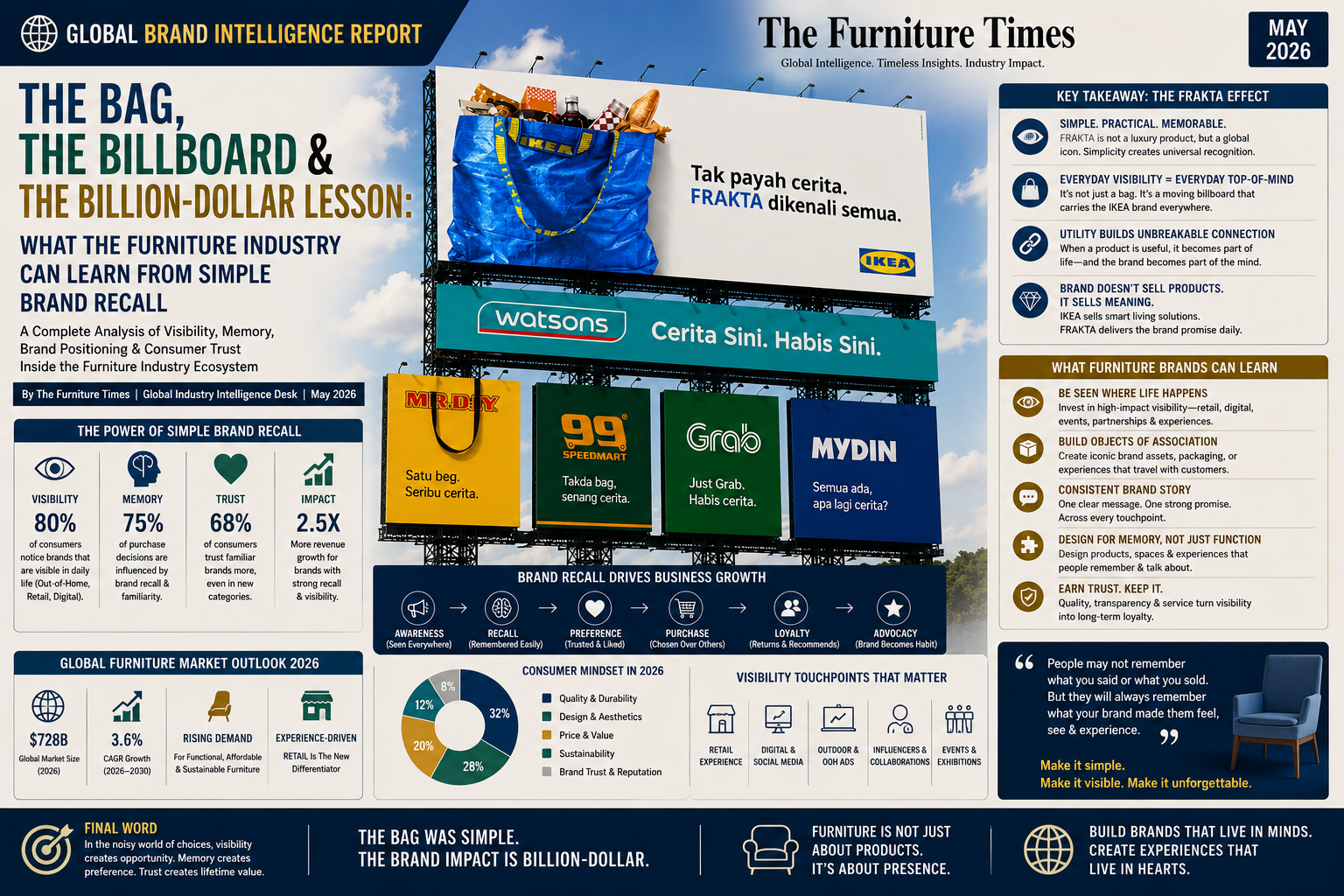
The Bag, the Billboard & the Billion-Dollar Lesson: What the Furniture Industry Can Learn From Simple Brand Recall
A Complete Analysis of Visibility, Memory, Brand Positioning & Consumer Trust Inside the Furniture Industry Ecosystem
By The Furniture Times | Global Industry Intelligence Desk | Global Brand Intelligence Report | May 2026
Sometimes, a simple visual idea can carry a very big business lesson.
The billboard concept shows a powerful marketing truth: when a brand becomes deeply known, people do not need long explanations. They already understand the story. A bag, a color, a logo, or a short phrase is enough to trigger recognition.
That is the power of brand memory.
And for the global furniture industry, this message is extremely important.
The Clear Message
The message is simple:
“When people know your brand, you do not need to explain too much.”
In marketing, the strongest brands do not always need long descriptions. Their identity is already stored in the customer’s mind.
A simple symbol can communicate:
- trust
- category
- experience
- memory
- habit
- buying confidence
This is what most furniture businesses must understand.
In 2026, the furniture industry is not only competing through products.
It is competing through:
visibility, recognition, trust, and recall.
What This Means for the Furniture Industry
Many furniture businesses still believe that success depends only on:
- good products
- good pricing
- good materials
- showroom location
- factory capacity
These are important.
But they are no longer enough.
Today, customers must first:
- remember you
- find you
- trust you
- recognize your category
- associate your brand with a clear promise
If customers cannot remember your brand, your product becomes one more product in a crowded market.
The Furniture Industry Has a Brand Recall Problem
The furniture industry is huge.
It is a $1 trillion global ecosystem.
But most furniture businesses are still invisible because they do not own a strong memory in the customer’s mind.
They may be good manufacturers.
They may have quality products.
They may have years of experience.
But customers still do not remember them because their brand message is weak, unclear, or inconsistent.
This is the real crisis:
Many furniture businesses exist, but they are not remembered.
The Power of One Clear Message
Great brands simplify their message.
They do not confuse customers with too many claims.
For furniture companies, the message must be clear.
For example:
- Outdoor Furniture Supplier Malaysia
- Luxury Teakwood Furniture Indonesia
- Hotel Furniture Manufacturer Vietnam
- Custom Kitchen Cabinet Shah Alam
- Office Furniture Supplier Dubai
- Resort Furniture Specialist Bali
- Premium Sofa Manufacturer India
When the message is clear, people understand quickly.
When the message is confusing, people forget.
Visibility Creates Trust
In today’s market, visibility is not only marketing.
Visibility is trust.
When customers repeatedly see a brand across:
- social media
- directories
- videos
- articles
- reviews
- search results
- industry platforms
they begin to believe the brand is active, serious, and reliable.
This is why furniture brands must not remain hidden.
A hidden brand may be good.
But a visible brand gets remembered.
Why Furniture Brands Must Think Like Media Brands
The strongest modern companies do not only sell products.
They publish.
They educate.
They explain.
They tell stories.
Furniture companies must also become content-driven brands.
They should publish:
- product education
- material guides
- project stories
- customer case studies
- factory stories
- craftsmanship stories
- sustainability updates
- design trend insights
Because content builds memory.
And memory builds trust.
The Billboard Lesson for Furniture Businesses
The billboard teaches five powerful lessons:
1. Simplicity Wins
Short messages are easier to remember.
2. Visual Identity Matters
Color, shape, and layout help people recognize brands faster.
3. Repetition Builds Recall
People remember brands they see often.
4. Category Ownership Is Powerful
A brand should be linked clearly to one strong category.
5. Visibility Must Be Consistent
One post is not enough. One advertisement is not enough. Brand memory comes from repeated visibility.
How This Applies to TFT & FISE
This is exactly why The Furniture Times and FISE matter.
The Furniture Times tells the story.
FISE helps the world find them.
Together, they support the future visibility economy of the furniture industry.
Furniture companies need:
- media visibility
- searchable profiles
- category pages
- supplier discovery
- digital trust
- AI discoverability
Because in the new furniture economy:
If you are not visible, you are not considered.
The Future Belongs to Memorable Furniture Brands
The furniture industry is entering a new age.
The winners will not only be those who manufacture well.
The winners will be those who:
- own a category
- build a clear message
- appear repeatedly
- become searchable
- become memorable
- create trust before the customer contacts them
That is the new rule.
Production creates products.
Visibility creates demand.
Memory creates power.
Final Thought
The furniture industry must learn one important lesson from strong consumer brands:
A business becomes powerful when people understand it quickly and remember it easily.
In 2026, furniture businesses must stop hiding behind products alone.
They must build:
- brand recall
- digital visibility
- search presence
- category authority
- emotional memory
Because the future customer will not choose the business that merely exists.
The future customer will choose the business they can find, trust, and remember.
Closing Insight
“In the furniture industry, the battle is no longer only inside factories or showrooms.
The real battle is inside the customer’s memory.
The brand that is remembered first is often the brand that wins first.”
