
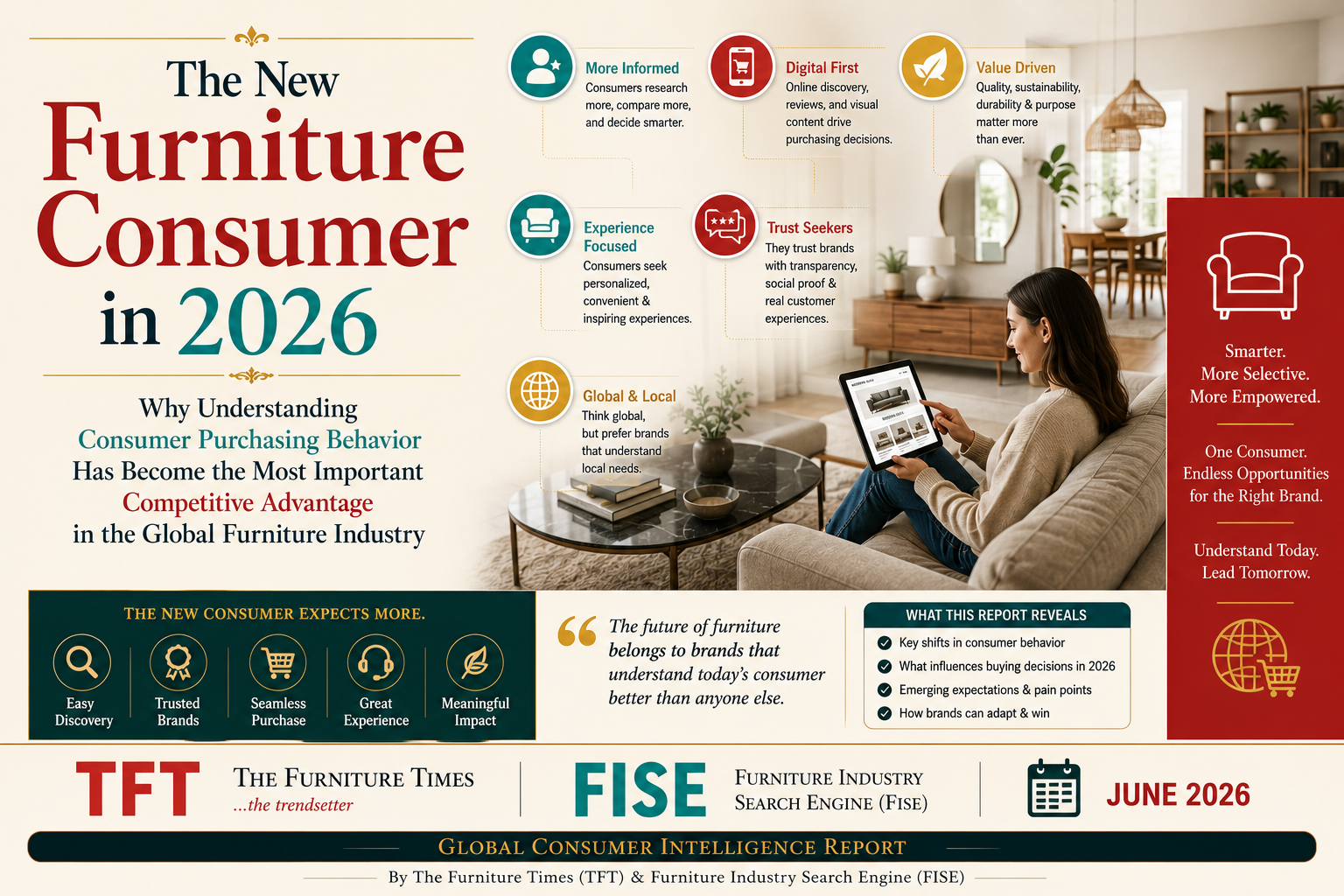
The New Furniture Consumer in 2026
Why Understanding Consumer Purchasing Behavior Has Become the Most Important Competitive Advantage in the Global Furniture Industry
Global Consumer Intelligence Report
By The Furniture Times (TFT) & Furniture Industry Search Engine (FISE)
June 2026
The global furniture industry is experiencing one of the most significant shifts in its history.
For decades, furniture purchasing decisions were relatively straightforward.
Consumers compared:
- Price
- Quality
- Durability
- Design
- Availability
Then they purchased.
Today, that model is rapidly disappearing.
The furniture consumer of 2026 is fundamentally different from the furniture consumer of 2006.
And perhaps even from the consumer of 2020.
Furniture is no longer viewed simply as a product.
It has become a reflection of identity.
A lifestyle statement.
A sustainability choice.
A social signal.
An emotional investment.
A digital shopping experience.
This transformation is reshaping the entire global furniture ecosystem.
From manufacturers and retailers to designers, suppliers, architects, developers, and hospitality groups.
The companies that understand this shift will grow.
The companies that ignore it may become increasingly irrelevant.
Furniture Is No Longer Just Furniture
One of the most important discoveries emerging from recent consumer research is that furniture purchasing is deeply emotional.
Consumers no longer buy furniture only because they need a table.
They buy because they want:
- Comfort
- Status
- Beauty
- Identity
- Sustainability
- Personal expression
Furniture has become part of how people tell their story.
A sofa is no longer merely seating.
It represents lifestyle.
A dining table represents family.
A workspace represents ambition.
A bedroom represents wellbeing.
Consumers increasingly see furniture as an extension of themselves.
Research reviewed in the study shows that furniture purchasing decisions are influenced by aesthetics, memories, personal experiences, cultural values, and self-expression.
The Rise of Emotional Purchasing
Traditional furniture businesses often focus on product specifications.
Dimensions.
Materials.
Features.
Prices.
While these remain important, they are no longer enough.
Modern consumers buy emotionally and justify logically.
People often fall in love with a product before they compare its technical details.
The emotional side of purchasing has become one of the strongest drivers of furniture sales.
Consumers increasingly seek experiences that satisfy emotional, aesthetic, and cognitive needs rather than purely practical requirements.
Sustainability Has Become Mainstream
Perhaps the biggest change in furniture purchasing behavior is the growing influence of sustainability.
Consumers today increasingly ask:
Where was this product made?
What materials were used?
Is it environmentally responsible?
Can it be recycled?
How long will it last?
Research highlighted in the review found that consumers increasingly evaluate furniture based on sustainability values, eco-friendly production processes, and environmental impact.
This trend is especially strong among younger consumers.
Generation Z and Millennials are redefining purchasing priorities.
Many are willing to pay more for products aligned with their environmental values.
However, sustainability alone is not enough.
Affordability remains critical.
The research reveals a continuing gap between environmental intentions and actual purchasing behavior because many consumers still prioritize affordability when making final decisions.
The Digital Furniture Consumer
The internet has fundamentally transformed how furniture is discovered and purchased.
Consumers now spend hours researching online before making decisions.
They compare:
- Reviews
- Images
- Videos
- Social proof
- Brand reputation
- Sustainability claims
Research shows that online platforms, digital advertising, and interactive experiences significantly influence consumer perceptions and purchasing intentions.
The showroom is no longer the beginning of the buying journey.
Search engines are.
Social media is.
AI is.
Digital visibility has become the new storefront.
Why Furniture Websites Matter More Than Ever
Many furniture companies still underestimate the importance of their digital presence.
Yet consumers increasingly evaluate:
- Website quality
- Product information
- User experience
- Visual presentation
- Trust signals
Before contacting suppliers.
Research cited in the review found that website quality and trust directly influence online furniture purchasing intentions.
In 2026, a poor website often communicates a poor brand.
Even if the products themselves are excellent.
The Experience Economy Has Arrived
Consumers increasingly want experiences, not transactions.
They want:
- Inspiration
- Storytelling
- Personalization
- Engagement
This is why augmented reality, virtual reality, 3D visualization, and immersive shopping experiences are becoming increasingly important.
Future furniture retailers will not simply sell products.
They will create experiences.
The research points toward virtual reality and immersive digital environments as major future influences on furniture purchasing behavior.
Why Used Furniture Is Growing
One of the most interesting findings in furniture consumer behavior is the increasing acceptance of:
- Used furniture
- Recycled furniture
- Inherited furniture
- Refurbished furniture
Younger consumers increasingly view these products positively.
Not as compromises.
But as conscious choices.
This trend reflects changing attitudes toward sustainability and responsible consumption.
The circular economy is becoming part of mainstream furniture consumption.
Social Media Is Influencing Furniture Choices
Furniture purchasing has become increasingly social.
Consumers are influenced by:
Furniture is no longer chosen only in stores.
It is discovered online.
Shared online.
Compared online.
Recommended online.
This shift is transforming how brands market products.
AI Will Change Furniture Buying Forever
Artificial intelligence is becoming a new decision-making partner.
Consumers increasingly ask AI:
What sofa is best for small apartments?
Which dining table style is trending?
Which furniture brands are sustainable?
Which manufacturers are reliable?
This creates a new challenge for furniture companies.
Visibility is no longer enough.
Brands must also become understandable to AI systems.
The future belongs to businesses that are searchable, discoverable, and information-rich.
What Consumers Really Want in 2026
After analyzing current trends, several themes emerge consistently across global markets.
Consumers increasingly want:
Quality
Sustainability
Design
Transparency
Affordability
Personalization
Convenience
Trust
Digital Experiences
Fast Information
Furniture businesses that align with these expectations will gain competitive advantages.
The Future Furniture Consumer
The next decade will likely see consumers becoming:
- More informed
- More connected
- More sustainability-focused
- More digitally dependent
- More experience-driven
The purchasing journey will become increasingly complex.
Yet one principle remains constant.
Consumers buy products that solve problems and improve lives.
The challenge for furniture businesses is understanding which problems matter most.
TFT & FISE Analysis
The global furniture industry is entering a new consumer era.
Manufacturing remains important.
Design remains important.
Pricing remains important.
But understanding consumer behavior is becoming equally important.
The companies that invest in understanding their customers will outperform those that focus solely on products.
The future winners of the furniture industry will not necessarily be those who manufacture the most.
They will be those who understand consumers the best.
Final Verdict
The furniture consumer of 2026 is smarter, more connected, more emotional, and more sustainability-conscious than ever before.
Furniture is no longer simply a purchase.
It is a reflection of identity.
A lifestyle decision.
A digital experience.
A sustainability statement.
And an emotional investment.
Understanding these shifts may become the single most important competitive advantage in the global furniture industry.
Because the future of furniture belongs not only to companies that build products.
But to companies that understand people.
By The Furniture Times (TFT) & Furniture Industry Search Engine (FISE)
Global Consumer Intelligence Report | June 2026
“TFT tells their story. FISE helps the world find them.”
The furniture industry ecosystem is a $1 Trillion Dollar Industry.
