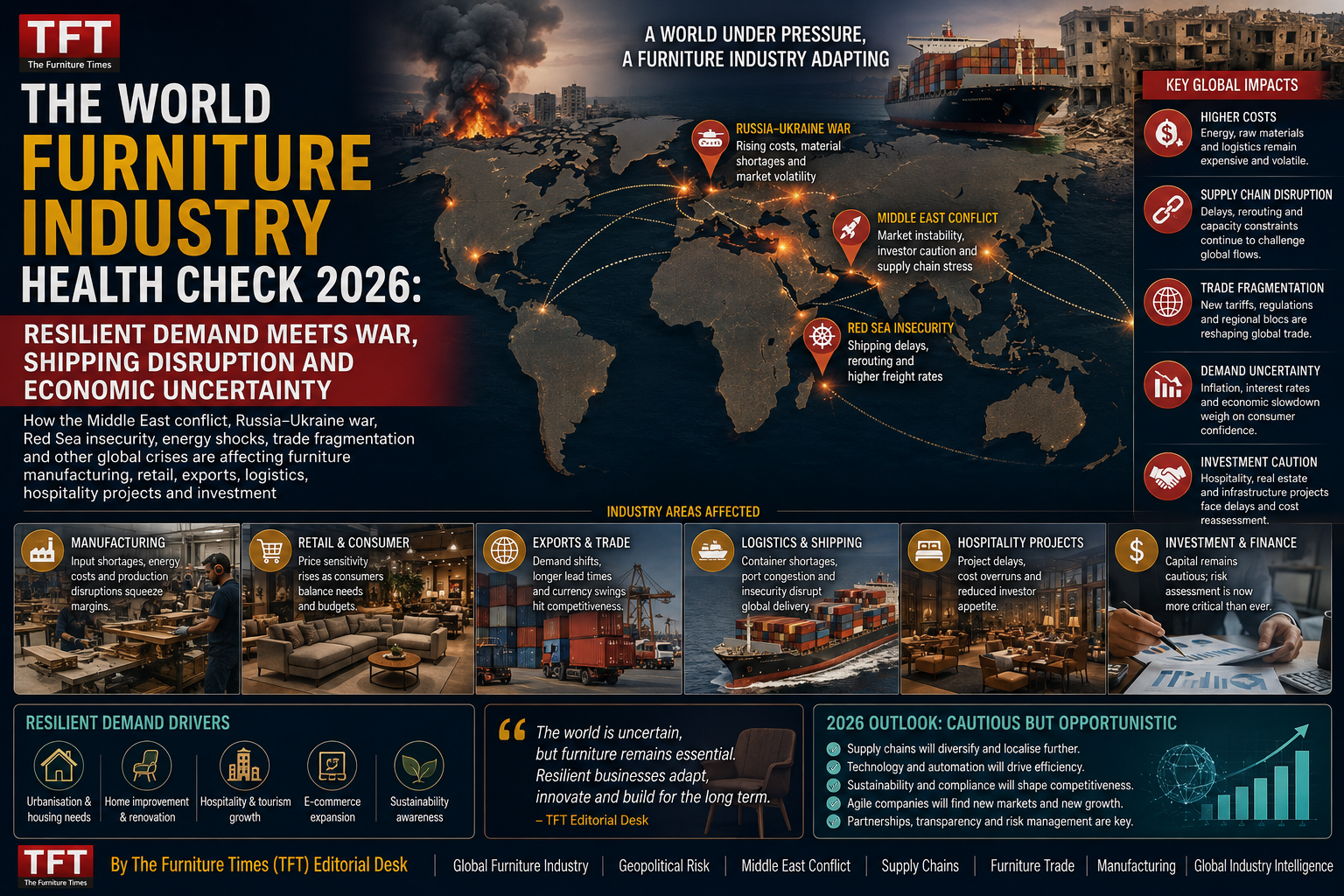
The World Furniture Industry Health Check 2026
Resilient Demand Meets War, Shipping Disruption and Economic Uncertainty
How the Middle East conflict, Russia–Ukraine war, Red Sea insecurity, energy shocks, trade fragmentation and other global crises are affecting furniture manufacturing, retail, exports, logistics, hospitality projects and investment
By The Furniture Times (TFT) Editorial Desk | Global Furniture Industry | Geopolitical Risk | Middle East Conflict | Supply Chains | Furniture Trade | Manufacturing | Global Industry Intelligence
The global furniture industry entered 2026 expecting a difficult but manageable year. Inflation was showing signs of easing in several markets, housing activity was expected to recover gradually, retailers were attempting to normalise inventories, and manufacturers were searching for growth after years of pandemic disruption and uneven consumer demand.
The escalation of conflict in the Middle East has changed that calculation.
Furniture companies now face another period of energy-market volatility, unreliable shipping routes, higher insurance costs, longer lead times and unpredictable consumer confidence. At the same time, the Russia–Ukraine war continues to affect European security, energy systems, timber-related supply chains and reconstruction expectations. Conflicts and instability across Sudan, the Democratic Republic of the Congo, Myanmar, the Sahel and other regions continue to destroy local markets, displace populations and weaken regional investment.
The global furniture industry has not collapsed. Production continues, international orders are still moving, large consumer markets remain active, and long-term demand drivers have not disappeared.
However, the sector’s operating environment has become materially more dangerous.
The industry’s condition in August 2026 can best be described as:
Operationally resilient, commercially uneven and geopolitically fragile.
The strongest companies are adapting through diversified sourcing, better inventory intelligence, regional production, stronger cash reserves and more disciplined logistics. The most vulnerable businesses are those dependent on one export market, one shipping route, one material source or continuous low-cost energy.
The health of the industry is therefore not uniform. Some countries, manufacturers and furniture categories remain relatively strong. Others are facing declining orders, margin pressure, delayed projects and higher working-capital requirements.
This TFT Global Furniture Industry Health Check examines where the industry stands, how current conflicts are transmitting risk into furniture markets and what businesses should prepare for next.
Executive Health Assessment
| Area | Current condition | TFT assessment |
|---|---|---|
| Global furniture demand | Positive in selected markets but inconsistent | Cautious |
| Residential furniture | Constrained by housing affordability and consumer pressure | Weak to stable |
| Hospitality and contract furniture | Supported by tourism and development, but regionally exposed | Stable with risks |
| Office furniture | Selective recovery, driven by refurbishment and flexible workplaces | Mixed |
| Outdoor furniture | Long-term demand remains, but highly discretionary | Stable |
| Furniture manufacturing | Operating, but facing energy, material and financing pressures | Resilient but squeezed |
| International furniture trade | Continuing despite geopolitical and tariff disruption | Vulnerable |
| Ocean freight | High-cost and unpredictable on major routes | Stressed |
| Middle East furniture market | Strong structural potential but immediate conflict exposure | High risk |
| European furniture market | Weak growth, energy exposure and subdued confidence | Fragile |
| North American furniture market | Large and resilient, but price-sensitive and import-dependent | Mixed |
| Asia-Pacific manufacturing | Strong production base, but exposed to energy and shipping costs | Relatively strong |
| Africa | Significant long-term need but uneven purchasing power and conflict exposure | Highly uneven |
| Furniture investment | Continuing selectively, especially in emerging manufacturing locations | Cautious |
| Industry confidence | Damaged by repeated shocks and policy uncertainty | Weak |
| Long-term furniture need | Supported by population, urbanisation, tourism and replacement | Fundamentally positive |
The furniture industry is not facing a universal demand collapse. It is facing a cost, confidence, logistics and predictability crisis.
The Middle East Conflict Has Become a Global Furniture-Industry Issue
Furniture companies may not immediately associate a military conflict in the Middle East with the cost of producing a sofa, transporting a dining table or furnishing a hotel.
The connection is nevertheless direct.
Furniture manufacturing depends heavily on energy and energy-derived materials. The industry also relies on shipping routes passing through or close to the Middle East.
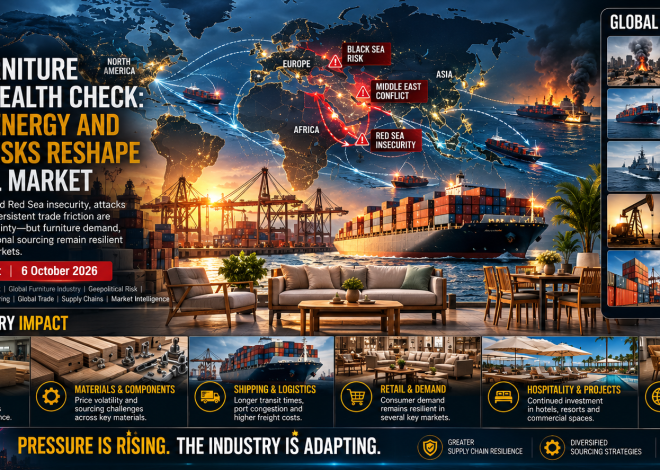
The Strait of Hormuz is one of the world’s most important energy chokepoints. UN Trade and Development has estimated that it normally carries approximately one-quarter of global seaborne oil trade. Disruption has increased freight costs, marine insurance premiums, fuel prices and uncertainty across international supply chains. UN Trade and Development
By late August 2026, vessel activity through the Strait remained severely constrained. Reuters reported that commodity-vessel transit remained significantly below recent averages, while oil flows were still far below pre-war levels despite diplomatic discussions involving Iran, Oman and Qatar. Reuters
The furniture industry feels this shock through several channels:
- Marine fuel
- Electricity generation
- Petrochemical feedstocks
- Foam production
- Synthetic textiles
- Plastics
- Adhesives
- Coatings
- Packaging
- Container freight
- War-risk insurance
- Currency pressure
- Consumer inflation
A factory located thousands of kilometres from the conflict may still face higher production costs if its foam, fabric, resin, coating, plastic fitting or shipping contract is connected to global energy markets.
Why Energy Prices Matter So Much to Furniture
Furniture is sometimes described as a traditional craft industry, but modern furniture production is energy-intensive.
Factories use electricity and fuel for:
- CNC machinery
- Panel cutting
- Edge banding
- Kiln drying
- Metal cutting and welding
- Powder coating
- Foam production
- Sewing and upholstery
- Spray finishing
- Dust extraction
- Air compression
- Climate control
- Packaging
- Internal transport
Energy also sits inside many furniture materials.
Polyurethane foam, polyester textiles, synthetic leather, polypropylene, polyethylene, plastic components, adhesives, laminates and coatings are connected to oil and petrochemical supply chains.
The World Bank said in April 2026 that the Middle East war represented a historic commodity shock. It projected energy prices to rise approximately 24% during 2026 and total commodity prices by around 16%, with the energy surge potentially becoming the largest since Russia’s invasion of Ukraine in 2022. World Bank Commodity Markets Outlook
Furniture manufacturers cannot absorb every increase.
They face three difficult options:
- Accept lower margins.
- Increase prices and risk losing orders.
- Redesign products or reduce specifications.
The third option can become dangerous when cost reduction weakens quality.
Manufacturers under severe margin pressure may be tempted to use:
- Lower-density foam
- Thinner metal
- Weaker hardware
- Lower-grade timber
- Reduced coating thickness
- Cheaper textiles
- Less protective packaging
- Fewer quality-control inspections
These substitutions may protect the initial selling price but increase warranty claims, breakage, customer dissatisfaction and long-term brand damage.
The industry must therefore distinguish between intelligent value engineering and hidden quality reduction.
Shipping Has Become the Industry’s Most Unpredictable Cost
Furniture is especially vulnerable to shipping disruption because it occupies substantial space.
A container carrying furniture may reach its volume limit long before its weight limit. Sofas, wardrobes, dining tables, mattresses and outdoor furniture can consume large amounts of container capacity relative to their commercial value.
This means even a moderate increase in container rates can significantly affect the landed price.
Drewry’s World Container Index rose to US$4,526 per 40-foot container on 20 August 2026. Shanghai-to-Los Angeles spot rates reached approximately US$6,802, while Shanghai-to-New York rates rose to around US$9,507. Drewry attributed the increases partly to resilient trans-Pacific demand, blank sailings and carrier capacity management. Drewry World Container Index
Intra-Asian freight has also come under pressure. Drewry’s Intra-Asia Container Index reached US$1,091 per 40-foot container on 20 August, its third consecutive weekly increase. Middle East unrest and weather-related congestion in China contributed to tightening market conditions. Drewry Intra-Asia Container Index
Higher freight costs affect:
- Export manufacturers
- Furniture importers
- Retailers
- E-commerce companies
- Property developers
- Hotel procurement teams
- Project-furniture suppliers
- Consumers
The effect is not limited to the freight invoice.
Longer voyages create additional inventory costs. Importers must order earlier, hold more stock and finance goods for longer periods before sale. Delayed shipments can also interfere with retail launches, property handovers and hotel openings.
For project furniture, the consequences can be severe.
If beds, wardrobes or restaurant seating arrive late, a hotel or serviced apartment may be unable to open rooms on schedule. A delayed furniture shipment can therefore create lost hospitality revenue far beyond the value of the furniture itself.
Red Sea Insecurity Continues to Reshape East–West Furniture Trade
The Red Sea and Suez Canal provide one of the most important connections between Asian manufacturing centres and European consumer markets.
When vessels avoid the Red Sea and travel around the Cape of Good Hope, they face:
- Longer transit times
- Higher fuel consumption
- Greater vessel requirements
- More schedule uncertainty
- Higher emissions
- Increased inventory in transit
- Additional insurance costs
- Port congestion risks
Furniture exporters in China, Vietnam, Malaysia, Indonesia and India are particularly exposed because Europe remains an important destination for Asian-made furniture.
European importers also face a difficult purchasing decision.
Ordering from Asia may still provide competitive factory pricing, but the difference can narrow after freight, inventory, insurance and financing costs are included. This can strengthen the case for sourcing from Turkey, Eastern Europe, North Africa or other near-market locations.
However, shifting production is not simple.
A buyer cannot replace a trusted supplier overnight. Furniture requires tooling, samples, approved materials, quality testing, packaging development and production knowledge. New suppliers may need months to reproduce an established collection.
The result is not a complete abandonment of global sourcing. It is a gradual movement towards:
- Dual sourcing
- Regional sourcing
- Nearshoring
- Larger safety stocks
- Smaller and more frequent orders
- Modular product design
- Improved container utilisation
- Alternative ports
- Greater supplier visibility
The industry is learning that the cheapest factory price is not necessarily the lowest total supply-chain cost.
Conflict Is Changing Working-Capital Requirements
The furniture industry already operates with long cash-conversion cycles.
A manufacturer may need to purchase materials, produce goods, pack containers, wait for shipping, deliver to the importer and then wait again for payment. When transit times increase, cash remains trapped for longer.
This creates pressure across the supply chain.
Manufacturers
They must finance materials, wages and production while waiting for final payment.
Importers
They may pay deposits months before the goods reach their warehouses.
Retailers
They must carry inventory while consumer demand remains uncertain.
Project suppliers
They may face delayed construction schedules and slow payment from contractors or developers.
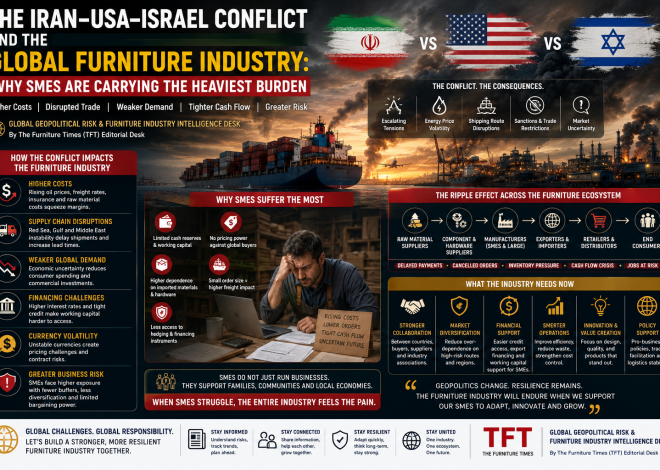
Small businesses
They may have limited access to affordable credit and little capacity to absorb unexpected freight increases.
The conflict therefore creates a financial risk even when no shipment is physically damaged.
Furniture businesses with strong order books can still fail if cash flow becomes unsustainable.
The critical metrics in 2026 are no longer only sales and gross margin. Companies must also monitor:
- Inventory days
- Receivable days
- Deposit exposure
- Goods in transit
- Supplier concentration
- Freight commitments
- Currency exposure
- Unused credit facilities
- Insurance coverage
- Customer payment risk
In a conflict-driven environment, liquidity becomes a competitive advantage.
The Russia–Ukraine War Remains a Structural European Risk
The Middle East conflict is the most immediate energy and shipping concern, but the Russia–Ukraine war continues to affect the furniture industry.
Its consequences include:
- European energy insecurity
- Weaker business confidence
- Pressure on household budgets
- Disruption to Black Sea trade
- Sanctions and compliance requirements
- Changes in timber and wood-product sourcing
- Higher defence spending
- Delayed residential investment
- Destruction of homes and infrastructure
- Future reconstruction demand
Ukraine had an established furniture and wood-products industry before the full-scale war. The conflict has damaged factories, displaced workers and complicated logistics, yet Ukrainian companies continue operating and exporting where possible.
The long-term reconstruction requirement is enormous.
Furniture will eventually be needed for:
- Rebuilt homes
- Schools
- Hospitals
- Government offices
- Temporary accommodation
- Hotels
- Community centres
- Public institutions
However, the industry should not confuse future need with immediate commercial demand.
Reconstruction depends on security, financing, procurement frameworks, building completion and the return of displaced populations. Furniture demand generally follows structural rebuilding rather than leading it.
For the present, the war remains more of a disruption and humanitarian catastrophe than a dependable furniture-market opportunity.
Sudan and Other Conflicts Are Destroying Local Furniture Economies
Not every conflict affects the global furniture industry through oil or shipping.
Some conflicts destroy the local foundations of furniture demand.
At the end of 2025, Sudan remained the world’s largest displacement crisis, with approximately 12.9 million Sudanese refugees, asylum-seekers and internally displaced people, according to UNHCR. UNHCR
Mass displacement affects the furniture sector through:
- Destruction of homes
- Closure of factories and workshops
- Loss of skilled craftspeople
- Reduced consumer purchasing power
- Interrupted timber and material supply
- Damaged retail networks
- Collapsed construction activity
- Loss of bank finance
- Unsafe transport routes
- Migration of entrepreneurs
The same pattern can be seen, to different degrees, in conflict-affected parts of Myanmar, the Democratic Republic of the Congo, the Sahel and other regions.
Furniture may eventually become part of recovery and reconstruction, but immediate markets are dominated by humanitarian needs.
The first furnishing requirements are often basic:
- Beds
- Mattresses
- Storage
- School desks
- Healthcare furniture
- Temporary seating
- Shelter components
The furniture industry has an opportunity to support humanitarian procurement, but products must be appropriate for emergency conditions: durable, repairable, transport-efficient, safe and affordable.
This is not a market for opportunistic pricing. It is an area requiring responsible cooperation with governments, aid organisations and local producers.
Global Economic Growth Is Continuing—but It Is Too Weak to Remove Furniture Risk
The global economy has shown greater resilience than many feared, but growth remains uneven.
The International Monetary Fund projected global growth of 3.0% in 2026, followed by 3.4% in 2027. It also expected world trade-volume growth to slow from 5.0% in 2025 to 3.5% in 2026 before recovering to 4.3% in 2027. IMF July 2026 World Economic Outlook Update
The IMF’s forecast reflects a global economy supported partly by technology investment but weakened by war, tariffs, energy costs and policy uncertainty.
This matters because furniture rarely moves in perfect alignment with headline gross domestic product.
Furniture demand is influenced by:
- Housing transactions
- Mortgage affordability
- Residential construction
- Household formation
- Consumer confidence
- Disposable income
- Tourism development
- Office occupancy
- Hotel renovation
- Commercial investment
- Government infrastructure
- Replacement cycles
A country can record economic growth while its residential furniture market remains weak if housing turnover is low or consumers prioritise essential expenses.
Similarly, a slow-growing market may still produce strong commercial furniture demand if hotels, offices or public projects are being developed.
The world furniture industry must therefore read beneath the global growth figure.
Global Trade Is Resilient, but the Middle East Is Contracting
World merchandise trade held up during the first half of 2026 despite severe uncertainty.
However, the regional effect of the Middle East conflict has been much more damaging. The World Trade Organization reported that the Middle East’s seasonally adjusted merchandise-export volume fell 9.7% year on year in the first quarter of 2026, while import volume dropped 11.9%. The WTO expected larger contractions during the second quarter because the conflict began affecting trade only near the end of the first. World Trade Organization
This decline has several implications for furniture.
Middle Eastern importers may experience:
- Delayed shipments
- Reduced port reliability
- Higher insurance costs
- Weaker credit availability
- Currency or payment pressure
- Postponed showroom investment
- Slower property development
- Reduced consumer confidence
Exporters should not assume that all orders from the region face equal risk.
The Middle East includes energy-rich Gulf markets, diversified commercial centres, conflict-affected territories and economies with very different fiscal capacity.
Furniture companies should assess customers country by country and project by project.
Gulf Furniture Demand: Delayed, Not Eliminated
The Middle East remains one of the world’s most important long-term markets for luxury, hospitality, outdoor, residential and project furniture.
Saudi Arabia, the United Arab Emirates, Qatar and other Gulf economies continue to pursue:
- Tourism development
- Hotels and resorts
- Residential communities
- Entertainment destinations
- Offices
- Retail projects
- Airports
- Cultural institutions
- Luxury villas
- Urban infrastructure
These programmes require enormous quantities of furniture, fixtures and equipment.
The immediate conflict creates uncertainty, but it does not automatically erase these structural requirements.
Some projects may be:
- Delayed
- Rephased
- Redesigned
- Rebudgeted
- Locally sourced
- Split into smaller procurement packages
Energy-exporting governments may receive fiscal support from higher oil prices, but war-related costs, security priorities and lower travel confidence can offset part of that advantage.
Dubai International Airport reportedly recorded a substantial decline in passenger traffic amid regional instability. Reduced aviation and tourism activity can affect hotel occupancy, retail spending and hospitality investment.
The Gulf furniture market is therefore experiencing two opposing forces:
- Long-term development and investment demand
- Short-term conflict, travel and logistics risk
Manufacturers should remain engaged but strengthen payment, insurance and delivery protections.
European Furniture Industry: Still the Most Fragile Major Region
Europe enters the current crisis from a relatively weak position.
The IMF projected euro-area growth of only 0.9% in 2026, reflecting weak momentum, higher energy costs and subdued consumer confidence. The United Kingdom was expected to grow by around 1.0%. IMF
Furniture demand in Europe faces several pressures:
- Slow housing activity
- High living costs
- Energy-price exposure
- Weak consumer confidence
- Ageing populations in some markets
- Expensive labour
- Environmental compliance costs
- Competition from imports
- Retail consolidation
- Factory closures and restructuring
European furniture manufacturers also face the challenge of maintaining premium positioning while consumers become more price-sensitive.
Italy, Germany, Poland and other major producing countries retain strong industrial and design capabilities. However, energy-intensive processes and weak domestic consumption can pressure margins.
The regional industry is likely to experience further consolidation.
Companies with recognised brands, specialised contract capability, export networks and high-value design may remain competitive. Businesses producing undifferentiated mid-market furniture face greater risk.
Europe’s long-term strengths remain substantial:
- Design
- Engineering
- Machinery
- Luxury production
- Sustainability systems
- Contract furniture
- International brands
- Skilled craftsmanship
But 2026 is not a comfortable operating year.
North America: A Large Market With Uneven Furniture Demand
The United States remains one of the world’s largest furniture-consuming and importing markets.
Its scale provides resilience, but conditions are uneven.
Demand is affected by:
- Mortgage rates
- Home sales
- Housing affordability
- Consumer credit
- Tariff policy
- Import costs
- Retail inventories
- Labour-market confidence
- Freight rates
Residential furniture companies need movement in the housing market because relocating households often purchase furniture. When homeowners remain locked into older, lower mortgage rates, housing transactions decline and furniture replacement can be postponed.
At the same time, the United States has several areas of relative strength:
- High household consumption
- Data-centre and technology investment
- Hospitality development
- Commercial renovation
- Outdoor-living demand
- Large e-commerce channels
- Strong premium and specialised segments
Importers face renewed pressure from trans-Pacific freight rates and trade-policy uncertainty.
The US market will not move uniformly. Value retailers may gain customers trading down, while premium brands continue serving wealthier households. The greatest pressure may fall on mid-market companies with high overheads and limited differentiation.
Canada faces weaker growth, slower population expansion and trade uncertainty, although some consumer demand remains resilient.
China: Manufacturing Strength Confronts Demand and Trade Pressure
China remains the central production force in the global furniture industry.
It offers:
- Deep supplier networks
- Production scale
- Machinery and automation
- Material availability
- Design capability
- Smart-furniture development
- Export logistics
- Rapid sample production
- Vast showroom districts
More than half of global furniture production originated in the Asia-Pacific region in 2024, according to industry information published by the China International Furniture Fair. China, Vietnam, Poland, Italy and Germany were identified among the leading furniture exporters. CIFF
China’s challenge is not manufacturing capability. It is balancing:
- Slower domestic property activity
- Higher energy-import costs
- Trade tensions
- Tariffs
- Export dependence
- Price competition
- Overcapacity in some categories
- Buyer diversification
The IMF projected Chinese growth of approximately 4.6% in 2026. That is strong compared with many developed economies, but slower than China’s historical performance.
Chinese furniture manufacturers are likely to respond through:
- Greater automation
- Smart furniture
- Original design
- Overseas factories
- Cross-border e-commerce
- Emerging-market expansion
- Private-label manufacturing
- More competitive pricing
The risk is that intense competition creates destructive discounting.
The healthier path is differentiation through design, product performance, brand identity, service and export-market knowledge.
Vietnam and Southeast Asia Remain Important—but Not Immune
Vietnam, Malaysia, Indonesia, Thailand and emerging locations such as Cambodia remain important to global sourcing diversification.
Their advantages include:
- Established furniture clusters
- Timber and material capabilities
- Export experience
- Competitive labour
- Trade agreements
- Growing domestic markets
- Proximity to Asian supply chains
However, Southeast Asian producers face several common risks:
- High shipping costs
- Dependence on imported components
- Energy-price increases
- Foreign-exchange volatility
- US and European demand weakness
- Timber-traceability requirements
- Labour shortages in industrial zones
- Climate and weather disruption
- Competition from China
Vietnam remains especially important to the US furniture market, while Malaysia has recognised strengths in rubberwood furniture, dining products and export manufacturing. Indonesia retains major capabilities in wooden, rattan and craft-based furniture.
Cambodia is attempting to attract new manufacturing investment, including reported South Korean interest in furniture production.
The region remains one of the healthiest parts of the furniture manufacturing map, but it is exposed to external buyers. Strong production does not guarantee strong profitability when freight and customer demand become unstable.
India: Large Domestic Potential Meets Compliance and Cost Challenges
India’s furniture market continues to attract interest because of:
- Population scale
- Urbanisation
- Housing development
- Hospitality growth
- Office investment
- Rising formal retail
- E-commerce
- Government infrastructure
Its large domestic market provides a degree of protection against international trade disruption.
India also has opportunities in:
- Wooden furniture
- Office furniture
- Institutional furniture
- Hospitality products
- Components
- Mattresses
- Home interiors
- Export manufacturing
However, manufacturers face increasingly formal expectations concerning standards, testing, documentation and factory readiness.
Compliance can strengthen the industry by removing unsafe and inconsistent products, but poorly prepared businesses may face delays and additional costs.
India’s future furniture strength will depend on whether it can connect design, manufacturing scale, compliance, machinery, skilled labour and digital distribution.
The Middle East conflict may raise energy and freight costs, but India’s proximity to Gulf markets also creates long-term export opportunities once regional conditions stabilise.
Turkey and Eastern Europe Could Benefit From Nearshoring
When Asian shipping routes become longer and less predictable, European buyers often reconsider suppliers closer to home.
Turkey and parts of Eastern Europe may benefit because they offer:
- Shorter delivery routes
- Furniture-manufacturing experience
- Access to European markets
- Flexible order quantities
- Upholstery capability
- Panel furniture production
- Faster replenishment
However, these regions face their own pressures:
- Energy costs
- Currency volatility
- Labour inflation
- Political risk
- Weak European demand
- Border and transport constraints
Nearshoring does not necessarily mean lower factory prices. Its advantage may come from:
- Reduced inventory
- Faster response
- Lower transit risk
- Easier factory visits
- Smaller orders
- Rapid replacement
Furniture buyers are increasingly comparing total landed and operational cost rather than production cost alone.
Africa: Long-Term Furniture Need, Short-Term Financial Pressure
Africa has enormous long-term furniture demand driven by:
- Population growth
- Urbanisation
- Housing
- Tourism
- Education
- Healthcare
- Offices
- Public infrastructure
Yet the continent is highly uneven.
Stable and growing markets may support hotel, residential and commercial furniture investment, while conflict-affected countries face market destruction and displacement.
Many African economies are also vulnerable to:
- Imported fuel costs
- Currency depreciation
- Expensive freight
- Limited consumer credit
- High interest rates
- Infrastructure gaps
- Dependence on imported furniture
These conditions can strengthen the case for local production.
Local manufacturers can reduce shipping exposure, adapt designs to regional preferences and provide replacement services. But they require investment in machinery, skills, materials, testing and finance.
The best long-term outcome is not for Africa to become permanently dependent on imported furniture. It is to develop more capable local and regional furniture industries.
Latin America: Regional Production Provides Some Protection
Latin American markets are less directly exposed to Middle Eastern shipping chokepoints than Asia–Europe trade, but they are affected through energy prices, inflation, currencies and global confidence.
Brazil and Mexico have significant furniture-manufacturing capabilities and large domestic markets. Mexico also benefits from proximity to the United States and interest in nearshoring.
Regional opportunities include:
- Residential furniture
- Office furniture
- Hospitality projects
- Retail fixtures
- Mattresses
- E-commerce
- US-oriented manufacturing
However, interest rates, currency volatility, inequality and uneven construction activity continue to influence demand.
Mexico could gain if US companies seek shorter and more controllable supply chains, although it must compete on quality, capacity and commercial reliability.
Residential Furniture Remains the Most Consumer-Sensitive Segment
Residential furniture is vulnerable because many purchases can be delayed.
A household may need a new sofa, dining table or bedroom set, but rising expenses can push that decision into the future.
Conflict-driven inflation forces consumers to prioritise:
- Food
- Energy
- Housing
- Transport
- Healthcare
- Education
- Debt repayment
Furniture often moves down the list.
This particularly affects:
- Mid-priced living-room furniture
- Complete bedroom sets
- Decorative furniture
- Non-essential outdoor products
- Impulse purchases
- Frequent style replacement
Some categories remain more resilient:
- Mattresses
- Replacement seating
- Storage
- Children’s furniture
- Work-from-home furniture
- Multifunctional furniture
- Affordable ready-to-assemble products
The residential market is not disappearing. Purchase cycles are lengthening, and consumers are becoming more value-conscious.
Hospitality Furniture Has Stronger Structural Support
Hotels, resorts, restaurants, holiday homes and serviced apartments must eventually furnish or renovate their properties.
Hospitality furniture demand is supported by:
- New hotel development
- Tourism recovery
- Room renovation cycles
- Restaurant openings
- Short-term rental growth
- Resort investment
- Branded residence projects
However, the Middle East conflict introduces major regional uncertainty.
Hospitality projects can be affected by:
- Falling tourist arrivals
- Airspace closures
- Construction delays
- Investor caution
- Material shortages
- Higher freight costs
- Delayed openings
- Budget reallocation
The most resilient hospitality suppliers will offer:
- Local or regional production
- Project management
- Installation
- Replacement support
- Fire and performance compliance
- Shorter lead times
- Product standardisation
- Clear documentation
Selling furniture is not enough. Hospitality clients increasingly need operational certainty.
Office Furniture Is Being Reshaped More by Work Patterns Than War
The office furniture industry is influenced by geopolitical conditions, but workplace behaviour remains its central structural challenge.
Hybrid work has changed demand for:
- Large office footprints
- Fixed workstations
- Meeting spaces
- Collaboration furniture
- Acoustic products
- Flexible seating
- Home-office furniture
- Technology-integrated furniture
Companies may reduce floor space while spending more per employee on flexible and collaborative environments.
Conflict and economic uncertainty can delay office projects, but the sector also benefits from employers upgrading spaces to attract workers back.
Office furniture demand is therefore selective rather than universally weak.
Outdoor Furniture Faces a Mixed Outlook
Outdoor furniture benefits from long-term interest in:
- Outdoor living
- Hospitality terraces
- Resorts
- Restaurants
- Rooftops
- Balconies
- Wellness environments
Yet residential outdoor furniture can be discretionary. Consumers under pressure may postpone replacing patio sets or loungers.
Commercial outdoor products may remain stronger because hotels and restaurants use outdoor areas to generate revenue.
Manufacturers must manage material-specific risks:
- Aluminium energy costs
- Synthetic-rattan petrochemical exposure
- Textile and foam costs
- Timber traceability
- Shipping volume
- UV and climate performance
Outdoor furniture’s bulky dimensions make packaging and container utilisation especially important.
Furniture Retailers Are Caught Between Cost and Consumer Resistance
Retailers face one of the industry’s most difficult positions.
Their costs may rise because of:
- Freight
- Product costs
- Warehousing
- Rent
- Labour
- Finance
- Insurance
- Returns
Consumers may simultaneously resist price increases.
Retailers must decide whether to:
- Increase prices
- Reduce promotions
- Accept lower margins
- Change suppliers
- Reduce inventory
- Introduce lower-priced products
- Expand finance offers
- Focus on private labels
Excessive discounting can create temporary sales but weaken brand value and cash flow.
The healthier strategy is to improve:
- Product differentiation
- Inventory accuracy
- Delivery reliability
- Customer service
- Digital presentation
- Financing options
- Replacement and repair support
- Local relevance
Retailers that compete only through price are most vulnerable during a cost shock.
E-Commerce Furniture Faces a New Delivery-Economics Test
Online furniture retail continues to grow, but bulky-product economics remain difficult.
E-commerce companies must manage:
- Last-mile delivery
- Failed deliveries
- Product damage
- Returns
- Assembly complaints
- Colour and comfort expectations
- Packaging waste
- Customer acquisition costs
Higher international freight costs add another layer.
Products designed for e-commerce should be:
- Packaging-efficient
- Easy to assemble
- Clearly documented
- Resistant to transport damage
- Dimensionally transparent
- Supported by spare parts
- Accurately visualised online
The conflict will not reverse furniture e-commerce. It will punish weak fulfilment models.
Trade Fragmentation Is Becoming as Important as War
Conflict is not the only geopolitical threat.
Furniture companies also face:
- Tariffs
- Anti-dumping investigations
- Sanctions
- Import controls
- Local-content rules
- Environmental border measures
- Product standards
- Changing trade preferences
- Rules-of-origin requirements
The World Trade Organization has noted that the proportion of world trade conducted under most-favoured-nation treatment fell from around 80% in 2024 to approximately 72% by early 2026 as tariffs and preferential arrangements expanded. World Trade Organization
Furniture companies can no longer select factory locations based only on labour and material costs.
They must evaluate:
- Tariff exposure
- Origin rules
- Sanctions
- Product classification
- Documentation
- Trade remedies
- Political relationships
- Market-access durability
The global furniture map is becoming more regional and politically influenced.
The Industry’s Largest Hidden Risk Is Supplier Concentration
Many furniture companies know their direct supplier but not the suppliers behind that supplier.
A sofa company may depend indirectly on:
- One motor producer
- One mechanism factory
- One foam chemical source
- One fabric mill
- One coating supplier
- One shipping line
- One port
If any link fails, production can stop.
Businesses should map at least the critical second-tier suppliers behind:
- Hardware
- Electronics
- Foam
- Textiles
- Panels
- Coatings
- Packaging
The objective is not to eliminate every risk. It is to identify which failure would stop production.
What Furniture Companies Should Do Now
Review every major shipping route
Identify which orders depend on Hormuz, the Red Sea, Suez, Black Sea or other exposed routes.
Separate confirmed cost increases from speculative surcharges
Request transparent breakdowns for freight, insurance, fuel and emergency fees.
Update customer quotations
Use validity periods, freight-adjustment clauses and clearly stated assumptions.
Protect cash flow
Monitor deposits, inventory, receivables and goods in transit.
Diversify critical suppliers
Prioritise components capable of stopping the entire production line.
Improve container utilisation
Redesign packaging, use knock-down formats and measure unused container volume.
Strengthen material traceability
Know the country, company and documentation behind timber, panels, textiles and chemicals.
Reassess market exposure
Measure dependence on individual countries, customers and project types.
Build replacement capacity
Maintain parts, standard components and alternative materials.
Communicate honestly
Do not promise delivery dates that logistics conditions cannot support.
Three Scenarios for the Rest of 2026
Scenario One: Managed De-escalation
Diplomatic arrangements restore more reliable commercial traffic through the Strait of Hormuz and reduce the immediate risk to Red Sea shipping.
Under this scenario:
- Oil prices ease
- Insurance premiums decline gradually
- Freight stabilises
- Consumer confidence improves
- Delayed projects resume
- Furniture demand remains uneven but manageable
This is the most favourable scenario, but costs may not return immediately to pre-conflict levels.
Scenario Two: Prolonged Controlled Disruption
Conflict continues without a complete regional escalation. Shipping remains possible but expensive and unreliable.
Under this scenario:
- Freight remains elevated
- Energy costs stay high
- Manufacturers protect margins
- Importers reduce inventory risk
- Project schedules lengthen
- Industry consolidation increases
This may be the most realistic planning assumption.
Scenario Three: Wider Regional Escalation
The conflict expands, commercial shipping is further restricted, energy infrastructure is attacked or regional air and sea routes become substantially less reliable.
Under this scenario:
- Oil and fuel costs surge
- Freight and insurance rise sharply
- Inflation increases
- Interest-rate relief is delayed
- Furniture demand weakens
- Gulf projects are postponed
- European manufacturers face renewed energy pressure
- Small furniture businesses experience liquidity crises
Companies should not assume this outcome, but they must prepare contingency plans for it.
TFT Global Furniture Industry Verdict
The furniture industry’s vital signs remain present.
People still need homes, beds, seating, storage, workspaces, schools, hotels, restaurants and public facilities. Urbanisation continues. Tourism development continues. Existing furniture continues to age and require replacement.
These structural drivers provide a foundation for long-term demand.
But the industry is operating under a heavy burden:
- War
- Energy volatility
- Freight disruption
- Trade fragmentation
- Weak housing markets
- High financing costs
- Consumer caution
- Regulatory pressure
- Climate risk
The global furniture industry is therefore not in a state of universal recession or universal growth.
It is becoming a two-speed industry.
The stronger side includes businesses with:
- Diversified customers
- Regional supply options
- Healthy cash flow
- Original design
- Recognised brands
- Strong compliance
- Digital visibility
- Efficient logistics
- Replacement and repair services
The weaker side includes businesses with:
- One major customer
- One export market
- One critical supplier
- High debt
- Undifferentiated products
- Weak documentation
- Poor inventory control
- No pricing power
- Limited online visibility
Current conflicts are accelerating this separation.
Furniture businesses cannot control wars, shipping chokepoints or global energy prices. They can control how exposed they are, how quickly they detect changes and how honestly they respond.
The next phase of the furniture industry will reward preparedness over prediction.
The objective is not to guess exactly when each conflict will end. It is to build a company capable of operating while uncertainty continues.
The furniture industry ecosystem is a $1 trillion industry ecosystem. Its long-term importance is unquestionable, but its supply chains must become more resilient, regional, transparent and intelligent.
The world will continue to need furniture.
The question is which businesses will remain strong enough to deliver it.