BIS Furniture Certification Is Not Just Product Testing
Why certification evaluates the factory, manufacturing process, quality controls, testing capabilities, documentation and traceability system behind every certified furniture product
By The Furniture Times (TFT) Editorial Desk | Furniture Compliance | BIS Certification | Quality Assurance | Manufacturing | Global Industry Intelligence
A furniture manufacturer may send a well-prepared chair, table, bed or storage unit to a laboratory and receive a satisfactory test result. Yet that result alone does not automatically mean the manufacturer is ready for BIS certification.
This distinction is one of the most misunderstood aspects of furniture compliance in India.
Many applicants approach BIS certification as though it were a one-time product-testing exercise:
- Select a furniture sample.
- Send it to a laboratory.
- Obtain a passing report.
- Receive permission to use the BIS Standard Mark.
The actual conformity-assessment framework is considerably broader.
Under the Bureau of Indian Standards’ Scheme I, a licence to use the Standard Mark is granted to a manufacturer after BIS assesses the organization’s manufacturing and testing capabilities. BIS describes its product-certification system as one intended to confirm that licensed manufacturers are capable of producing goods conforming to the applicable Indian Standard on a continuing basis—not only when a specially selected certification sample is tested. BIS Product Certification Overview
For furniture manufacturers, this means certification is not merely an examination of one chair, desk, wardrobe or bed.
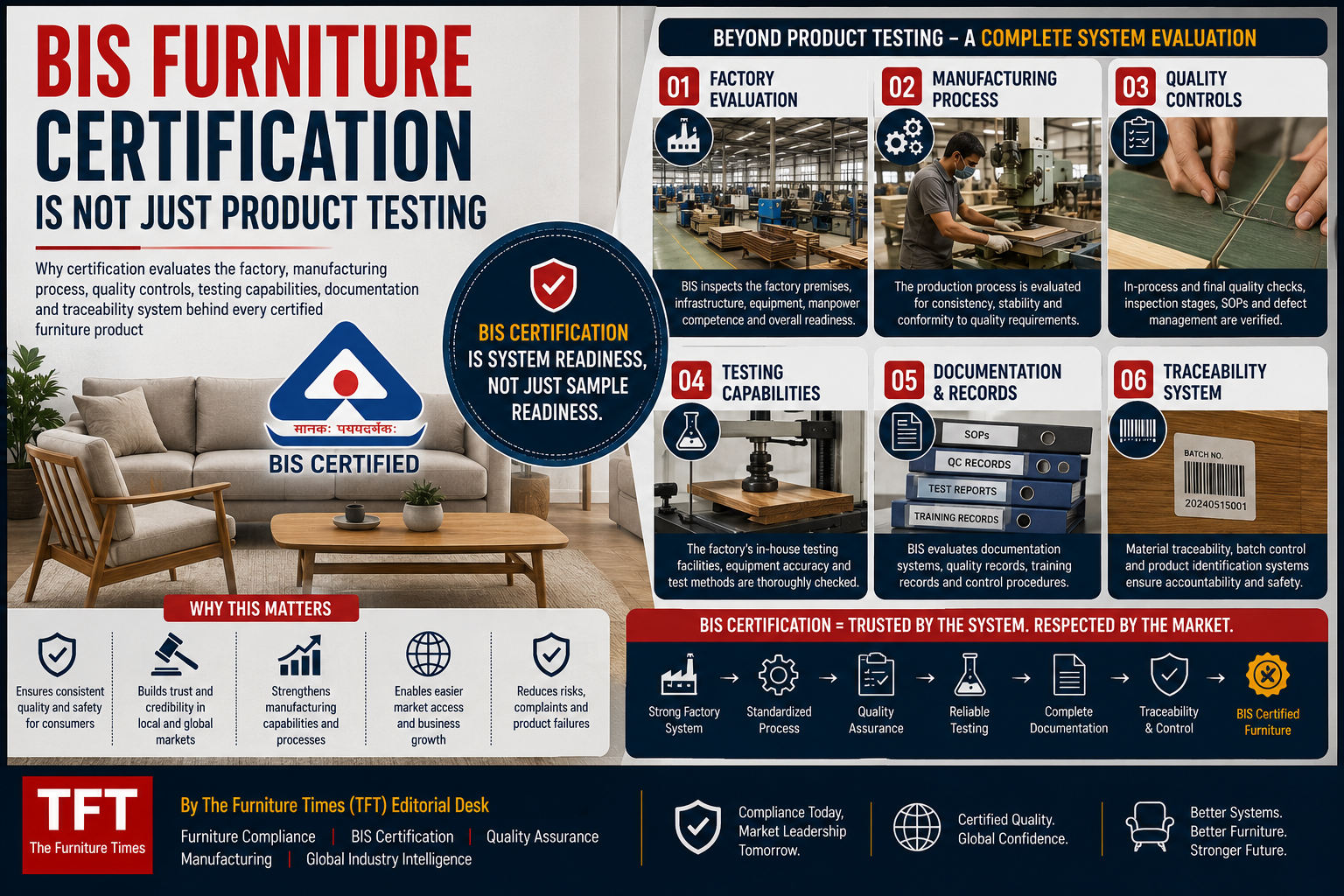
It is an evaluation of the system that repeatedly produces that furniture.
The product must comply, but the factory must also demonstrate that it can control raw materials, manufacturing operations, models, variants, inspections, testing, records, markings and nonconforming products consistently.
The real question is not:
“Can this sample pass?”
The real question is:
“Can this manufacturing system consistently produce conforming furniture after the licence is granted?”
Furniture has entered a more formal compliance era
Furniture has historically been treated differently from highly regulated products such as electrical appliances, pressure equipment or construction materials.
That position is changing.
Furniture performance has direct implications for safety. A chair can collapse. A bunk bed can create entrapment or fall hazards. A desk can overturn. A storage unit can become unstable. A bed frame can fail under load. A work chair can malfunction through repeated use.
India’s Furniture (Quality Control) Order framework brings specified furniture categories under compulsory conformity requirements linked to Indian Standards. The official BIS compulsory-certification listing identifies six principal categories:
| Furniture category | Indian Standard |
|---|---|
| Work chairs | IS 17631:2022 |
| General-purpose chairs and stools | IS 17632:2022 |
| Tables and desks | IS 17633:2022 |
| Storage units | IS 17634:2022 |
| Beds | IS 17635:2022 |
| Bunk beds | IS 17636:2022 |
The original Furniture (Quality Control) Order, 2025 has subsequently been accompanied by amendments and transition-related measures. Manufacturers and importers should therefore verify the latest commencement dates, exemptions and transitional provisions directly through the official BIS Scheme I furniture listing rather than relying on old summaries or social-media explanations.
The important strategic point remains unchanged: once a relevant compulsory requirement applies, certification becomes a market-access issue—not simply a voluntary quality claim.
A laboratory result is evidence, not the entire certification system
Product testing remains essential. The applicable standard may require furniture to undergo assessments involving strength, stability, durability, dimensions, structural safety or other category-specific performance requirements.
But a test report answers only a limited question:
Did the tested sample satisfy the specified requirements under the conditions of that test?
It does not necessarily prove:
- That normal production is identical to the tested sample
- That all declared models and variants are adequately covered
- That incoming materials remain consistent
- That critical hardware will not be changed without control
- That production workers follow approved instructions
- That inspection and testing are performed at defined frequencies
- That failed products are identified and segregated
- That test records are reliable
- That marked products can be traced to production
- That future batches will continue complying
Certification must address these additional risks.
A manufacturer could prepare one exceptional sample using carefully selected materials, specially trained workers and additional supervision. BIS certification is intended to assess whether the manufacturer’s ordinary controlled production—not merely a showcase sample—can continue meeting the standard.
This is why certification extends from the laboratory into the factory.
The licence belongs to a manufacturing system
A common misconception is that BIS certifies a brand independently of the place where the furniture is produced.
Under a manufacturing-based product-certification approach, the manufacturing location is central.
The licence is associated with the manufacturer, manufacturing premises, product scope and applicable standard. If identical-looking furniture is produced at different factories, the quality systems, machinery, suppliers, workers and testing arrangements may differ.
The fact that one factory can produce a conforming product does not automatically demonstrate that another factory can do the same.
Applicants must therefore clearly identify:
- The legal manufacturer
- The manufacturing address
- The applicable product category
- The models and variants
- The manufacturing operations performed at the premises
- Any subcontracted processes
- The testing arrangements
- The quality-control responsibility
- The marking and traceability arrangements
Brand owners using third-party or contract manufacturers must pay particular attention to these relationships.
A brand may own the design and sell the furniture, but the certification process needs clarity about who actually manufactures it, where production occurs and which entity controls conformity.
What BIS is really evaluating
The specific assessment depends on the applicable standard, product manual, application route and BIS instructions. However, manufacturers should prepare for a system-level review covering several interconnected areas.
1. Manufacturing infrastructure
The factory must demonstrate that it has access to the manufacturing infrastructure needed to produce the declared furniture.
Depending on the product and construction method, this may include:
- Cutting equipment
- Panel-processing machinery
- Drilling and boring machines
- CNC machines
- Edge-banding equipment
- Welding facilities
- Metal-forming machinery
- Woodworking machines
- Upholstery equipment
- Finishing or coating systems
- Assembly areas
- Jigs, fixtures and templates
- Inspection areas
- Storage facilities
- Testing equipment
The assessment is not simply a machine-counting exercise.
BIS needs to understand whether the manufacturing arrangement is capable of producing the certified product consistently. Machinery must be appropriate to the construction, dimensions, tolerances and processes involved.
A factory should be able to connect each major production stage with the relevant equipment, instruction, control and inspection.
2. Manufacturing-process control
Furniture quality does not appear only at final inspection. It is built into each production stage.
A typical process may include:
- Receipt of raw materials
- Incoming inspection
- Cutting or forming
- Machining
- Drilling
- Welding or joint preparation
- Surface preparation
- Finishing or coating
- Upholstery
- Assembly
- In-process inspection
- Final inspection
- Testing
- Marking
- Packaging
- Dispatch
Each stage can introduce defects.
Incorrect drilling can weaken a joint. Poor welding can reduce frame strength. Inadequate curing can affect adhesive performance. Incorrect hardware can change stability. Weak assembly torque can cause loosening. Poor packaging can damage an otherwise compliant product.
The manufacturer should define:
- What is controlled at each stage
- Who performs the control
- What acceptance criteria apply
- How frequently checks occur
- What equipment is used
- Where the result is recorded
- What happens when a result fails
This is the practical meaning of process readiness.
3. Raw-material and component controls
Furniture performance depends heavily on materials and components that may be purchased from external suppliers.
These may include:
- Timber
- Plywood
- Particleboard
- Fibreboard
- Steel or aluminum sections
- Fasteners
- Hinges
- Drawer slides
- Castors
- Gas lifts
- Recliner mechanisms
- Adhesives
- Coatings
- Foam
- Fabric
- Leather
- Glass
- Plastics
- Packaging materials
If a tested furniture model uses one material specification but routine production uses another, the test result may no longer represent the manufactured product.
The factory should therefore identify critical inputs and define how they are controlled.
Controls may involve:
- Approved supplier lists
- Purchase specifications
- Incoming inspection
- Supplier test certificates
- Material identification
- Dimensional checks
- Batch records
- Storage requirements
- Rejection procedures
- Change approval
Not every input carries the same risk. A decorative label may have little effect on structural performance, while a frame section, connector, fastener or board thickness may be critical.
The quality system should distinguish between ordinary and conformity-critical inputs.
4. Model and variant control
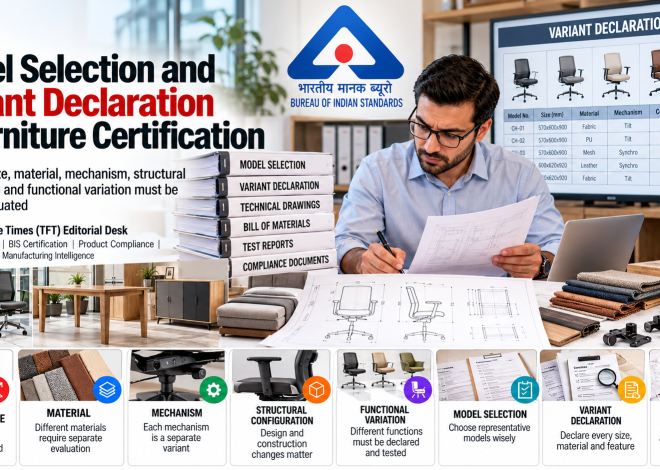
Furniture manufacturers often produce many models with differences in size, materials, configurations, finishes, frames and accessories.
One of the most serious certification risks is assuming that visually similar products automatically belong to the same certification family.
A change may affect compliance if it alters:
- Overall dimensions
- Load-bearing structure
- Frame material
- Board thickness
- Joint construction
- Hardware
- Base design
- Castors
- Gas-lift mechanism
- Backrest structure
- Storage configuration
- Bed support system
- Guardrails or ladders
- Extension mechanisms
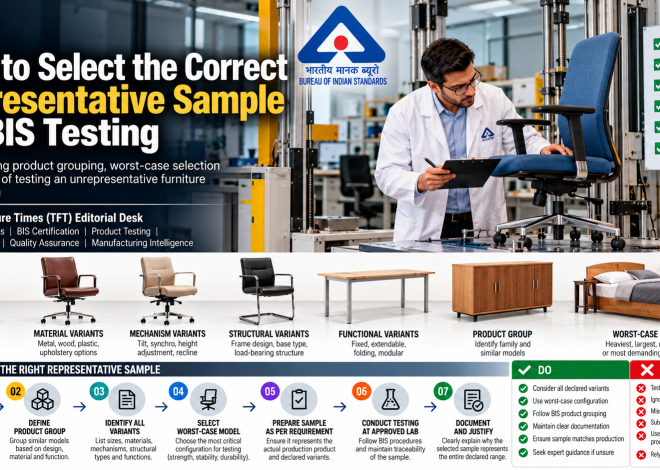
The manufacturer must clearly define which models and variants are included in the application and how representative samples were selected.
Undeclared variants create a traceability and scope problem. Over-declaration without supporting evidence can also delay the application.
A disciplined model-control system should maintain:
- Unique model codes
- Approved drawings
- Bills of materials
- Product specifications
- Variant matrices
- Photographs
- Test coverage
- Change histories
The purpose is to ensure that everyone—the factory, laboratory, certification body and market—refers to the same product.
5. Drawings and specifications
Drawings are not optional paperwork. They define the product that is intended to comply.
A useful drawing should correspond with:
- The tested sample
- The production sample
- The bill of materials
- The model designation
- The declared dimensions
- The actual construction
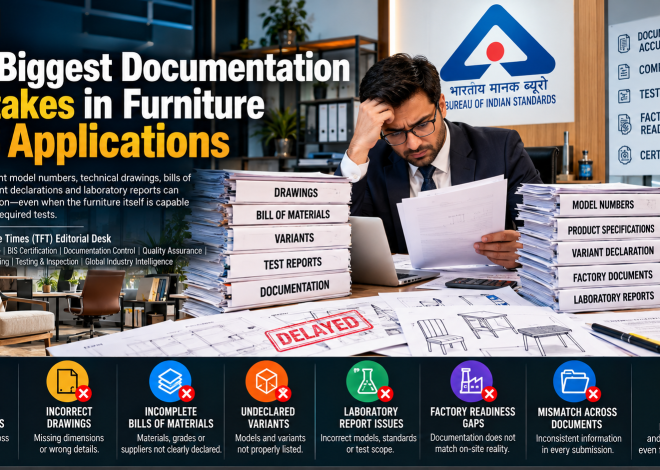
Common inconsistencies include:
- Dimensions differing from the test sample
- Components missing from the drawing
- Incorrect material descriptions
- Different model names across documents
- Drawings that do not show variant differences
- Revision numbers not being controlled
- Production teams using outdated drawings
A factory may manufacture a technically sound product but still face difficulty if the documentation cannot establish which configuration was tested and approved.
Document accuracy is part of conformity.
6. Quality Assurance Plan
The relevant BIS furniture product manuals emphasize the expectation that manufacturers implement a Quality Assurance Plan covering regular testing and in-process controls.
For example, the BIS product manual for tables and desks states that manufacturers are expected to define a Quality Assurance Plan specifying the control unit—such as a lot or batch—and the level and frequency of controls required to ensure that products bearing the Standard Mark comply with the applicable Indian Standard. BIS Product Manual for IS 17633
A credible Quality Assurance Plan should answer:
- What constitutes a production batch or control unit?
- Which tests or inspections are required?
- At what stage are they performed?
- How many samples are checked?
- How frequently are checks performed?
- Who is authorized to test or inspect?
- What are the acceptance criteria?
- What records must be retained?
- What happens after a failure?
The plan should reflect the factory’s actual operations. A generic document copied from another company may not match the product, process or available test facilities.
BIS is interested in implementation, not merely the existence of a document.
7. Testing capabilities
The factory must understand which tests it is expected to perform and how it will demonstrate continuing conformity.
Testing readiness can involve:
- Suitable test equipment
- Adequate capacity and range
- Documented test methods
- Trained personnel
- Calibration or verification
- Sample identification
- Test records
- Environmental conditions where relevant
- Maintenance
- External laboratory arrangements where permitted
The manufacturer should not assume that every test can automatically be outsourced. Requirements depend on the applicable standard, product manual, Scheme I provisions and BIS guidance.
BIS has issued specific guidance allowing eligible MSME manufacturers, subject to conditions, to use recognized common testing facilities for certain in-house testing needs. This shows that testing arrangements can have defined alternatives, but such alternatives must be formally acceptable—not informally assumed. BIS Common Testing Facility Guidelines
The correct question is not simply, “Do we own a laboratory?”
It is:
“Do we have an approved, reliable and documented system for performing every required control and test?”
8. Calibration and equipment control
A test result is only as dependable as the equipment used to produce it.
Factories should maintain a system covering:
- Equipment identification
- Calibration or verification status
- Calibration frequency
- Traceability to appropriate standards
- Acceptance criteria
- Equipment maintenance
- Out-of-calibration handling
- Calibration records
- Status labels
A measuring device that produces inaccurate results can make compliant products appear nonconforming or allow defective products to pass.
If equipment is found outside acceptable limits, the manufacturer may need to examine previous results and determine whether earlier product decisions remain valid.
Calibration is therefore not clerical housekeeping. It protects the reliability of conformity decisions.
9. Competence of quality and testing personnel
Testing equipment does not operate itself.
Inspectors and laboratory personnel must understand:
- The applicable standard
- Sampling requirements
- Test procedures
- Equipment operation
- Acceptance criteria
- Recordkeeping
- Failure escalation
- Product identification
A factory should define responsibility clearly.
Who can release a production batch? Who can reject it? Who approves a material substitution? Who controls the Standard Mark? Who communicates with BIS?
If these responsibilities depend on one person’s memory, the system is fragile.
Training and authorization records help demonstrate that conformity responsibilities are understood and assigned.
10. Identification and traceability
Traceability connects a finished product with the records that demonstrate how it was made.
A functioning traceability system may connect:
- Product model
- Production date
- Batch or lot
- Raw-material receipts
- Component suppliers
- Inspection results
- Test records
- Operators or production line
- Marking information
- Dispatch records
Traceability becomes especially important when a problem appears after dispatch.
If a chair fails in the market, can the manufacturer identify:
- When it was produced?
- Which materials and components were used?
- Which inspection and test records apply?
- Whether similar units remain in stock?
- Which customers received the same batch?
Without traceability, corrective action becomes broad, expensive and uncertain.
The company may be forced to inspect or recall more products than necessary because it cannot isolate the affected production.
11. Control of nonconforming products
Certification does not require a factory to pretend that defects never occur.
A credible quality system assumes that problems can occur and defines how they are controlled.
The factory should have procedures to:
- Identify failed materials or products
- Segregate them from conforming production
- Prevent unauthorized marking or dispatch
- Record the nonconformity
- Investigate the cause
- Decide on rework, repair, downgrade or rejection
- Retest where appropriate
- Verify corrective action
- Monitor recurrence
The most dangerous nonconformity is not the one discovered and controlled. It is the one that passes through the system unnoticed or is deliberately ignored.
BIS has formal guidance for managing product nonconformities identified through testing and surveillance, which can involve corrective action, review of performance and other regulatory responses. BIS Nonconformity Guidelines
12. Control of the Standard Mark
The BIS Standard Mark is not a general company logo.
It applies to products covered by a valid licence and manufactured in accordance with the relevant conformity requirements.
The factory should control:
- Where the mark is applied
- Which models are authorized
- The licence information displayed
- When marking occurs
- Who authorizes marking
- How labels or marking materials are stored
- What happens to rejected products
- How dispatch records are connected with marked production
A product outside the licensed scope should not be marked merely because it resembles a certified model.
The marking system must be connected with production release and traceability.
13. Record control
If an inspection or test was performed but no reliable record exists, it may be difficult to demonstrate that the control occurred.
Records can include:
- Incoming-material inspection
- In-process inspection
- Final inspection
- Test results
- Calibration
- Equipment maintenance
- Training
- Batch release
- Nonconformity
- Corrective action
- Marking
- Dispatch
- Complaints
- Warranty claims
Records should be legible, identifiable, retrievable and protected from unauthorized alteration.
Factories relying on handwritten records should ensure that forms are complete and controlled. Digital systems should maintain access controls and revision histories.
The sophistication of the software matters less than the reliability of the information.
Factory inspection is a reality check
A factory inspection allows BIS to compare the application documents with actual operations.
The inspection may examine whether:
- The declared manufacturing premises are genuine
- The production facilities match the application
- The product is being manufactured as declared
- Testing equipment is available and functional
- Quality personnel understand their responsibilities
- Records demonstrate implementation
- Models and variants are controlled
- Samples can be identified and drawn
- Marking and traceability arrangements are credible
An application can appear complete on paper while the factory remains unprepared in practice.
For example:
- The quality plan exists but workers do not follow it.
- The test equipment appears on a list but is not operational.
- Calibration certificates exist but do not cover the required range.
- Drawings are submitted but production uses different dimensions.
- Inspection records are created retrospectively.
- A test area exists but personnel cannot demonstrate the method.
- Model codes in the factory differ from those in the application.
Factory readiness means that the documentation and actual operation tell the same story.
The demonstration test matters
During an inspection, factory personnel may be required to demonstrate testing or control activities.
This is not a ceremonial exercise.
A demonstration can reveal whether:
- Equipment is suitable
- Personnel understand the method
- Samples are properly conditioned or positioned
- Loads and cycles are applied correctly
- Results are accurately observed
- Acceptance criteria are understood
- Records are completed properly
Manufacturers should conduct internal trial inspections before the official visit.
The goal should not be to rehearse a performance. It should be to find weaknesses while there is still time to correct them.
Passing today does not guarantee compliance tomorrow
BIS certification is not completed forever on the day a licence is granted.
The licence operates within an ongoing conformity-assessment system that may include surveillance, sample testing, record review and investigation of complaints or nonconformities.
BIS issued updated guidelines in February 2026 for factory surveillance under Scheme I. These guidelines describe surveillance as a mechanism for monitoring the operation of licences and checking continued product conformity. BIS Factory Surveillance Guidelines, February 2026
This means the manufacturer must remain prepared after certification.
The factory should continue to maintain:
- Approved production controls
- Testing arrangements
- Calibration
- Traceability
- Records
- Product consistency
- Correct marking
- Corrective-action systems
Certification is not a project handed to a consultant and forgotten. It becomes an operational responsibility.
Why furniture manufacturers fail despite having good products
Many certification failures do not begin with a fundamentally unsafe product. They begin with an uncontrolled system.
Common causes include:
Incomplete scope definition
The manufacturer has not clearly identified all models and variants requiring certification.
Inconsistent documents
The drawing, bill of materials, test report and production sample do not match.
Uncontrolled substitutions
Hardware, board thickness, foam, fasteners or structural materials are changed without evaluation.
Inadequate testing arrangements
Equipment is missing, unsuitable, uncalibrated or not operated correctly.
Weak production records
The factory cannot demonstrate that inspections and tests are performed consistently.
Poor traceability
The company cannot connect marked products with production and test records.
Factory unpreparedness
Employees do not know the quality plan, equipment is unavailable, or actual production differs from the submitted process.
Nonconformity not controlled
Failed products are not segregated or corrective action is not documented.
Certification treated as paperwork
The applicant focuses on forms and fees while ignoring process implementation.
These failures are avoidable when management treats certification as a factory-readiness program.
Normal and simplified procedures do not change the need for conformity
Manufacturers may encounter references to different routes or options for grant of licence, sometimes described in practice as normal and simplified processes.
The exact route, documentation and processing steps can vary. An applicant may submit test evidence from an acceptable laboratory under the relevant provisions, while other cases may involve sample drawing and testing during the certification process.
However, no procedural route should be interpreted as permission to bypass manufacturing capability, testing arrangements or quality control.
A faster application route is not a weaker compliance standard.
Even where a recent third-party test report supports the application, BIS’s official certification FAQs state that reports used for grant under the relevant option should generally not be more than 90 days old. BIS Product Certification FAQs
More importantly, the factory must still demonstrate that the report represents the declared product and that continued production will remain under control.
Contract manufacturing requires clear responsibility
Furniture brands commonly outsource manufacturing. This creates additional questions:
- Which entity applies for the licence?
- Where is the product physically manufactured?
- Who controls specifications and changes?
- Who maintains test equipment and records?
- Who applies the Standard Mark?
- Who controls nonconforming production?
- Can the brand owner require material substitutions?
- Who is responsible during surveillance?
A commercial agreement does not replace conformity responsibility.
Brand owners should audit their manufacturing partners before beginning the certification process. A contract factory may manufacture good furniture but lack the documentation, testing capabilities or change-control discipline required for certification.
The certification strategy should be agreed before product launch—not after large quantities are already ordered.
Foreign manufacturers face the same fundamental question
Foreign factories wishing to supply regulated furniture to India must also demonstrate that the manufacturing system behind the product is capable of maintaining conformity.
A passing overseas laboratory report alone should not be assumed to complete the process.
Foreign manufacturers need to prepare:
- Factory details
- Manufacturing processes
- Product scope
- Testing arrangements
- Quality-control documentation
- Authorized Indian representation where applicable
- Factory-inspection logistics
- Marking and traceability systems
- Continuing compliance
International suppliers should allow sufficient time for application, inspection, testing and corrective action. Commercial shipment deadlines should not be planned on the assumption that certification is automatic.
The role of management cannot be delegated away
Consultants, laboratories and quality professionals can guide the process. They can interpret requirements, review documents and identify gaps.
But management retains responsibility for making the factory compliant.
Leadership must provide:
- Resources
- Suitable equipment
- Trained people
- Production discipline
- Authority for quality decisions
- Time for corrective action
- Control over suppliers
- Accurate declarations
If management treats certification as an administrative inconvenience, employees will do the same.
A strong compliance culture begins when leadership recognizes that quality controls protect the company from:
- Product failures
- Market complaints
- Costly rework
- Warranty claims
- Regulatory action
- Shipment delays
- Reputational damage
BIS readiness should be integrated with the business—not operated as a parallel system that appears only during inspection.
A practical BIS factory-readiness checklist
Before submitting an application, furniture manufacturers should conduct a structured internal review.
Product scope
- Is the correct Indian Standard identified?
- Are all models and variants listed?
- Is the family or grouping logic technically justified?
- Does the representative sample cover the declared scope?
Technical documentation
- Are drawings complete and current?
- Do bills of materials match the drawings?
- Do specifications match actual production?
- Are document revisions controlled?
Manufacturing
- Is the process flow documented?
- Are critical stages identified?
- Are work instructions available?
- Are jigs, fixtures and machinery suitable?
Materials and suppliers
- Are critical input specifications defined?
- Are suppliers approved?
- Is incoming inspection implemented?
- Are substitutions controlled?
Testing
- Are all required tests identified?
- Is suitable equipment available?
- Is external testing formally acceptable where used?
- Can employees demonstrate the test methods?
Equipment
- Is calibration or verification current?
- Does the calibration range cover actual use?
- Is equipment maintenance documented?
- Is defective equipment controlled?
Quality system
- Is a product-specific Quality Assurance Plan implemented?
- Are control units and testing frequencies defined?
- Are records genuine and retrievable?
Traceability
- Can a product be traced to its production batch?
- Can the batch be linked to materials and test records?
- Are model codes consistent across the system?
Nonconformity
- Are failed products identified and segregated?
- Are causes investigated?
- Are corrective actions verified?
Marking
- Is the Standard Mark controlled?
- Can only authorized products be marked?
- Are marking and dispatch connected with production release?
People
- Do quality personnel understand the standard?
- Are testing personnel trained?
- Are responsibilities and authorities defined?
Inspection readiness
- Can the factory demonstrate the entire process?
- Do documents match physical operations?
- Are records available without being recreated?
If any answer is uncertain, the application may not yet be ready.
A four-stage preparation model
Manufacturers can organize compliance work into four stages.
Stage One: Define
Identify the applicable standard, product scope, models, variants, factory and certification responsibilities.
Stage Two: Build
Prepare drawings, bills of materials, process controls, testing arrangements, equipment and documentation.
Stage Three: Demonstrate
Produce representative units under normal controlled conditions, conduct internal testing and complete genuine records.
Stage Four: Sustain
Continue inspections, testing, traceability, corrective action and surveillance readiness after the licence is granted.
This approach shifts certification from last-minute paperwork to long-term operational capability.
Certification can strengthen the business
BIS certification may initially be viewed as a cost involving testing, equipment, inspection, consulting and administration.
But a properly implemented conformity system can create operational benefits.
It can help manufacturers:
- Standardize production
- Reduce uncontrolled variants
- Improve supplier quality
- Identify critical components
- Strengthen drawings and specifications
- Reduce product failures
- Improve traceability
- Analyze complaints more effectively
- Support institutional procurement
- Increase customer confidence
- Prepare for export compliance
Certification should not be confused with perfect quality. No system eliminates all risk. But the discipline required for certification can improve the factory’s ability to detect, prevent and correct problems.
FurniReviewology and the compliance–trust connection
BIS certification and customer reviews serve different purposes.
BIS conformity assessment evaluates compliance with applicable requirements and the manufacturing system supporting certified production. Customer reviews reflect what buyers experience after purchase.
Neither should be treated as a substitute for the other.
A complete trust picture can include:
- Certification status
- Technical compliance
- Product specifications
- Factory controls
- Warranty support
- Delivery experience
- Long-term customer feedback
- Complaint-resolution performance
This is where FurniReviewology can add value to the wider compliance ecosystem.
Reviews can help reveal whether certified production continues to perform reliably in actual use. Recurring complaints can signal issues involving components, assembly, packaging, delivery or service that may not be visible in a one-time laboratory test.
FurniReviewology can help organize this feedback into meaningful categories while distinguishing technical compliance from broader customer satisfaction.
The trust pathway becomes:
Certification demonstrates controlled conformity.
Traceability connects the product with its manufacturing history.
Reviews reveal the ownership experience.
Corrective action demonstrates accountability.
The larger message for the furniture ecosystem
BIS furniture certification affects more than finished-product manufacturers.
It has implications for:
- Component suppliers
- Board and panel manufacturers
- Hardware producers
- Fabric and foam suppliers
- Testing laboratories
- Certification consultants
- Machinery companies
- Importers
- Retailers
- E-commerce platforms
- Commercial buyers
- Logistics providers
Manufacturers will increasingly need suppliers capable of providing consistent materials, technical specifications, batch identification and supporting records.
Retailers and marketplaces may need to verify the compliance status of products within applicable scope. Importers must confirm that foreign factories are certification-ready. Laboratories must develop suitable furniture-testing competence and capacity.
The furniture ecosystem is moving from informal quality claims toward documented conformity.
That transition will reward businesses that prepare early.
Final conclusion: certify the system, not only the sample
A compliant test sample is necessary, but it is not the complete objective.
The objective is a factory capable of repeatedly manufacturing furniture that complies with the applicable Indian Standard.
That requires:
- Correct product scope
- Controlled models and variants
- Accurate drawings
- Defined materials
- Capable manufacturing processes
- Reliable testing arrangements
- Calibrated equipment
- Trained personnel
- Authentic records
- Product traceability
- Controlled marking
- Effective corrective action
Furniture manufacturers should stop asking only:
“Will our product pass the test?”
They should begin asking:
“Can our factory prove that every marked product is made under a controlled, traceable and continuously conforming system?”
That is the deeper meaning of BIS certification.
It is not just product testing.
It is complete manufacturing-system readiness.
Regulatory note
This article provides general industry information and should not be treated as legal or certification advice. Furniture QCO requirements, implementation dates, exemptions, transition provisions, product manuals and certification procedures may be amended.
Manufacturers, importers and brand owners should verify the latest official documents through the Bureau of Indian Standards, the applicable ministry notification and the relevant BIS branch office before making production, import or market-access decisions.
The Furniture Times (TFT) & Furniture Industry Search Engine (FISE)
“TFT tells their story. FISE helps the world find them.”
FurniReviewology helps the world trust them.
The furniture industry ecosystem is a $1 trillion industry ecosystem.
Do not prepare only the sample. Prepare the factory, the process, the people, the records and the complete compliance system.