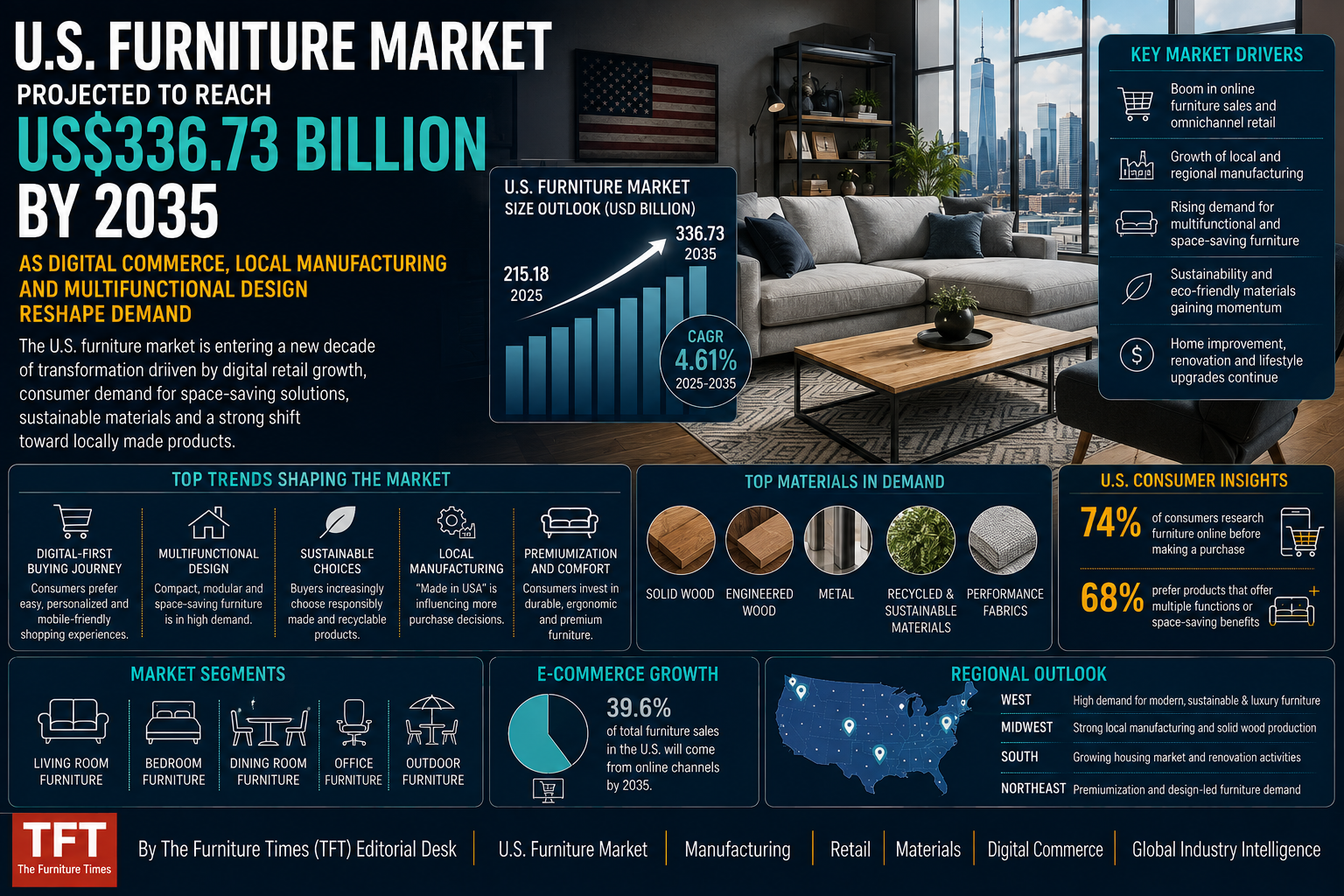
U.S. Furniture Market Projected to Reach US$336.73 Billion by 2035
as Digital Commerce, Local Manufacturing and Multifunctional Design Reshape Demand
New industry analysis points to a 6.87% growth rate, with bedroom furniture, wood products and residential demand maintaining strong positions while storage, commercial and plastic furniture record faster expansion
By The Furniture Times (TFT) Editorial Desk | U.S. Furniture Market | Manufacturing | Retail | Materials | Digital Commerce | Global Industry Intelligence
The United States furniture market is entering a decade of structural transformation in which growth will be shaped not only by the number of homes, offices, hotels and public facilities requiring furniture, but also by fundamental changes in how furniture is designed, produced, discovered, purchased, delivered and maintained.
According to a newly published U.S. Furniture Market 2026–2035 report by Custom Market Insights, the market was valued at approximately US$173.27 billion in 2025 and is expected to reach US$185.17 billion in 2026. The research projects that the market could expand to around US$336.73 billion by 2035, representing a compound annual growth rate of approximately 6.87%.
If the forecast is realized, the U.S. furniture market will add more than US$150 billion in annual market value between 2026 and 2035. This would create opportunities across a much larger ecosystem extending from forests, material processors and component manufacturers to furniture factories, logistics companies, retailers, interior designers, installers, repair specialists, technology providers and digital marketplaces.
The forecast does not mean that every category or company will experience equal growth. The next decade is likely to produce a more competitive and technology-intensive market where businesses must respond to affordability pressures, changing household behavior, commercial-space transformation, sustainability expectations and rising digital-discovery requirements.
The emerging message is clear: furniture demand will remain substantial, but the way companies capture that demand is changing.
U.S. furniture market forecast at a glance
The report presents the following principal projections:
| Market indicator | Report estimate |
|---|---|
| Market value in 2025 | US$173.27 billion |
| Estimated market value in 2026 | US$185.17 billion |
| Projected market value in 2035 | US$336.73 billion |
| Forecast CAGR | 6.87% |
| Forecast period | 2026–2035 |
| Leading product segment in 2025 | Bedroom furniture |
| Leading material segment in 2025 | Wood |
| Leading application segment in 2025 | Residential |
| Fastest-growing product segment | Storage furniture |
| Fastest-growing material segment | Plastic furniture |
| Fastest-growing application | Commercial furniture |
These figures are forecasts based on the research company’s market definition, assumptions and methodology. They should therefore be treated as estimates rather than guaranteed outcomes. Nevertheless, the report identifies several important directions that furniture businesses should consider in their investment, production and market-development strategies.
Furniture is not one market—it is an interconnected economy
The U.S. furniture sector cannot be understood only through sales of sofas, beds, tables and cabinets. Every finished product represents the combined output of multiple industries.
The ecosystem includes:
- Timber growers, sawmills and wood processors
- Engineered-board and panel manufacturers
- Steel, aluminum, glass and plastics suppliers
- Foam, fabric, leather and textile businesses
- Hinges, slides, connectors and fastener manufacturers
- Adhesives, coatings, paints and finishing suppliers
- Furniture designers and product-development studios
- Machinery, tooling and automation providers
- Domestic manufacturers and international exporters
- Importers, wholesalers and regional distributors
- Independent furniture stores and national retailers
- Online marketplaces and direct-to-consumer brands
- Warehousing, freight and final-mile delivery companies
- Interior designers, architects and commercial specifiers
- Installers, repair providers and furniture-care businesses
- Resale, refurbishment and recycling operators
- Financing, insurance, warranty and payment providers
- Software, artificial-intelligence and visualization companies
Growth in the U.S. furniture market can therefore create demand far beyond furniture factories and retail showrooms. It can influence employment, commercial real estate, domestic manufacturing, logistics investment, technology adoption and material innovation.
At the same time, weakness in housing turnover, consumer confidence or commercial construction can move through the same ecosystem, affecting suppliers that consumers rarely see.
Bedroom furniture remains the largest product category
Custom Market Insights estimates that bedroom furniture accounted for approximately 37% of the U.S. market in 2025, making it the leading product category.
The segment includes mattresses, beds, headboards, nightstands, dressers, wardrobes and related storage products. Its scale reflects the essential nature of bedroom furniture. While many discretionary furnishings can be delayed, every household requires sleeping and storage solutions.
Several changes are reshaping the category.
Consumers increasingly expect bedroom furniture to combine appearance with practical performance. Beds may incorporate storage, charging ports, lighting, adjustable bases or modular headboard systems. Dressers and wardrobes are being designed for smaller spaces, while mattresses and sleep systems are becoming more personalized.
Demand is also becoming segmented by lifestyle:
- Young renters may prioritize affordability and ease of relocation.
- Families may seek durability, storage and stain-resistant finishes.
- Older consumers may value accessibility, comfort and adjustable features.
- Premium buyers may prefer solid wood, craftsmanship and customization.
- Environmentally conscious consumers may investigate material sourcing and chemical emissions.
- Urban residents may favor compact or multifunctional bedroom systems.
The continued dominance of bedroom furniture does not guarantee easy growth. The category is highly competitive, and online comparison has made prices, dimensions and reviews more visible. Manufacturers must differentiate through material quality, durability, comfort, storage functionality, design and service.
Storage furniture is forecast to grow fastest
Although bedroom furniture currently holds the largest product share, the report forecasts that storage furniture will achieve the fastest product-category CAGR—approximately 8.13% from 2026 to 2035.
Storage is becoming more important because American homes and workplaces must accommodate more functions within the same space. A living room may also serve as a work area, play space and entertainment center. Bedrooms often require integrated storage, while smaller apartments demand vertical and concealed solutions.
Growth opportunities include:
- Modular wardrobes
- Wall-mounted shelving
- Media and entertainment units
- Under-bed storage
- Cabinets for home offices
- Entryway organization systems
- Garage and utility storage
- Children’s storage furniture
- Kitchen and pantry organization
- Flexible commercial storage
- Hospitality and institutional casegoods
Storage furniture also aligns well with customization. Consumers may select dimensions, finishes, door styles, internal accessories and modular configurations. This can create higher-value opportunities for companies able to combine scalable production with personalized ordering.
For component suppliers, storage growth can increase demand for hinges, drawer slides, handles, connectors, lifting systems, soft-close mechanisms, lighting accessories and organization hardware.
Wood maintains its leadership
Wood furniture accounted for an estimated 46.35% of the U.S. market by material in 2025, according to the report.
Its position is supported by durability, familiarity, design versatility and the perception of natural value. Wood can serve traditional, rustic, minimalist, contemporary and luxury interiors, making it relevant across a broad range of price levels and applications.
However, the term “wood furniture” covers products with significantly different construction and performance characteristics:
- Solid hardwood
- Softwood
- Plywood
- Medium-density fiberboard
- Particleboard
- Veneered panels
- Reclaimed timber
- Bamboo and wood-based composites
- Mixed-material furniture combining wood with metal, glass or plastics
Customers increasingly want to know what type of wood they are purchasing, where it originated, what finishes were applied and how the furniture should be maintained.
This makes transparency an important competitive tool. Manufacturers and retailers should avoid vague material descriptions and provide clear information about solid-wood components, veneers, substrates, finishes and certifications.
The growth of sustainability awareness may benefit responsibly sourced wood, reclaimed materials, low-emission panels and repairable construction. However, environmental claims will need credible evidence. Labels such as “natural,” “green” or “sustainable” are no longer sufficient without documented sourcing, material composition or certification.
Plastic furniture could record the fastest material growth
One of the report’s more notable findings is the forecast that plastic furniture could grow at approximately 8.97% annually between 2026 and 2035, making it the fastest-growing material category in the study.
The forecast may reflect demand for lightweight, affordable, weather-resistant and easily maintained products. Plastic furniture is used across residential, outdoor, hospitality, educational, event, healthcare and recreational applications.
Its future growth will likely depend on innovation in:
- Recycled plastics
- High-performance polymers
- UV-resistant outdoor materials
- Improved textures and finishes
- Furniture designed for disassembly
- Mono-material construction
- Replaceable components
- Collection and recycling programs
Plastic furniture also faces environmental scrutiny. Low-quality products with short lifespans can contribute to waste, while mixed plastics may be difficult to recycle. The strongest opportunity may therefore lie in durable products using verified recycled content and designed for longer service life or material recovery.
The issue is not simply whether plastic is used, but how responsibly it is sourced, engineered, maintained and managed after use.
Residential demand holds the largest share
Residential furniture represented approximately 61.37% of the U.S. market in 2025, according to Custom Market Insights.
The residential segment includes furniture for bedrooms, living rooms, dining areas, kitchens, home offices, patios and other household spaces. It is influenced by new household formation, housing transactions, renovation, rental turnover, migration, lifestyle changes and replacement cycles.
Residential demand is also affected by how consumers perceive their homes. The home is no longer only a place for sleeping and family life. It may simultaneously function as an office, classroom, entertainment space, fitness area and social environment.
This has encouraged demand for furniture that is:
- Multifunctional
- Compact
- Modular
- Easy to assemble
- Easy to move
- Durable and repairable
- Suitable for hybrid work
- Compatible with technology
- Adaptable to changing households
However, residential furniture is sensitive to affordability. When consumers face higher living costs or financial uncertainty, they may delay major purchases, trade down to lower-priced products, use financing, seek promotions or enter the second-hand market.
Manufacturers and retailers therefore need portfolios that address different income groups without sacrificing essential safety and quality.
Commercial furniture may expand faster
The report forecasts that commercial furniture will grow at approximately 7.32% annually, exceeding the wider market’s projected growth rate.
Commercial demand covers offices, hotels, restaurants, schools, universities, hospitals, clinics, care facilities, retail stores, public buildings and coworking environments.
The market is changing as organizations reconsider how physical spaces should support people. In offices, furniture is increasingly expected to facilitate collaboration, concentration, hybrid meetings and employee wellbeing. In hospitality, furniture must support distinctive guest experiences while withstanding intensive use. In healthcare and education, safety, ergonomics, cleanability and accessibility are essential.
Commercial buyers often consider the total cost of ownership rather than only the purchase price. Their decisions can include:
- Initial cost
- Installation
- Maintenance
- Cleaning requirements
- Warranty coverage
- Replacement-part availability
- Furniture downtime
- Reconfiguration
- End-of-life value
- Compliance and certification
- Repair and refurbishment potential
This creates opportunities for manufacturers offering durable products, modular systems, long-term warranties, repair services and verified performance data.
The future of commercial furniture may be less focused on selling individual products and more focused on managing furniture as an operational asset.
Digital-first brands are changing the retail structure
The report identifies the expansion of digital-first and direct-to-consumer businesses as a major influence on the U.S. market.
Online furniture retail gives consumers access to larger assortments, price comparison, reviews, visualization and home delivery. It also allows emerging brands to reach national customers without building extensive networks of conventional stores.
Yet physical stores remain relevant because furniture is a tactile, high-consideration purchase. Consumers may want to sit on a sofa, compare fabrics, inspect construction or discuss customization before ordering.
This is producing an omnichannel market rather than a purely online one. The most effective retailers increasingly connect:
- Online research
- Digital advertising
- AI-assisted discovery
- Virtual consultations
- Physical showrooms
- Material samples
- Mobile applications
- Social media
- Click-and-collect services
- Scheduled home delivery
- Installation
- Post-purchase support
A showroom may function as an experience center, design studio, consultation space, fulfilment point and local service hub. Meanwhile, the website becomes the always-open front door through which customers discover the brand.
Furniture companies that keep online and offline operations separate risk creating inconsistent prices, unavailable inventory, conflicting product information and poor customer experiences.
Augmented reality is reducing digital uncertainty
Augmented reality and three-dimensional visualization are becoming important tools for furniture retailers because they help answer two of the buyer’s biggest questions:
Will it fit?
Will it look right?
Digital visualization allows shoppers to position a virtual product inside a room, compare colors and test configurations before purchasing. This can improve confidence, particularly for large items such as sofas, beds, dining tables, wardrobes and office systems.
However, visualization technology must be supported by accurate product data. A beautiful 3D model with incorrect dimensions can increase rather than reduce problems.
Manufacturers need reliable digital assets, including:
- Accurate measurements
- High-resolution product photography
- Realistic material textures
- 360-degree views
- Configurable 3D models
- Color and finish references
- Assembly diagrams
- Space-planning files
- Commercial specification documents
Digital product content is becoming part of the product itself. A company that invests heavily in manufacturing but provides incomplete online information may still lose the customer.
AI is moving into every part of the value chain
The report highlights artificial intelligence as a growing force in forecasting, inventory management, customer engagement and visualization.
AI can help furniture businesses analyze large volumes of search, sales, inventory and social data. This may allow them to identify emerging styles, improve demand forecasting and reduce overproduction.
Potential applications include:
- Product recommendations
- Visual search
- Conversational shopping assistants
- Automated room design
- Demand forecasting
- Inventory allocation
- Pricing analysis
- Customer-service automation
- Product-description generation
- Quality inspection
- Predictive maintenance
- Delivery-route optimization
- Review and sentiment analysis
- Fraud and return-risk identification
But AI also introduces a new competitive issue: whether machines can find and understand a furniture company.
A business may manufacture excellent products but remain absent from AI-generated recommendations because its website contains limited information, inconsistent company details or poorly structured product data.
The future furniture market will require two types of visibility:
- Human visibility, through media, branding, search results, marketplaces and showrooms.
- Machine visibility, through structured data, clear product information, trusted citations, credible reviews and consistent digital identities.
This is where the role of specialist furniture media, search infrastructure and review intelligence becomes increasingly important.
Smart furniture moves from novelty to practical value
Smart furniture is developing as consumers seek greater comfort, connectivity and efficiency.
Products may incorporate:
- Wireless charging
- USB and power connections
- Built-in lighting
- Speakers
- Adjustable ergonomic controls
- Temperature management
- Sensors
- App connectivity
- Voice-enabled functions
- Health and posture monitoring
However, adding electronics does not automatically create useful innovation. Smart furniture must still perform its primary function effectively.
A smart desk must remain stable and ergonomic. A connected bed must remain comfortable and durable. A charging table must be safe, repairable and easy to use.
Manufacturers must also consider software support, electrical certification, component replacement, data privacy and technological obsolescence. Furniture may last considerably longer than the electronics installed inside it. Modular and replaceable technology components may therefore become essential.
Local manufacturing and sourcing gain strategic importance
The report identifies growing interest in U.S.-based manufacturing and sourcing. Local production can offer advantages in lead times, customization, supply-chain responsiveness and quality control.
It can also support regional employment, specialist craftsmanship and smaller suppliers.
However, domestic manufacturing does not eliminate global dependence. U.S. furniture producers may still rely on imported hardware, fabrics, machinery, chemicals, electronics, boards or raw materials. A more resilient strategy requires companies to understand the full depth of their supply chains.
Resilience may involve:
- Multiple qualified suppliers
- Regional material alternatives
- Strategic component inventories
- Better demand forecasting
- Standardized interchangeable components
- Supplier-quality monitoring
- Digital supply-chain visibility
- Repair and replacement-part systems
The likely future is not complete localization or complete globalization. It is a more carefully balanced sourcing model built around risk, cost, speed and market requirements.
Sustainability is becoming a commercial requirement
American consumers and institutional buyers are paying closer attention to material sourcing, durability, emissions, packaging and end-of-life management.
This creates opportunities for companies using certified wood, recycled metals, organic textiles, reclaimed materials and lower-impact production methods.
Yet sustainability must be assessed across the whole product lifecycle. A product made from recycled material may still perform poorly if it cannot be repaired. A solid-wood product may still carry environmental risk if its source is unclear. A lightweight product may reduce transport emissions but create waste if it fails prematurely.
A more complete sustainability strategy includes:
- Responsible material sourcing
- Efficient manufacturing
- Reduced production waste
- Low-emission adhesives and finishes
- Durable construction
- Replaceable parts
- Repair instructions
- Minimal and recyclable packaging
- Take-back programs
- Refurbishment
- Resale
- Material recovery
Furniture businesses should be prepared for customers to demand evidence. Environmental performance is gradually becoming a product-data issue as much as a marketing issue.
Affordability will remain a major constraint
The U.S. furniture market has strong growth potential, but price pressure remains significant. Furniture competes with housing costs, food, transport, healthcare, education and other household priorities.
Manufacturers also face costs involving labor, energy, foam, wood, metals, fabrics, freight, warehousing and returns.
When costs rise, companies have several choices:
- Increase retail prices
- Reduce promotional discounts
- Redesign products
- Substitute materials
- Improve production efficiency
- Simplify packaging
- Reduce SKU complexity
- Increase local sourcing
- Introduce financing
- Develop entry-level collections
Poorly managed cost reduction can damage quality. Thinner materials, weaker hardware and reduced quality control may lower manufacturing expenses in the short term but increase returns, warranty claims and reputational damage.
The strongest companies will distinguish between removing waste and removing value.
Logistics will determine who converts market growth into profit
Furniture logistics remains one of the industry’s most difficult operational challenges.
Furniture is large, expensive to store and vulnerable to damage. Delivery may require specialized vehicles, appointment scheduling, two-person teams, assembly and packaging removal.
A retailer can successfully advertise and sell a product but still lose money if delivery is repeatedly delayed, damaged or returned.
The next decade will reward businesses that improve:
- Inventory visibility
- Warehouse placement
- Protective packaging
- Route optimization
- Delivery scheduling
- Real-time customer communication
- Final-mile training
- Assembly quality
- Damage reporting
- Reverse logistics
- Spare-parts fulfilment
- Refurbishment and resale
Delivery is not separate from the brand. For many online buyers, the delivery team is the only human contact they have with the retailer.
Reviews increasingly determine trust
Furniture customers face uncertainty over comfort, construction, finish, delivery and after-sales support. Reviews help reduce this uncertainty.
The influence of reviews extends beyond star ratings. Customers examine comments, photographs and company responses to understand whether a business fulfils its promises.
A weak review profile can reduce conversion even when products are competitively priced. Conversely, transparent and credible reviews can help smaller companies compete with larger brands.
Reviews also provide valuable product-development intelligence. Recurring comments can reveal:
- Weak connectors or slides
- Fabric performance problems
- Packaging failures
- Confusing instructions
- Color inconsistencies
- Comfort issues
- Inaccurate dimensions
- Delivery weaknesses
- Poor complaint handling
This makes review intelligence an operational tool, not merely a promotional one.
Competitive landscape remains broad
The report identifies companies including Ashley Furniture Industries, La-Z-Boy, Bassett Furniture Industries, Steelcase, Haworth, MillerKnoll, HNI, Sauder Woodworking, Flexsteel and L. & J.G. Stickley among prominent participants.
However, the U.S. furniture market is much larger than its leading manufacturers. It includes thousands of independent retailers, specialist workshops, designers, importers, contract manufacturers, component suppliers and service providers.
Large companies benefit from brand recognition, purchasing power, logistics networks and advertising resources. Smaller businesses can compete through craftsmanship, speed, customization, local service, specialization and authenticity.
Their biggest challenge is often not product quality—it is visibility.
Many capable manufacturers and craftspeople are difficult to find online. They may lack optimized websites, structured catalogues, media coverage and reliable review profiles. This prevents customers, designers and commercial buyers from discovering them.
A more inclusive furniture economy must give credible smaller businesses a fair opportunity to be found.
What furniture businesses should prepare for before 2035
The market forecast offers opportunities, but participation will require preparation.
1. Create complete digital product information
Every product should have accurate dimensions, materials, finishes, functions, care instructions, warranty conditions and delivery details.
2. Build AI-readable catalogues
Structured product data will help search engines, marketplaces and AI assistants understand and recommend furniture.
3. Develop multifunctional products
Furniture should respond to smaller spaces, hybrid work, household flexibility and storage needs.
4. Protect quality while managing costs
Cost reduction should focus on waste, inefficiency and unnecessary complexity—not safety, durability or component reliability.
5. Improve supply-chain resilience
Manufacturers should identify critical components, alternative suppliers and potential regional sourcing options.
6. Invest in logistics
Accurate inventory, protective packaging, delivery communication and trained installation teams can reduce costly failures.
7. Prepare credible sustainability evidence
Environmental claims should be supported by sourcing records, certifications, material data and measurable practices.
8. Connect physical and digital channels
Showrooms, websites, marketplaces, mobile experiences and customer service should operate as one system.
9. Build review intelligence
Businesses should collect authentic feedback, respond professionally and use reviews to improve operations.
10. Increase industry visibility
Manufacturers, suppliers, designers and service providers need accurate business profiles, searchable product categories, credible news coverage and consistent online identities.
The wider opportunity for the furniture ecosystem
The projected growth of the U.S. furniture market represents more than a retail opportunity. It may create demand across furniture materials, machinery, accessories, logistics, technology, design, repair and circular services.
Bedroom furniture may remain dominant, but storage is positioned for faster growth. Wood may retain its leadership, while plastic products evolve through recycled materials and improved engineering. Residential demand will remain central, but commercial furniture could expand more quickly as workplaces, hospitality venues, healthcare facilities and educational institutions adapt their spaces.
Digital commerce will continue to influence purchasing, but physical showrooms will remain valuable. Artificial intelligence will improve recommendations and forecasting, yet it will also raise the importance of accurate product data. Sustainability will attract interest, but evidence will matter more than slogans.
The real competitive advantage will come from combining six capabilities:
A strong product. Accurate information. Reliable delivery. Credible reviews. Digital visibility. Long-term service.
The U.S. furniture market may reach US$336.73 billion by 2035, but market growth alone will not guarantee success. Companies must make themselves discoverable, understandable and trustworthy throughout the purchasing journey.
In the future furniture economy, making an excellent product will remain essential—but ensuring that customers can find it, verify it and confidently purchase it will be equally important.
Editorial and methodology note
The market values, segment shares and growth forecasts in this article are attributed to the Custom Market Insights U.S. Furniture Market 2026–2035 report, published on July 14, 2026. Market forecasts depend on definitions, data sources, modelling assumptions, inflation, economic conditions, housing activity, construction, trade policy and consumer behavior. They should not be interpreted as guaranteed financial outcomes.
References to business implications and strategic priorities represent editorial analysis by The Furniture Times based on the report’s published findings.
The Furniture Times (TFT) & Furniture Industry Search Engine (FISE)
“TFT tells their story. FISE helps the world find them.”
FurniReviewology helps the world trust them.
The furniture industry ecosystem is a $1 trillion industry ecosystem.
Be visible. Be searchable. Be trusted. Be part of the movement.