Airbnb Furniture Procurement: What Manufacturers Should Prepare For
Understanding Orders, Lead Times, Customisation, Replacements and Operational Requirements
By The Furniture Times (TFT) Editorial Desk | Airbnb & Homestay Furniture | Furniture Procurement | Short-Term Rentals | Manufacturing | Property Management | Global Industry Intelligence
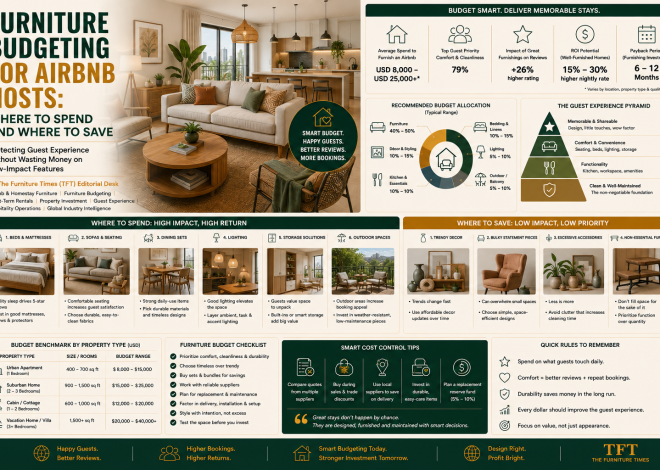
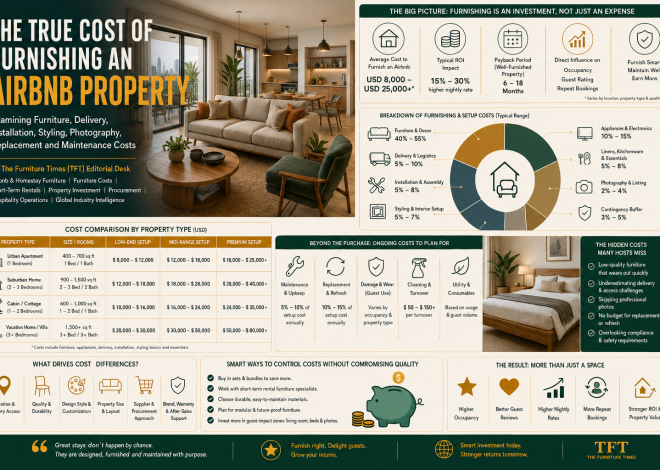
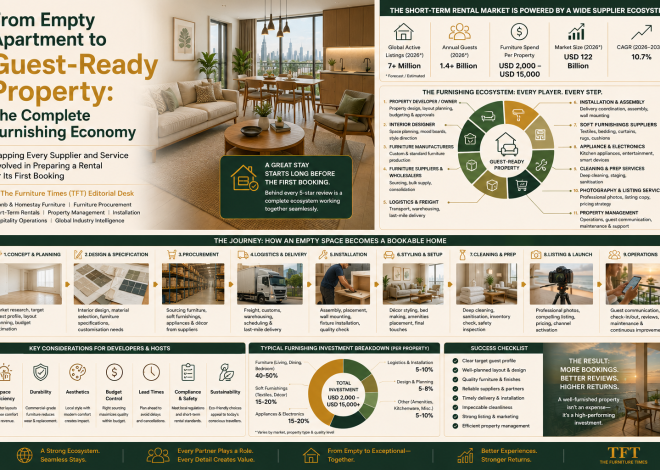
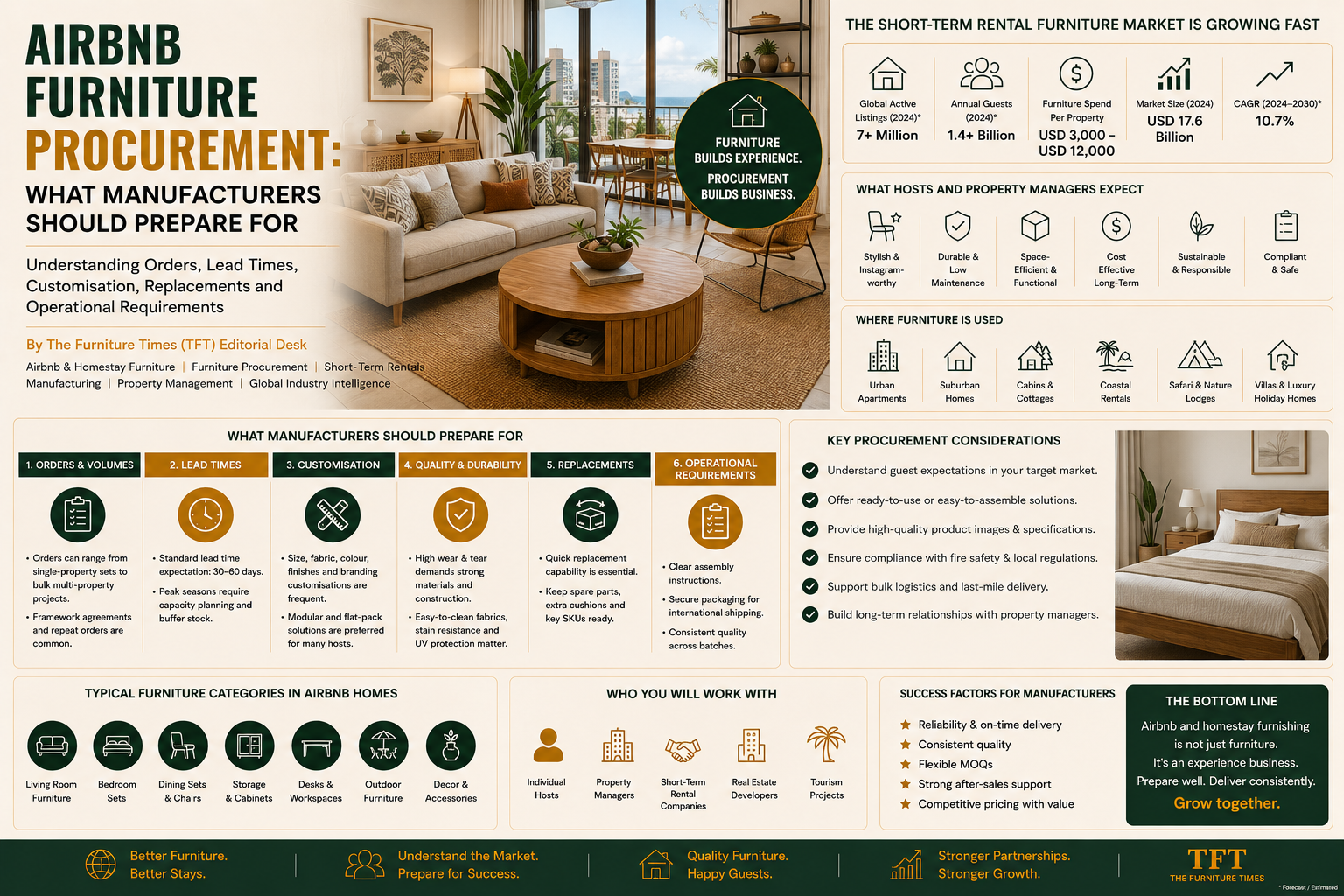
Airbnb and homestay furniture procurement is becoming a specialised business-to-business market with requirements that differ significantly from ordinary residential retail and conventional hotel projects.
A private homeowner may buy a sofa because it matches a personal preference. A hotel developer may order hundreds of identical guestrooms through a long, highly structured contract process. Short-term-rental operators often sit between these two models.
They may need to furnish five, twenty or several hundred apartments, but the properties may not be identical. They need consistent products, yet each unit may have different dimensions. They may want custom colours, but they cannot always meet high factory minimum-order quantities. They require durable furniture, but their budgets may be closer to residential retail than luxury hospitality.
Above all, they need speed.
Every day an unfurnished property remains unavailable can mean lost revenue. When a bed, sofa or dining chair fails, the replacement may be required before the next guest arrives—not at the end of a conventional six-week manufacturing cycle.
This creates both an opportunity and a challenge for furniture manufacturers.
The opportunity is access to a growing accommodation category that generates initial furnishing, repeat orders, replacement demand, refurbishment and portfolio expansion. The challenge is developing the flexibility, documentation, inventory and service infrastructure required by professional operators.
Manufacturers that prepare for these operational realities can move beyond one-time product sales and become long-term furnishing partners.
Short-Term-Rental Procurement Occupies a New Middle Ground
The Airbnb and homestay market cannot be served effectively through a purely retail model or a conventional hotel-contract model.
Residential Retail
Residential retail generally involves:
- Small order quantities
- Personal design preferences
- Limited standardisation
- Long replacement cycles
- Products intended for predictable household use
- Few demands for operational data
Hotel Procurement
Hotel procurement generally involves:
- Large project quantities
- Detailed specifications
- Professional purchasing teams
- Standard guestrooms
- Long project timelines
- Formal testing and compliance
- Coordinated installation
Short-Term-Rental Procurement
Airbnb and homestay purchasing often involves:
- Small-to-medium batch orders
- Multiple property layouts
- Repeated but uncertain purchasing
- Fast launch schedules
- Greater product wear than residential furniture
- Residential-looking design
- Commercial operating requirements
- Urgent replacement
- Budget pressure
- Need for flexible customisation
This hybrid purchasing structure requires a new manufacturing and service approach.
Manufacturers Must Understand Who Is Buying
The term “Airbnb buyer” can describe very different customers.
Individual Hosts
They may furnish one room, apartment or villa. Their purchasing behaviour can resemble residential retail, but they still require durability, easy cleaning and quick replacement.
Property Investors
Investors may own several units and want complete packages that allow properties to begin generating income quickly.
Professional Property Managers
These companies may operate dozens or hundreds of properties owned by different investors. They need standardisation, approved product lists, replacement stock and data.
Serviced-Apartment Operators
They frequently require consistent apartment packages, commercial warranties and products suitable for longer stays.
Developers
Developers may offer fully furnished, rental-ready units or connect owners with approved furniture packages.
Interior Designers
Designers select products based on concept, layout, photography, budget and guest experience.
Turnkey Furnishing Companies
These businesses purchase from multiple manufacturers, consolidate products and deliver complete booking-ready interiors.
Co-Hosts and Local Operators
They may influence replacement and maintenance decisions because they understand daily property operations.
Manufacturers should identify which buyer type they are serving before defining pricing, minimum orders, customisation or warranties.
Order Volumes Are Often Smaller but More Frequent
One of the biggest misunderstandings is that short-term-rental procurement will always resemble a hotel project with hundreds of identical units.
Many operators purchase in smaller batches.
A growing property manager may order:
- Five beds this month
- Eight sofa beds next month
- Twenty dining-chair replacements later
- Three complete apartments in another city
- Outdoor furniture before the summer season
- Additional inventory after onboarding a new owner
The annual volume may become commercially significant even though no individual order is extremely large.
Manufacturers should evaluate customers based on expected annual and portfolio demand—not only the size of the first purchase order.
A small initial order may function as a product trial. If the furniture performs well, it could become part of the operator’s standard package.
The Market Needs Flexible Minimum-Order Quantities
Traditional contract manufacturers may require minimum quantities that many property managers cannot meet.
Short-term-rental customers need flexibility across:
- Frame finish
- Fabric colour
- Product dimensions
- Hardware
- Mattress firmness
- Furniture combinations
- Packaging
- Delivery schedules
Manufacturers can respond by creating structured customisation rather than unlimited custom work.
For example, a sofa programme could offer:
- Two standard frame sizes
- Three approved fabrics
- Two leg finishes
- A sofa-bed option
- Replaceable covers
- A defined cushion specification
This gives operators meaningful choice while keeping production manageable.
The objective is controlled flexibility.
Standard Products Should Form the Foundation
Customisation can strengthen a property’s identity, but excessive customisation creates cost, delay and replacement problems.
Manufacturers should encourage operators to divide products into two groups.
Standard Operational Products
These include:
- Bed frames
- Mattresses
- Dining chairs
- Desks
- Wardrobes
- Sofa beds
- Luggage benches
- Outdoor chairs
They should ideally come from stable, repeatable product programmes.
Custom Identity Products
These may include:
- Headboards
- Statement chairs
- Decorative tables
- Locally inspired benches
- Custom screens
- Accent furniture
These products help differentiate the listing but are less operationally critical.
A property should not become impossible to maintain because every furniture item was individually customised.
Standardisation should protect operations, while selected custom pieces provide identity.
Lead Time Is a Revenue Issue
For short-term-rental operators, lead time is connected directly to revenue.
A property cannot begin accepting guests until essential furniture is installed. Delays in beds, mattresses, dining furniture or sofas can postpone the entire launch.
The real cost of late delivery may include:
- Lost booking nights
- Missed peak season
- Cancelled photography
- Idle cleaning and management contracts
- Loan or rental costs on a non-operating property
- Rescheduled installation
- Owner dissatisfaction
- Emergency retail purchases
Manufacturers should therefore provide realistic lead times rather than optimistic dates that cannot be maintained.
A professional quotation should distinguish between:
- Production time
- Quality inspection
- Packing
- Factory release
- Freight
- Customs
- Local delivery
- Installation
- Final correction
The customer needs the installation-completion date—not merely the factory dispatch date.
Different Order Types Need Different Lead-Time Systems
Manufacturers should classify orders according to urgency.
Planned New-Property Order
Usually ordered several weeks or months before launch. This allows greater customisation and coordinated installation.
Portfolio Expansion Order
Repeat products for newly added properties. Standardisation can shorten lead time.
Seasonal Refurbishment Order
Furniture required before summer, winter, a major event or peak tourism period.
Emergency Replacement Order
A critical product has failed and must be replaced before an upcoming reservation.
Cosmetic Refresh Order
New covers, cushions, chairs or accent products intended to improve photography and perceived quality.
Each order type requires a different fulfilment model.
Emergency replacement should not enter the same production queue as a custom villa project.
Replacement Speed Can Become a Competitive Advantage
A broken bed, unsafe chair or failed sofa bed can reduce the property’s usable capacity.
Manufacturers and distributors can create replacement programmes based on:
- Regional stock
- Core product continuity
- Standard components
- Reserved inventory
- Replacement modules
- Express delivery
- Local repair partners
- Temporary substitute products
A manufacturer that supplies a sofa but cannot provide a replacement cushion, leg or mechanism may be unsuitable for professional operators.
The ability to solve a problem quickly can be more valuable than offering the lowest initial price.
Manufacturers Should Define Critical Products
Not every furniture failure has the same operational effect.
Critical Furniture
- Beds
- Mattresses
- Sofa beds
- Dining chairs
- Dining tables
- Safety-related storage
- Essential outdoor seating where it is a major advertised amenity
Failure may reduce capacity or make the property unsafe.
Non-Critical Furniture
- Accent tables
- Decorative benches
- Occasional chairs
- Some accessories
Failure may affect presentation but not necessarily stop operation.
Manufacturers can work with operators to establish minimum replacement stock for critical products.
A property manager may not need a spare decorative console, but it may need immediate access to bed hardware, chair glides and sofa-bed components.
Product Continuity Matters
Residential furniture ranges often change quickly.
A retailer may discontinue a chair after one season or introduce a slightly different fabric and frame. This can create major problems for a property manager using that chair across dozens of apartments.
Professional operators need to know:
- How long a product will remain available
- Whether dimensions will remain consistent
- Whether finishes may change
- Whether spare parts will remain available
- Whether a successor model will be compatible
- How much notice will be given before discontinuation
Manufacturers should consider maintaining a stable core collection specifically for short-term-rental customers.
Fashion-driven products can remain available as optional accents, but operational furniture should not disappear without warning.
Customisation Must Be Documented
Verbal instructions are insufficient for multi-property furnishing.
Every customised product should have an approved specification containing:
- Product code
- Dimensions
- Materials
- Finish
- Fabric
- Foam density where relevant
- Hardware
- Weight capacity
- Assembly method
- Packaging
- Care requirements
- Approved sample or reference image
- Revision number
- Production date
Documentation prevents confusion when the customer reorders months later.
A phrase such as “the same beige sofa as before” is not a reliable manufacturing specification.
Colour, texture and construction should be defined through traceable codes.
Samples and Mock-Ups Reduce Expensive Mistakes
Before manufacturing a large or repeated order, suppliers should encourage product approval through:
- Material samples
- Fabric swatches
- Finish boards
- Prototype furniture
- Mock-up rooms
- Pre-production samples
- Digital visualisation
- Technical drawings
A sample can reveal problems with:
- Proportion
- Colour
- Comfort
- Fabric appearance
- Sofa-bed operation
- Table height
- Delivery access
- Cleaning
- Storage
- Guest circulation
The cost of correcting one prototype is much lower than correcting furniture already installed across fifty properties.
Manufacturers Need Accurate Property Information
Furniture performance begins with correct measurements and property data.
The buyer or designer should provide:
- Floor plans
- Room dimensions
- Door and corridor widths
- Lift dimensions
- Staircase restrictions
- Ceiling height
- Wall construction
- Electrical locations
- Balcony dimensions
- Outdoor exposure
- Advertised occupancy
- Target guest
- Installation access
- Building-management requirements
A product may fit the room but fail to fit through the entrance.
Manufacturers and turnkey suppliers should include access verification in the procurement process, particularly for large sofas, headboards and assembled wardrobes.
Furniture Packages Should Be Designed by Property Type
Manufacturers can make purchasing easier by developing packages around accommodation formats.
Studio Package
- Bed or sofa bed
- Bedside storage
- Compact dining
- Wall-mounted desk
- Wardrobe
- Luggage bench
One-Bedroom Apartment Package
- Bedroom set
- Living-room seating
- Dining for two to four
- Workspace
- Storage
- Balcony option
Family Apartment Package
- Multiple bedrooms
- Larger dining
- Sofa bed
- Children’s options
- Extra storage
- Durable living-room furniture
Villa Package
- Several bedrooms
- Indoor dining
- Outdoor dining
- Pool furniture
- Multiple lounges
- Entrance furniture
- Workspaces
Cabin Package
- Robust beds
- Bunk options
- Timber dining
- Entryway storage
- Fireplace seating
- Deck furniture
Packages should remain configurable. They provide a procurement framework, not an inflexible interior.
Advertised Occupancy Should Guide Procurement
One of the most common furnishing mistakes is planning beds without planning the rest of the guest experience.
If a property accommodates eight people, procurement should consider:
- Eight dining positions
- Sufficient living-room seating
- Storage for eight travellers
- Luggage capacity
- Bedside surfaces
- Outdoor seating
- Safe circulation
- Adequate sofa-bed comfort
- Children’s requirements where relevant
Manufacturers and designers can help operators understand the relationship between occupancy and furniture capacity.
This creates an opportunity for “occupancy-based” furniture packages rather than room-based packages alone.
Durability Must Be Specified, Not Assumed
Terms such as “strong,” “heavy-duty” or “commercial quality” are too vague.
Manufacturers should provide measurable information where possible:
- Intended use
- Tested weight capacity
- Structural-test results
- Abrasion resistance
- Fabric performance
- Finish resistance
- Outdoor suitability
- UV resistance
- Corrosion resistance
- Moisture performance
- Warranty limitations
Short-term-rental operators need to know how products will perform under repeated guest turnover.
A visually residential product may require reinforced construction to survive commercially.
Beds Require Particular Attention
Beds are critical assets because a failure can make a room unusable.
Manufacturers should consider:
- Frame strength
- Slat systems
- Centre support
- Joint noise
- Headboard stability
- Mattress movement
- Cleaning clearance
- Assembly consistency
- Replaceable components
- Twin-to-king flexibility
- Under-bed storage
- Access for linen changes
Headboards should be securely installed and easy to maintain. Bed frames should not develop noise after repeated disassembly, cleaning or guest use.
Spare hardware should be available.
Sofa Beds Need Real Operational Testing
Sofa beds are commonly used to increase property capacity, but they can become major sources of complaints.
Manufacturers should test:
- Opening and closing
- Mechanism durability
- Mattress comfort
- Frame stability
- Finger-trap risks
- Fabric wear
- Cleaning access
- Replacement-part availability
- Instructions for guests
- Reset time for housekeeping
A mechanism that is easy in a showroom may be confusing to a tired guest arriving late at night.
Simple operation is a commercial feature.
Dining Chairs Are High-Risk, High-Repetition Products
Dining chairs are frequently moved, tilted and used by guests of different sizes.
They are among the products most likely to develop:
- Loose joints
- Broken stretchers
- Worn glides
- Stains
- Frame movement
- Upholstery damage
Manufacturers should consider reinforced joints, replaceable glides, easy-clean upholstery and clear weight capacities.
Property managers may also need spare chairs stored locally so that one failure does not reduce dining capacity.
Outdoor Furniture Requires Location-Specific Specifications
“Outdoor suitable” does not mean suitable for every outdoor environment.
Manufacturers should ask whether the property faces:
- Tropical humidity
- Coastal salt air
- Extreme UV
- Snow
- Heavy rain
- Desert heat
- Strong wind
- Pool chemicals
- Seasonal closure
The specification may need to address:
- Frame material
- Coating
- Fasteners
- Fabric
- Cushion foam
- Drainage
- Furniture weight
- Anchoring
- Protective covers
- Storage
Supplying the wrong product for the climate creates premature failure and warranty disputes.
Cleanability Should Be Designed Into Furniture
Housekeeping is one of the largest recurring operational activities in short-term accommodation.
Furniture should help cleaning teams through:
- Removable covers
- Washable fabrics
- Wipeable surfaces
- Accessible under-furniture clearance
- Minimal dust-catching details
- Replaceable cushions
- Open luggage storage
- Resistant finishes
- Lightweight movable pieces
- Visible inspection areas
Manufacturers should consult cleaners and property managers during product development.
A product that saves five minutes per turnover may create significant portfolio-wide value.
Packaging Is Part of Product Performance
Furniture can arrive damaged even when it leaves the factory in perfect condition.
Packaging should protect products through:
- Factory handling
- Warehousing
- Long-distance transport
- Customs inspection
- Last-mile delivery
- Narrow-building access
- On-site movement
- Assembly
Manufacturers should also avoid excessive packaging that creates disposal problems at multi-unit projects.
Useful improvements include:
- Clearly labelled cartons
- Room-by-room packaging
- Product codes
- Hardware packs
- Assembly instructions
- Recyclable materials
- Damage-resistant corners
- Replacement hardware
- Packaging collection
For portfolio projects, incorrect labelling can create major installation delays.
Installation Must Be Included in Procurement Planning
Furniture is not operational until it is correctly assembled, positioned and inspected.
Installation planning should cover:
- Delivery slots
- Building access
- Lift bookings
- Floor protection
- Assembly space
- Wall fixings
- Waste removal
- Product inspection
- Defect reporting
- Final positioning
- Safety checks
- Sign-off
Manufacturers may offer installation directly or work with approved regional teams.
The customer should know who is responsible when a product is damaged during assembly or incorrectly fixed to a wall.
Final Inspection Protects Both Parties
Before a property launches, every product should be checked for:
- Damage
- Stability
- Correct finish
- Correct quantity
- Proper assembly
- Alignment
- Sharp edges
- Missing hardware
- Cleanliness
- Mechanism operation
- Wall-fixing security
- Floor protection
The installation team should record defects with photographs and product codes.
A formal handover reduces disputes and prevents guests from becoming the first people to discover a problem.
Warranty Terms Must Reflect Commercial Use
A residential warranty may exclude furniture used in income-generating accommodation.
Manufacturers should make warranty coverage explicit.
The warranty should address:
- Commercial short-term-rental use
- Structural components
- Upholstery
- Mechanisms
- Finishes
- Outdoor exposure
- Hardware
- Labour
- Transport
- Replacement
- Exclusions
- Claim procedures
Operators need to understand what happens when a product fails—not merely how long the warranty lasts.
A five-year warranty with no local service and expensive return freight may provide less value than a shorter warranty with rapid repair.
Spare Parts Need Their Own Supply System
Useful replacement parts include:
- Bed hardware
- Sofa legs
- Chair glides
- Drawer slides
- Hinges
- Handles
- Cushion covers
- Foam inserts
- Sofa-bed mechanisms
- Outdoor fasteners
- Table levellers
- Assembly bolts
Parts should be labelled and connected to product codes.
Manufacturers can offer a starter spare-parts kit with portfolio orders. This enables maintenance teams to resolve small problems without waiting for factory shipments.
Replacement Products Must Remain Visually Compatible
When one item fails, the operator should not need to replace the entire room.
Manufacturers should maintain:
- Consistent dimensions
- Compatible finishes
- Replacement upholstery
- Interchangeable components
- Successor-model guidance
- Colour records
- Product archives
A discontinued chair can create a visible mismatch in listing photographs and complicate portfolio presentation.
Product continuity is therefore both an operational and marketing requirement.
Procurement Data Will Become More Important
Professional operators increasingly need digital records for every furniture asset.
A furniture register may include:
- Product name
- Product code
- Manufacturer
- Supplier
- Property location
- Room location
- Purchase price
- Installation date
- Warranty expiry
- Care instructions
- Repair history
- Replacement parts
- Condition
- Expected service life
- End-of-life route
Manufacturers can support this process by providing structured digital product information.
QR codes or digital product passports could allow maintenance teams to identify furniture, access instructions and order parts from the property.
Guest Reviews Can Inform Product Development
Guest reviews contain valuable information about furniture performance.
Comments may identify:
- Uncomfortable mattresses
- Noisy beds
- Unstable chairs
- Difficult sofa beds
- Inadequate storage
- Poor workspaces
- Insufficient seating
- Worn outdoor furniture
- Stained upholstery
Property managers can share aggregated feedback with manufacturers.
This allows product development to be based on real guest use rather than assumptions. A manufacturer may discover that a product’s most important weakness is not structural failure but difficult cleaning or confusing operation.
The future procurement relationship can become data-driven.
Returns and Defects Need a Clear Process
Furniture projects will occasionally experience:
- Transit damage
- Manufacturing defects
- Incorrect finishes
- Missing components
- Quantity errors
- Installation damage
- Dimensional conflicts
Suppliers should establish:
- How defects are reported
- What photographic evidence is needed
- How quickly the claim will be reviewed
- Whether the product will be repaired or replaced
- Who pays transport and labour
- How urgent property-launch cases are prioritised
- How recurring defects are investigated
A slow or confusing claim process can damage the relationship more than the original defect.
Pricing Should Reflect the Full Service
Manufacturers should not compete only through unit price.
The total offer may include:
- Product
- Customisation
- Packaging
- Freight
- Installation
- Spare parts
- Replacement stock
- Warranty
- Repair support
- Digital records
- Product continuity
- Refurbishment
- Take-back
Professional buyers increasingly understand lifecycle cost.
A higher-priced chair that lasts longer, can be repaired and remains available for replacement may be more economical than a cheaper product with no support.
Manufacturers should help customers compare total ownership cost rather than initial purchase price alone.
Seasonal Procurement Requires Forward Planning
Many operators renovate before a peak season.
Examples include:
- Summer coastal demand
- Winter ski seasons
- Religious festivals
- School holidays
- Major exhibitions
- Sporting events
- Cultural festivals
- National celebrations
Manufacturers should identify seasonal order patterns and communicate production cut-off dates.
Property managers should not place peak-season orders at the last minute and expect unlimited customisation.
A shared procurement calendar can reduce emergency purchasing and delivery pressure.
Regional Warehousing Can Unlock Larger Portfolios
International manufacturers may offer competitive production but struggle with replacement speed.
Regional stock can solve this problem.
A warehouse or distribution partner can hold:
- Core beds
- Dining chairs
- Sofa modules
- Replacement covers
- Hardware
- Outdoor chairs
- Mattresses
- Critical spare parts
This creates a hybrid supply model:
- Factory production for planned projects
- Regional inventory for urgent replacement
Manufacturers targeting large geographic markets should evaluate warehouse locations according to active property clusters, logistics cost and regulatory conditions.
Repair Networks Can Differentiate Manufacturers
A product should not be considered unsupported simply because the factory is overseas.
Manufacturers can build approved networks of:
- Carpenters
- Upholsterers
- Mechanism technicians
- Finish repairers
- Outdoor-furniture specialists
- Installation teams
These partners can perform repairs, inspect warranty claims and replace components locally.
A strong service network can transform an international manufacturer into a locally responsive supplier.
Refurbishment Can Create Recurring Revenue
Manufacturers can extend customer relationships by offering:
- New covers
- Cushion replacement
- Foam renewal
- Surface refinishing
- Hardware upgrades
- Mechanism replacement
- Colour refreshes
- Furniture take-back
- Product redeployment
A sofa that can be refurbished twice may remain in a portfolio for many years.
This benefits the operator, manufacturer and environment.
It also moves the supplier away from a business model dependent entirely on complete-product replacement.
Sustainability Must Be Operational
Short-term-rental operators may request sustainable furniture, but manufacturers should provide measurable information.
Useful evidence includes:
- Material origin
- Responsible timber certification
- Recycled content
- Repairability
- Replaceable components
- Product lifespan
- Packaging reduction
- Local production
- Take-back programmes
- End-of-life options
A durable product that can be repaired locally may deliver greater environmental value than a product marketed as sustainable but replaced frequently.
Sustainability should be connected to the complete lifecycle.
Forecasting Demand Will Remain Difficult
Short-term-rental portfolios can grow or contract quickly because of:
- Property acquisitions
- Owner departures
- Regulation
- Tourism cycles
- Interest rates
- Seasonality
- Property performance
- Company consolidation
Manufacturers should not require perfect forecasts. Instead, they can create flexible systems using:
- Rolling forecasts
- Reserved capacity
- Framework agreements
- Core inventory
- Phased production
- Flexible call-off orders
- Standard materials
- Forecast bands
The goal is to provide responsiveness without exposing the factory to uncontrolled inventory risk.
A Strong Procurement Relationship Needs Clear Responsibilities
The manufacturer, designer, operator, installer and logistics provider should understand who is responsible for each stage.
| Procurement Stage | Primary Responsibility |
|---|---|
| Property measurement | Buyer, designer or approved surveyor |
| Product specification | Designer, manufacturer and operator |
| Sample approval | Operator or authorised buyer |
| Production quality | Manufacturer |
| Packaging | Manufacturer |
| Freight | Agreed logistics party |
| Building access | Operator |
| Installation | Manufacturer or approved installer |
| Final inspection | Operator and installer |
| Warranty service | Manufacturer or authorised supplier |
| Routine maintenance | Property operator |
| Replacement planning | Operator and supplier |
Clear responsibility reduces disputes and project delays.
What Manufacturers Should Build Now
Manufacturers serious about serving Airbnb, homestay and vacation-rental operators should develop five core capabilities.
1. A Stable Product Programme
Maintain beds, chairs, sofas, desks and storage products that can be reordered consistently.
2. Controlled Customisation
Offer practical choices without allowing every order to become a completely new product.
3. Replacement Infrastructure
Maintain stock, components or regional partnerships for urgent requirements.
4. Digital Documentation
Provide specifications, care instructions, warranties, product codes and asset data.
5. After-Sales Service
Support repair, refurbishment, replacement and recurring portfolio needs.
These capabilities are more important than simply adding “Airbnb furniture” to a catalogue.
Airbnb Furniture Procurement: What Manufacturers Should Prepare For
Understanding Orders, Lead Times, Customisation, Replacements and Operational Requirements
By The Furniture Times (TFT) Editorial Desk | Airbnb & Homestay Furniture | Furniture Procurement | Short-Term Rentals | Manufacturing | Property Management | Global Industry Intelligence
Airbnb and homestay furniture procurement is emerging as a specialised commercial opportunity for manufacturers—but it does not behave exactly like conventional residential retail or traditional hotel contracting.
The market is highly fragmented. One host may require furniture for a single studio apartment, while a professional property-management company may need standardised packages for hundreds of units. A villa operator may request customised products in small quantities. A developer may require complete furnishings for an entire rental-ready residence project.
Orders can be smaller than hotel contracts but more complex than normal retail transactions. Timelines are often connected directly to property-launch dates and confirmed reservations. Products must look attractive in listing photographs, withstand repeated guest use, simplify cleaning and remain available for rapid replacement.
Manufacturers that enter this market without understanding its operational reality may encounter unexpected problems: urgent delivery demands, small-batch customisation, frequent replacement requests, installation challenges and pressure to maintain product continuity.
Those that prepare correctly can build recurring relationships with hosts, designers, developers, furnishing companies and professional rental operators.
The opportunity is not merely to sell furniture. It is to become part of the operating infrastructure behind short-term accommodation.
Short-Term-Rental Buyers Are Not One Customer Group
The first procurement challenge is understanding who is purchasing the furniture.
The market includes several buyer types, each with different expectations.
| Buyer Type | Typical Order | Primary Requirement |
|---|---|---|
| Individual host | One room or one property | Affordability, speed and simple purchasing |
| Property investor | Complete apartment or villa | Turnkey packages and launch certainty |
| Interior designer | Customised property scheme | Design flexibility, samples and specifications |
| Property manager | Multiple units and replacements | Standardisation, stock continuity and rapid service |
| Developer | Furnished rental-ready residences | Project pricing, scheduling and installation |
| Serviced-apartment operator | Repeatable multi-unit packages | Contract durability and portfolio consistency |
| Furnishing company | Mixed products for several projects | Trade pricing, broad catalogue and dependable supply |
| Furniture rental company | Repeat-use furniture fleet | Durability, repairability and residual value |
| Luxury-villa operator | High-value customised project | Premium appearance, craftsmanship and after-sales support |
Manufacturers should not present the same commercial offer to every customer.
An individual host may need immediate delivery and a clear all-inclusive price. A professional operator may prioritise product continuity and spare parts. A designer may need finish options and digital specification files. A developer may require phased installation coordinated with construction handover.
Market success begins with procurement segmentation.
Orders Often Fall Into the “Missing Middle”
Traditional furniture procurement generally operates through two familiar channels:
- Residential retail involving individual products and small orders
- Contract furnishing involving large, standardised projects
Airbnb and homestay procurement frequently falls between these categories.
An operator may need:
- Furniture for three apartments
- Ten identical bed frames
- Seven sofas in two configurations
- A customised dining table in a relatively small quantity
- Standard products with property-specific upholstery
- Replacements for products installed several years earlier
The order may be too large and commercially complex for ordinary retail, but too small for a factory’s traditional contract minimums.
This “missing middle” creates an opportunity for manufacturers capable of:
- Smaller production runs
- Flexible minimum-order quantities
- Controlled customisation
- Repeat orders
- Mixed-container shipments
- Regional warehousing
- Stock programmes
- Modular products
- Digital ordering
Factories that depend entirely on large, one-time orders may find the category difficult. Those that can combine manufacturing scale with smaller-batch flexibility may occupy a valuable market position.
The Complete Property Is the Real Purchasing Unit
Hosts may initially think in terms of individual items, but the property operates as one complete system.
A furnished studio may require:
- Bed and mattress
- Headboard
- Bedside table
- Wardrobe
- Desk and chair
- Dining table
- Dining chairs
- Sofa or lounge chair
- Coffee table
- Television unit
- Luggage bench
- Balcony furniture
- Lighting and accessories
A villa may need several bedroom packages, multiple lounges, indoor and outdoor dining, pool furniture, daybeds, parasols and children’s furniture.
Manufacturers should therefore consider selling by:
- Room
- Property type
- Guest capacity
- Design package
- Investment level
Useful package categories might include:
- Essential studio package
- Premium studio package
- One-bedroom apartment package
- Two-bedroom family package
- Three-bedroom villa package
- Luxury holiday-home package
- Coastal outdoor package
- Mountain-cabin package
- Business-travel apartment package
- Long-stay furniture package
This approach makes budgeting easier and creates a higher-value transaction than selling isolated products.
Lead Time Can Determine Whether a Property Generates Revenue
In short-term rentals, delivery delays can translate directly into lost income.
A property cannot be photographed, listed or opened if critical furniture is missing. If the investor has already begun paying financing, rent, utilities and management costs, every delayed day may increase the project’s financial pressure.
Manufacturers must therefore provide realistic lead times.
The schedule should account for:
- Design approval
- Material procurement
- Sample approval
- Production
- Quality control
- Packing
- Export documentation
- Shipping
- Customs
- Local delivery
- Building access
- Installation
- Defect correction
- Final photography preparation
Promising an unrealistic delivery date to win an order can damage the entire customer relationship.
It is better to provide a conservative, dependable schedule than a fast promise that repeatedly changes.
Different Products Require Different Lead-Time Strategies
Not every item should follow the same procurement process.
Critical Opening Products
Beds, mattresses, dining chairs and primary sofas can prevent a property from opening if absent. These should receive the highest scheduling priority.
Stock Products
Standard beds, tables, chairs and outdoor sets can be held in regional inventory for faster delivery.
Custom Products
Headboards, built-in furniture and specialised upholstery require longer development and approval periods.
Decorative Products
Accent chairs, side tables and accessories may be installed later if they do not prevent operations.
Manufacturers and furnishing companies should establish a critical-path product list at the beginning of each project.
This allows the property to become operational even if a small number of non-essential decorative items arrive later.
Accurate Specifications Prevent Procurement Failure
Short-term-rental projects can involve owners, designers, property managers, factories, logistics providers and installers. Incomplete specifications create confusion across this chain.
Every product specification should ideally include:
- Product name
- Model or SKU
- Dimensions
- Materials
- Finish
- Colour
- Fabric code
- Foam specification
- Hardware
- Weight
- Weight capacity
- Packaging dimensions
- Assembly requirements
- Cleaning instructions
- Warranty
- Replacement-part information
- Intended use
- Country of origin
- Compliance information where relevant
Drawings should match the written specifications.
If a dining chair is approved in one fabric but ordered in another, or if a bed size differs between the drawing and purchase order, the problem may not be discovered until installation.
Manufacturers should use structured specification systems rather than rely on informal conversations and messaging applications.
Room Dimensions Must Be Verified Before Production
One of the most common procurement mistakes is selecting products without confirming the actual property dimensions.
A sofa may technically fit inside the room but block circulation. A dining table may leave insufficient chair clearance. A bed may obstruct a wardrobe door. A custom headboard may conflict with sockets or switches.
Manufacturers and suppliers should request:
- Floor plans
- Measured room dimensions
- Door dimensions
- Lift dimensions
- Staircase information
- Ceiling height
- Window positions
- Electrical points
- Air-conditioning locations
- Building access restrictions
For significant projects, physical site measurement or professional survey should be considered.
The cost of measurement is usually much lower than the cost of remaking or returning unsuitable furniture.
Delivery Access Is Part of Product Design
Many short-term-rental properties are located in high-rise buildings, historic apartments, narrow urban streets, island destinations or remote tourism areas.
Manufacturers must understand how products will physically reach the room.
Important questions include:
- Does the building have a service lift?
- What is the lift-door width?
- Are stairs narrow or curved?
- Can delivery vehicles access the building?
- Are there restricted delivery hours?
- Is advance management approval required?
- Must furniture be carried across sand, gravel or uneven ground?
- Will the product cross by ferry or small boat?
- Is on-site assembly possible?
Large one-piece sofas, headboards and tables may be impossible to deliver into some properties.
Modular and knock-down construction can become a major competitive advantage, especially when it remains structurally reliable after assembly.
Customisation Must Be Controlled
Short-term-rental operators want interiors that look distinctive. Manufacturers want efficient production. These objectives can conflict.
Unlimited customisation creates:
- More drawings
- More samples
- Higher error risk
- Complex production
- Higher inventory cost
- Difficult replacement
- Longer lead times
- Inconsistent quality
A better approach is controlled customisation.
Manufacturers can allow buyers to choose from a defined system of:
- Approved fabrics
- Standard finishes
- Leg options
- Handle options
- Modular configurations
- Headboard sizes
- Table dimensions
- Cushion colours
The underlying frame, hardware and construction system can remain standard.
This allows properties to develop individual identities without making every item technically unique.
Product Modularity Supports Both Customisation and Replacement
Modular furniture is particularly valuable in short-term rentals.
Examples include:
- Sofas with replaceable sections
- Headboards made from interchangeable panels
- Tables with replaceable tops
- Chairs with removable seat pads
- Beds with standardised components
- Outdoor furniture with replaceable cushions
- Wardrobes with modular internal storage
- Sofa beds with serviceable mechanisms
If one component is damaged, the operator can replace that part rather than the entire product.
Modularity also simplifies portfolio expansion. An operator can add or reconfigure products without redesigning everything.
Manufacturers should treat modularity as an operational strategy, not merely a design trend.
Durability Must Be Matched to Actual Use
The phrase “commercial quality” is often used without sufficient explanation.
Manufacturers should identify how furniture will actually be used.
A dining chair in a two-person studio faces different pressure from a chair in a twelve-guest villa. An outdoor lounger in a seasonal property has different requirements from one used year-round beside a busy pool.
Useful durability considerations include:
- Static-load capacity
- Repeated-use testing
- Joint strength
- Upholstery abrasion resistance
- Colourfastness
- UV resistance
- Moisture resistance
- Corrosion resistance
- Drawer-cycle performance
- Sofa-bed mechanism cycles
- Stability
- Tip-over risk
- Impact resistance
Product claims should be supported by relevant tests or clear internal quality standards.
Manufacturers should not assume that all residential products are automatically suitable for repeated commercial guest use.
Cleanability Should Be Designed Into the Product
Short-term-rental furniture is repeatedly handled by housekeeping teams.
Design details can either reduce or increase turnover time.
Cleaning-friendly products may include:
- Removable cushion covers
- Washable or wipeable upholstery
- Accessible clearance beneath beds
- Smooth dining surfaces
- Limited dust-catching details
- Open luggage storage
- Replaceable seat pads
- Moisture-resistant materials
- Furniture glides
- Lightweight movable tables
- Modular sofa sections
Manufacturers should test products with actual cleaning teams.
A decorative groove that appears attractive in a catalogue may collect dust. A low bed frame may prevent cleaners from reaching beneath it. A delicate coating may react badly to common cleaning products.
Operational testing can reveal these problems before mass production.
Replacement Availability Can Be More Important Than Initial Price
A manufacturer may win the first order with an attractive price but lose the customer if replacements are unavailable.
Property managers need continuity.
When a chair breaks, they want the same model, finish and upholstery—or at least a compatible component. If the product has been discontinued, the operator may need to purchase a mismatched chair or replace an entire set.
Manufacturers should consider:
- Guaranteed product-support periods
- Standard replacement components
- Archived finish information
- Retained fabric codes
- Spare hardware
- Replacement cushion covers
- Modular repair parts
- Small repeat-order capability
A product-support commitment of several years can become a strong commercial differentiator.
The manufacturer should also explain what happens if a material or fabric is discontinued.
Spare Parts Should Be Part of the Original Order
Manufacturers can reduce future disruption by supplying a maintenance kit with the project.
A project spare-parts package may include:
- Chair glides
- Levelling feet
- Handles
- Hinges
- Drawer slides
- Connectors
- Screws
- Bolts
- Touch-up finish
- Fabric patches
- Cushion covers
- Replacement zippers
- Assembly tools
- Mechanism instructions
For larger portfolios, spare parts should be labelled and documented.
A minor component costing very little at the factory can become difficult and expensive to source after installation.
Manufacturers Need a Rapid-Replacement Strategy
A normal furniture lead time may be unacceptable when an active rental property has confirmed guests arriving.
Suppliers can create service tiers:
Standard Replacement
Delivered through the next production cycle.
Priority Replacement
Produced or dispatched within a shorter guaranteed period.
Emergency Replacement
Drawn from regional stock or a maintained spare pool.
Professional property managers may be willing to pay for guaranteed replacement service because property downtime can cost more than the furniture itself.
Manufacturers can also work with distributors to maintain local inventory of critical products.
Packaging Must Protect Furniture Through a Complex Delivery Chain
Short-term-rental furniture may pass through factories, freight forwarders, warehouses, building loading bays, lifts and installation teams before reaching the room.
Poor packaging can create:
- Scratches
- Chipped corners
- Fabric stains
- Broken legs
- Missing hardware
- Water damage
- Installation delays
- Claims and disputes
Packaging should reflect the actual delivery environment.
Useful measures include:
- Corner protection
- Moisture barriers
- Clearly labelled hardware
- Assembly instructions
- Product identification
- Room-location labels
- Stackability guidance
- Recyclable materials where practical
- Photographic packing records
For multi-unit projects, packages should be labelled according to building, floor, unit and room.
This reduces handling errors and installation time.
Installation Is Part of the Product Experience
A good product can fail because it was assembled incorrectly.
Installation teams should receive:
- Approved drawings
- Product lists
- Assembly instructions
- Fixing requirements
- Room plans
- Hardware schedules
- Safety guidance
- Inspection checklists
Installers should verify:
- Furniture stability
- Headboard fixing
- Wardrobe alignment
- Drawer operation
- Sofa-bed function
- Chair levelling
- Surface condition
- Wall protection
- Electrical furniture connections
- Removal of packaging
A final installation inspection should be completed before photography or guest arrival.
Manufacturers providing trained installation or certified installation partners can reduce claims caused by third-party assembly.
Quality Control Must Consider the Guest Environment
Factory quality control often checks dimensions, finishes and visible defects. Short-term-rental quality control should also consider operational use.
Manufacturers should test questions such as:
- Does the bed make noise?
- Does the table wobble?
- Can the sofa bed be opened easily?
- Are handles secure?
- Can covers be removed without specialist tools?
- Are edges appropriate for family properties?
- Does the furniture damage the floor?
- Is the finish resistant to common cleaning products?
- Can staff move the product safely?
- Are replacement components identifiable?
The final product should be evaluated as part of an accommodation environment, not only as an isolated factory item.
Mattresses Require a Dedicated Procurement Strategy
Mattresses are among the most important products in short-term accommodation.
A mattress procurement programme should define:
- Comfort level
- Support
- Thickness
- Construction
- Edge stability
- Fire and safety requirements
- Protector compatibility
- Warranty
- Rotation instructions
- Expected service life
- Replacement process
- Packaging and delivery
Properties should avoid selecting mattresses entirely on personal preference because guests have varied comfort expectations.
Manufacturers may offer a balanced hospitality specification designed to serve a broad guest population.
Mattress protectors should be treated as part of the system, not an optional accessory.
Sofa Beds Need Honest Performance Standards
Sofa beds can increase property capacity, but they are also a frequent source of disappointment.
A sofa bed should be evaluated for:
- Sitting comfort
- Sleeping comfort
- Mechanism durability
- Ease of operation
- Mattress quality
- Weight capacity
- Noise
- Safety
- Cleaning
- Replacement parts
- Space required when open
Manufacturers should clearly distinguish between occasional sleeping products and those suitable for regular guest use.
Advertising a weak occasional-use sofa bed as a full commercial sleeping solution can create negative reviews and warranty claims.
Outdoor Furniture Requires Climate-Specific Procurement
Outdoor furniture should not be purchased under one universal specification.
A coastal property, desert villa, tropical balcony and mountain deck face different risks.
Coastal Locations
Require corrosion resistance, moisture resistance and salt-air durability.
Tropical Markets
Require fast drainage, mould resistance, UV stability and pest-aware materials.
Desert Environments
Require heat resistance, UV performance and dust-tolerant mechanisms.
Cold Climates
Require freeze-thaw durability, seasonal storage and snow-load awareness where relevant.
Manufacturers should provide honest guidance about:
- Intended climate
- Maintenance
- Cushion storage
- Wind risk
- Anchoring
- Covers
- Cleaning
- Warranty exclusions
Outdoor product failure is often caused by incorrect specification rather than poor manufacturing alone.
Order Forecasting Helps Both Operators and Factories
Professional operators should share forecast information where practical.
A manufacturer may need to know:
- Expected number of new units
- Typical replacement rates
- Seasonal launch patterns
- Preferred product families
- Geographic expansion
- Planned refurbishment cycles
Forecasting allows the factory to plan:
- Materials
- Capacity
- Stock
- Components
- Labour
- Packaging
- Regional inventory
In return, manufacturers should communicate capacity constraints, planned factory closures, material discontinuations and realistic production windows.
Better information reduces emergency purchasing and expensive expedited delivery.
Procurement Agreements Should Address Repeat Orders
A commercial agreement should clarify:
- Prices
- Minimum quantities
- Lead times
- Payment terms
- Incoterms where relevant
- Approved specifications
- Sample approval
- Quality standards
- Inspection
- Warranty
- Damage claims
- Replacement availability
- Spare parts
- Installation responsibilities
- Product discontinuation
- Intellectual-property ownership
- Custom-design rights
Small operators may use simplified agreements, but professional portfolios need structured procurement documentation.
Verbal assurances are insufficient when a product failure affects multiple properties.
Technology Can Improve Furniture Procurement
Digital tools can connect design, ordering, installation and maintenance.
Useful capabilities include:
- Digital catalogues
- 3D product files
- Room visualisation
- Automated quotations
- Online finish selection
- Purchase-order tracking
- Delivery tracking
- Product QR codes
- Warranty records
- Maintenance histories
- Damage reporting
- Replacement ordering
- Furniture asset registers
A property manager could scan a QR code on a chair, identify its model, view the warranty and order the correct replacement glide immediately.
This is far more efficient than attempting to identify an unlabelled product from an old photograph.
Furniture Data Should Travel With the Product
Every product should have a persistent digital record containing:
- Manufacturer
- Model
- Dimensions
- Materials
- Finish
- Fabric
- Installation date
- Care instructions
- Warranty
- Replacement parts
- Repair instructions
- Sustainability information
- End-of-life options
This information could eventually form part of a furniture digital product passport.
For short-term-rental portfolios, persistent furniture identity would improve procurement, maintenance and asset recovery.
Sustainability and Procurement Must Be Connected
Sustainable procurement should consider the entire product lifecycle.
Questions should include:
- How long should the product last?
- Can it be repaired?
- Can upholstery be replaced?
- Are components available?
- Can the surface be refinished?
- Can the product be disassembled?
- Are materials documented?
- Can the manufacturer take it back?
- Does it have resale value?
- How will it be disposed of?
The lowest-cost product may create greater waste if it requires frequent replacement.
Manufacturers should offer durability and repairability data alongside environmental claims.
Furniture Leasing May Change the Procurement Model
Some operators may prefer to lease furniture instead of purchasing it.
Leasing can support:
- New property launches
- Seasonal accommodation
- Corporate rentals
- Mid-term rentals
- Operators preserving capital
- Temporary projects
- Design refreshes
- Expansion into new markets
Manufacturers can participate directly or partner with furniture-leasing companies.
A leasing model may include:
- Delivery
- Installation
- Maintenance
- Damage replacement
- Periodic refresh
- Removal
- Refurbishment
- Redeployment
To succeed, products must be durable enough to generate value across more than one rental cycle or property.
Manufacturers Should Prepare for Refurbishment and Take-Back
The relationship should not end when the product is delivered.
Manufacturers can offer:
- Reupholstery
- Replacement cushions
- New covers
- Surface refinishing
- Hardware upgrades
- Component replacement
- Product take-back
- Resale
- Redeployment
- Recycling
These services create recurring revenue while helping operators manage sustainability and disposal.
A furniture company that understands the full product lifecycle can become more valuable than a supplier focused only on the initial sale.
Common Procurement Failures
Choosing Furniture Only by Price
This ignores maintenance, repair, downtime and replacement cost.
Approving Products Without Measurements
Furniture may not fit the room or delivery route.
Allowing Unlimited Customisation
This increases errors, lead times and replacement difficulty.
Ignoring Cleaning Teams
Products may create recurring housekeeping problems.
Failing to Order Spare Parts
Minor damage can make an entire product unusable.
Selecting Discontinued Retail Products
Future replacements become mismatched or impossible.
Relying on Verbal Specifications
Disputes arise when colour, dimensions or materials differ.
Ignoring Climate
Outdoor products fail prematurely.
Scheduling Furniture Too Late
The property launch is delayed.
Neglecting Installation Quality
Products become unstable or unsafe.
Buying Beds Without Considering Mattresses
The sleeping system performs poorly.
Failing to Track Furniture
Warranty, repair and replacement information is lost.
What Manufacturers Should Build Internally
Manufacturers serious about this market should establish:
- A dedicated short-term-rental product range
- Flexible minimum-order policies
- Controlled customisation systems
- Clear commercial specifications
- Replacement-part inventories
- Rapid quotation procedures
- Realistic lead-time reporting
- Installation guidance
- Regional distributor relationships
- Warranty and repair systems
- Digital product documentation
- Refurbishment and take-back options
They should also train sales teams to speak the language of property operations.
The buyer is not only asking, “Does this sofa look good?”
The buyer is asking:
- Will it survive?
- Can it be cleaned?
- Can it be repaired?
- Will it arrive before the booking launch?
- Can I order another one next year?
- What happens when a guest damages it?
- Can you serve my next twenty properties?
Manufacturers that answer these questions clearly will be better prepared for the market.
The Searchability and Supplier-Discovery Challenge
Short-term-rental buyers often struggle to find manufacturers that openly identify this market as a specialisation.
A manufacturer may already produce suitable beds, mattresses, sofas or outdoor furniture but remain invisible because its website and catalogue do not mention:
- Airbnb furniture
- Homestay furniture
- Vacation-rental furniture
- Short-term-rental packages
- Turnkey furnishing
- Property-management supply
- Rapid replacement
- Contract durability
- Installation areas
Furniture Industry Search Engine (FISE) can help make suppliers more discoverable by product, geography, manufacturing capability and market specialisation.
If you are not searchable, you do not exist in the moment the buyer needs you.
TFT tells their story. FISE helps the world find them. FurniReviewology helps the world trust them.
Procurement Is Moving From Products to Systems
The next stage of Airbnb furniture procurement will be more organised, data-driven and service-oriented.
Professional operators will increasingly want:
- Pre-approved furniture packages
- Guaranteed lead times
- Installation
- Product identification
- Spare parts
- Digital warranties
- Rapid replacement
- Maintenance tracking
- Refurbishment
- End-of-life recovery
Furniture will be evaluated not only through design and price, but through the total contribution it makes to property performance.
Manufacturers that prepare for this transition can build long-term, repeatable relationships rather than depend on one-time sales.
Conclusion
Airbnb and homestay furniture procurement is becoming a specialised commercial discipline.
The market requires manufacturers to manage a difficult combination of smaller orders, controlled customisation, urgent timelines, repeated replacement, commercial durability and residential visual appeal.
Success depends on understanding that the furniture is supporting an active hospitality business.
A delayed bed can postpone a property launch. A discontinued chair can disrupt portfolio consistency. A fragile sofa bed can create negative reviews. An unavailable replacement part can turn minor damage into a complete product loss.
Manufacturers should therefore prepare for the full lifecycle:
- Specification
- Sampling
- Ordering
- Production
- Delivery
- Installation
- Cleaning
- Maintenance
- Repair
- Replacement
- Refurbishment
- Recovery
The strongest opportunity is not simply to manufacture products for short-term rentals. It is to create an operational furnishing system that helps hosts and property managers open properties faster, maintain them more efficiently and protect the guest experience.
For manufacturers ready to offer flexibility, transparency, durability and long-term support, Airbnb and homestay furniture procurement can become a valuable and recurring global market.